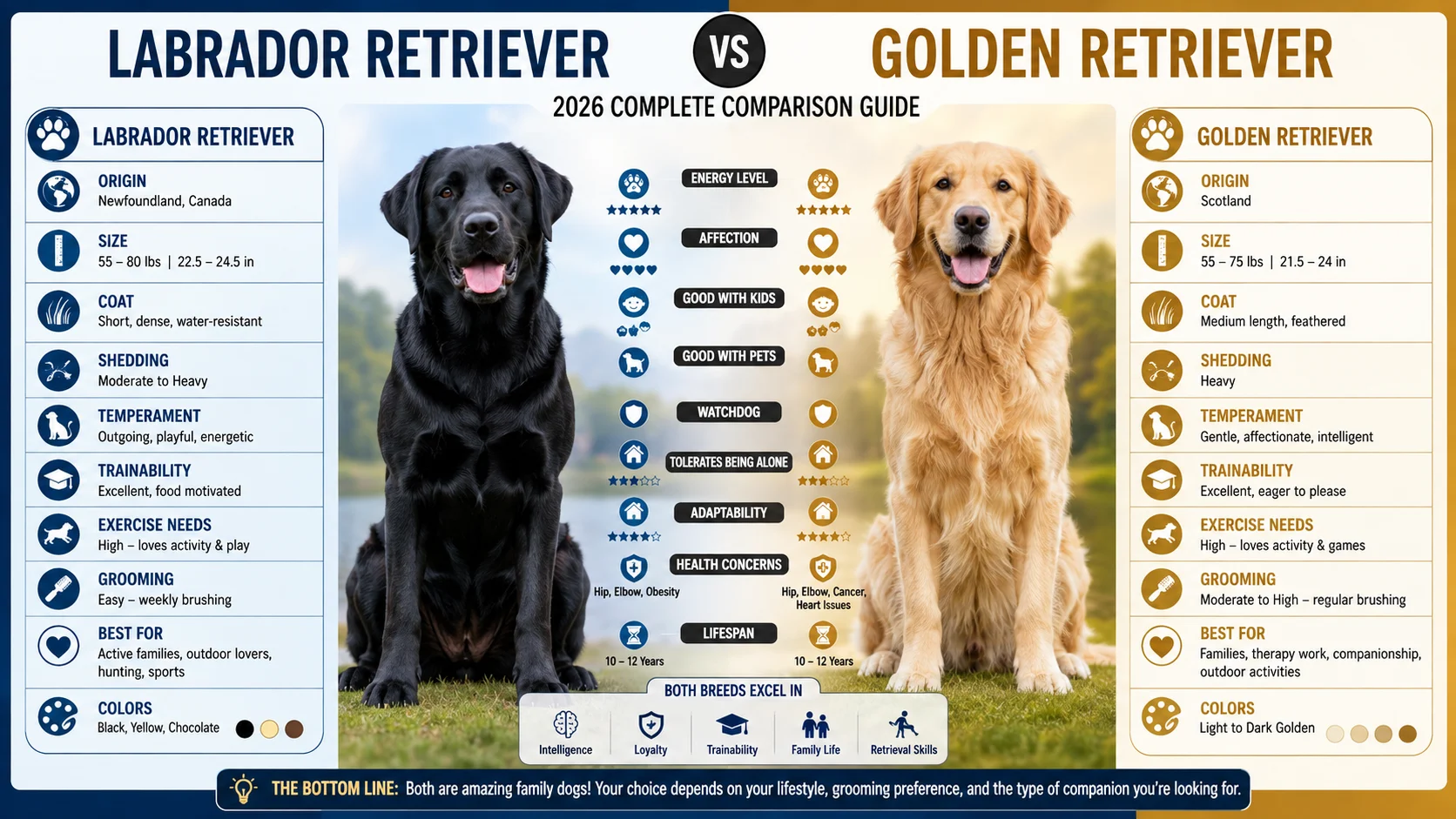
Labradors and Golden Retrievers are both intelligent, affectionate, family friendly sporting breeds, but they differ in energy, coat care, temperament, and everyday behavior. Labradors are typically more exuberant and practical, while Goldens tend to be softer, more emotionally sensitive, and noticeably feathered.
If you are choosing between them, temperament and lifestyle fit matter more than appearance. The best breed is the one whose exercise, grooming, training, and social needs match your daily routine.
Quick Snapshot
| Feature | Labrador Retriever | Golden Retriever |
|---|---|---|
| Size | Large | Large |
| Weight | About 55 to 80 lbs | About 55 to 75 lbs |
| Energy | High | High |
| Trainability | Excellent | Excellent |
| Temperament | Outgoing, playful, adaptable | Gentle, affectionate, sensitive |
| Coat | Short, dense, water resistant | Medium length, feathered |
| Shedding | Moderate to heavy | Heavy |
| Grooming | Easier | More demanding |
| Exercise | High | High |
| With Children | Usually excellent | Usually excellent |
| Stranger Friendly | Usually very friendly | Usually very friendly |
| Retrieving Instinct | Very strong | Very strong |
| Watchdog Ability | Low to moderate | Low to moderate |
| Best For | Active, practical households | Active families wanting a softer companion |
Labrador vs Golden Retriever at a Glance
If you only want the short answer, the biggest difference is how they express their personality.
Labradors often feel more physically enthusiastic. They can be bouncy, mouthy, food motivated, and ready to participate in almost anything.
Golden Retrievers tend to be slightly more emotionally tuned in. Many are eager to please, affectionate, and responsive to their owner’s mood.
Neither is automatically “better.”
The better choice depends on what you want from your dog.
What Is the Difference Between a Labrador and Golden Retriever?
Both breeds were developed as retrieving dogs, and both belong to the sporting group. They share a remarkable number of qualities, including intelligence, athleticism, trainability, and a strong desire to work with people.
Their biggest differences are easier to see in everyday ownership.
Labradors generally have:
- shorter coats
- heavier, more compact builds
- strong food motivation
- exuberant personalities
- relatively simple grooming
Golden Retrievers generally have:
- longer feathered coats
- softer facial expressions
- more coat maintenance
- strong human focus
- sensitive temperaments
Here is where many comparison articles get it wrong: breed averages are useful, but individual bloodlines matter enormously.
A field-bred Golden can be dramatically more energetic than a calm show-bred Labrador.
Appearance and Physical Differences
Labrador Retriever
Labradors have a compact, athletic appearance with:
- short dense double coat
- broad head
- strong jaw
- thick tail
- muscular body
- distinctive “otter” tail
Common coat colors include:
- black
- yellow
- chocolate
Golden Retriever
Golden Retrievers have a more flowing appearance, characterized by:
- medium length double coat
- feathering on legs and tail
- broader variety of golden shades
- longer facial hair
- graceful athletic structure
Their coat can range from very light cream to deep golden depending on lineage.
Size Comparison
| Measurement | Labrador Retriever | Golden Retriever |
|---|---|---|
| Male Height | 22.5 to 24.5 in | 23 to 24 in |
| Female Height | 21.5 to 23.5 in | 21.5 to 22.5 in |
| Typical Male Weight | 65 to 80 lbs | 65 to 75 lbs |
| Typical Female Weight | 55 to 70 lbs | 55 to 65 lbs |
Individual dogs can fall outside these ranges, particularly depending on breeding, body condition, and working versus show lines.
Temperament Comparison
Labrador Temperament
Labradors are often:
- outgoing
- playful
- confident
- food motivated
- socially enthusiastic
- physically exuberant
Young Labs can be especially intense.
A six month old Labrador may have plenty of intelligence but very little impulse control.
That combination is why some first time owners underestimate them.
Golden Retriever Temperament
Goldens are commonly:
- affectionate
- people oriented
- gentle
- eager to please
- socially motivated
- emotionally sensitive
They can also be energetic and mischievous, especially during adolescence.
The idea that every Golden is naturally calm is misleading.
A well bred young Golden Retriever can be an extremely athletic dog that needs substantial daily activity.
Which Is More Affectionate?
Both breeds are highly affectionate, but they can express that affection differently.
Labradors often show affection through physical enthusiasm:
- following you around
- bringing toys
- leaning against people
- demanding interaction
Golden Retrievers often seek prolonged human contact:
- staying close
- resting beside family members
- checking in frequently
- responding strongly to emotional tone
There is no scientifically reliable way to declare one breed universally more loving.
Individual temperament matters.
Intelligence and Trainability
Both breeds are highly trainable.
Labrador Training
Labs are often exceptionally motivated by:
- food
- retrieving
- play
- human interaction
This can make reward based training extremely effective.
Golden Retriever Training
Goldens are similarly eager to please but can be more emotionally sensitive.
Harsh handling can be particularly counterproductive.
Both breeds generally respond best to:
- positive reinforcement
- consistency
- short training sessions
- clear boundaries
- gradual difficulty increases
Which Is Easier to Train?
For basic obedience, both are excellent choices.
A Labrador may sometimes appear easier because of its strong food motivation and enthusiastic engagement.
A Golden may excel when training depends heavily on close cooperation and handler feedback.
The breeder’s selection priorities matter too. A dog bred specifically for field work can have significantly more drive than a companion bred primarily for family life.
Exercise Requirements
Neither breed is a couch potato.
Labrador Exercise
A healthy adult Labrador generally benefits from:
- brisk walks
- retrieving
- swimming
- hiking
- obedience
- interactive play
Labs often love repetitive retrieving games, although owners should still teach them how to settle.
Golden Retriever Exercise
Goldens benefit from:
- walking
- retrieving
- swimming
- hiking
- scent games
- obedience
- controlled off leash activity
Their longer coats do not make them less athletic.
Which Needs More Exercise?
There is no universal winner.
Working and field lines of either breed can require substantially more exercise than typical companion lines.
If you want a calm adult dog, choosing the right breeder may matter more than choosing Labrador versus Golden Retriever.
Grooming and Shedding
This is one category where the difference is obvious.
Labrador Grooming
Labs have short coats, but don’t confuse short hair with low shedding.
They can shed heavily, particularly during seasonal coat changes.
Typical care includes:
- weekly brushing
- occasional bathing
- nail maintenance
- ear checks
Golden Retriever Grooming
Goldens require more hands on coat maintenance because of their feathering and longer hair.
Regular brushing helps prevent:
- mats
- tangles
- excessive loose hair
Pay particular attention to:
- ears
- tail
- legs
- chest
- feathering
Which Sheds More?
Both shed significantly.
However, Golden Retrievers generally require more grooming effort, while Labrador shedding can feel surprisingly intense despite the shorter coat.
If you hate dog hair, neither breed is an ideal choice.
Health Comparison
Both breeds can be affected by inherited and age related health conditions.
| Health Concern | Labrador | Golden Retriever |
|---|---|---|
| Hip Dysplasia | Possible | Possible |
| Elbow Dysplasia | Possible | Possible |
| Obesity | Common concern | Common concern |
| Ear Problems | Common | Common |
| Joint Problems | Possible | Possible |
| Certain Cancers | Concern | Important concern |
| Heart Conditions | Possible | Possible |
The real issue is not simply the breed label.
Breeding quality, health testing, nutrition, body condition, and veterinary care all influence lifetime health.
Why Weight Matters More Than Many Owners Realize
Both breeds love food.
That creates an ownership trap.
A slightly overweight retriever may still look adorable, but excess body weight puts additional stress on:
- hips
- elbows
- knees
- spine
Keeping a Labrador or Golden lean throughout adulthood is one of the simplest things an owner can do to support mobility.
Labrador vs Golden Retriever With Children
Both breeds can be excellent family dogs when properly bred, socialized, trained, and supervised.
Labrador With Children
Labs are often:
- playful
- tolerant
- energetic
- enthusiastic
The challenge is their physical exuberance.
A young Labrador can accidentally knock over a small child simply because it is excited.
Golden Retriever With Children
Goldens are often gentle and socially attentive.
But again, puppies and adolescents can be:
- mouthy
- jumpy
- excitable
- physically energetic
Never assume a breed’s reputation replaces supervision.
Which Is Better for Families?
Both can be outstanding family dogs.
Choose based on:
- children’s ages
- family activity
- grooming tolerance
- training experience
- available time
A calm adult temperament should be a higher priority than choosing based on coat color or popularity.
Labrador vs Golden Retriever With Other Pets
Both breeds can generally live successfully with:
- other dogs
- cats
- household pets
However, retrieving breeds may retain significant prey or chase instincts.
Early controlled introductions are more reliable than simply assuming your puppy will automatically accept every animal.
Apartment Living
Neither breed is naturally designed around apartment living, but either can adapt.
The deciding factor is not square footage alone.
A Labrador or Golden can live successfully in an apartment when the owner provides:
- sufficient daily exercise
- mental stimulation
- training
- predictable routines
A large house does not fix an under-exercised dog.
Cost of Ownership
The purchase price is only the beginning.
Budget for:
- quality food
- veterinary examinations
- vaccinations
- parasite prevention
- grooming
- training
- toys
- bedding
- emergency care
Golden Retrievers may cost more in grooming because of their longer coats.
Labradors can incur substantial food costs because many have excellent appetites.
Which Breed Is Better for a First Time Owner?
Both can work for responsible first time owners.
But neither should be confused with a low maintenance breed.
A first time owner should be prepared for:
- puppy biting
- house training
- adolescence
- jumping
- chewing
- daily exercise
- consistent training
The easiest puppy is usually the one from a responsible breeder who carefully matches temperament to the buyer.
Working Ability
Both breeds were developed to retrieve game for hunters.
Labrador Retriever
Labs are particularly respected for:
- retrieving
- field work
- detection
- service work
- assistance work
Golden Retriever
Goldens are also highly capable in:
- retrieving
- assistance work
- therapy work
- obedience
- detection
- search related activities
Their willingness to cooperate with humans is one reason both breeds remain so versatile.
Puppy Development Timeline
| Age | Labrador Retriever | Golden Retriever |
|---|---|---|
| 8–12 Weeks | Socialization and house training | Socialization and house training |
| 3–4 Months | Rapid learning and teething | Rapid learning and teething |
| 5–6 Months | Increased energy and boundary testing | Increased energy and boundary testing |
| 6–12 Months | Adolescence begins | Adolescence begins |
| 12–18 Months | Strength and confidence increase | Emotional maturity continues |
| 18–24 Months | Adult behavior becomes clearer | Adult behavior becomes clearer |
| 2–3 Years | Many dogs reach greater maturity | Many dogs settle emotionally |
Do not judge either breed’s final personality by its puppy behavior alone.
Adolescence can make an otherwise wonderful dog look temporarily chaotic.
Common Mistakes Buyers Make
Choosing Based on Appearance
The Golden’s beautiful coat and the Labrador’s classic athletic appearance are appealing.
But appearance should come after:
- temperament
- health
- breeder quality
- lifestyle compatibility
Assuming Goldens Are Automatically Calm
They are not.
Assuming Labs Are Automatically Hyperactive
They are energetic, but individual dogs vary significantly.
Ignoring Bloodlines
Field bred and show bred dogs can have very different energy levels and working instincts.
Underestimating Adolescent Retrievers
Both breeds can be challenging between roughly 6 and 18 months.
That stage requires patience, structure, and consistency.
Insights Most Comparison Articles Miss
Bloodline Can Matter More Than Breed
A field Labrador and a heavily companion bred Labrador may behave very differently.
The same is true for Goldens.
Both Breeds Need an Off Switch
Exercise is important, but teaching calm behavior is equally important.
A dog that only learns how to run harder is not necessarily a better behaved dog.
Food Motivation Has a Downside
Their enthusiasm for food makes training easier but can also contribute to obesity.
Portion control matters throughout adulthood.
Temperament Testing Has Limits
Puppy temperament tests can provide useful information, but they cannot perfectly predict adult behavior.
A breeder’s knowledge of the parents, relatives, and bloodline is often more valuable.
Lifestyle Compatibility
| Your Lifestyle | Better Fit |
|---|---|
| Very active household | Either |
| Frequent swimming | Either |
| Minimal grooming | Labrador |
| Comfortable with brushing | Golden |
| Highly food motivated training | Labrador |
| Emotionally sensitive companion | Golden |
| Hunting/retrieving | Either |
| Family with children | Either |
| Low activity household | Neither |
| First time owner | Either with good breeder support |
How to Choose Between a Labrador and Golden Retriever
Ask yourself these questions before choosing.
Choose a Labrador if you prefer
- shorter coat
- highly playful personality
- strong food motivation
- athletic build
- enthusiastic retrieving
- relatively straightforward grooming
Choose a Golden Retriever if you prefer
- longer feathered coat
- highly affectionate personality
- softer expression
- close human companionship
- willingness to work
- greater tolerance for regular grooming
If You Still Cannot Decide
Visit adult dogs from reputable breeders.
Do not base your decision entirely on puppies.
Puppies from both breeds are adorable. Adult temperament tells you much more about what daily life will actually be like.
Buyer Checklist
Before putting down a deposit, ask the breeder:
Health
- What health testing has been completed?
- Can I see documentation?
- What conditions have occurred in the parents’ close relatives?
Temperament
- How do the parents behave around strangers?
- Are they environmentally confident?
- How do they settle inside the home?
Puppy Raising
- How are puppies socialized?
- What experiences have they had?
- How are puppies matched with families?
Breeding Ethics
Avoid breeders who:
- guarantee a perfect temperament
- focus entirely on appearance
- dismiss health questions
- pressure you to buy quickly
- cannot explain their breeding goals
Frequently Asked Questions
Is a Labrador better than a Golden Retriever?
Neither is universally better. Labradors tend to be more physically exuberant, while Golden Retrievers are often softer and more emotionally sensitive. Lifestyle fit is more important than breed popularity.
Which is calmer, Labrador or Golden Retriever?
Individual temperament and bloodline matter greatly. Some Goldens are calm, while others are extremely energetic. The same variation exists in Labradors.
Which sheds more, Labrador or Golden Retriever?
Both shed heavily. Golden Retrievers generally require more grooming because their coats are longer and feathered, while Labrador hair is shorter but can still appear everywhere.
Which is easier to train?
Both are highly trainable. Labradors are often exceptionally food motivated, while Goldens are typically eager to cooperate with their handlers.
Which is better with children?
Both can be excellent with children when properly bred, socialized, trained, and supervised.
Which lives longer, Labrador or Golden Retriever?
Lifespan varies considerably by individual and breeding line. Neither breed should be selected primarily on a small difference in average lifespan; health screening and responsible breeding are more important.
Are Labradors or Golden Retrievers more intelligent?
Both are highly intelligent and trainable. Comparing them by a simple intelligence ranking is misleading because working ability includes motivation, cooperation, impulse control, and the specific task being trained.
Which is better for an active family?
Either can be an excellent choice. Labradors often suit families wanting an especially enthusiastic, athletic companion, while Goldens can be ideal for owners who want a similarly active dog with a somewhat softer social style.
Final Verdict
The Labrador Retriever and Golden Retriever are remarkably similar on paper, but living with them reveals meaningful differences.
Choose a Labrador if you want a short coated, athletic, enthusiastic dog with tremendous food and retrieving motivation.
Choose a Golden Retriever if you want a highly affectionate, people focused companion and do not mind significantly more coat maintenance.
But if you are buying a puppy, there is one decision that matters more than Labrador versus Golden Retriever: choose health, stable temperament, and responsible breeding over appearance.
A beautifully bred dog with the right temperament will fit your life far better than the “perfect looking” puppy from the wrong breeding program.