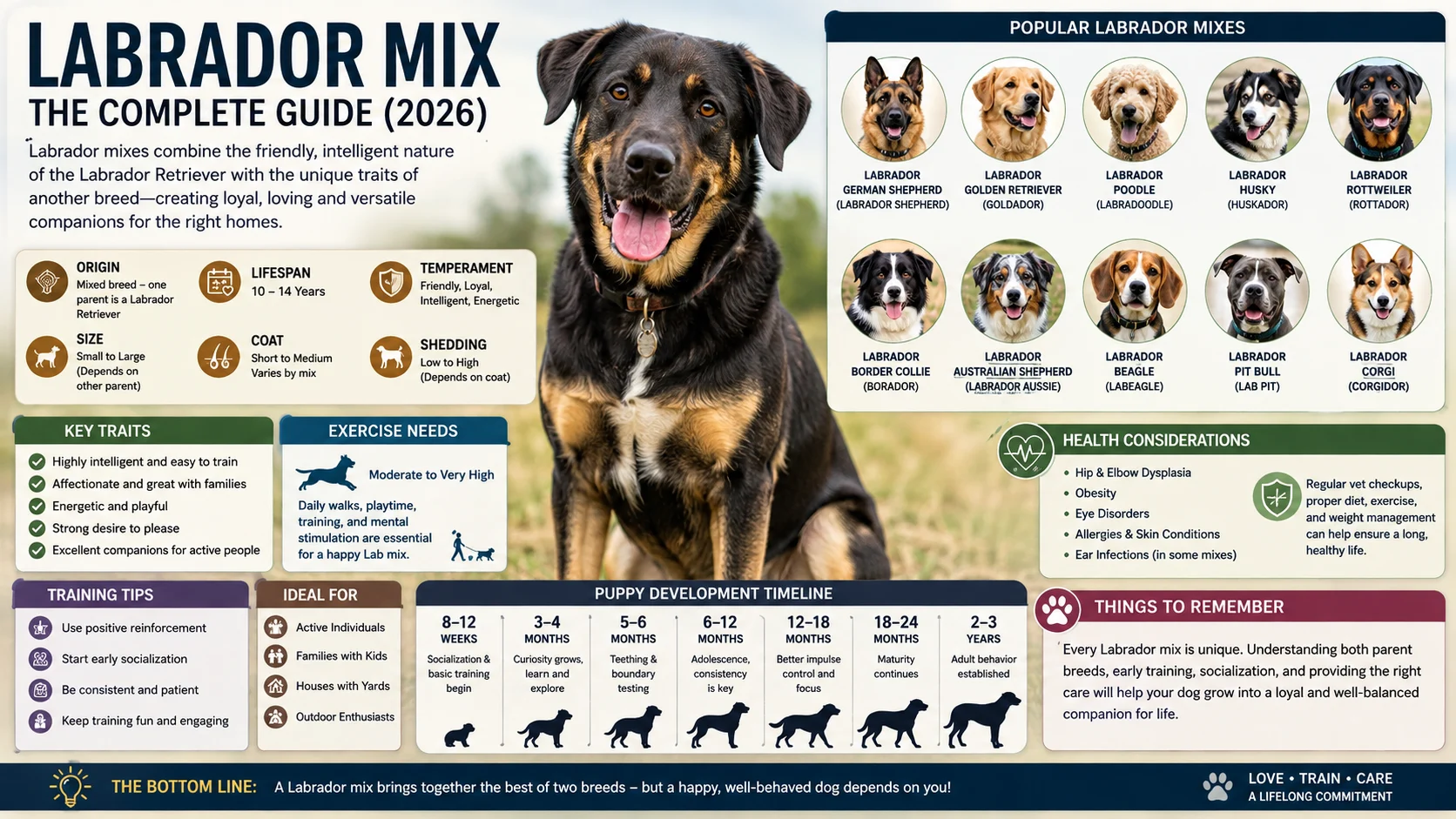
Labrador Mix: Loyal, Smart & Active
A Labrador mix is a dog bred from a Labrador Retriever and another breed, combining Labrador traits with characteristics inherited from the other parent. The result can vary widely in size, coat, energy, temperament, and health.
The most important point for potential owners is simple: a Lab mix is not automatically a calmer or easier Labrador. The other parent breed can strongly influence the dog’s adult personality, exercise needs, appearance, and training difficulty.
Quick Snapshot Table
| Category | Key Details |
|---|---|
| Dog Type | Mixed breed |
| Common Parent | Labrador Retriever |
| Other Parent | Varies by mix |
| Adult Size | Small to large depending on parent breeds |
| Temperament | Usually intelligent, social, and affectionate |
| Energy Level | Moderate to very high |
| Trainability | Generally high |
| Exercise Needs | Usually significant |
| Family Compatibility | Often excellent with proper socialization |
| Shedding | Low to heavy depending on coat |
| Grooming | Low to moderate, sometimes high |
| Lifespan | Commonly around 10 to 14 years |
| Main Health Concerns | Depends on both parent breeds |
| Best For | Active owners and families |
What Is a Labrador Mix?
A Labrador mix is a mixed breed dog with at least one Labrador Retriever parent and another breed as the second parent.
That second breed could be:
- German Shepherd
- Golden Retriever
- Poodle
- Husky
- Rottweiler
- Border Collie
- Australian Shepherd
- Corgi
- Beagle
- Pit Bull type breed
This is why the phrase “Labrador mix” describes a broad category rather than one predictable type of dog.
Two Lab mixes from different parents can look and behave completely differently.
Why the Other Parent Matters
A Labrador typically contributes traits such as:
- sociability
- food motivation
- retrieving instinct
- trainability
- enthusiasm
- strong human attachment
The other breed may add:
- guarding instincts
- herding drive
- independence
- higher prey drive
- different coat characteristics
- different energy levels
The resulting puppy inherits a combination of genes from both sides. There is no guarantee that it will simply become a smaller, calmer, or healthier version of a Labrador.
Why Labrador Mixes Are So Popular
Labrador Retrievers have long been valued for their combination of intelligence, trainability, friendliness, and versatility.
When crossed with another breed, breeders and owners often hope to combine desirable characteristics from both parents.
But responsible breeding requires more than choosing two attractive dogs.
Experienced breeders look at:
- temperament
- structural soundness
- genetic health
- orthopedic history
- working ability
- behavior around people and other animals
Appearance should come later.
Most Popular Labrador Mixes
Labrador German Shepherd Mix
Often called a Sheprador, this combination can produce a highly intelligent, energetic, loyal dog.
The Labrador side may contribute sociability and playfulness, while the German Shepherd side can add stronger guarding instincts and environmental awareness.
This is usually better suited to active owners than sedentary households.
Labrador Golden Retriever Mix
The Labrador Golden Retriever mix combines two closely related retrieving breeds.
These dogs are often:
- affectionate
- people oriented
- playful
- highly trainable
- energetic
They can make excellent family companions, but their enthusiasm can be overwhelming during adolescence.
Labrador Poodle Mix
Commonly known as a Labradoodle, this mix can vary considerably depending on the Poodle size and generation.
Potential characteristics include:
- high intelligence
- strong human focus
- curly or wavy coats
- lower shedding in some individuals
One important misconception is that every Labradoodle is automatically hypoallergenic. No dog can be guaranteed completely allergen free.
Labrador Husky Mix
Often called a Huskador, this combination can produce a dog with substantial exercise requirements.
The Labrador may contribute food motivation and sociability, while the Husky side may contribute:
- independence
- endurance
- vocal behavior
- strong running ability
These dogs can be challenging for owners who want a naturally obedient, low effort companion.
Labrador Rottweiler Mix
This mix can combine Labrador friendliness with the Rottweiler’s confidence and protective instincts.
Early socialization and consistent training become especially important.
The adult dog may be powerful, energetic, and physically demanding.
Labrador Mix Temperament
There is no single temperament that applies to every Labrador mix.
However, Labrador genetics commonly contribute:
- friendliness
- playfulness
- eagerness to interact
- trainability
- strong food motivation
The other parent can dramatically modify these traits.
Are Labrador Mixes Good Family Dogs?
Many are excellent family dogs.
But “Lab mix” should never be treated as a guarantee of child friendly behavior.
The individual dog’s:
- genetics
- early socialization
- training
- previous experiences
- household environment
all matter.
A well bred, stable dog can thrive around children, while a poorly socialized dog from an unsuitable pairing may struggle.
Social Behavior
Many Labrador mixes enjoy meeting people and interacting with their families.
However, some combinations may inherit stronger:
- territorial behavior
- guarding
- prey drive
- independence
- sensitivity
This is one reason meeting the parents, when possible, can provide useful information before choosing a puppy.
Intelligence and Trainability
Labrador mixes are often highly trainable, particularly when the other parent also comes from a working or companion breed.
Food rewards can be particularly effective because Labradors commonly have strong food motivation.
Best Training Approach
Focus on:
- positive reinforcement
- impulse control
- recall
- loose leash walking
- calm greetings
- environmental confidence
- consistent household rules
Avoid assuming that intelligence means effortless obedience.
A clever dog can learn undesirable behaviors just as quickly as desirable ones.
Exercise Requirements
Most Labrador mixes need considerably more activity than a casual household dog.
A typical adult may benefit from:
- daily walks
- retrieving games
- obedience training
- scent activities
- hiking
- swimming where appropriate
- structured play
The Exercise Mistake Many Owners Make
More exercise is not always the answer.
A dog that receives endless high intensity ball throwing can become physically conditioned while remaining mentally overaroused.
A better approach combines:
Physical exercise + mental work + calmness training
That combination creates a more balanced companion.
Puppy Development Timeline
Labrador mix puppies can develop at different rates depending on their other parent and expected adult size.
| Age | Typical Development |
|---|---|
| 8 to 12 Weeks | Socialization and basic training begin |
| 3 to 4 Months | Confidence and curiosity increase |
| 5 to 6 Months | Teething and boundary testing |
| 6 to 12 Months | Adolescence and increased independence |
| 12 to 18 Months | Better impulse control develops |
| 18 to 24 Months | Physical and emotional maturity improves |
| 2 to 3 Years | Adult temperament becomes more established |
The Puppy Stage Most Owners Underestimate
The 6 to 18 month period can be difficult.
A puppy that seemed exceptionally obedient at four months may suddenly:
- ignore commands
- pull harder
- become more distracted
- test boundaries
- develop stronger environmental reactions
This is normal adolescent development in many dogs.
Consistency during this stage matters more than constantly changing training methods.
Health and Genetics
This is where Labrador mix buyers should slow down.
A mixed breed dog is not automatically free from inherited health problems.
The puppy can inherit genetic risks from either parent.
Common Health Concerns
Depending on the mix, potential concerns can include:
- hip dysplasia
- elbow dysplasia
- obesity
- eye disorders
- allergies
- certain inherited heart conditions
- joint problems
- breed specific genetic disorders
The actual risk depends heavily on the parent breeds and individual lineage.
Obesity Deserves Special Attention
Labradors are well known for their strong appetite, and some genetic variants are associated with increased food motivation and obesity risk.
For a Labrador mix, uncontrolled feeding can quickly become a problem.
Keeping the dog lean is one of the simplest ways owners can protect long term joint health.
How to Evaluate a Labrador Mix Breeder
Ask About Both Parents
Do not accept vague statements such as:
“Both parents are healthy.”
Ask for documented health information appropriate to both breeds.
Depending on the parent breeds, this may include:
- hip evaluations
- elbow evaluations
- eye examinations
- cardiac screening
- DNA testing
Observe Temperament
A breeder should be able to explain:
- how the parents behave around strangers
- how they respond to handling
- whether they have strong anxiety
- their working or companion background
The puppy’s appearance should not be the main selling point.
Breeder Evaluation Feature Image
Image Prompt
“Realistic professional breeder evaluation scene featuring a healthy Labrador mix puppy being calmly examined beside its Labrador Retriever parent and second breed parent, clean ethical kennel environment, health focused atmosphere, natural daylight, realistic canine anatomy, documentary photography style, premium responsible breeding article aesthetic.”
Image Alt Text
“Labrador mix puppy with parents during a responsible breeder evaluation.”
Coat, Shedding and Grooming
Coat type depends heavily on the other parent.
A Labrador mix may have:
- short dense fur
- medium length fur
- double coat
- wavy coat
- curly coat
Shedding Expectations
Do not assume “mixed breed” means low shedding.
A Labrador crossed with a heavy shedding breed may produce a dog that sheds substantially.
Regular brushing is particularly useful during seasonal coat changes.
Feeding and Weight Management
Labrador mixes can become overweight surprisingly easily.
Practical Feeding Rules
Measure meals rather than free feeding.
Monitor:
- body condition
- waist definition
- rib coverage
- treat intake
A healthy adult should generally have a visible waist when viewed from above, with ribs that can be felt without excessive fat covering them.
Common Mistakes
Choosing Based Only on Appearance
A cute puppy can become a large, energetic adult with demanding behavioral needs.
Assuming Every Lab Mix Is Friendly
Temperament comes from the individual dog and both sides of its genetics.
Ignoring Adult Size
Always consider the expected size of both parent breeds.
Underestimating Adolescence
The first six months are not the end of training.
Overfeeding
Food motivated dogs can gain weight quickly.
Treating “Mixed Breed” as a Health Guarantee
Hybrid genetics do not eliminate inherited disease.
Insights Most Articles Miss
The Second Parent Can Matter More Than the Labrador Side
When predicting adult behavior, you need to understand both breeds.
A Labrador crossed with a calm companion breed can be very different from a Labrador crossed with a high drive working or independent breed.
Puppy Behavior Is Not Adult Temperament
A quiet eight week old puppy does not automatically become a calm adult.
Development, genetics, socialization, and training continue shaping behavior.
Energy Is Not the Same as Exercise
A dog can be physically tired while still lacking impulse control.
Mental enrichment and calmness training deserve equal attention.
Size Can Be Difficult to Predict
Crossbreeding does not create a precise middle point between two breeds.
A Labrador mix can resemble one parent much more strongly than the other.
Buyer Warning
Be cautious of sellers advertising Labrador mixes using claims such as:
- guaranteed temperament
- guaranteed hypoallergenic coat
- guaranteed no shedding
- perfect family dog
- naturally trained
- designer breed with no health risks
No responsible breeder can guarantee every adult characteristic from an eight week old puppy.
A good breeder discusses uncertainty honestly.
Labrador Mix vs Purebred Labrador
| Feature | Labrador Mix | Purebred Labrador |
|---|---|---|
| Appearance | Less predictable | More predictable |
| Adult Size | Depends on second parent | More predictable |
| Temperament | Combination of breeds | More established breed tendencies |
| Coat | Highly variable | Predictable Labrador coat |
| Energy | Depends on mix | High |
| Training | Usually good | Usually excellent |
| Health Risks | From both parent breeds | Labrador specific risks |
| Predictability | Lower | Higher |
Lifestyle Compatibility
| Lifestyle | Suitability |
|---|---|
| Active family | Excellent |
| Hiking household | Excellent |
| Experienced dog owner | Excellent |
| First time owner | Depends on mix |
| Apartment lifestyle | Depends heavily on exercise |
| Sedentary household | Often poor |
| Outdoor enthusiast | Excellent |
Preparation Checklist
Before bringing home a Labrador mix, make sure you have:
- appropriate food
- crate or safe sleeping area
- collar and identification
- secure leash
- grooming equipment
- chew toys
- training rewards
- veterinarian selected in advance
- puppy socialization plan
- realistic exercise schedule
Most importantly, research the other parent breed.
That single step can prevent many mismatched placements.
Frequently Asked Questions
What is a Labrador mix?
A Labrador mix is a mixed breed dog with a Labrador Retriever parent and another breed as the second parent.
Are Labrador mixes good dogs?
They can be excellent companions, particularly for active owners who understand the characteristics of both parent breeds.
Are Labrador mixes easy to train?
Many are highly trainable because Labradors are intelligent and food motivated. However, the other parent’s genetics can influence independence, drive, and focus.
How big will a Labrador mix get?
Adult size varies considerably. The size and genetics of the other parent should be considered alongside the Labrador parent’s size.
Do Labrador mixes shed?
Many do. Shedding depends largely on the coat genetics inherited from both parents.
Are Labrador mixes healthier than purebred Labradors?
Not automatically. Mixed breeding can introduce genetic diversity, but a Labrador mix can still inherit health conditions from either parent.
What is the best Labrador mix?
There is no universally best Labrador mix. The right choice depends on your lifestyle, experience, activity level, housing, and preferred temperament.
Is a Labrador mix good with children?
Many are, but individual temperament and early socialization matter more than the label “Labrador mix.”
Final Thoughts
A Labrador mix can be an outstanding companion, but choosing one should involve more than falling in love with a puppy’s face.
The Labrador side often brings intelligence, enthusiasm, trainability, and affection. The other parent can dramatically change the finished dog.
That is why experienced owners look beyond the puppy.
They ask:
What will this dog need at two years old?
That question tells you much more than how cute the puppy is today.
A well matched Labrador mix can become a loyal, athletic, intelligent family companion for many years. The key is choosing based on temperament, health, adult size, energy, and lifestyle compatibility, rather than marketing claims or appearance alone.