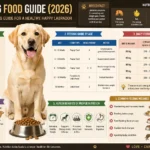
The best Labrador dog food is a complete, balanced diet matched to the dog’s age, activity level, and body condition. Labradors are especially prone to overeating and weight gain, so calorie control matters as much as ingredient quality.
The biggest mistake is choosing food because the label looks premium; for Labradors, the right calories, protein, fat, and portion size are what make the real difference.
Quick Snapshot Table
| Category | Labrador Dog Food Guidance |
|---|---|
| Best Food Type | Complete and balanced dog food |
| Protein | High quality animal or mixed protein sources |
| Fat | Moderate and appropriate for activity level |
| Carbohydrates | Digestible sources are generally suitable |
| Puppies | Puppy formula designed for growth |
| Adults | Adult maintenance formula |
| Seniors | Adjust calories according to activity and body condition |
| Main Concern | Overeating and obesity |
| Feeding Priority | Calories, nutrients, portions, and body condition |
| Treats | Keep controlled and included in daily calorie intake |
| Water | Fresh water available at all times |
Why Choosing Labrador Dog Food Is Different
Labradors have an unfair reputation for acting as though every meal might be their last.
The reputation exists for a reason.
Many Labradors are highly food motivated, and research has identified a genetic association involving the POMC gene that can contribute to increased appetite and food-seeking behavior in some dogs.
That does not mean every Labrador will become overweight.
It does mean owners should take portion control seriously from puppyhood.
A Labrador can look perfectly healthy while gradually accumulating excess body fat. By the time the weight becomes obvious, the feeding routine may already have been too generous for months.
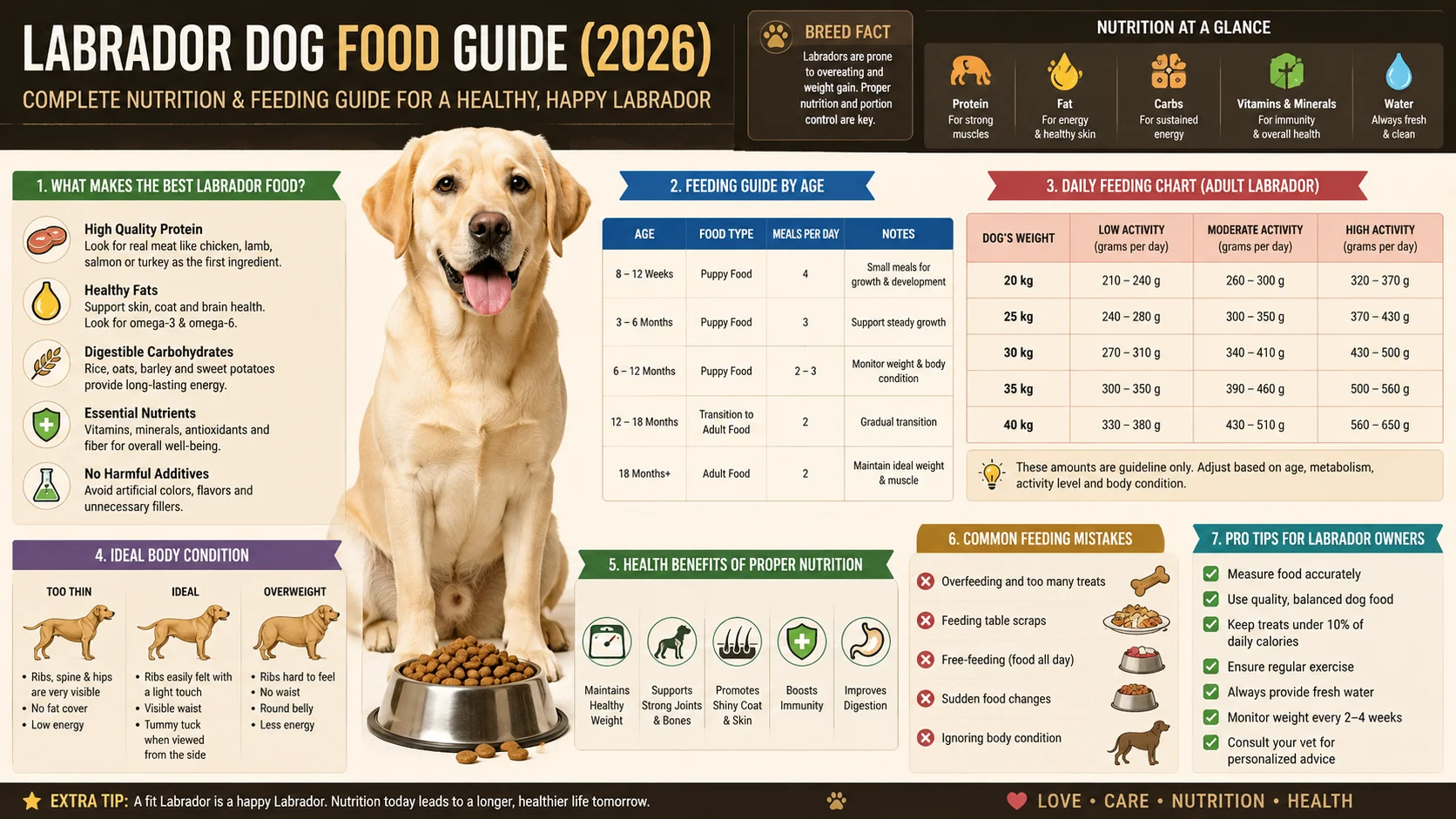
What Makes the Best Labrador Dog Food?
The best Labrador food is not necessarily the most expensive bag on the shelf.
A good diet should provide:
Complete and Balanced Nutrition
Look for a food formulated to meet established nutritional standards for the dog’s particular life stage.
Puppies, adults, and senior dogs do not necessarily have identical nutritional requirements.
High Quality Protein
Protein supports:
- muscle development
- tissue maintenance
- recovery
- healthy body condition
Good sources may include:
- chicken
- turkey
- beef
- lamb
- fish
- eggs
The ingredient list should be considered alongside the food’s complete nutritional profile rather than used as the only measure of quality.
Appropriate Fat Levels
Fat provides concentrated energy and supports essential biological functions.
But this is where Labrador owners need to be careful.
A highly palatable, calorie dense food can make portion control harder for a dog that already loves eating.
Digestible Carbohydrates
Carbohydrates are not automatically “bad” for dogs.
Ingredients such as:
- rice
- oats
- barley
- potatoes
- sweet potatoes
can provide useful energy when incorporated into a nutritionally complete diet.
The question is not whether a food contains carbohydrates. The more important question is whether the overall diet is appropriate for the individual Labrador.
Puppy vs Adult Labrador Dog Food
One of the most important decisions is choosing food according to life stage.
| Labrador Stage | Food Priority |
|---|---|
| 8 to 12 weeks | Growth nutrition and digestibility |
| 3 to 6 months | Controlled skeletal development |
| 6 to 12 months | Continued growth with calorie control |
| 12 to 18 months | Transition toward adult maintenance |
| Adult | Healthy weight and muscle maintenance |
| Senior | Calorie control and age appropriate nutrition |
Labrador Puppy Food
Labrador puppies grow quickly, but faster growth is not necessarily better growth.
Overfeeding can encourage excessive weight gain and place additional stress on developing joints.
A puppy diet should therefore support steady development rather than simply maximizing calories.
Adult Labrador Food
For adult Labradors, weight management becomes one of the biggest nutritional priorities.
A food that provides adequate nutrition without excessive calories is often more useful than a highly calorie dense formula.
Senior Labrador Food
Older Labradors often become less active.
If food intake remains unchanged while activity declines, weight can creep upward.
Senior feeding should therefore be adjusted according to:
- body condition
- activity
- muscle mass
- veterinary recommendations
How Much Should a Labrador Eat?
There is no single feeding amount that works for every Labrador.
The correct portion depends on:
- body weight
- age
- activity level
- neuter status
- metabolism
- calorie density of the food
The feeding chart printed on the package is a starting point, not a guarantee.
A Better Way to Judge Portions
Monitor your Labrador’s body condition regularly.
You should generally be able to:
- feel the ribs without excessive pressure
- see a noticeable waist from above
- observe an abdominal tuck from the side
If the waist disappears and the ribs become difficult to feel, the feeding plan may need adjustment.
Labrador Weight Management
Weight control deserves its own section because obesity is one of the most important nutritional concerns for Labradors.
A Labrador does not need to be dramatically overweight before excess body fat starts affecting mobility.
Signs Your Labrador May Be Overweight
Watch for:
- ribs becoming difficult to feel
- absent waist
- rounded abdomen
- reduced willingness to exercise
- excessive panting during normal activity
The Treat Problem
Many owners carefully measure meals but forget about treats.
A few biscuits throughout the day can become a substantial calorie contribution.
Count:
- training treats
- table scraps
- dental chews
- treats from children
- food used for medication
The daily calorie budget includes all of them.
Labrador Dog Food Ingredients: What Should You Look For?
Instead of searching for one “perfect” ingredient, evaluate the entire nutritional profile.
Ingredients Worth Paying Attention To
Look for clear sources of:
- protein
- essential fatty acids
- vitamins
- minerals
- appropriate fiber
Ingredients That Need Context
Words such as:
- grain free
- natural
- holistic
- premium
- human grade
can sound impressive, but marketing terminology does not automatically mean a food is nutritionally superior.
Here is where many owners get misled.
A beautiful ingredient list is not a substitute for a complete and balanced diet.
Labrador Dog Food and Joint Health
Labradors are predisposed to orthopedic problems, including hip and elbow dysplasia.
Nutrition cannot eliminate genetic risk.
However, maintaining an appropriate body condition is extremely important because carrying unnecessary weight places additional mechanical stress on joints.
Nutritional Priorities for Active Labradors
Consider:
- appropriate calorie intake
- adequate protein
- controlled growth during puppyhood
- healthy body condition
Some foods also contain ingredients associated with joint support, but owners should discuss supplements and therapeutic diets with their veterinarian rather than assuming they are necessary for every dog.
Labrador Dog Food and Sensitive Stomachs
Some Labradors have digestive sensitivities.
Possible signs include:
- recurring loose stools
- excessive gas
- vomiting
- inconsistent appetite
If digestive problems persist, changing foods repeatedly can make the situation harder to understand.
Better Approach
Introduce dietary changes gradually and keep track of:
- food brand
- protein source
- portion size
- treats
- stool quality
Persistent digestive problems deserve veterinary evaluation rather than endless food experimentation.
Homemade Food vs Commercial Labrador Dog Food
Homemade diets can work when properly formulated.
The problem is that many homemade diets are nutritionally incomplete.
Common deficiencies may involve:
- calcium
- essential fatty acids
- vitamins
- trace minerals
If you want to feed homemade food long term, veterinary nutrition guidance is much safer than designing the diet from online recipes.
Dry Food vs Wet Food
Both can be useful.
| Food Type | Advantages | Considerations |
|---|---|---|
| Dry food | Convenient and easy to portion | Lower moisture |
| Wet food | High moisture and often highly palatable | More expensive per calorie |
| Mixed feeding | Combines formats | Calories must still be calculated |
The best option is the one that provides appropriate nutrition while allowing you to control your Labrador’s calorie intake.
Puppy Development and Feeding Timeline
8 to 12 Weeks
Feed a properly formulated puppy diet in several smaller meals.
At this age, consistency matters more than variety.
3 to 6 Months
Growth accelerates.
Monitor body condition rather than constantly increasing portions because your puppy “looks hungry.”
6 to 12 Months
Adolescence begins.
Activity may increase dramatically, but appetite can increase too.
This is an important period for preventing unnecessary weight gain.
12 to 18 Months
Depending on individual development and veterinary guidance, many Labradors transition toward adult maintenance nutrition.
18 Months and Beyond
Focus shifts toward maintaining:
- lean muscle
- healthy body condition
- appropriate activity
Step By Step Labrador Feeding Routine
Step 1: Choose a Life Stage Appropriate Food
Start with a complete and balanced diet designed for your Labrador’s developmental stage.
Step 2: Calculate the Daily Portion
Use the manufacturer’s calorie information and feeding guidance as your starting point.
Step 3: Divide Meals
Many Labradors do well with structured meal times rather than unrestricted access to food.
Step 4: Measure Food Accurately
A measuring cup is useful.
A kitchen scale can be even more precise, particularly when managing weight.
Step 5: Monitor Body Condition
Check your dog’s body shape regularly.
Step 6: Adjust Gradually
If your Labrador gains or loses too much weight, make measured changes rather than dramatically cutting food overnight.
Common Labrador Feeding Mistakes
Free Feeding
Leaving food available all day can be particularly problematic for food motivated Labradors.
Overestimating Exercise
A long walk does not necessarily compensate for excessive calories.
Too Many Treats
Training can unintentionally become a major source of calories.
Switching Foods Too Frequently
Constant changes can create digestive problems and make it difficult to identify what actually works.
Feeding Human Food
Some table foods are harmless in small quantities, but others are dangerous for dogs.
Avoid foods such as:
- chocolate
- grapes and raisins
- onions
- garlic
- xylitol containing products
- alcohol
Insights Most Labrador Food Articles Miss
A Hungry Labrador Is Not Necessarily an Underfed Labrador
Food motivation is part of the breed’s challenge.
A Labrador can enthusiastically request another meal immediately after eating an appropriate portion.
The owner’s job is to judge body condition, not simply appetite.
Weight Is More Than a Cosmetic Issue
Keeping a Labrador lean can be one of the most useful things an owner does for long term mobility.
The Best Food Is Individual
Two Labradors of identical weight may require different calorie intakes because their:
- activity
- age
- metabolism
- health
- reproductive status
can differ.
Buyer Guide: How to Choose Labrador Dog Food
Before buying a food, check:
Nutrition Checklist
☐ Appropriate life stage
☐ Complete and balanced nutritional profile
☐ Clear calorie information
☐ Suitable protein and fat levels
☐ Reliable manufacturer
☐ Appropriate for your dog’s health needs
☐ Feeding instructions based on body weight
Do not choose solely because the packaging features a beautiful Labrador.
When Should You Change Your Labrador’s Food?
A food change may be appropriate when:
- your veterinarian recommends it
- your Labrador has a diagnosed nutritional need
- the current diet is causing persistent problems
- calorie requirements have changed
- your dog has entered a new life stage
Change diets gradually whenever possible.
Sudden dietary changes can trigger gastrointestinal upset.
Lifestyle Compatibility and Feeding Needs
| Labrador Lifestyle | Feeding Consideration |
|---|---|
| Family companion | Strict portion control |
| Highly active dog | Higher energy requirements may apply |
| Working Labrador | Carefully matched calories |
| Overweight Labrador | Calorie controlled plan |
| Senior Labrador | Adjust intake as activity decreases |
| Puppy | Growth appropriate nutrition |
Labrador Dog Food Preparation Checklist
Before bringing home a Labrador puppy, prepare:
☐ Age appropriate puppy food
☐ Measuring cup or kitchen scale
☐ Stainless steel food bowls
☐ Fresh drinking water
☐ Treat allowance
☐ Feeding schedule
☐ Body condition monitoring routine
☐ Veterinarian contact
☐ Gradual food transition plan
Frequently Asked Questions
What is the best dog food for a Labrador?
The best Labrador dog food is a complete and balanced diet appropriate for the dog’s age, activity level, health, and calorie requirements. There is no single food that is best for every Labrador.
How many times a day should a Labrador eat?
Puppies generally need more frequent meals than adults. Many adult Labradors do well with two measured meals per day.
What food is best for Labrador puppies?
Choose a complete and balanced puppy diet formulated for appropriate growth. Portion control is particularly important because Labradors can gain excess weight easily.
Can Labradors eat grain?
Yes. Grains such as rice, oats, and barley can be appropriate ingredients in a nutritionally complete canine diet unless an individual dog has a specific medical reason to avoid them.
Should Labradors eat grain free food?
Not automatically. Grain free does not mean healthier, and removing grains is generally unnecessary unless there is a specific reason recommended by a veterinarian.
How do I stop my Labrador from overeating?
Use measured meals, limit treats, avoid free feeding, and monitor body condition. Slow feeders and food based enrichment can also help some food obsessed Labradors eat more deliberately.
What human foods can Labradors eat?
Some plain foods can be appropriate in moderation, including certain cooked meats and vegetables. However, treats should remain a small part of the overall diet, and potentially toxic foods should be avoided.
How can I tell if my Labrador is overweight?
You should generally be able to feel the ribs without pressing hard and see a waist when looking from above. If you are unsure, ask your veterinarian to assess body condition.
Final Thoughts
Choosing Labrador dog food is less about finding a magical ingredient and more about getting the fundamentals right.
Your Labrador needs a nutritionally complete diet, appropriate calories, sensible portions, and regular body condition monitoring.
And there is one lesson worth remembering: a Labrador’s enthusiasm for food is not a reliable measurement of how much food the dog needs.
Keep the dog lean, feed according to life stage and individual needs, and adjust the plan when your Labrador’s body condition or lifestyle changes. That simple approach will usually matter far more than chasing the latest dog food marketing trend.