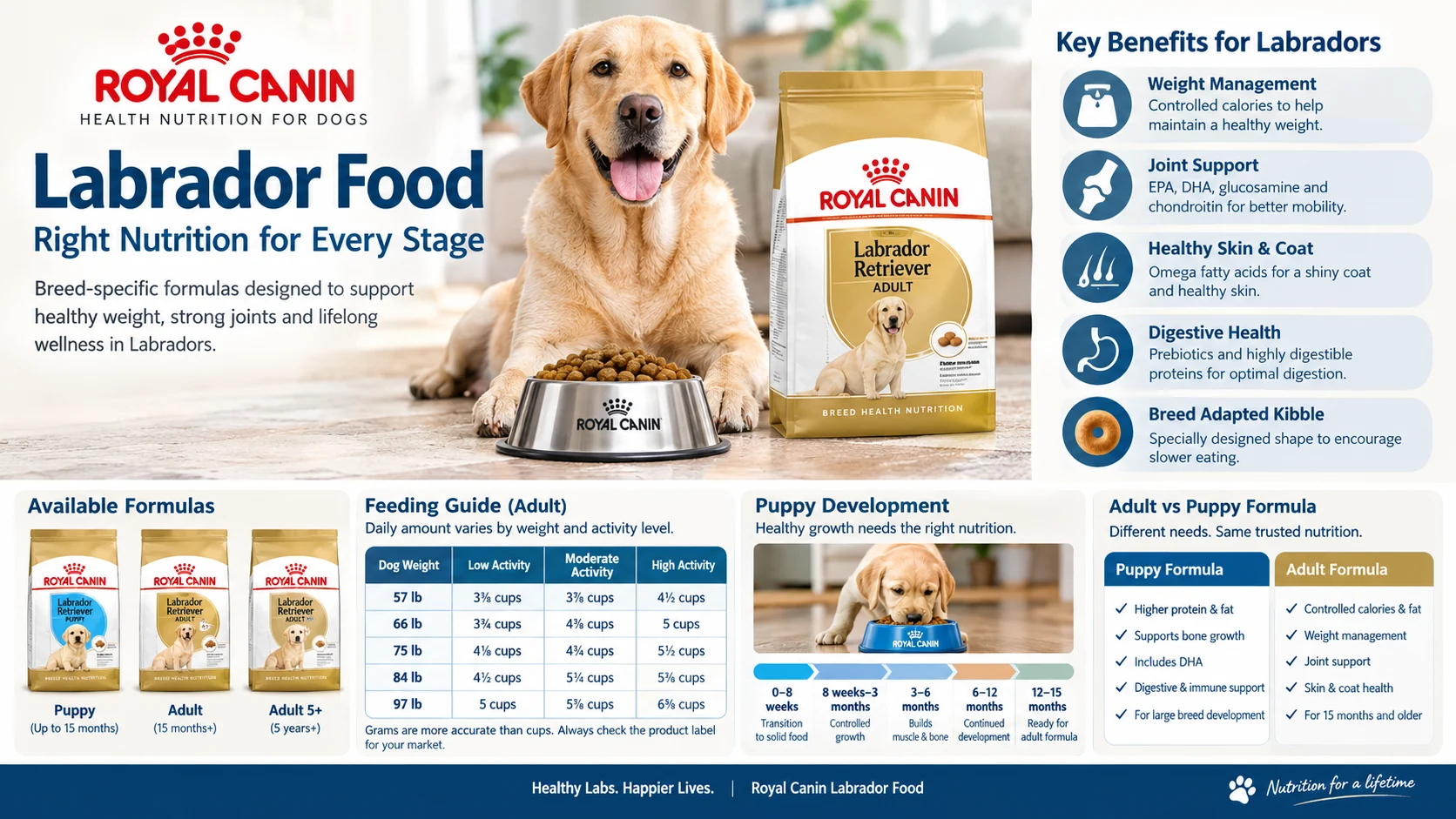
Royal Canin Labrador food is breed specific nutrition designed around a Lab’s tendency to overeat, gain weight, and eat quickly.
The right formula depends on age and condition, because Labrador puppies, adults, and senior dogs have different nutritional needs.
Quick Snapshot
| Category | Royal Canin Labrador Food |
|---|---|
| Main Formula | Labrador Retriever Adult |
| Puppy Formula | Labrador Retriever Puppy |
| Adult Age | 15 months and older |
| Puppy Age | Up to 15 months |
| Senior Formula | Labrador Retriever Adult 5+ |
| Main Concern | Weight management |
| Kibble Design | Breed adapted shape and texture |
| Adult Protein | 28% minimum in U.S. dry formula |
| Adult Fat | 11% minimum |
| Adult Calories | 306 kcal per cup |
| Puppy Protein | 31% minimum in U.S. formula |
| Puppy Fat | 12% minimum |
| Puppy Calories | 307 kcal per cup |
| Joint Support | EPA, DHA, glucosamine and related nutrients |
| Digestive Support | Prebiotics and selected proteins |
| Best For | Owners wanting breed specific nutrition |
Royal Canin’s U.S. adult formula is formulated for purebred Labrador Retrievers 15 months and older and provides 306 kcal per cup. Its U.S. puppy formula is designed for growth, including large size dogs, and provides 307 kcal per cup.
Is Royal Canin Labrador Food Good?
Yes, Royal Canin Labrador food can be a sensible option for many Labradors, particularly owners who want a breed specific formula with controlled calories and a kibble designed around typical Labrador eating behavior.
But “breed specific” does not automatically mean “best food for every Labrador.”
The better question is whether your individual dog:
• maintains a healthy body condition
• has good stool quality
• tolerates the ingredients
• maintains healthy skin and coat
• has appropriate energy levels
• maintains lean muscle
Royal Canin specifically describes its Labrador Retriever Adult formula as having adapted calories and fat to help Labradors maintain a healthy weight. The formula also includes nutrients such as EPA, DHA and glucosamine to support bones and joints.
Here is where many owners get it wrong: they choose dog food based on the ingredient list alone.
A food can look impressive on paper and still be a poor match for an individual dog.
Why Labrador Retrievers Need Careful Food Management
Labradors have a reputation for eating enthusiastically.
That is not simply a funny personality trait.
Overfeeding a Labrador during puppyhood or adulthood can create unnecessary pressure on:
• joints
• mobility
• body condition
• long term health
Royal Canin specifically notes that Labradors can tend to overeat and gulp food quickly, which is one reason its adult formula uses a specialized donut shaped kibble intended to encourage slower eating.
The goal should not be making a Labrador “look big.”
The goal is maintaining a lean, muscular body throughout life.
Royal Canin Labrador Food Formulas Explained
Royal Canin Labrador Retriever Puppy
This formula is designed for Labrador puppies up to 15 months.
Royal Canin states that the puppy formula is formulated with adapted energy, protein, calcium and phosphorus to support healthy development. It also includes nutrients intended to support digestive health and the developing immune system.
The U.S. formula lists:
| Nutrient | Minimum or Maximum |
|---|---|
| Protein | 31% minimum |
| Fat | 12% minimum |
| Fiber | 3.8% maximum |
| Moisture | 10.5% maximum |
| Calories | 307 kcal/cup |
Royal Canin Labrador Retriever Adult
This is the primary adult formula for Labradors 15 months and older.
The U.S. formula provides:
| Nutrient | Amount |
|---|---|
| Protein | 28% minimum |
| Fat | 11% minimum |
| Fiber | 4.9% maximum |
| Moisture | 10.5% maximum |
| EPA + DHA | 0.2% minimum |
| Calories | 306 kcal/cup |
The formula also includes glucosamine, chondroitin, fish oil, L-carnitine and other nutrients.
Royal Canin Labrador Retriever Adult 5+
Older Labradors have different nutritional priorities.
Royal Canin’s Adult 5+ formula is designed for Labradors aged 5 years and older and focuses more heavily on healthy aging, weight management, muscle maintenance, joints and kidney support.
The formula provides 277 kcal per cup in the U.S. version, with adapted fat and protein levels compared with the standard adult formula.
Puppy Development and Royal Canin Labrador Food
The puppy stage deserves special attention because Labrador puppies grow rapidly.
Birth to 8 Weeks
Puppies depend primarily on their mother and gradually transition to solid food.
Rapid growth makes nutritional balance particularly important.
8 Weeks to 3 Months
This is when most puppies enter their new homes.
A Labrador puppy needs:
• controlled growth
• appropriate calcium and phosphorus
• adequate protein
• digestive support
• consistent feeding
Royal Canin Labrador Retriever Puppy is specifically formulated for growth, including growth of large size dogs.
3 to 6 Months
Growth accelerates.
This is not the time to deliberately push calories simply because the puppy looks thin.
A healthy Labrador puppy should develop steadily rather than becoming excessively heavy.
6 to 12 Months
Muscle and skeletal development continue.
Owners should monitor:
• body condition
• stool quality
• appetite
• activity
• growth pattern
12 to 15 Months
The puppy approaches physical maturity.
Royal Canin’s Labrador puppy formula is intended for puppies up to 15 months, after which the adult formula becomes appropriate according to the product’s life stage guidance.
After 15 Months
Most Labradors transition to the adult formula.
The transition should be gradual rather than switching foods suddenly.
Royal Canin Labrador Food Ingredients: What Should You Know?
The ingredient list can look complicated at first.
The U.S. adult formula includes ingredients such as chicken by product meal, corn, oat groats, brewers rice, chicken fat, fish oil, beet pulp, psyllium and various vitamins and minerals.
This is important because some owners automatically assume that ingredients such as corn or by product meals make a dog food unsuitable.
That conclusion is too simplistic.
The more useful questions are:
Is It Nutritionally Complete?
The U.S. adult formula is stated by Royal Canin to be complete and balanced for adult maintenance under AAFCO Dog Food Nutrient Profiles.
Does Your Dog Tolerate It?
Individual response matters.
Watch for:
• persistent loose stools
• vomiting
• excessive itching
• ear problems
• unusual gas
• poor coat condition
If these occur consistently, discuss the problem with your veterinarian rather than assuming the food is automatically appropriate.
Is Your Labrador Maintaining a Healthy Body Condition?
This may be more important than whether the food looks impressive on a marketing label.
Does Royal Canin Labrador Food Help With Weight Control?
It is specifically designed with weight management in mind.
Royal Canin states that the adult formula uses a precise amount of calories and fat to help maintain a Labrador’s healthy weight.
But food cannot compensate for overfeeding.
A Labrador can gain weight on excellent dog food if portions are too large.
Signs Your Labrador May Be Overweight
Look for:
• ribs that are difficult to feel
• little or no visible waist
• broad abdominal area
• reduced stamina
• reluctance to exercise
You should be able to feel the ribs without pressing hard, while the waist should remain visible when viewed from above.
Royal Canin Labrador Feeding Amounts
Feeding amounts should be treated as a starting point rather than an absolute prescription.
Royal Canin’s U.S. adult feeding guide varies portions according to body weight and activity level. For example, a 66 lb Labrador is listed at approximately 3¾ cups daily for low activity, 4⅜ cups for moderate activity, and 5 cups for high activity.
| Labrador Weight | Low Activity | Moderate Activity | High Activity |
|---|---|---|---|
| 57 lb | 3⅜ cups | 3⅞ cups | 4½ cups |
| 66 lb | 3¾ cups | 4⅜ cups | 5 cups |
| 75 lb | 4⅛ cups | 4¾ cups | 5½ cups |
| 84 lb | 4½ cups | 5¼ cups | 5⅞ cups |
| 97 lb | 5 cups | 5⅞ cups | 6⅝ cups |
These are Royal Canin’s U.S. recommendations and can vary by market, individual dog, activity and health status.
Cups or Grams?
Grams are generally more precise.
Royal Canin itself notes that grams are the more accurate method of measuring portions.
This matters for Labradors because small daily overfeeding can accumulate into significant weight gain.
How to Transition Your Labrador to Royal Canin
Do not normally replace the old food overnight.
Days 1 to 3
Feed approximately:
• 75% old food
• 25% new food
Days 4 to 6
Move toward:
• 50% old food
• 50% new food
Days 7 to 9
Use:
• 25% old food
• 75% new food
Day 10
Move to:
• 100% new food
If digestive problems develop, slow the transition and speak with your veterinarian if symptoms persist.
Royal Canin Labrador Food for Fast Eaters
This is one of the more interesting breed specific features.
The adult formula uses a specialized kibble shape intended to encourage Labradors to chew rather than gulp their food.
That does not mean it will solve every fast eating problem.
If your Labrador still inhales food, consider:
• slow feeder bowls
• dividing meals
• measured feeding
• controlled meal times
Very fast eating combined with large meals deserves particular attention because Labrador owners should take gastrointestinal emergencies such as bloat seriously.
Joint Support and Labrador Nutrition
Labradors are active dogs and their body weight can place considerable demand on their joints.
Royal Canin’s adult formula includes EPA, DHA and glucosamine, while the product information identifies joint health as one of its targeted benefits.
However, joint health is not just about supplements.
The bigger picture includes:
• maintaining healthy weight
• controlled puppy growth
• regular exercise
• avoiding repetitive high impact activity in growing puppies
• appropriate veterinary care
Keeping a Labrador lean is one of the most practical things an owner can do for long term mobility.
Royal Canin Labrador Food for Senior Dogs
A five year old Labrador is not necessarily a frail senior dog.
However, nutritional priorities can begin changing as activity levels and metabolism change.
Royal Canin Adult 5+ is formulated specifically for maturing Labradors and includes adjusted calorie content, protein, L-carnitine, antioxidants and nutrients aimed at supporting joints and healthy aging.
When Should You Consider Adult 5+?
Consider discussing the transition with your veterinarian when your Labrador:
• reaches the relevant age range
• becomes less active
• begins gaining weight more easily
• shows changes in muscle condition
Age alone should not determine a diet change.
Common Mistakes Labrador Owners Make
Feeding by Cup Without Monitoring Body Condition
The feeding chart is a starting point.
Your Labrador’s actual needs may differ.
Giving Too Many Treats
Treat calories count.
If you give:
• training treats
• dental chews
• table scraps
• food toppers
those calories should be considered in the overall diet.
Keeping a Puppy Overweight
A chubby Labrador puppy may look adorable.
But healthy growth is not the same as maximum growth.
Assuming More Food Means More Muscle
Extra calories generally do not create better structure.
They can simply create excess body fat.
Changing Food Too Frequently
Constantly changing diets can make it difficult to determine what your dog actually tolerates.
What Most Royal Canin Labrador Food Articles Miss
The Food Is Not the Whole Health Plan
Even a breed specific diet cannot prevent every Labrador health problem.
Genetics still matter.
So do:
• exercise
• weight
• veterinary care
• breeding background
• environmental factors
Breed Specific Does Not Mean Automatically Superior
Royal Canin’s Labrador formula is specifically designed around Labrador characteristics, but individual dogs vary.
One Labrador may thrive on it.
Another may require a different diet because of:
• allergies
• gastrointestinal disease
• kidney disease
• obesity
• another medical condition
Body Condition Beats the Number on the Bag
The most useful question is not:
“Is Royal Canin Labrador food premium?”
Ask:
“Is my Labrador healthy, lean, energetic and digestively stable on it?”
That is a much better measure.
Buyer Warning
If you are purchasing Royal Canin Labrador food online, check the exact formula rather than buying based only on the Royal Canin name.
Look for:
• Labrador Retriever Puppy
• Labrador Retriever Adult
• Labrador Retriever Adult 5+
Formulas, package sizes and nutritional details can vary between countries, so check the product label for your market.
Who Should Consider Royal Canin Labrador Food?
| Owner Situation | Suitability |
|---|---|
| Healthy adult Labrador | Excellent option to consider |
| Labrador puppy | Puppy formula is specifically designed for growth |
| Fast eating Labrador | Specialized kibble may be useful |
| Overweight Labrador | Discuss calorie needs with vet |
| Senior Labrador | Adult 5+ may be appropriate |
| Food allergy | Veterinary evaluation recommended |
| Kidney disease | Veterinary diet may be more appropriate |
| Chronic digestive disease | Discuss diet with veterinarian |
Preparation Checklist
Before feeding Royal Canin Labrador food, determine:
Your Labrador’s Age
Choose puppy, adult or mature formula based on life stage.
Current Weight
Do not estimate portions from appearance alone.
Activity Level
A working or highly active Labrador may require more calories than a sedentary companion.
Body Condition
Monitor waist and rib coverage regularly.
Treat Intake
Include treats in the overall calorie picture.
Digestive Response
Monitor stool consistency after transitioning.
Frequently Asked Questions
Is Royal Canin Labrador food good for Labradors?
Yes. Its Labrador specific formulas are designed around characteristics such as weight management, fast eating behavior, skin and coat support, and joint health. Whether it is the best choice depends on the individual dog.
Is Royal Canin Labrador food good for puppies?
Royal Canin Labrador Retriever Puppy is specifically formulated for Labrador puppies up to 15 months and provides nutrition designed to support growth and development.
When should I switch my Labrador from puppy to adult food?
Royal Canin’s Labrador Retriever Puppy formula is designed for puppies up to 15 months, while its Labrador Retriever Adult formula is intended for dogs 15 months and older.
Does Royal Canin Labrador food help prevent obesity?
It is formulated with adapted calorie and fat levels to support healthy weight, but portion control and activity remain essential.
How many cups of Royal Canin should I feed my Labrador?
The correct amount depends on body weight and activity. Royal Canin provides different daily amounts for low, moderate and high activity levels, and recommends using grams for greater accuracy.
Is Royal Canin Labrador food good for senior Labradors?
Royal Canin Labrador Retriever Adult 5+ is specifically formulated for mature Labradors and targets healthy aging, weight management, muscle maintenance and joint support.
Does Royal Canin Labrador food contain glucosamine?
Yes. The U.S. Labrador Retriever Adult formula lists glucosamine and chondroitin among its ingredients and guaranteed nutritional information.
Is Royal Canin Labrador food suitable for every Labrador?
No. Individual dogs can have different nutritional and medical needs. Dogs with allergies, chronic gastrointestinal problems, kidney disease or other medical conditions may need a veterinarian recommended diet.
Conclusion
Royal Canin Labrador food stands out because it is designed around several genuine Labrador challenges rather than simply putting the breed’s name on a standard formula.
Its adult formula focuses on controlled calories, breed adapted kibble, joint support, and skin and coat health, while the puppy formula is designed around the nutritional demands of large breed growth.
But the most important lesson is simple:
The best Labrador food is the one that keeps your individual dog lean, healthy, energetic, and digestively comfortable.
Royal Canin can be a strong option, but portion control, body condition, life stage and veterinary guidance matter just as much as the brand on the bag.