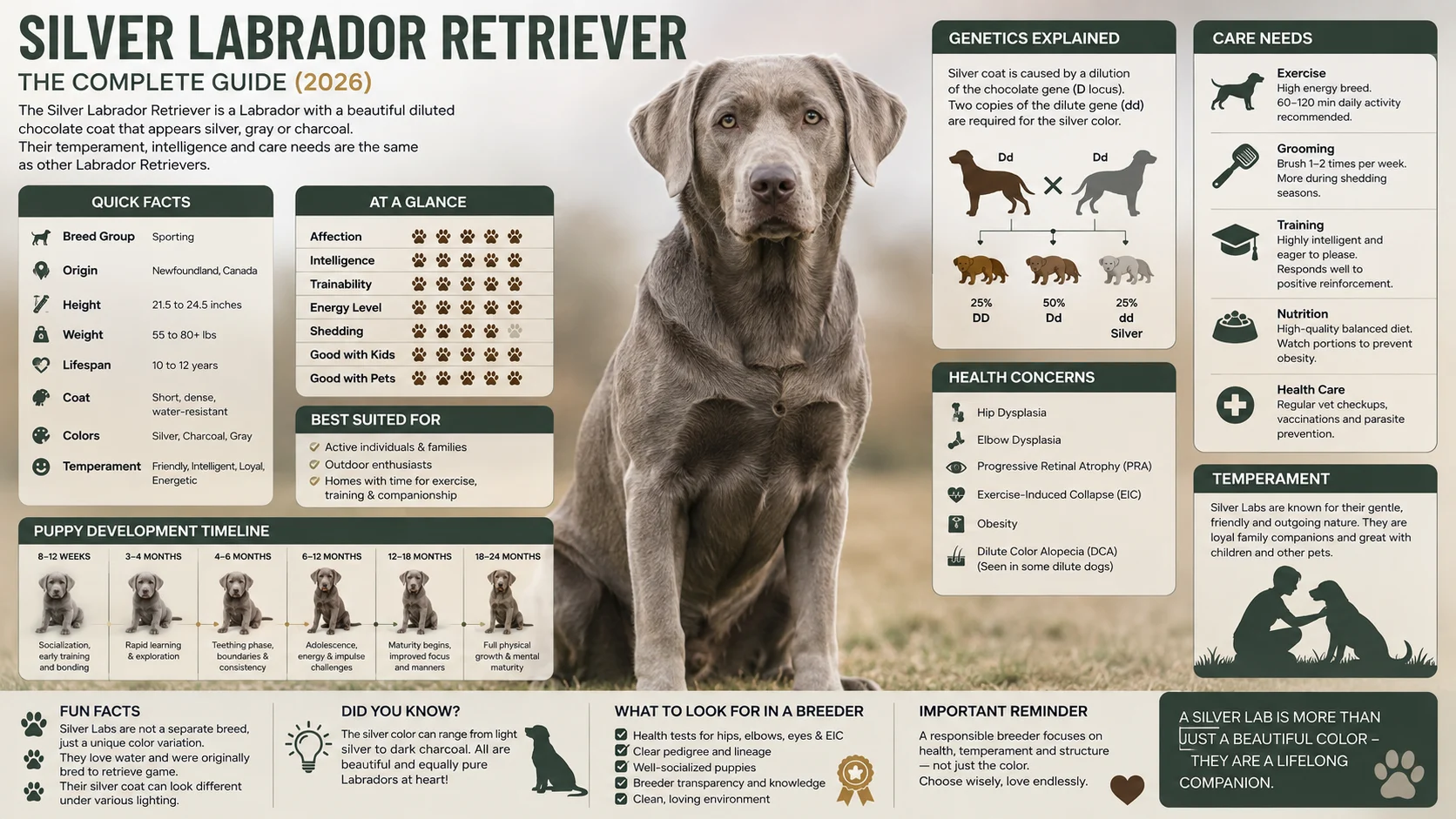
The Silver Labrador Retriever is a Labrador with a distinctive diluted chocolate coat that gives it a silver, charcoal, or gray appearance. Its temperament and care needs are essentially those of a Labrador Retriever, not a separate breed type.
The controversial part is genetics: silver Labs are linked to the dilute D locus, and responsible buyers should investigate health testing, pedigree, temperament, and breeder practices rather than paying a premium for color alone.
Quick Snapshot Table
| FeatureSilver Labrador Retriever | |
|---|---|
| Breed | Labrador Retriever |
| Coat Color | Silver, charcoal, gray |
| Genetic Basis | Dilution of chocolate pigmentation |
| Breed Group | Sporting |
| Temperament | Friendly, affectionate, energetic |
| Intelligence | High |
| Trainability | Excellent |
| Energy Level | High |
| Adult Height | About 21.5 to 24.5 inches |
| Typical Weight | About 55 to 80+ lbs |
| Lifespan | Generally around 10 to 12 years |
| Shedding | Moderate to heavy |
| Grooming | Relatively easy |
| Exercise | High |
| Good Family Dog | Usually yes |
| Main Concern | Breeder quality and genetic health |
What Is a Silver Labrador Retriever?
A Silver Labrador Retriever is a Labrador whose coat has a diluted chocolate appearance, producing shades ranging from pale silver-gray to darker charcoal.
The important distinction is that silver is a coat color, not a separate Labrador breed.
Silver Labradors generally have the same basic characteristics as other Labradors:
• Friendly temperament
• Strong retrieving instinct
• High food motivation
• Athletic build
• Desire for human interaction
• Considerable exercise requirements
The unusual color is what separates them visually.
Why Do Some Labradors Look Silver?
The silver appearance is associated with dilution of the chocolate coat.
At a simplified genetic level, the dilution gene changes how dark pigment is distributed through the hair shaft. In a chocolate Labrador, this can produce the lighter gray or silver appearance commonly described as “silver.”
That does not mean that silver Labs have a fundamentally different personality.
Silver Labrador Genetics Explained
The Dilute Gene
The D locus is involved in pigment dilution.
A simplified example is:
A puppy generally needs two copies of the recessive dilution allele to express a diluted coat.
This is why two dogs that do not visually appear silver can potentially produce diluted offspring if both carry the relevant allele.
Why Silver Labrador Genetics Are Controversial
The debate is not simply about whether a silver-colored Labrador can exist.
The larger discussion concerns where the dilution gene entered Labrador breeding populations and how breeders should manage it.
The Labrador Retriever Club and other breed organizations have historically expressed concerns about silver Labradors and their registration or breeding practices.
For a buyer, the practical lesson is simple:
Do not let an unusual coat color distract you from pedigree, health testing, temperament, and structural quality.
What Does a Silver Lab Look Like?
A well-built Silver Labrador should still look unmistakably like a Labrador Retriever.
Typical characteristics include:
• Broad head
• Friendly expression
• Medium-sized floppy ears
• Strong neck and shoulders
• Deep chest
• Short, dense coat
• Thick “otter” tail
• Balanced athletic structure
Silver vs Charcoal vs Gray
Breeders and owners may use several descriptions for diluted chocolate Labradors.
| Description | Typical Appearance |
|---|---|
| Silver | Light metallic gray |
| Charcoal | Darker gray |
| Gray | General description for diluted coat |
| Silver Chocolate | Another term sometimes used by sellers |
These labels are not necessarily separate varieties of Labrador.
Lighting also changes how the coat appears. A dog can look almost charcoal indoors and noticeably silver in direct natural light.
Silver Labrador vs Chocolate Labrador
The biggest visual difference is coat pigmentation.
| Trait | Silver Labrador | Chocolate Labrador |
|---|---|---|
| Base Pigment | Diluted chocolate | Chocolate |
| Coat Appearance | Gray or silver | Brown |
| Temperament | Labrador typical | Labrador typical |
| Exercise Needs | High | High |
| Trainability | Excellent | Excellent |
| Grooming | Moderate | Moderate |
| Retrieving Instinct | Strong | Strong |
There is no scientific reason to assume that a silver coat automatically makes a Labrador calmer, smarter, more athletic, or more affectionate.
Silver Labrador Temperament
A Silver Labrador should generally have the same basic temperament expected from a Labrador Retriever.
They tend to be:
• Affectionate
• Social
• Playful
• Food motivated
• Intelligent
• Energetic
• People oriented
A well-socialized Lab usually enjoys being involved in family activities rather than spending most of the day alone.
Are Silver Labs Aggressive?
Coat color does not determine aggression.
A Labrador with poor breeding or inadequate socialization can develop behavioral problems, just as any dog can. Conversely, a responsibly bred and properly raised Silver Labrador can be friendly, stable, and highly social.
This is why experienced breeders evaluate nerve stability and temperament, not just appearance.
Intelligence and Trainability
Silver Labradors can be extremely easy to train because Labradors generally combine intelligence with strong food motivation.
They often respond particularly well to:
• Positive reinforcement
• Retrieve-based games
• Short training sessions
• Reward-based obedience
• Scent games
• Structured exposure to new environments
The Labrador Training Trap
Because Labradors learn quickly, owners sometimes assume they require little training.
The opposite is often true.
A clever young Lab can learn unwanted behaviors just as quickly as desirable ones.
Jumping, stealing food, pulling on the leash, and demanding attention can become habits if they are accidentally rewarded.
Exercise Requirements
Silver Labradors are active sporting dogs.
A healthy adult generally needs daily physical activity combined with mental stimulation.
Good activities include:
• Fetch
• Swimming
• Hiking
• Retrieving drills
• Scent games
• Obedience training
• Controlled running
• Field work
How Much Exercise Does a Silver Lab Need?
Many adult Labs do well with approximately 60 to 120 minutes of combined activity per day, although individual requirements vary according to age, health, genetics, and lifestyle.
A young working-bred Labrador may require considerably more engagement than a calmer companion-bred dog.
The goal is not simply to exhaust the dog.
You also want to teach the ability to settle calmly after activity.
Puppy Development Timeline
Silver Labrador puppies develop broadly like other Labrador puppies.
The silver coat does not create a separate developmental schedule.
| Age | Typical Development |
|---|---|
| 8 to 12 Weeks | Socialization, bite inhibition, basic routines |
| 3 to 4 Months | Rapid learning and environmental exploration |
| 4 to 6 Months | Teething, increased confidence, impulse challenges |
| 6 to 12 Months | Adolescence and increasing physical ability |
| 12 to 18 Months | Greater maturity and improved impulse control |
| 18 to 24 Months | Adult behavior becomes more consistent |
| 2 to 3 Years | Many Labs reach full behavioral maturity |
The Most Important Puppy Period
The first few months are not about teaching dozens of tricks.
They are about building:
• Confidence
• Neutrality
• Good handling tolerance
• Reliable recall
• Calm greetings
• Bite inhibition
• Positive environmental experiences
A Labrador that learns how to settle is often much easier to live with than one that only learns how to retrieve.
Health and Genetic Considerations
This is one of the most important sections for prospective owners.
A Silver Labrador should not be judged by color alone.
Labradors are predisposed to several inherited and lifestyle-related health problems, including:
• Hip dysplasia
• Elbow dysplasia
• Progressive retinal atrophy
• Exercise-induced collapse
• Obesity
• Certain inherited eye disorders
• Ear problems
What Should a Responsible Breeder Test?
A serious Labrador breeder should be willing to discuss health screening for breeding dogs.
Depending on the breeding program, relevant evaluations can include:
| Health Area | What Buyers Should Ask About |
|---|---|
| Hips | OFA or equivalent evaluation |
| Elbows | OFA or equivalent evaluation |
| Eyes | Current ophthalmic examination |
| EIC | Genetic testing |
| PRA | Relevant DNA testing |
| Other inherited conditions | Breed-appropriate screening |
Do not accept “the parents are healthy” as a substitute for documented testing.
Does the Silver Gene Cause Health Problems?
This question requires nuance.
The dilution gene itself is not automatically proof that a dog will be unhealthy. However, color dilution in dogs can be associated with dilute color alopecia, a condition involving abnormal hair follicles and coat loss in some dilute-colored dogs.
That does not mean every Silver Labrador will develop coat disease.
It does mean buyers should ask informed questions about:
• Parent health
• Skin and coat history
• Genetic testing
• Pedigree
• Veterinary records
The real issue is not whether the puppy looks healthy at eight weeks.
The question is whether the breeding program has prioritized long-term health.
Grooming a Silver Labrador
Silver Labs have relatively straightforward grooming requirements.
Their short double coat does not usually require professional grooming.
Weekly Grooming
A basic routine can include:
• Brushing once or twice weekly
• Nail trimming
• Ear checks
• Dental care
• Occasional bathing
Seasonal Shedding
This is where new Labrador owners sometimes get surprised.
Labradors shed year-round and often shed considerably more during seasonal coat changes.
If you want a dog that leaves very little hair around the house, a Labrador is probably not the right choice.
Nutrition and Weight Management
Labradors are famously food motivated.
Unfortunately, that can become a health problem.
Obesity is common in the breed and can put additional stress on:
• Hips
• Elbows
• Joints
• Cardiovascular health
• Mobility
Practical Feeding Rule
Measure meals rather than free-feeding.
Treat calories should also count toward the daily intake.
A Labrador that constantly acts hungry is not necessarily a Labrador that needs more food.
Common Mistakes Silver Lab Owners Make
Focusing Too Much on Color
The silver coat is attractive, but it should be one of the least important factors when evaluating a puppy.
Assuming Every Silver Lab Has the Same Temperament
Bloodline matters.
A field-bred Labrador can have dramatically more drive than a companion-bred dog.
Underestimating Exercise
A bored young Lab can become destructive very quickly.
Overfeeding
Those pleading Labrador eyes are remarkably effective.
Do not let them determine portion size.
Ignoring Structure
A puppy can have a beautiful silver coat while having poor movement or weak structural quality.
Watch the dog walk, trot, sit, stand, and interact naturally.
What Experienced Breeders Look For
When evaluating a Silver Labrador puppy, experienced breeders usually look beyond the color.
They want:
• Correct structure
• Balanced movement
• Stable nerves
• Appropriate confidence
• Good recovery after surprises
• Healthy body condition
• Strong pedigree
• Documented health testing
A flashy coat cannot compensate for weak genetics or poor temperament.
Buyer Warning: Silver Labrador Pricing
Silver Labradors are sometimes sold for significantly higher prices because the color is marketed as rare.
That should make buyers cautious.
Ask These Questions Before Buying
- Can I see the parents?
- What health tests have been completed?
- Can I verify the results?
- What is the pedigree?
- How are the puppies socialized?
- What happens if the puppy develops a serious inherited condition?
- Why did the breeder choose these two parents?
- What temperament should I expect from this bloodline?
If the breeder spends most of the conversation discussing silver color and price, but very little discussing health and temperament, walk away.
Silver Labrador Lifestyle Compatibility
| Lifestyle | Compatibility |
|---|---|
| Active family | Excellent |
| Outdoor enthusiast | Excellent |
| Retriever/sporting home | Excellent |
| Family with older children | Usually excellent |
| First-time owner | Often manageable with commitment |
| Sedentary household | Poor |
| Owner away all day | Challenging |
| Small apartment | Possible with substantial exercise |
Is a Silver Labrador Right for You?
A Silver Labrador may be a great choice if you want a dog that is:
• Friendly
• Active
• Trainable
• Affectionate
• Social
• Involved in family life
Think twice if you want:
• A naturally low-energy dog
• Minimal shedding
• A dog comfortable being ignored for long periods
• Very low exercise requirements
The Labrador personality is generally people-focused. They want to participate.
Preparation Checklist
Before Bringing Your Puppy Home
☐ Research the breeder’s reputation
☐ Verify health testing
☐ Meet the parents when possible
☐ Ask about temperament
☐ Prepare a crate and safe sleeping area
☐ Choose an appropriate puppy diet
☐ Find a veterinarian
☐ Plan early socialization
☐ Prepare chew toys
☐ Establish household rules
☐ Plan daily exercise and training
Insights Most Articles Miss
Silver Does Not Mean Special Temperament
A silver coat can make a Labrador visually unusual, but it does not automatically make the dog rarer in personality or better as a companion.
Bloodline Can Matter More Than Color
Two Silver Labradors can have very different energy levels depending on whether their ancestry is primarily field, show, or companion oriented.
A Beautiful Puppy Is Not Proof of a Good Breeding Program
This is perhaps the most important buyer lesson.
Puppies are supposed to be cute.
The breeder’s real job is producing dogs that remain healthy, structurally sound, and behaviorally stable as adults.
Frequently Asked Questions
Is a Silver Labrador Retriever a purebred Labrador?
This depends on the registry and breeding history. Dogs marketed as Silver Labradors may have different pedigree backgrounds, so buyers should verify registration and lineage rather than relying on the seller’s description.
Are Silver Labs rare?
They are less common than traditional black, yellow, and chocolate Labradors. Their relative rarity is one reason they are frequently marketed at premium prices.
Are Silver Labradors good family dogs?
They can be excellent family dogs when properly bred, socialized, trained, and exercised. Their friendly Labrador temperament generally suits active families well.
Are Silver Labs aggressive?
Silver coat color does not inherently cause aggression. Temperament is influenced much more by genetics, early development, socialization, training, and environment.
Do Silver Labradors shed?
Yes. They have a dense double coat and can shed heavily, particularly during seasonal shedding periods.
Are Silver Labs easy to train?
Generally yes. Labradors are intelligent, food motivated, and responsive to reward-based training. Their enthusiasm can sometimes create impulse-control challenges during puppyhood.
How much does a Silver Labrador cost?
Prices vary considerably by breeder, pedigree, location, health testing, and demand. A higher price for silver coloring alone should not be interpreted as evidence of superior quality.
Do Silver Labs have more health problems?
There is no simple answer. Labrador Retrievers already have several important inherited health risks, while dilute-colored dogs can potentially experience coat-related conditions. The breeder’s health screening and breeding practices therefore deserve careful scrutiny.
Conclusion
The Silver Labrador Retriever is undeniably eye-catching, but the silver coat should never be the reason you choose a particular puppy.
The better question is: What kind of Labrador is underneath that coat?
Look for stable temperament, sound structure, appropriate working ability, responsible socialization, and documented health testing. Those qualities will influence your life with the dog for years after the novelty of the silver color has worn off.
A responsibly bred Silver Labrador can be an affectionate, intelligent, athletic companion. But a beautiful color cannot fix poor genetics, weak structure, or irresponsible breeding.
Choose the health and temperament first. Let the silver coat be the bonus.