
A true black Golden Retriever does not exist the breed’s genetics make a pure black coat scientifically impossible in purebred Golden Retrievers. Dogs sold as “black Golden Retrievers” are either mixed breeds (commonly Flat-Coated Retrievers or Golden/Lab crosses) or misidentified purebreds. Understanding this distinction protects buyers from misinformation and helps them find the right dog for their lifestyle.
Quick Snapshot Table
| Feature | Golden Retriever (Standard) | Flat-Coated Retriever (Common “Black GR” Look-Alike) |
| AKC Recognition | Yes | Yes |
| Accepted Coat Colors | Golden (light to dark) | Black, Liver |
| Black Coat Possible? | No genetically impossible | Yes standard color |
| Average Weight (Adult) | Males: 65–75 lbs / Females: 55–65 lbs | Males: 60–70 lbs / Females: 55–65 lbs |
| Height | 21.5–24 inches | 22–24.5 inches |
| Lifespan | 10–12 years | 8–10 years |
| Temperament | Friendly, gentle, eager to please | Exuberant, playful, high energy |
| Energy Level | Moderate–High | High |
| Trainability | Excellent | Excellent |
| Shedding | Heavy | Moderate–Heavy |
| Common Health Issues | Cancer, hip dysplasia, heart disease | Cancer (very high rate), hip dysplasia |
| Average Puppy Price | $1,000–$3,500+ | $1,500–$2,500+ |
What Is a Black Golden Retriever?
Here is where most articles mislead readers: a black Golden Retriever is not a real, recognized breed variation. It is not a rare color variant. It is not a hidden coat type that appears occasionally in Golden Retriever litters.
A purebred Golden Retriever cannot produce a black-coated offspring. The genetics simply do not allow it.
When someone uses the term “black Golden Retriever,” they are almost always referring to one of the following:
- A Flat-Coated Retriever a separate AKC-recognized breed that closely resembles the Golden Retriever in structure and temperament but comes in black or liver
- A Golden Retriever mix commonly a Golden/Labrador cross or Golden/Flat-Coated Retriever cross that inherits a darker or black coat from the non-Golden parent
- A misidentified dog a dark golden or reddish-golden retriever photographed in certain lighting conditions that appears near-black
Understanding this is not just trivia it directly affects what dog you will actually bring home, what health risks that dog carries, and whether the breeder selling you a “black Golden Retriever” is being honest with you.
Breed History and Origin
Golden Retriever History
The Golden Retriever was developed in the Scottish Highlands in the mid-19th century by Lord Tweedmouth (Dudley Marjoribanks), who crossed a yellow Wavy-Coated Retriever with the now-extinct Tweed Water Spaniel. Subsequent crosses with Irish Setters, Bloodhounds, and more Wavy-Coated Retrievers refined the breed into the retrieving companion we recognize today.
The breed was officially recognized by the UK Kennel Club in 1911 and the AKC in 1925. From the very beginning, the breed standard defined golden as the only accepted coat color a reflection of the founding genetics, not an aesthetic preference made after the fact.
Flat-Coated Retriever History
The Flat-Coated Retriever predates the Golden Retriever as a distinct breed and is in fact part of the Golden’s genetic ancestry. Developed in England in the 1800s from crosses between Newfoundlands, setters, sheepdogs, and water spaniels, the Flat-Coat was the dominant retriever breed in the UK before the Golden Retriever’s rise in popularity.
AKC recognized the Flat-Coated Retriever in 1915. It remains a legitimate, health-tested, working retriever breed that most casual observers mistake for a “black Golden Retriever” because structurally and behaviorally, the two breeds share significant common ancestry.
Why the “Black Golden” Myth Persists
The internet has amplified this confusion considerably. Photos of dark-coated Flat-Coated Retrievers are shared widely with captions calling them “black Golden Retrievers.” Backyard breeders use the term to market mixed-breed puppies to buyers willing to pay Golden Retriever prices. Social media accounts built around “rare” black Goldens accumulate large followings without ever addressing the underlying genetics.
The result is a generation of buyers arriving at breeders asking for something that does not biologically exist.
Appearance: Golden Retriever vs. Black Look-Alikes

Golden Retriever Standard Appearance
- Coat color: Light golden to dark golden (cream, gold, red-gold) never black, brown, or white
- Coat texture: Dense, water-repellent outer coat with a thick undercoat; wavy or straight; feathering on chest, legs, and tail
- Head: Broad, clean, slightly arched skull; friendly expression with medium-sized dark or medium brown eyes
- Body: Well-balanced, symmetrical, active build; medium to large
- Ears: Short, pendant, set at eye level
- Tail: Thick at the base, carried level or with a slight upward curve never curled over the back
Flat-Coated Retriever Appearance (The “Black Golden”)
- Coat color: Black or liver the only two accepted colors
- Coat texture: Moderately dense flat coat with feathering; similar texture to Golden Retriever
- Head: Long, lean, one-piece appearance (not as broad as Golden); distinctive “molded” look
- Body: Slightly more elegant and less blocky than Golden Retriever; longer head and neck
- Ears: Pendant, relatively small
- Expression: Often described as “happy” and “optimistic” frequently compared to the Golden’s expression
Key Visual Differences
| Feature | Golden Retriever | Flat-Coated Retriever |
| Coat Color | Golden only | Black or liver only |
| Head Shape | Broader, more rounded | Longer, leaner, more “chiseled” |
| Body Build | Slightly heavier, blockier | More elegant, slightly lighter |
| Feathering | Heavy on chest, legs, tail | Moderate; similar pattern |
| Expression | Gentle, soft | Exuberant, bright |
| Size (typical) | Slightly heavier on average | Slightly lighter on average |
Genetics and Color Explanation
This is the core of the black Golden Retriever question, and it deserves a clear, honest answer.
Why a purebred Golden Retriever cannot be black:
Golden Retrievers are genetically fixed for the “e/e” genotype at the Extension (E) locus. This genotype prevents the production of eumelanin (black/dark pigment) in the coat entirely the dog can only express phaeomelanin (yellow/red/golden pigment). There is no combination of other coat color genes that can “override” this and produce a black coat in a dog that is e/e.
This is not a matter of selective breeding or rarity. It is a biological ceiling. A Golden Retriever carrying e/e at the E locus literally cannot produce black coat pigment in the fur regardless of what other genes are present.
What creates the range of golden shades:
The variation from pale cream to deep red-gold in Golden Retrievers comes from modifier genes (primarily the Intensity locus) that control how strongly phaeomelanin is expressed. These modifiers can produce a dog that appears very dark golden or even reddish but “dark” and “black” are not the same thing, and no amount of modifier genes can produce eumelanin-based black pigment in a dog that is e/e.
Genetic Summary:
| Scenario | Result |
| Purebred Golden Retriever | Genetically e/e only golden coat possible |
| Golden × Labrador Retriever cross | Non-e/e possible from Lab parent black, chocolate, or yellow puppies possible |
| Golden × Flat-Coated Retriever cross | Black or liver possible from Flat-Coat parent |
| Dog sold as “black Golden Retriever” | Either mixed breed or misidentified Flat-Coated Retriever |
What about “rare black Goldens” advertised online?
Any breeder advertising purebred black Golden Retriever puppies is either knowingly misrepresenting a mixed-breed dog, or is genuinely unaware of basic canine genetics neither of which inspires confidence. If someone offers you a “black Golden Retriever” at Golden Retriever prices, ask to see AKC registration paperwork and DNA breed verification. The results will tell you everything.
Temperament and Personality
Golden Retriever Temperament
The Golden Retriever is consistently ranked among the most family-friendly, trainable, and gentle breeds in the world and that reputation is well-earned, not just well-marketed.
Core temperament traits:
- Friendliness: Genuinely enthusiastic about people, including strangers not ideal as a guard dog, excellent as a family companion
- Patience: Unusually tolerant with children; slow to react to provocation; typically non-reactive
- Eagerness to please: Strong desire to work with and for their handler; responds exceptionally well to reward-based training
- Playfulness: Retains puppy-like enthusiasm well into adulthood often described as “eternal puppies” until age 3–4
- Sensitivity: More sensitive to harsh handling than their friendly demeanor suggests; positive reinforcement outperforms correction-based methods significantly
- Retrieving instinct: Strong oral fixation; will carry objects, retrieve instinctively, and mouth gently throughout life
What experienced owners observe that articles rarely mention:
Golden Retrievers are significantly more demanding of human interaction than casual buyers expect. This is not a dog that tolerates isolation well. They bond closely, they need to be with their family, and a Golden left alone for long hours consistently will develop anxiety, destructive behavior, or depression in ways that can be surprising given the breed’s easygoing reputation.
Flat-Coated Retriever Temperament
The Flat-Coated Retriever the dog most often mistaken for a “black Golden” has a reputation for being the “Peter Pan” of retriever breeds. Experienced owners describe them as exuberant, joyful, and youthful in their energy well past middle age.
Compared to Golden Retrievers:
- Generally higher energy level
- Slower to settle mentally (full maturity often not until 3–5 years)
- Equally friendly and family-oriented
- Excellent hunting and working ability
- Significantly shorter average lifespan (8–10 years vs. 10–12 for Goldens)
- Very high cancer rate an important health consideration discussed below
Intelligence and Trainability
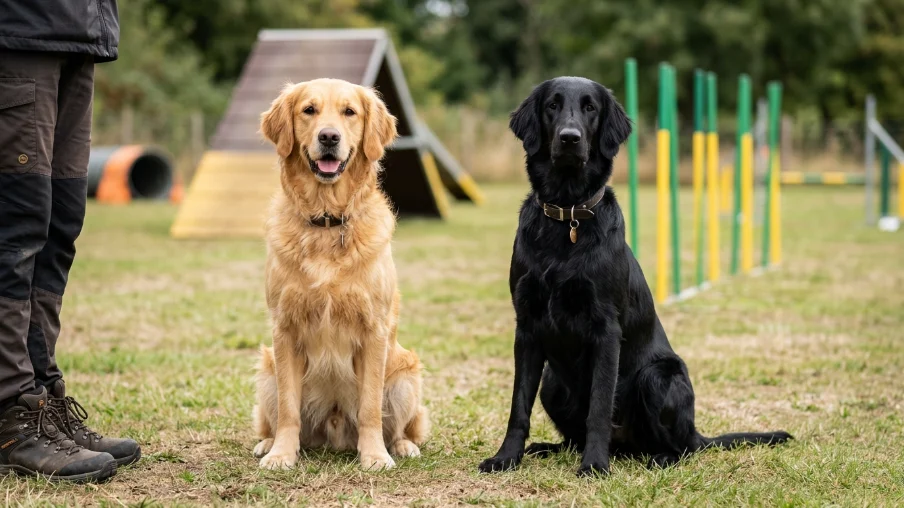
Both Golden Retrievers and Flat-Coated Retrievers rank among the most trainable breeds in existence, which is part of why the visual confusion between them persists they behave similarly enough that casual observers assume they are color variants of the same dog.
Golden Retriever trainability:
- Ranks 4th in Dr. Stanley Coren’s dog intelligence research
- Learns new commands in under 5 repetitions; obeys first command 95%+ of the time in controlled conditions
- Naturally gentle retrieve one of the softest mouths of any sporting breed
- Excels in obedience, agility, therapy work, guide dog work, search and rescue, and competitive hunt tests
Flat-Coated Retriever trainability:
- Highly intelligent but with more independent thinking than Goldens
- Responds best to positive reinforcement; can be stubborn with repetitive drills
- Strong working instinct; excellent hunting dog
- Can be distracted by environmental stimuli especially birds during training
For buyers seeking a black-coated retriever with high trainability: the Flat-Coated Retriever is the honest, reputable answer. They are an excellent breed they simply need to be honestly identified rather than mismarketed.
Exercise Requirements
Golden Retriever Exercise Needs
| Activity | Duration/Frequency |
| Structured walk or light jog | 30–45 minutes, twice daily |
| Off-leash play or swimming | 20–30 minutes |
| Retrieving games | 15–20 minutes (leverages breed instinct efficiently) |
| Mental enrichment | 10–15 minutes of training or puzzle work |
| Total daily minimum | 60–90 minutes |
Golden Retrievers are sporting dogs they were bred to work all day retrieving game in the field. Adult dogs without adequate exercise develop restlessness, weight gain, and problem behaviors. They are not high-strung about it the way a herding breed might be, but the need is real.
Puppy exercise caution (applies to both Golden Retrievers and Flat-Coated Retrievers): Growth plates remain open until 12–18 months. Avoid extended runs, repetitive jumping, or high-impact fetch sessions before this point. Short, varied, low-impact play is more appropriate for puppies under a year.
Flat-Coated Retriever Exercise Needs
Flat-Coated Retrievers require slightly more vigorous exercise than Goldens plan for 90–120 minutes of active engagement daily for an adult Flat-Coat. Their “eternal puppy” energy profile means this need remains relatively constant well into middle age, unlike some breeds that naturally slow after age 5–6.
Health Problems and Genetic Risks
This section carries particular importance for anyone considering a “black Golden Retriever” because the two most likely candidates (Golden Retriever and Flat-Coated Retriever) have meaningfully different health profiles.
Golden Retriever Health Concerns
Cancer: The leading cause of death in Golden Retrievers. Studies suggest approximately 60% of Golden Retrievers will develop some form of cancer during their lifetime one of the highest rates of any dog breed. Hemangiosarcoma, lymphoma, osteosarcoma, and mast cell tumors are the most common types. The Morris Animal Foundation’s Golden Retriever Lifetime Study has been tracking this since 2012 to identify causes and risk factors.
Hip Dysplasia: A developmental malformation of the hip joint leading to arthritis and pain. OFA data consistently places Golden Retrievers among the more frequently affected breeds. Both parents should hold OFA or PennHIP hip certifications.
Elbow Dysplasia: Similarly common in the breed; often appears alongside hip dysplasia. OFA elbow evaluation of both parents is standard in responsible breeding programs.
Subvalvular Aortic Stenosis (SAS): A heart condition more common in Goldens than most breeds; causes a narrowing of the aortic valve outlet. Can be inherited; cardiac evaluation by a board-certified cardiologist (OFA Cardiac exam) is recommended for breeding dogs.
Progressive Retinal Atrophy (PRA): A degenerative eye disease causing progressive vision loss and eventual blindness. DNA testing can identify carriers; responsible breeders test for PRA-prcd.
Golden Retriever Health Testing Minimum:
| Test | Purpose |
| OFA Hip Evaluation | Hip dysplasia screening |
| OFA Elbow Evaluation | Elbow dysplasia screening |
| OFA Cardiac (cardiologist) | SAS and other heart conditions |
| OFA Eye Exam (CAER) | PRA and other eye diseases |
| PRA-prcd DNA Test | Progressive retinal atrophy carrier status |
| Ichthyosis DNA Test | Skin condition carrier status |
Flat-Coated Retriever Health Concerns
Cancer an even more serious concern: The Flat-Coated Retriever has one of the highest cancer rates of any dog breed higher even than the Golden Retriever. Histiocytic sarcoma, a particularly aggressive cancer rare in most breeds, is disproportionately common in Flat-Coats. This is a primary reason the breed’s average lifespan (8–10 years) is shorter than the Golden’s. Prospective owners should understand this reality before purchasing.
Hip Dysplasia: OFA testing of both parents is standard and should be required by buyers.
Glaucoma: More prevalent in Flat-Coated Retrievers than many breeds; CAER eye exams for breeding stock are important.
Health comparison:
| Condition | Golden Retriever Risk | Flat-Coated Retriever Risk |
| Cancer (general) | High (~60% lifetime) | Very High (even higher rate) |
| Histiocytic Sarcoma | Low–Moderate | High |
| Hip Dysplasia | Moderate–High | Moderate |
| Elbow Dysplasia | Moderate | Moderate |
| Heart Disease (SAS) | Moderate | Lower |
| Eye Disease (PRA) | Moderate | Moderate |
| Average Lifespan | 10–12 years | 8–10 years |
Puppy Development Timeline
| Age | Development Stage | Key Actions for Owners |
| Birth–2 Weeks | Neonatal; eyes and ears closed; fully dependent | Leave with mother; minimal intervention |
| 2–4 Weeks | Eyes and ears open; begin social responses | Short, gentle daily handling |
| 4–8 Weeks | Critical socialization begins; littermate learning | Expose to varied stimuli; leave with litter until 8 weeks minimum |
| 8–12 Weeks | Primary socialization window most important developmental period | Daily positive exposure: people, surfaces, sounds, environments |
| 3–5 Months | Rapid growth; baby teeth falling out; early obedience | Begin puppy classes; leash manners; name recognition; basic commands |
| 5–9 Months | Adolescent energy spikes; may test limits; strong retrieving urge | Consistent training; retrieving games to channel drive constructively |
| 9–14 Months | Sexual maturity; hormones affecting behavior; growth plates closing | Continue training; discuss spay/neuter timing with veterinarian |
| 14–24 Months | Physical maturity; mental settling beginning | Advanced obedience; introduce sport, therapy, or hunting activities if planned |
| 2–3 Years | Full mental maturity; adult temperament fully established | Dog should be reliable, well-mannered, and stable |
Feeding and Nutrition
Both Golden Retrievers and Flat-Coated Retrievers are large, active sporting breeds with similar nutritional requirements.
Feeding guidelines:
| Life Stage | Recommended Food | Frequency |
| 8–16 weeks | Large-breed puppy kibble | 3–4 small meals daily |
| 4–12 months | Large-breed puppy formula | 2–3 meals daily |
| 12+ months | Large-breed adult formula | 2 meals daily |
| Senior (8+ years) | Senior or joint-support formula | 2 meals, adjusted for activity |
Critical nutritional notes:
- Large-breed puppy food is essential standard puppy formulas are too calorie-dense and can accelerate growth-plate development in ways that increase joint disease risk
- Goldens are prone to obesity; measure meals, avoid free-feeding, and limit high-calorie treats
- Weight management is particularly important given both breeds’ orthopedic risks an overweight retriever places significantly more stress on already vulnerable hips and elbows
- Omega-3 fatty acids (fish oil supplementation or DHA-enriched kibble) support coat quality, joint health, and may have anti-inflammatory benefits relevant to the breed’s cancer risk
Monitoring body condition: You should be able to feel the ribs easily without pressing hard, see a defined waist from above, and see a slight abdominal tuck from the side. Overweight retrievers are far more common than underweight ones err toward lean.
Grooming Guide
Golden Retriever grooming requirements:
| Task | Frequency |
| Brushing | 3–4 times per week; daily during seasonal shedding |
| Full bath | Every 4–6 weeks or as needed |
| Nail trimming | Every 3–4 weeks |
| Ear cleaning | Monthly; check weekly for redness, moisture, odor |
| Teeth brushing | Daily ideal; minimum 3 times weekly |
| Feathering trim | Every 8–12 weeks to maintain neat appearance |
| De-shedding sessions | Weekly year-round; more frequently in spring and fall coat blows |
Flat-Coated Retriever grooming (for “black Golden” owners):
Similar to Golden Retriever requirements, with slightly less feathering. The black coat does not show dirt as readily as white or cream coats but the shedding volume is comparable. Ear care is especially important in both breeds as pendant ears trap moisture and can be prone to infection particularly in dogs that swim frequently.
Useful tools for both breeds:
- Slicker brush for surface coat
- Undercoat rake during shedding season
- Stainless steel comb for feathering
- High-velocity dryer for post-bath blowout (dramatically reduces shedding)
Step-by-Step Daily Care Guide
- Morning exercise 30–45 minute walk, run, or swim
- Breakfast measured, scheduled meal; never free-feed
- Training session 10 minutes of obedience, retrieval games, or new skills
- Mental enrichment scatter feeding, puzzle feeder, or structured sniff work
- Rest period adult retrievers nap well; provide a comfortable, quiet space
- Afternoon exercise second structured activity (fetch, swimming, off-leash run)
- Evening meal allow 30–60 minutes rest before/after activity (bloat prevention)
- Grooming check brief brush-through; check ears, paws, and coat after outdoor time
- Evening wind-down calm interaction; settle cue reinforcement
Common Owner Mistakes
1. Buying a “black Golden Retriever” without questioning the claim Buyers who accept this description without asking for AKC registration paperwork, breed DNA verification, or genetic explanation are frequently purchasing mixed-breed dogs at purebred prices. This is not always a bad outcome mixed breeds can be wonderful but it should be an informed choice.
2. Underestimating emotional neediness Golden Retrievers and Flat-Coated Retrievers are companion-oriented breeds that do not tolerate isolation well. Owners who work 10-hour days and leave these dogs alone without adequate enrichment consistently report behavioral problems within the first year.
3. Allowing weight gain Overweight Goldens are extremely common and consistently reduce quality of life and lifespan. The breed’s friendly, food-motivated nature makes overfeeding easy. Measured meals and regular weight monitoring are non-negotiable for this breed.
4. Skipping health testing when selecting a breeder The cancer rate in Golden Retrievers is serious enough that selecting a breeder who prioritizes health-tested, cancer-screened bloodlines is meaningful not just a checkbox. Ask about the longevity in their lines. Ask about cancer history in parents and grandparents.
5. Mismanaging adolescence Golden Retrievers between 6–18 months can be energetic, mouthy, and boundary-testing in ways that surprise owners who expected a consistently gentle dog. This phase is manageable with consistent training but does require active effort it does not simply pass on its own.
6. Neglecting ear care Pendant-eared breeds that love water are prime candidates for chronic ear infections. A retriever that swims should have ears dried and inspected after every water session. Chronic ear infections that go unaddressed cause significant pain and eventually hearing damage.
Insights Most Articles Miss
The Flat-Coated Retriever deserves honest recognition not just as a “black Golden substitute”
The Flat-Coated Retriever is an excellent breed in its own right. Experienced owners of both breeds consistently describe Flat-Coats as more energetic, more independently-minded, and slower to mentally mature than Goldens but equally joyful and deeply family-oriented. Calling them “black Goldens” does a disservice to both breeds and misleads buyers who should be making an informed choice about which dog actually fits their lifestyle.
The Golden Retriever Lifetime Study is changing what we know
The Morris Animal Foundation’s ongoing Golden Retriever Lifetime Study, following over 3,000 Golden Retrievers since 2012, is generating the largest body of data ever assembled on any dog breed’s health. Early findings have identified environmental factors, dietary links, and reproductive status correlations that may contribute to cancer risk. Buyers and owners who follow this research are better positioned to make evidence-based decisions about their dog’s care.
Dark golden vs. black a photography problem
Many viral images of “black Golden Retrievers” are simply dark-red or mahogany Golden Retrievers photographed in low light or with certain camera settings. Red-golden Goldens (sometimes called “field Goldens” due to their prevalence in hunting lines) can appear almost brown-black in certain conditions. This perpetuates the myth significantly.
Flat-Coat cancer risk should not be minimized
Prospective Flat-Coated Retriever owners occasionally minimize the breed’s cancer rate because they are captivated by the dog’s temperament and appearance. The reality is that histiocytic sarcoma and other cancers in this breed are aggressive and often diagnosed late. Buyers should go in with clear eyes about the likely health trajectory and plan accordingly including pet insurance and proactive veterinary monitoring.
Price Guide and Ownership Costs
Puppy prices (2026):
| Dog Type | Price Range | Notes |
| Purebred Golden Retriever (health-tested) | $1,500–$3,500+ | OFA-tested parents, GRCA breeder referral |
| Purebred Flat-Coated Retriever (health-tested) | $1,500–$2,500+ | FCRSA breeder referral; cancer history in lines matters |
| Golden Retriever mix (marketed as “black Golden”) | $500–$2,000 | Variable; DNA test before purchasing at premium prices |
| Rescue / adoption (either breed) | $50–$500 | Adults more available; puppies rare |
Annual ownership costs (estimated for either breed):
| Expense | Annual Cost (USD) |
| High-quality food | $900–$1,500 |
| Routine veterinary care | $400–$800 |
| Preventive medications | $200–$400 |
| Grooming | $150–$700 |
| Training | $200–$600 (especially Year 1) |
| Pet insurance | $500–$1,200 |
| Enrichment, supplies, toys | $200–$500 |
| Annual Total Estimate | $2,550–$5,700 |
Given the cancer rates in both breeds, pet insurance is strongly recommended. Chemotherapy, surgery, and palliative care for cancer in large breed dogs regularly exceeds $5,000–$15,000 or more.
How to Find a Reputable Breeder
For a Golden Retriever
Start here:
- Golden Retriever Club of America (GRCA) grca.org maintains a breeder referral program and a Code of Ethics that members must follow
- GRCA Breed Health & Genetics committee resources for understanding health testing expectations
What a responsible Golden Retriever breeder does:
- Tests both parents for hips (OFA or PennHIP), elbows (OFA), heart (OFA Cardiac by cardiologist), eyes (CAER), and PRA-prcd DNA
- Evaluates temperament and conformation in breeding stock
- Breeds selectively with attention to cancer history in the line asks about longevity in parent and grandparent generations
- Places puppies with a written health guarantee and return policy
- Is available to buyers after purchase for the life of the dog
For a Flat-Coated Retriever
Start here:
- Flat-Coated Retriever Society of America (FCRSA) fcrsa.org maintains breed health guidelines and breeder referrals
- Ask specifically about cancer history in the breeder’s lines a responsible Flat-Coat breeder tracks this closely
Red flags (both breeds):
- No OFA testing of parents
- Puppies always available without a waitlist
- Resistance to buyer visiting the facility
- Puppies leaving before 8 weeks
- “Rare” or “unique” marketing language for a standard breed characteristic
- Selling a mixed-breed dog as a purebred “black Golden Retriever”
Questions to Ask Before Buying
- Can I see OFA health test results for both parents hips, elbows, cardiac, and eyes?
- What is the cancer history in your breeding lines over the past two to three generations?
- How do you socialize puppies before they leave for new homes?
- At what age do puppies go to their new families?
- What are the terms of your health guarantee?
- What is your policy if I can no longer keep the dog?
- How many litters do you breed per year?
- Can I visit the facility and meet the dam in person?
- Are you a member of the GRCA or FCRSA, and do you follow their Code of Ethics?
- If I am asking about a “black Golden Retriever” can you explain in genetic terms why that is or is not possible in your breeding program?
That last question is deliberate. The answer tells you a great deal about what you are actually dealing with.
Buyer Warning Section
“Black Golden Retriever” as a sales term is a red flag. Any breeder describing puppies as purebred black Golden Retrievers is either genetically uninformed or deliberately misleading buyers. Neither situation is acceptable when paying $1,000–$3,000+ for a puppy. Always request AKC registration paperwork and consider DNA breed testing before finalizing a purchase.
Mixed-breed puppies at purebred prices. A Golden Retriever crossed with a Labrador or Flat-Coated Retriever may produce black-coated puppies that superficially resemble “black Goldens.” These dogs can be wonderful companions. But they should be priced and marketed as the mixed-breed dogs they are, not as rare purebreds commanding premium prices.
Social media misinformation. Viral accounts and YouTube channels built around “black Golden Retriever” content are primarily entertainment products, not educational resources. The dogs featured are typically Flat-Coated Retrievers, Golden mixes, or dark-golden Goldens in specific lighting. Do not base a purchasing decision on this content without independent research.
Health guarantees on genetically misrepresented dogs. A health guarantee from a breeder selling a “black Golden Retriever” is only meaningful if you know what you are actually buying. A guarantee that covers “Golden Retriever health conditions” on a dog that is 50% Labrador does not cover that dog’s actual health risks accurately.
Lifestyle Compatibility
| Lifestyle Factor | Golden Retriever | Flat-Coated Retriever | Notes |
| Families with children | Excellent | Excellent | Both breeds are outstanding family dogs |
| Young children (under 5) | Excellent | Good (with supervision) | Flat-Coat’s higher energy can overwhelm toddlers |
| Apartment living | Possible | Difficult | Both need significant outdoor exercise; Flat-Coat especially demanding |
| Active outdoor owners | Excellent | Excellent | Both thrive with hiking, swimming, and outdoor activity |
| Working homes (long hours alone) | Not recommended | Not recommended | Both breeds are companion-oriented; isolation causes problems |
| Multi-dog households | Generally excellent | Generally excellent | Both sociable breeds; early socialization important |
| Cats and small pets | Good | Good | Retrieving instinct manageable with early exposure |
| First-time dog owners | Excellent | Good | Golden is easier for first-timers; Flat-Coat requires more commitment |
| Experienced dog owners | Excellent | Excellent | Both highly rewarding for experienced handlers |
| Cold climates | Excellent | Excellent | Both double-coated and cold-tolerant |
| Hot climates | Moderate caution | Moderate caution | Avoid midday exercise; both susceptible to heat given dense coats |
| Swimming and water activities | Excellent | Excellent | Both bred to retrieve from water; natural swimmers |
Breed Comparison: Which Dog Is Right for You?
| Feature | Golden Retriever | Flat-Coated Retriever | Golden × Lab Mix |
| Coat Color | Golden only | Black or liver | Black, yellow, chocolate possible |
| AKC Purebred | Yes | Yes | No (mixed breed) |
| Energy Level | Moderate–High | High | Varies |
| Mental Maturity | 2–3 years | 3–5 years | Varies |
| Trainability | Outstanding | Excellent | Generally good |
| Family Suitability | Outstanding | Excellent | Generally good |
| Cancer Risk | High | Very High | Varies (lower if bred carefully) |
| Average Lifespan | 10–12 years | 8–10 years | 10–14 years (hybrid vigor possible) |
| Grooming Needs | High | Moderate–High | Varies |
| Best For | Families, therapy, service, hunting | Active families, hunting, sport | Families wanting a lower-cost active companion |
Preparation Checklist
Before your dog comes home:
- [ ] Appropriately sized crate (large breed)
- [ ] Crate pad or washable mat
- [ ] Puppy-proofed space or exercise pen
- [ ] Stainless steel food and water bowls
- [ ] Well-fitted collar, ID tag, and 4–6 foot leash (avoid retractable leashes)
- [ ] High-quality large-breed puppy food (confirm current brand with breeder)
- [ ] Retrieving toys both breeds have strong instincts that benefit from appropriate outlets
- [ ] Grooming brush, undercoat rake, and nail trimmer
- [ ] Ear cleaning solution (especially for water-retrieving dogs)
Appointments and planning:
- [ ] Veterinarian appointment scheduled within 72 hours of pickup
- [ ] Puppy obedience class researched and enrolled
- [ ] Pet insurance researched and policy obtained before first vet visit (pre-existing conditions)
- [ ] Emergency veterinary clinic identified near your home
- [ ] Family agreement on rules: furniture access, sleeping location, feeding schedule
Documentation from breeder:
- [ ] AKC registration paperwork (or FCRSA for Flat-Coats)
- [ ] Written health guarantee
- [ ] Parent OFA certification copies (hips, elbows, cardiac, eyes)
- [ ] Vaccination and deworming records
- [ ] Feeding schedule and current food brand
- [ ] DNA breed test results if purchasing a dog marketed as “black Golden Retriever”
FAQs
Q: Do black Golden Retrievers exist? No. A purebred Golden Retriever cannot produce a black coat due to fixed genetics at the Extension locus the gene that controls whether black or golden pigment is expressed in the coat. Dogs marketed as black Golden Retrievers are either Flat-Coated Retrievers, Golden Retriever mixes, or misidentified individuals.
Q: What breed is closest to a “black Golden Retriever”? The Flat-Coated Retriever is the closest match in appearance, temperament, and history. It shares common ancestry with the Golden Retriever, comes in black as a standard color, and has a similarly friendly and family-oriented temperament. It is a recognized AKC breed with its own health profile and breed standard.
Q: Are black Flat-Coated Retrievers healthy? Flat-Coated Retrievers have a higher cancer rate than most breeds, including histiocytic sarcoma, which is aggressive and relatively uncommon in other dogs. Average lifespan is 8–10 years. Reputable breeders track cancer history carefully in their lines. This health reality should be part of any prospective owner’s decision.
Q: Can you get a black Golden Retriever from mixing breeds? A Golden Retriever crossed with a black Labrador Retriever or a Flat-Coated Retriever can produce black-coated offspring but those dogs are mixed breeds, not Golden Retrievers. They may share some Golden traits but they are not purebred and should not be sold at purebred prices without transparent disclosure.
Q: How long do Golden Retrievers live? The average Golden Retriever lifespan is 10–12 years. Cancer is the leading cause of death in the breed. Selecting from health-conscious bloodlines, maintaining appropriate weight, providing regular veterinary care, and considering pet insurance all contribute to better outcomes.
Q: Are Flat-Coated Retrievers good family dogs? Yes. The Flat-Coated Retriever is an excellent family dog joyful, energetic, friendly with children, and deeply attached to its family. The primary considerations are their high energy level (requiring 90–120 minutes of daily exercise), slower mental maturity (3–5 years), and elevated cancer risk compared to other retrievers.
Q: What should I do if a breeder is selling “black Golden Retriever” puppies? Ask for AKC registration paperwork showing both parents are registered Golden Retrievers. Ask the breeder to explain the genetics of how a black coat is possible in a purebred Golden. Request a DNA breed test. If the breeder cannot provide registration paperwork or explain the genetics coherently, you are likely looking at a mixed-breed dog being misrepresented.
Q: Can a very dark golden coat appear black in photos? Yes, this is part of the confusion. Deep red-gold or mahogany Golden Retrievers photographed in low light, shade, or with certain camera settings can appear almost black in photos. These dogs are still golden the photographic representation is misleading. If you see a “black Golden” online, look for multiple photos in bright natural light before drawing conclusions.
Q: Are Golden Retriever mixes good dogs? Many Golden Retriever mixes including Golden/Lab, Golden/Poodle (Goldendoodle), and Golden/Flat-Coat crosses are excellent dogs with wonderful temperaments. The concern is not the dog itself but honest representation. A mixed-breed dog sold transparently as a mix at an appropriate price is a perfectly valid choice. The same dog sold as a purebred “black Golden Retriever” at purebred prices is a misrepresentation.
Q: Which retriever is better for a first-time dog owner? The Golden Retriever is generally considered the more approachable choice for first-time owners, owing to its slightly calmer temperament, faster mental maturity, and exceptional response to positive training methods. The Flat-Coated Retriever is equally lovable but requires a more committed exercise schedule and more patience through a longer adolescence.
Conclusion
A black Golden Retriever is one of the most searched dog topics on the internet and one of the most misunderstood.
The honest answer is straightforward: purebred Golden Retrievers do not come in black. The genetics that make a Golden Retriever a Golden Retriever also make a black coat impossible. This is not a matter of debate among canine geneticists it is settled biology.
What does exist is a beautiful, joyful, family-oriented black retriever breed in its own right: the Flat-Coated Retriever. It shares the Golden’s warmth, trainability, and love of people, comes in black as its standard color, and has a rich history as a working and companion breed. It deserves to be sought out and celebrated on its own terms not positioned as a novelty variant of a different breed.
For buyers who want a Golden Retriever and nothing else the range of golden shades from pale cream to deep mahogany offers plenty of variation within the standard. For buyers drawn to the idea of a black retriever the Flat-Coated Retriever is the honest, wonderful answer.
The right dog is out there. Make sure you know exactly what you are bringing home.