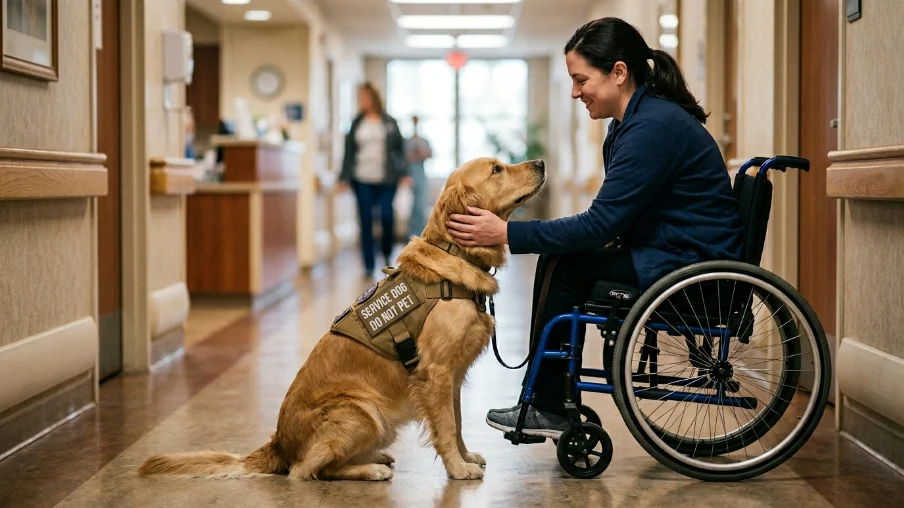
Golden Retrievers are one of the most widely used service dog breeds in the world trained to assist individuals with physical disabilities, psychiatric conditions, diabetes, seizure disorders, and more. Their combination of high trainability, calm temperament, and natural people-focus makes them uniquely suited for close handler work in public environments. Not every Golden Retriever qualifies as a service dog temperament, health, drive, and training depth determine suitability, not breed alone.
Quick Snapshot Table
| Feature | Details |
|---|---|
| Breed | Golden Retriever |
| Service Dog Category | Physical Disability, Psychiatric, Medical Alert, Mobility Assistance, Guide Work |
| ADA Legal Status | Fully Protected Under the Americans with Disabilities Act (ADA) |
| Average Training Duration | 18–24 Months |
| Program Dog Cost | $20,000–$50,000+ (Fully Trained) |
| Owner-Trained Dog Cost | $10,000–$30,000+ (Training, Equipment, Health Care) |
| Ideal Temperament | Calm, Focused, Non-Reactive, Biddable, Confident |
| Tasks Performed | 20+ Documented Task Types |
| Public Access Rights | Yes – Protected Access Under ADA |
| Lifespan (Working) | Typically 8–10 Years of Active Service |
| Retirement Age | Usually 8–10 Years Depending on Health |
| Shedding Level | Heavy |
| Energy Level | Moderate to High |
| Trainability | Excellent – Consistently Among Top Service Dog Breeds |
| Intelligence | Very High |
| Handler Focus | Excellent |
| Human Bonding Ability | Exceptional |
| Social Stability | Excellent |
| Aggression Risk | Extremely Low |
| Stranger Neutrality | Typically Good |
| Adaptability | High |
| Recovery From Stress | Generally Excellent |
| Noise Sensitivity | Usually Low |
| Confidence Level | High |
| Motivation Style | Food, Praise, and Toy Motivated |
| Learning Speed | Fast |
| Public Behavior Reliability | Excellent With Proper Training |
| Guide Dog Potential | Outstanding |
| Mobility Assistance Potential | Excellent |
| Psychiatric Service Potential | Excellent |
| Autism Assistance Potential | Excellent |
| Medical Alert Potential | Moderate to Excellent (Individual Dependent) |
| Seizure Response Potential | Excellent |
| Diabetic Alert Potential | Variable by Individual |
| PTSD Support Potential | Excellent |
| Therapy Dog Potential | Outstanding |
| Emotional Support Suitability | Excellent |
| First-Time Handler Friendly | Often Yes |
| Family Compatibility | Exceptional |
| Child Compatibility | Excellent |
| Working Drive | Moderate to High |
| Exercise Requirements | 60–90 Minutes Daily |
| Mental Stimulation Needs | High |
| Grooming Needs | Moderate to High |
| Coat Type | Dense Water-Repellent Double Coat |
| Heat Tolerance | Moderate |
| Cold Tolerance | High |
| Common Career Length | 6–10 Years |
| Washout Rate During Training | Significant (Many Dogs Do Not Graduate) |
| Service Dog Success Rate | Often Less Than 50% Even in Professional Programs |
| Health Screening Importance | Critical |
| Required Health Tests | OFA Hips, Elbows, Heart, Eyes, Genetic Screening |
| Common Career-Limiting Issues | Orthopedic Disease, Cancer, Anxiety, Allergies |
| Equipment Cost | $500–$3,000+ Over Career |
| Annual Veterinary Cost | $500–$2,500+ |
| Travel Compatibility | Excellent |
| Air Travel Suitability | Excellent With Training |
| Apartment Compatibility | Good if Exercise Needs Are Met |
| Off-Leash Reliability | High With Advanced Training |
| Public Access Training Time | Often 12–18 Months Alone |
| Ethical Breeding Importance | Extremely High |
| Breed Popularity in Service Work | Among the Most Common Service Dog Breeds Worldwide |
| Major Strength | Combination of Intelligence, Stability, and Sociability |
| Main Limitation | Cancer Risk and Relatively Short Working Lifespan Compared to Some Breeds |
| Overall Service Dog Rating | Excellent |
What Is a Golden Retriever Service Dog?
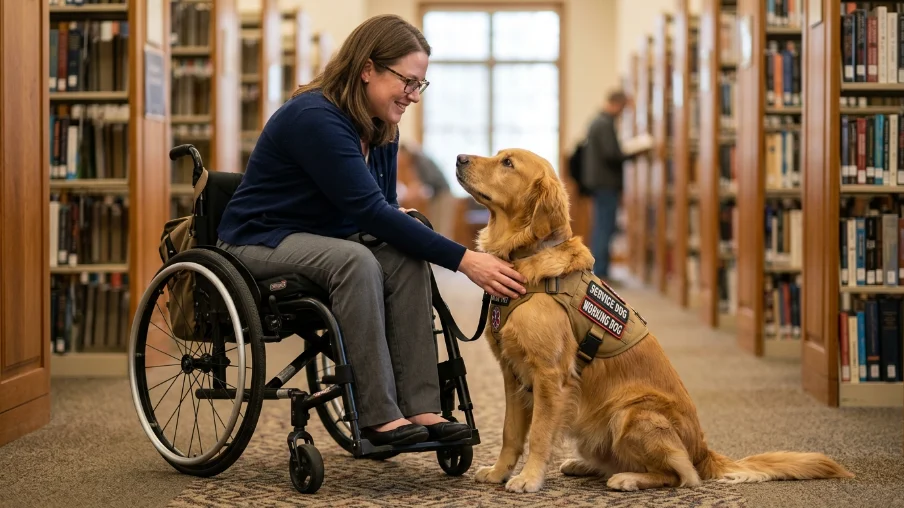
A Golden Retriever service dog is a specifically trained working dog that performs task-based assistance for a person with a physical, psychiatric, sensory, or medical disability not to be confused with therapy dogs or emotional support animals.
The legal definition matters. Under the Americans with Disabilities Act (ADA), a service dog is defined as a dog individually trained to perform tasks directly related to a person’s disability. The breed is not specified by law but Golden Retrievers are among the most commonly chosen breeds by professional programs and independent trainers alike.
Here is where most people get it wrong: they assume any friendly, well-behaved Golden Retriever can become a service dog. The reality is that fewer than 30–50% of dogs entering formal service dog programs graduate successfully and even purpose-bred dogs from established programs wash out regularly. Temperament, health soundness, and specific trainability characteristics determine suitability, not breed reputation alone.
A Golden Retriever service dog is a working dog that has cleared a high bar and maintaining that dog’s welfare, training reinforcement, and health throughout its working life is the handler’s ongoing responsibility.
Why Golden Retrievers Excel as Service Dogs
Golden Retrievers have been used in formal assistance dog programs since the earliest days of guide dog training in the 20th century. Their consistent appearance in professional programs is not tradition it reflects genuine breed-level advantages.
Core breed characteristics that support service work:
- Handler focus: Golden Retrievers have been selectively bred for generations to work in close partnership with humans first as gun dogs retrieving game, later as guide and assistance dogs. This produces a dog that actively orients toward its handler rather than away from them.
- Biddability: High willingness to follow direction, repeat trained behaviors reliably, and defer to handler judgment a critical trait in public access work
- Emotional stability: Well-bred Goldens have a calm, adaptable temperament that tolerates crowded, noisy, and unpredictable environments without chronic stress
- Low reactivity: Properly bred Golden Retrievers have significantly lower predatory and defensive reactivity than many working breeds, making public access work safer and more manageable
- Physical capability: Medium-large size (55–75 lbs) allows them to perform mobility tasks, bracing, and retrieval without the joint stress that affects very large breeds earlier in life
- Mouth sensitivity: Their original function required soft-mouthed retrieval this translates directly into precise item retrieval tasks without damage
Experienced service dog trainers focus on something else beyond the breed’s reputation: individual dog assessment. A Golden with high reactivity, noise sensitivity, or instability under stress will not succeed as a service dog regardless of pedigree breed averages do not override individual temperament.
Service Dog vs. Therapy Dog vs. Emotional Support Animal
This is the most consistently misunderstood distinction in service dog discussions. The terms are not interchangeable they carry completely different legal protections and training requirements.
| Category | Legal Definition | Training Required | Public Access Rights | Housing Rights |
| Service Dog | ADA: task-trained for specific disability | Task training required | All public spaces | Yes (Fair Housing Act) |
| Psychiatric Service Dog | Same as above; tasks for mental health disability | Task training required | All public spaces | Yes |
| Emotional Support Animal (ESA) | Provides comfort by presence alone | No task training required | Limited (no general public access) | Yes (Fair Housing Act) |
| Therapy Dog | Visits facilities to benefit others | Certification varies by org | Facility-dependent; not ADA protected | No |
The real issue is this: The proliferation of online ESA letters and fake service dog certifications has created significant confusion and genuine service dog handlers face increased scrutiny and access challenges as a result. A Golden Retriever in a vest purchased online is not legally a service dog if it has not been individually task-trained for a specific disability.
Under ADA law, staff can only ask two questions:
- Is this a service dog required because of a disability?
- What work or task has the dog been trained to perform?
They cannot ask about the disability itself, request documentation, or ask for a demonstration of the task.
Types of Service Work Golden Retrievers Perform
Golden Retrievers are among the most versatile assistance dog breeds capable of performing across multiple service categories.
Guide Dogs (Visual Impairment)
Golden Retrievers work as guide dogs navigating obstacles, stopping at curbs and stairs, finding doors and seats, and making intelligent disobedience decisions when a handler’s instruction would lead to danger. Guide dog programs such as Guide Dogs for the Blind (GDB) and Guiding Eyes for the Blind have used Goldens extensively for decades.
Mobility Assistance Dogs
For handlers with physical disabilities, mobility dogs perform:
- Bracing (supporting a handler’s weight during balance transitions)
- Momentum pulling (assisting with wheelchair or walker movement)
- Retrieving dropped items
- Opening and closing doors, drawers, and appliances
- Turning light switches on and off
- Carrying items in a pack or to a person
Physical requirements matter here: a mobility assistance dog performing brace work must be structurally sound with certified hips and elbows. A Golden with hip dysplasia cannot safely perform brace tasks this is why health testing is inseparable from service dog suitability.
Medical Alert Dogs
Trained to detect physiological changes associated with:
- Hypoglycemia (low blood sugar in diabetic handlers)
- Oncoming seizures (seizure alert and seizure response are different tasks alert is prediction, response is post-seizure assistance)
- Severe allergen detection (peanut, gluten, and other allergen alert dogs)
- Adrenal crisis in Addison’s disease
The science on seizure alert is ongoing dogs appear to detect changes in body chemistry, behavior patterns, or electromagnetic fields preceding seizures, but the mechanism is not fully understood. Diabetic alert detection is better studied, with scent training protocols based on isoprene and other volatile compounds associated with blood sugar changes.
Psychiatric Service Dogs (PSD)
Distinct from emotional support animals PSDs perform specific tasks for diagnosed psychiatric conditions:
| Condition | Example Tasks |
| PTSD | Nighttime room checks; interrupting hypervigilance behaviors; creating physical space in crowds; waking from nightmares |
| Anxiety disorders | Deep pressure therapy (DPT); grounding during dissociation; alerting to oncoming panic |
| Major depressive disorder | Medication reminders; disrupting self-harm behaviors; initiating activity (nudging) |
| Autism (adult handlers) | Interrupting repetitive behaviors; environmental anchoring; social buffering |
Hearing Alert Dogs
Alerting deaf or partially deaf handlers to specific sounds: doorbells, smoke alarms, crying infants, oncoming vehicles, name calls. Golden Retrievers are less commonly placed in hearing alert roles compared to smaller breeds, but perform reliably when trained for this work.
Temperament Requirements for Service Work
Not all Golden Retrievers are suited for service dog work. The appearance of the breed tells you nothing about suitability. Experienced program evaluators assess specific traits that most pet owners and even many breeders do not evaluate systematically.
Essential temperament traits:
- Confidence without dominance: The dog must be stable in novel environments without being distracted, reactive, or avoidant. Confidence does not mean boldness it means the dog processes new stimuli without significant stress.
- Handler focus over environmental distraction: A service dog that prioritizes squirrels, other dogs, or food on the ground over its handler is not ready for public access work regardless of how well it performs in a controlled environment.
- Noise and motion tolerance: Service dogs work in hospitals, airports, shopping centres, schools, and transit systems. Chronic stress in high-stimulation environments undermines the dog’s welfare and reliability.
- Neutral response to other animals: The dog should acknowledge other animals without fixating, redirecting toward them, or displaying predatory behavior.
- Body handling tolerance: Medical alert and mobility dogs are often touched, jostled, and handled by medical staff and emergency personnel. The dog must tolerate comprehensive body handling without stress.
- Recovery speed: The dog’s ability to self-settle after exposure to a startling stimulus is one of the most predictive indicators of working suitability.
Temperament traits that disqualify a dog from service work:
- Persistent fear responses in normal environments
- Redirected aggression or resource guarding
- High arousal that does not reliably settle on cue
- Chronic anxiety
- Excessive environmental scanning (hypervigilance)
Health Requirements for Service Dogs
A service dog that cannot work is not serving its handler. Health is not secondary to training it is a prerequisite.
Mandatory health screening for Golden Retriever service dogs:
| Health Test | Purpose | Certification Body |
| Hip Evaluation | Screen for hip dysplasia critical for mobility dogs | OFA or PennHIP |
| Elbow Evaluation | Screen for elbow dysplasia | OFA |
| Eye Examination | Screen for hereditary cataracts, PRA, and other eye conditions | OFA CAER (annual) |
| Cardiac Examination | Screen for subvalvular aortic stenosis (SAS) | OFA |
| DM (SOD1) DNA Test | Degenerative myelopathy screening | OFA/CHIC |
| Thyroid Testing | Golden Retrievers have elevated hypothyroidism rates | OFA |
| Cancer Screening | Goldens have among the highest cancer rates of any breed | Annual veterinary monitoring |
Golden Retriever cancer rates an honest discussion:
The Morris Animal Foundation’s Golden Retriever Lifetime Study, one of the largest canine health studies ever conducted, has documented that Golden Retrievers develop cancer at a significantly higher rate than most breeds estimated at approximately 60% over a lifetime. Hemangiosarcoma, lymphoma, osteosarcoma, and mast cell tumors are the most common.
This is not a reason to avoid the breed as a service dog but it is a reason to take annual veterinary monitoring seriously and to understand that a working Golden may face a cancer diagnosis during its active service years. Responsible handlers and programs plan for this possibility.
Additional health maintenance for service dogs:
- Annual wellness examinations (minimum)
- Joint supplement protocols for mobility dogs (omega-3s, glucosamine/chondroitin under veterinary guidance)
- Weight management higher weight service dogs develop joint problems faster and work shorter careers
- Dental care oral health affects systemic health and working longevity
- Mental health monitoring yes, service dogs experience stress, burnout, and overwork
Golden Retriever Service Dog Training: What It Actually Involves
Service dog training is not basic obedience with a vest added. It is a multi-year, multi-layer process that builds on a foundation of exceptional obedience and socialization before introducing task-specific work.
Phase 1: Foundation (0–12 Months)
- Extensive socialization across environments, surfaces, sounds, crowds, vehicles, and public spaces
- Core obedience: sit, down, stay, heel, recall, leave it, drop it on leash, off leash, and at distance
- Impulse control: food refusal, toy distraction, other dog distraction
- Basic public access behavior: lying quietly under a table or seat, ignoring food on the ground, settling in crowded spaces
- Body handling conditioning: ears, paws, mouth, belly with veterinary context
Phase 2: Advanced Obedience and Public Access (12–18 Months)
- Consistent public access behavior in increasingly complex environments
- Extended downs and stays (30+ minutes in active environments)
- Working through distractions: food, other animals, loud noises, medical equipment
- Elevator and escalator navigation
- Vehicle behavior (loading, settling, exiting safely)
- Public access test preparation (Assistance Dogs International standards)
Phase 3: Task Training (18–24 Months)
Task training is specific to the handler’s disability and begins after the dog has demonstrated reliable foundation work.
Tasks are trained using:
- Shaping (breaking the task into small successive steps, rewarding each)
- Luring (guiding the dog through the motion with food or toy)
- Capturing (rewarding naturally occurring behaviors that approximate the task)
Each task requires hundreds to thousands of repetitions before it is considered reliable not just in controlled training environments, but in real-world conditions with distractions present.
Ongoing Training (Throughout Working Life)
Service dog training is never complete. Daily reinforcement maintains task reliability. Monthly or quarterly formal training sessions maintain public access standards. Handler training teaching the human how to work with the dog is equally important and often underemphasized.
Public Access Standards
A fully trained service dog should meet Assistance Dogs International (ADI) public access standards at minimum. These standards assess:
What the dog must do reliably:
- Heel on a loose leash without pulling
- Sit or down on cue immediately
- Stay in position with handler out of sight
- Ignore food on the floor
- Ignore other dogs without fixating
- Remain calm when approached and touched by a stranger
- Walk calmly through a crowd
- Enter and exit a building without pulling
- Settle quietly for an extended period (30+ minutes)
- Respond to basic commands in a busy public environment
A dog that cannot pass these standards consistently is not ready for public access work regardless of how many tasks it knows. Handler safety and public trust in working dogs depends on dogs that meet this bar.
Puppy Development for Service Dog Candidates
The foundation of a reliable service dog is built in the first two years of life. Professional programs typically begin socialization protocols immediately after birth.
| Age | Key Development Focus | Program Actions |
| Birth–3 Weeks | Neonatal neurological stimulation | ENS (Early Neurological Stimulation) exercises brief daily handling |
| 3–7 Weeks | Littermate socialization; bite inhibition | Puppy raised in domestic environment; human handling increased |
| 7–12 Weeks | Critical socialization window | Maximum positive exposure to environments, sounds, surfaces, people |
| 3–6 Months | Puppy raiser placement; basic obedience begins | Puppy raisers socialize extensively; basic commands introduced |
| 6–12 Months | Advanced socialization; public access introduced | Regular outings to stores, transit, schools, medical facilities |
| 12–18 Months | Formal training evaluation; task training begins | Only dogs meeting temperament and obedience standards proceed |
| 18–24 Months | Task training; team training with handler | Dog matched to handler; team trained together |
Programs like Canine Companions, Guide Dogs for the Blind, and Southeastern Guide Dogs invest 18–24 months and approximately $50,000+ per dog before placement. That investment reflects the genuine complexity of producing a reliable working dog.
Owner-Training a Golden Retriever Service Dog
Owner-training where a disabled individual trains their own service dog rather than receiving one through a program is legal under the ADA in the United States. It is also genuinely challenging.
Realistic requirements for owner-training:
- The handler must have a qualifying disability under ADA definition
- A professional trainer with service dog experience is strongly recommended owner-training without guidance produces inconsistent results
- Budget: $10,000–$30,000+ over 2 years for trainer fees, veterinary costs, equipment, and ongoing training
- Time commitment: Multiple training sessions daily, consistent for 18–24 months minimum
- Starting point: A dog with strong foundation temperament ideally from health-tested parents with working-dog lines or program-washout dogs
Program washout dogs as owner-training candidates:
Dogs that do not graduate from formal service dog programs often due to excessive distraction in highly demanding environments rather than fundamental temperament problems can make excellent owner-trained service dogs for less complex roles. They arrive with solid foundations and significant socialization. Contact programs directly to ask about their washout adoption process.
Owner-training advantages:
- The dog is bonded to the handler from early in training
- Task training can be precisely tailored to the handler’s specific needs
- Flexibility in training timeline and methods
Owner-training disadvantages:
- No organizational accountability or support system
- Public access challenges if the dog’s training is questioned
- High rate of incomplete training without professional support
- Difficult emotional investment in a dog that may ultimately not qualify
Costs: Programs vs. Owner Training vs. Assistance
Program-trained service dogs:
| Program Type | Wait Time | Cost to Recipient |
| Established nonprofit programs (e.g., Canine Companions) | 1–4 years | Free or subsidized |
| Private service dog programs | 1–3 years | $20,000–$50,000+ |
| Psychiatric service dog programs | 6 months–2 years | $15,000–$35,000 |
Annual cost of maintaining a service dog:
| Expense | Annual Estimate (USD) |
| Veterinary care (wellness + unexpected) | $1,500–$4,000 |
| Food (high-quality large breed) | $900–$1,400 |
| Grooming | $400–$800 |
| Training maintenance / refreshers | $500–$2,000 |
| Equipment (vests, leashes, gear replacement) | $200–$500 |
| Pet insurance | $500–$1,200 |
| Total Annual Estimate | $4,000–$9,900 |
Funding resources:
- VA (Veterans Affairs) service dogs for eligible veterans with service-connected disabilities
- State vocational rehabilitation programs
- Nonprofit organizations: American Humane, Assistance Dogs International member programs
- Crowdfunding platforms for individual training costs
- Service dog-specific grants (Paws with a Cause, Freedom Service Dogs, etc.)
How to Get a Golden Retriever Service Dog
There are three primary pathways each with different timelines, costs, and requirements.
Pathway 1: Apply to a Nonprofit Program
Best for handlers who qualify for specific disability categories covered by established programs.
Steps:
- Research ADI or IGDF (International Guide Dog Federation) accredited programs
- Verify the program serves your disability type
- Complete their application (medical documentation required)
- Interview and assessment process
- Waitlist (often 1–4 years for established programs)
- Team training typically 2 weeks to 1 month at the program’s facility
- Graduated placement with ongoing support
Recommended programs to research:
- Canine Companions (physical and neurological disabilities)
- Guide Dogs for the Blind (visual impairment)
- Paws with a Cause (multiple disability types)
- Southeastern Guide Dogs
- Freedom Service Dogs of America
Pathway 2: Private Service Dog Program
Faster placement but significantly higher cost.
Steps:
- Research programs with ADI accreditation or equivalent standards
- Consult with program about your disability and task needs
- Dog selection and matching process
- Team training
- Delivery and follow-up support
Due diligence is critical here: private service dog programs vary enormously in quality, and the industry is not uniformly regulated. Ask for ADI accreditation, graduation rate data, and handler references before committing.
Pathway 3: Owner-Train with Professional Support
Best for handlers with training experience, flexible schedules, and specific task requirements not covered by programs.
Steps:
- Identify a service dog trainer with documented ADI or equivalent certification
- Source a suitable puppy (health-tested parents; breeder experienced with working dogs or program-washout dog)
- Begin socialization and foundation training from week 8
- Work through structured training curriculum with professional oversight
- Conduct public access evaluation before beginning task training
- Train tasks with handler and dog together
- Conduct final public access evaluation
Grooming a Working Golden Retriever
A working service dog is a public-facing dog its appearance reflects on its handler and on service dogs broadly. Grooming maintenance is professional responsibility, not optional.
| Task | Frequency |
| Full brushing | 3–4 times weekly; daily during coat blows |
| Bathing | Every 4–6 weeks; more frequent for medical alert dogs in clean environments |
| Nail trimming | Every 3–4 weeks (important for dogs performing brace tasks) |
| Ear cleaning | Monthly; inspect weekly |
| Paw pad inspection | Weekly; check for cuts, cracks, foreign objects |
| Teeth brushing | Daily; dental disease affects systemic health |
| Vet dental cleaning | Annually or as recommended |
Golden Retriever shedding in service contexts:
Heavy shedding is a practical consideration in some environments surgical suites, allergen-sensitive households, and certain care facilities. Regular grooming significantly reduces ambient shedding, and some handlers opt for periodic professional de-shedding treatments. No grooming approach eliminates shedding entirely in this breed.
Common Mistakes Handlers and Trainers Make
1. Advancing too quickly to task training Public access reliability must be established before task training begins. A dog that knows five tasks but cannot settle for 30 minutes in a hospital waiting room is not a functional service dog.
2. Allowing “off-duty” behaviors to become inconsistent When a service dog is “off duty,” handlers sometimes relax all structure which the dog notices. Basic training standards should remain consistent whether the vest is on or off.
3. Neglecting the dog’s stress and wellbeing Service dogs experience stress. Extended work hours, insufficient rest, inadequate play and enrichment, and over-reliance on the dog create burnout a real phenomenon documented in working dogs that manifests as task avoidance, shutdown behavior, and increased reactivity. Regular decompression time, off-leash freedom, and play are not optional; they are part of maintaining a working dog.
4. Over-certifying without task specificity A “certified service dog” from an online registry that has not been individually task-trained for a specific disability is not a legal service dog under the ADA regardless of what the certificate states. There is no national service dog registry, and online certifications carry no legal weight.
5. Underestimating public access challenges New handlers are often surprised by how frequently their service dog’s legitimacy is questioned, how exhausting daily public access work is, and how much ongoing advocacy is required. Connecting with the service dog handler community before placement prepares for this reality.
6. Skipping handler training The dog’s training quality is meaningless if the handler does not know how to cue, reinforce, correct, and read the dog accurately. Handler training is an equal component of team success.
Insights Most Articles Miss
Service dog fatigue is real and often missed Most articles describe service dog training and deployment as linear and permanent. In practice, working dogs plateau, develop stress responses, and sometimes need temporary withdrawal from work for recovery. A good working relationship includes monitoring the dog for burnout indicators and responding with rest, reduced work hours, and enrichment.
Golden Retrievers age faster in demanding roles A Golden Retriever performing mobility assistance bracing, momentum pulling places more physical demand on joints than guide work or alert tasks. These dogs often show joint deterioration earlier and may need task modification or retirement sooner. Annual orthopedic examinations, weight management, and proactive joint support extend working careers.
The “friendly” temperament creates a training challenge unique to this breed Golden Retrievers are socially motivated dogs. One of the most common issues in Golden service dog training is managing their desire to greet every person they encounter. Training reliable “working mode” behavior requires specific protocol not just general obedience. Handlers must consistently reinforce that in-vest behavior means no social engagement, which runs against this breed’s strongest natural drives.
Psychiatric service dog use is growing and misunderstood PSDs for PTSD, anxiety, and other psychiatric conditions are the fastest-growing service dog category. They are genuine service dogs under the ADA when task-trained. The tasks they perform deep pressure therapy, nightmare interruption, creating physical space are real working behaviors, not companionship described with formal language. Understanding this distinction helps handlers advocate for their rights confidently.
Retirement planning is part of ownership A retired service dog at 8–10 years has spent its adult life working. Retirement requires deliberate transition the dog’s identity, routine, and purpose change significantly. Many handlers keep their retired dogs as pets; some programs have waiting lists for retired dog adoptions. Planning for retirement before it arrives reduces the crisis of a sudden health-forced retirement.
Legal Rights of Service Dog Handlers
Understanding ADA rights is essential for every service dog handler.
Where service dogs must be allowed:
- Restaurants, hotels, stores, and all places of public accommodation
- Government buildings and programs
- Public transportation
- Schools and universities
- Hospitals (with limited exceptions for sterile environments handled case by case)
- Workplaces (handled under ADA reasonable accommodation, separate from public access provisions)
What businesses cannot do:
- Require documentation, certification, or identification
- Ask about the nature of the handler’s disability
- Charge extra fees for the service dog
- Require the dog to wear a vest or identification
- Isolate the handler from other patrons
- Refuse service based on other patrons’ allergies or fear of dogs (may require seating accommodation but not exclusion)
What businesses can do:
- Ask the two permitted questions
- Remove a service dog that is out of control (growling, jumping on others, eliminating in the facility) though they must still serve the handler without the dog
- Maintain legitimate safety requirements in sterile environments
State laws: Many states have service dog protections that extend beyond the ADA, covering housing, air travel (Air Carrier Access Act), and employment separately. Handlers should know both federal and state-level rights.
Lifestyle Compatibility for Service Dog Handlers
| Lifestyle Factor | Impact on Service Dog Work | Notes |
| Urban living | Manageable | High public access demand; elevator and transit training essential |
| Rural living | Generally easier socially | Less daily public access complexity; space for decompression |
| Active handler | Beneficial | Dog’s exercise needs met; stimulation supports working drive |
| Sedentary handler (medical need) | Requires planning | Professional dog walker or enrichment routine needed to meet exercise requirements |
| Household with other pets | Manageable with planning | Service dog must maintain focus; separate spaces recommended during off-duty time |
| Household with children | Manageable | Clear boundaries required: children must not distract or disrupt working dog |
| Frequent travel | Requires preparation | Air travel, hotel access, and unfamiliar environments require advanced public access training |
| Medical facility use | High grooming standard | Regular bathing and de-shedding; discuss with facility in advance |
Preparation Checklist: Getting Ready for a Service Dog
Before the dog arrives:
- [ ] Research and select a program or trainer with documented accreditation
- [ ] Complete medical documentation for disability qualification
- [ ] Prepare home environment: sleeping space, designated relief area, safe off-leash space
- [ ] Purchase working equipment: vest, leash, collar, ID cards (optional but helpful)
- [ ] Identify a service dog-experienced veterinarian
- [ ] Study ADA rights for handlers know the two permitted questions and standard responses
- [ ] Connect with the handler community (Assistance Dogs International, service dog forums)
Legal and documentation preparation:
- [ ] Letter from treating physician or psychiatrist documenting disability (not legally required but useful)
- [ ] Program graduation documentation (if program-trained)
- [ ] Know your state’s specific service animal laws in addition to federal ADA
Ongoing maintenance planning:
- [ ] Daily training reinforcement schedule (10–15 minutes minimum)
- [ ] Veterinary care budget and pet insurance arranged
- [ ] Emergency veterinary clinic identified
- [ ] Grooming schedule established
- [ ] Retirement plan considerations begun
FAQs
Q: What is a Golden Retriever service dog? A Golden Retriever service dog is a trained working dog that performs specific tasks for a person with a physical, psychiatric, medical, or sensory disability. Unlike therapy dogs or emotional support animals, service dogs have full legal public access rights under the ADA and are individually trained to mitigate their handler’s disability.
Q: Are Golden Retrievers good service dogs? Yes Golden Retrievers consistently rank among the most effective service dog breeds due to their high trainability, handler focus, calm public temperament, and physical capability. They are used extensively in guide dog, mobility, medical alert, and psychiatric service dog roles by programs worldwide.
Q: How long does it take to train a Golden Retriever service dog? Typically 18–24 months from puppyhood to fully trained service dog status. Foundation socialization begins at 8 weeks; formal obedience and public access training through 12–18 months; task-specific training in the final phase. Programs may take longer; owner-training timelines vary significantly.
Q: How much does a trained Golden Retriever service dog cost? Program-trained dogs from nonprofit organizations range from free (recipient-cost programs) to $20,000–$50,000+ from private programs. Owner-trained dogs cost $10,000–$30,000+ over the training period accounting for trainer fees, veterinary costs, and equipment.
Q: Can I train my own Golden Retriever as a service dog? Yes the ADA does not require service dogs to be professionally trained. However, the dog must be individually task-trained for your specific disability and meet public access behavioral standards. Professional trainer support is strongly recommended; self-training without guidance produces inconsistent results.
Q: What tasks can a Golden Retriever service dog perform? Golden Retrievers perform over 20 documented service tasks including: mobility assistance (bracing, retrieving, opening doors), guide work (visual impairment navigation), diabetic alert, seizure alert and response, psychiatric tasks (deep pressure therapy, nightmare interruption, room checks), and hearing alert.
Q: Can a Golden Retriever with hip dysplasia be a service dog? It depends on the severity and the tasks required. A dog with mild hip dysplasia may still perform guide or alert tasks, but should not perform brace work, momentum pulling, or physically demanding mobility assistance. Veterinary evaluation and honest task limitation are required.
Q: Do service dogs have to wear a vest? No. The ADA does not require service dogs to wear a vest, patch, or any identification. Vests are widely used as a practical communication tool signaling to the public that the dog is working and should not be distracted but they carry no legal weight.
Q: What is the difference between a service dog and an emotional support animal? A service dog performs specific, trained tasks directly related to a disability and has full public access rights under the ADA. An emotional support animal provides comfort by its presence alone, requires no task training, and does not have public access rights though it has limited housing protections under the Fair Housing Act.
Q: When do Golden Retriever service dogs retire? Most service dogs retire between 8–10 years of age, depending on health and task demands. Mobility dogs often retire earlier due to joint wear. Signs of retirement need include consistent task avoidance, difficulty sustaining attention, reduced recovery speed from stress, or health conditions limiting work capacity.
Conclusion
A Golden Retriever service dog is not a pet with extra training. It is a working partner whose reliability, health, and welfare determine the quality of life for a disabled handler every single day.
The breed earns its place at the top of service dog programs through decades of proven performance but the breed’s reputation does not substitute for individual evaluation, serious health testing, and the depth of training required to produce a reliable public access dog.
If you are considering a service dog whether through a program, a private trainer, or the owner-training pathway the most important things you can do are research programs with verifiable accreditation, understand the full cost and time commitment honestly, and connect with working handler communities before making decisions.
The bond between a handler and a well-trained service dog is one of the most functional, deeply trusted partnerships in working animal history.
It is earned through two years of consistent work and maintained for the duration of a life lived together.