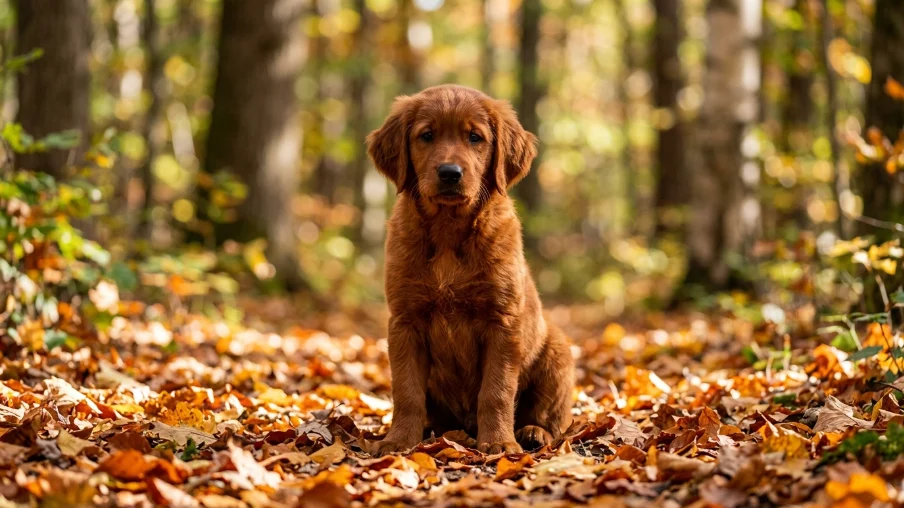
A dark golden retriever is a purebred Golden Retriever with a deep red, mahogany, or dark gold coat produced by natural genetic variation within the breed, not a separate type. Coat shade does not affect temperament, intelligence, or working ability; darker dogs are not rarer or more valuable than lighter ones despite common marketing claims. Responsible buyers should prioritize health testing, temperament, and breeder ethics over coat color when selecting a puppy.
Quick Snapshot Table
| Feature | Details |
| Breed Type | Purebred Golden Retriever (dark coat shade) |
| AKC Recognition | Yes registered as Golden Retriever |
| Coat Color Range | Dark gold, red-gold, mahogany, deep copper |
| Average Weight (Adult) | Males: 65–75 lbs / Females: 55–65 lbs |
| Height | Males: 23–24 inches / Females: 21.5–22.5 inches |
| Lifespan | 10–12 years |
| Coat Type | Dense double coat, wavy or straight, water-repellent |
| Temperament | Friendly, reliable, trustworthy, confident |
| Energy Level | Moderate to high |
| Trainability | Excellent |
| Good With Children | Yes one of the best family breeds |
| Good With Other Pets | Excellent |
| Shedding Level | Heavy, year-round |
| Exercise Needs | 60–90 minutes daily |
| Average Puppy Price | $1,000–$3,500+ (reputable breeders) |
What Is a Dark Golden Retriever?
A dark golden retriever is simply a Golden Retriever with a coat at the deeper end of the breed’s natural color spectrum ranging from rich dark gold to red-gold and mahogany tones. It is not a separate breed, not a crossbreed, and not a genetically distinct type.
The AKC breed standard for Golden Retrievers describes the acceptable coat color as “rich, lustrous golden of various shades.” Extremely pale or extremely dark coats are noted as undesirable in the show ring but this is a cosmetic distinction that means nothing for a family companion or working dog.
Here is where most people get it wrong: darker coat Golden Retrievers are frequently marketed as “rare red Goldens” or “mahogany Goldens” at premium prices. The reality is that dark coat shading is a normal, expected variation within the breed. It is not rare. It does not indicate superior genetics. A higher price tag attached to coat color alone should be a red flag, not a selling point.
What actually matters temperament stability, structural soundness, and documented health clearances has nothing to do with how dark or light a dog’s fur is.
Breed History and Origin
The Golden Retriever was developed in Scotland in the mid-to-late 19th century by Dudley Marjoribanks (Lord Tweedmouth), who selectively bred for a dog capable of retrieving waterfowl across the rugged Scottish terrain a dog with a soft mouth, swimming ability, trainability, and an even temperament.
The original breeding records, which Tweedmouth kept meticulously from 1835 to 1890, show crosses involving Yellow Flat-Coated Retrievers, the now-extinct Tweed Water Spaniel, Irish Setters, and Bloodhounds. The Irish Setter influence is relevant here it is frequently cited as a contributing factor to the darker, reddish coats still seen in some Golden Retriever lines today.
The breed was officially recognized by The Kennel Club (UK) in 1911 and by the AKC in 1925. From the beginning, Golden Retrievers ranged across multiple coat shades within the same litters, which is why dark golden coloring is a natural, established variation not a modern marketing invention.
American vs. British Golden Retrievers:
Many buyers searching for “dark golden retriever” will encounter discussions of American vs. English (British/Canadian) Golden Retrievers. American lines tend to produce darker, reddish coats more frequently. English/British lines are more commonly associated with the cream or pale gold coat. Both are the same breed but this distinction is relevant when evaluating a breeder’s dogs.
Appearance
Dark golden retrievers are structurally identical to any other Golden Retriever. Only the coat shade differs.
Key physical traits:
- Head: Broad, clean skull with a well-defined but not abrupt stop; friendly, intelligent expression
- Eyes: Medium-large, dark to medium brown, set well apart with dark rims
- Ears: Short, pendulous, hanging close to the cheeks, set at eye level
- Body: Well-balanced, short-coupled, deep-chested; males slightly longer than tall
- Coat: Dense, water-repellent double coat with a firm outer coat can be wavy or straight; feathering on chest, back of legs, underbelly, and tail
- Coat color in dark Goldens: Rich deep gold, copper-gold, mahogany, or reddish-gold consistent throughout with potential slight lightening at the feathering
- Tail: Thick at the base, carried level with the back or with a slight upward curve
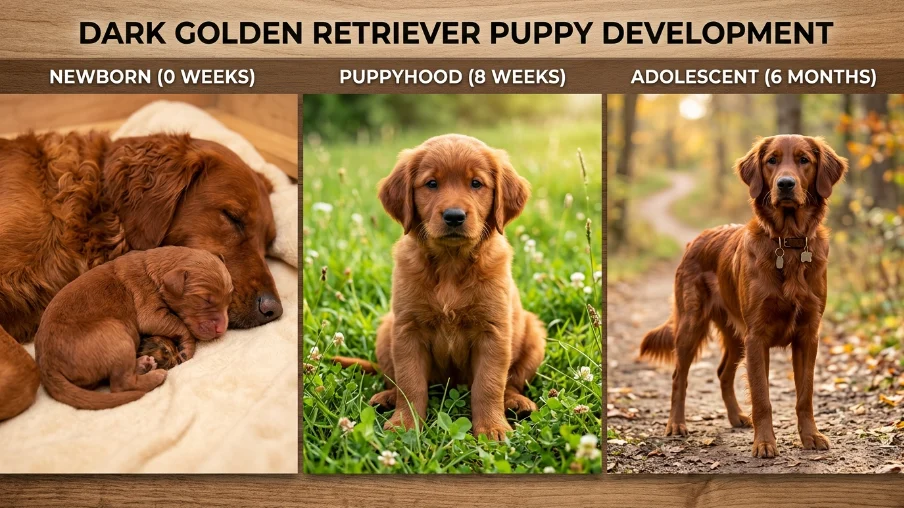
Puppy coat vs. adult coat: Dark golden retriever puppies often look different at 8 weeks than they will as adults. Puppy coats are typically softer and may appear lighter or more uniformly golden. The full adult coat with its distinctive color depth and feathering develops through the first 18–24 months. A puppy with a mid-gold coat can darken significantly; a puppy that appears very red at 8 weeks may lighten slightly by adulthood. Ask breeders to show photos of previous litters at multiple ages.
Genetics and Color Explanation

The color range in Golden Retrievers from pale cream to deep mahogany is controlled by two primary gene loci:
1. The E Locus (Extension Locus) Controls whether pigment is expressed at all. Golden Retrievers carry a specific genotype (e/e) that restricts expression to phaeomelanin (yellow/red pigment), which is why they cannot be black. This is the foundational gene that makes all Goldens “golden.”
2. The A Locus (Agouti Locus) and Intensity Genes The depth of the golden color from pale cream to deep red is controlled by multiple intensity modifier genes. Dogs with high phaeomelanin intensity expression produce darker, more saturated red-gold coats. Dogs with low intensity produce the pale cream coats more common in English/British lines.
What this means practically:
| Coat Shade | Genetics | Frequency |
| Pale cream / white | Low phaeomelanin intensity, specific line genetics | Common in English lines |
| Classic golden | Mid-range intensity | Most common in AKC show lines |
| Dark gold / deep gold | Higher intensity | Common in American field lines |
| Red-gold / mahogany | High phaeomelanin intensity | Common in field/hunting lines; some show lines |
Important: Dark coat color does not reliably predict temperament, drive level, or health. These are separate genetic factors. Breeders who claim that red or dark golden retrievers have “superior drive” or “better health” based on coat color are making claims unsupported by genetics.
Temperament and Personality
The Golden Retriever’s temperament is the most carefully preserved and consistently bred trait in the breed’s history and for good reason. It is why this breed has become one of the most popular family dogs in the world, and one of the most commonly used breeds for therapy, assistance, and search and rescue work.
Coat color does not change this. A dark golden retriever and a pale cream golden retriever are temperamentally the same breed.
Core temperament traits:
- Friendliness: Genuine, not trained Golden Retrievers are among the most reliably friendly dogs toward people and other animals of any breed
- Patience: Exceptional tolerance, especially with children; widely regarded as one of the best breeds for young families
- Eagerness to please: Drives outstanding trainability; Goldens genuinely enjoy working cooperatively with humans
- Confidence: Should be neither shy nor aggressive; a well-bred Golden meets the world with calm, happy confidence
- Adaptability: Adjusts well to varied environments when adequately exercised and socialized
- Emotional sensitivity: More attuned to human emotional states than many breeds; can develop anxiety if exposed to chronic household stress
What experienced breeders focus on:
Appearance alone tells you very little about what you are actually buying. Temperament in Golden Retrievers is strongly heritable. Breeders who evaluate their breeding stock for stability not just appearance or titles produce consistently even-tempered litters. Ask to meet the dam. Observe her behavior in normal household situations. A dam that is fearful, reactive, or overly anxious is a meaningful indicator of what you may see in the puppy at maturity.
A note on field vs. show line temperament:
Dark golden retrievers are more commonly produced in field/hunting lines, which tend toward higher energy, more intense prey drive, and a more driven working style than conformation show lines. Neither is better they suit different homes. A field-bred dark golden in a sedentary household is a recipe for frustration on both sides.
Intelligence and Trainability
Golden Retrievers consistently rank among the top five most trainable dog breeds, and this reputation is fully earned. Dr. Stanley Coren’s breed intelligence rankings placed the Golden Retriever fourth overall for working and obedience intelligence.
In practice, this means Goldens learn new commands quickly, retain them reliably, and generalize learned behaviors across contexts. They are forgiving of training mistakes, which makes them excellent first-time owner breeds but this should not be mistaken for low training requirements.
Training principles that work well with this breed:
- Positive reinforcement is highly effective Goldens are food and praise motivated and respond exceptionally well to reward-based methods
- Early socialization matters, though Goldens are typically less reactive than herding or guarding breeds when socialization is incomplete
- Consistency and clear expectations matter; Goldens that are over-indulged (a common pattern given their endearing nature) can become pushy, demanding, and difficult to manage as adults
- Mental enrichment prevents boredom-based destructive behavior this breed needs to use its brain, not just its legs
- Off-leash recall training should begin early; Goldens have moderate prey drive and will follow interesting scents given the opportunity
Activities dark golden retrievers excel in: Obedience, AKC CGC, hunt tests and field trials, agility, rally, dock diving, search and rescue, therapy work, assistance dog work.
Exercise Requirements
Golden Retrievers were bred for full days of physical work in demanding terrain. The modern family dog version does not need that level of activity but the underlying drive remains.
Daily exercise needs by age:
| Age | Exercise Type | Duration |
| 8–16 weeks | Unstructured free play; short leash walks | 10–15 minutes, 3–4 times daily |
| 4–6 months | Puppy play, short walks, swimming if available | 20–30 minutes twice daily |
| 6–12 months | Moderate walks, play, introduce structured training | 30–45 minutes twice daily |
| 1–2 years | Full walks, fetch, swimming, structured activities | 45–60 minutes twice daily |
| Adult (2–7 years) | Vigorous walks, off-leash play, sport activities | 60–90 minutes daily |
| Senior (7+ years) | Gentle walks, low-impact activity | Adjusted to individual capability |
Growth plate caution: Like all large breeds, Golden Retriever puppies should not be forced into high-impact repetitive exercise long runs, sustained fetch sessions, steep stair climbing before 12–18 months when growth plates close. This is particularly relevant for field-bred dark Goldens, which tend to be higher energy and self-motivating.
Signs of under-exercise:
- Destructive chewing (especially in puppies and adolescents)
- Counter-surfing and demand attention-seeking
- Inability to settle indoors
- Excessive mouthing and jumping up
Golden Retrievers are adaptable to apartment living with sufficient daily exercise. A home with a yard is helpful but not required provided the owner is committed to structured daily activity.
Health Problems and Genetic Risks
This is the most important section for any prospective Golden Retriever buyer because the breed carries a significantly elevated risk of several serious health conditions that buyers need to understand before purchasing.
Cancer prevalence: Golden Retrievers have one of the highest cancer rates of any dog breed. Studies suggest that approximately 60% of Golden Retrievers die from cancer roughly twice the rate of dogs generally. This is not a reason to avoid the breed, but it is a reality every owner should know.
The Morris Animal Foundation’s Golden Retriever Lifetime Study one of the largest canine health studies ever conducted is actively investigating the genetic and environmental factors behind this. Buyers should be aware of it.
Primary health concerns:
Cancer
Hemangiosarcoma, lymphoma, mast cell tumors, and osteosarcoma are the most common cancer types affecting the breed. No single gene has been identified; research is ongoing. Health testing cannot screen for cancer risk directly but choosing breeders who track longevity in their lines is meaningful.
Hip Dysplasia
A malformation of the hip joint causing pain and early-onset arthritis. Golden Retrievers are among the breeds with higher OFA hip dysplasia rates. Both OFA and PennHIP testing should be current for both breeding parents.
Elbow Dysplasia
Causes forelimb lameness and pain, particularly in adolescent dogs. OFA elbow clearances on both parents are essential.
Subvalvular Aortic Stenosis (SAS)
A congenital heart condition found in Golden Retrievers, involving obstruction of blood flow from the heart. OFA cardiac evaluation by a board-certified cardiologist (not a general vet) is the appropriate screening.
Progressive Retinal Atrophy (PRA)
A hereditary eye disease causing progressive vision loss and eventual blindness. DNA testing can identify Clear, Carrier, and Affected status. Carriers can be bred responsibly to Clear dogs without producing Affected offspring.
Ichthyosis
A skin condition causing excessive scaling. DNA testing is available and increasingly standard among responsible Golden Retriever breeders.
Pigmentary Uveitis (GRPU)
A serious eye condition specific to Golden Retrievers causing inflammation in the eye, potentially leading to secondary glaucoma and blindness. More recently recognized; OFA eye exams (CAER) should screen for early signs.
Complete Health Testing Checklist:
| Test | Recommended Standard |
| OFA Hip Evaluation | OFA Good/Excellent or PennHIP |
| OFA Elbow Evaluation | OFA Normal |
| OFA Cardiac Evaluation | By board-certified cardiologist |
| CAER Eye Exam | Annual OFA eye examination |
| PRA DNA Test | Clear or Carrier (not Affected) |
| Ichthyosis DNA Test | Clear or Carrier (not Affected) |
Responsible breeders performing all of the above are doing the minimum expected by the Golden Retriever Club of America (GRCA) health guidelines. Buyers who settle for breeders offering “vet-checked” parents without documented panel testing are accepting unnecessary risk.
Puppy Development Timeline
| Age | Development Stage | Key Owner Actions |
| Birth–2 Weeks | Neonatal period; eyes and ears sealed; sleeps and nurses | No owner intervention needed; leave with dam |
| 2–4 Weeks | Eyes open; ears open; wobbly first steps; littermate interaction begins | Brief gentle daily handling; early neurological stimulation |
| 4–8 Weeks | Prime fear imprint period; play with littermates; weaning begins | Breeder’s responsibility: environmental exposure, positive human handling |
| 8–12 Weeks | Second prime socialization window; puppy goes to new home at 8 weeks | Broad daily exposure: people, surfaces, sounds, environments always positive |
| 3–6 Months | Baby teeth shed; puppy obedience begins; rapid physical growth | Puppy class enrollment; consistent house rules; short leash walks |
| 6–12 Months | Adolescence: increased independence, boundary testing, hormonal changes | Consistent daily training; avoid high-impact exercise; maintain socialization |
| 12–18 Months | Physically approaching adult size; growth plates closing | Increase structured exercise; continue training; evaluate spay/neuter timing with vet |
| 18–24 Months | Adolescent brain maturing; adult temperament clarifying | Advanced training activities; sport introduction if planned |
| 2–3 Years | Full mental and physical maturity | Reliable, settled adult; optimal time for therapy or advanced titles |
On coat color development: Dark golden retriever puppies’ coats change significantly in the first year. Most do not display their full adult color depth until 12–18 months. Ear color at 8 weeks (often darker than the body coat) is a useful predictor of adult coat shade darker ears generally indicate darker adult coats.
Feeding and Nutrition
Golden Retrievers are notorious food lovers a trait that contributes to the breed’s trainability and, if mismanaged, to one of its most common preventable health problems: obesity.
Obesity in Golden Retrievers is a serious health concern, not a cosmetic one. Excess weight significantly accelerates hip and elbow dysplasia progression, increases cancer risk, and reduces average lifespan. Many veterinary studies suggest obesity can reduce a dog’s life by 1.5–2 years.
General feeding guidelines:
| Life Stage | Food Type | Meals Per Day |
| 8–16 weeks | High-quality large-breed puppy formula | 3–4 times daily |
| 4–12 months | Large-breed puppy or all-life-stages formula | 3 times daily |
| 12 months+ | Large-breed adult formula | 2 times daily |
| Senior (7+ years) | Senior formula or vet-recommended diet | 2 times daily, adjusted portions |
Key nutritional principles:
- Large-breed puppy food controls calcium and phosphorus ratios to support healthy bone development do not use regular puppy food for large breeds
- Measure every meal by weight or volume; do not free-feed
- Monitor body condition score monthly: ribs should be easily felt but not prominently visible; a defined waist should be visible from above
- Omega-3 fatty acids (from fish oil or DHA-enriched kibble) support coat quality, joint health, and cognitive function
- Avoid excessive treats; training treats should be small (pea-sized) and counted within daily calorie allowance
A practical note on dark coat and nutrition: Some owners notice coat color depth fluctuating with diet specifically, higher dietary fat content can intensify coat richness. This is real but modest. Do not chase coat color through diet manipulation at the expense of balanced nutrition.
Grooming Guide
Dark golden retrievers have the same dense double coat as all Golden Retrievers and the same significant grooming requirements. The darker coat does have one practical difference: it shows lighter-colored shed hair more visibly on dark furniture and clothing.
Grooming schedule:
| Task | Frequency |
| Brushing | 3–4 times per week; daily during seasonal coat blows |
| Bathing | Every 4–6 weeks or when needed |
| Nail trimming | Every 3–4 weeks |
| Ear cleaning | Monthly; check weekly for odor, redness, discharge |
| Teeth brushing | Daily ideally; minimum 3 times per week |
| Full de-shedding brush-out | Weekly year-round; twice-weekly in spring and fall |
| Feathering trim (optional) | Every 8–12 weeks to maintain neatness |
Recommended tools:
- Slicker brush for surface coat and feathering
- Undercoat rake or shedding blade for undercoat removal
- Pin brush for everyday maintenance
- Wide-tooth comb for feathering tangles
- High-velocity dryer for post-bath blowout (reduces drying time significantly)
Coat care specific to dark Goldens: The richer, denser coats common in mahogany and red-gold lines can be more prone to matting in the feathering areas behind the ears, armpits, and tail base. These areas need regular attention. Neglected mats can become painful and harbor skin irritation underneath.
Professional grooming every 8–12 weeks is manageable for most owners. Full coat stripping is not required for Golden Retrievers; regular brushing and occasional trims are sufficient.
Step-by-Step Daily Care Guide
Daily routine for a dark golden retriever puppy:
- Morning exercise 20–30 minute structured walk or off-leash play in a fenced area
- Breakfast measured portion; monitor appetite, stool quality, and energy level daily
- Training session 5–10 minutes; new commands or proofing existing ones
- Mental enrichment scatter feed lunch portion, Kong stuffed with kibble, or brief nose work session
- Rest period puppies require 16–18 hours of sleep daily; do not overstimulate
- Afternoon play fetch, swimming if accessible, or free play with another dog
- Evening meal scheduled; do not exercise vigorously within one hour of feeding (bloat prevention)
- Grooming check 5-minute brush to maintain coat and catch tangles early
- Calm wind-down settle training; practice “place” or “down-stay” for mental calm
Common Owner Mistakes
1. Buying based on coat color alone Dark golden retrievers are actively marketed by some breeders at premium prices purely on the basis of coat shade. Color is the last thing that should drive a purchasing decision. Buyers who pay $3,500 for a “rare red golden” from an untested breeder are frequently paying a premium for a dog with unknown health and temperament history.
2. Underestimating the shedding Golden Retrievers shed a lot, year-round, with two major seasonal coat blows. This surprises almost every first-time Golden owner. Plan for daily vacuuming, lint rollers everywhere, and significant grooming time. The darker coat makes lighter shed hair more conspicuous on furniture.
3. Overfeeding The breed’s food motivation that makes them so easy to train also makes them relentless beggars. Golden Retrievers will eat far beyond satiety if given the opportunity and are prone to obesity-related joint and health problems. Measured meals and disciplined treat management are non-negotiable.
4. Skipping the health test conversation Many breeders produce Golden Retriever puppies without full health panels. Given the breed’s cancer risk and orthopedic vulnerability, this is a meaningful risk the buyer absorbs entirely. “Vet-checked” is not the same as OFA-certified, PRA-tested, or CAER-cleared.
5. Failing to address adolescent behavior Golden Retrievers between 6–18 months become rambunctious, mouthy, easily distracted, and selectively deaf. Owners who assume the breed’s gentle reputation means adolescent chaos is impossible frequently end up with a 70-pound dog they cannot manage in public. Consistent training through adolescence is essential.
6. Assuming all Golden Retrievers are the same Field-bred dark golden retrievers are meaningfully different in energy level and drive from show-bred dogs. A buyer expecting a calm lap dog from a field line will be surprised. Research the specific line, not just the breed.
Insights Most Articles Miss
Field-bred dark Goldens are a different ownership experience
The most common sources of dark/mahogany Golden Retrievers are field and hunting lines, where generations of selection for high drive, retrieving intensity, and endurance have produced dogs that look like the classic Golden Retriever but behave with noticeably more intensity. These dogs are wonderful for active owners, hunters, and sport enthusiasts but they are frequently mismatched with families who bought a “dark golden” for its looks without researching its breeding background.
Coat color fading is real and normal
Many dark golden retriever puppies lighten as they mature. The intense reddish coat seen at 8–12 weeks frequently transitions to a deeper gold or copper-gold by 2–3 years. Owners who purchased specifically for the very dark puppy color sometimes feel misled but this is a natural part of coat development, not a bait-and-switch. Ask breeders to show adult photos of their previous litters.
The “rare red golden” marketing is largely fabrication
Red or dark golden retrievers are not rare, not a separate breed, and not inherently more valuable than other Golden Retrievers. The “red golden retriever” is a marketing term not a recognized AKC variety, not a breed standard distinction, and not a genetic category. Buyers who pay significant premiums for “redness” alone are paying for a coat shade that the breed standard actually lists as less preferred for conformation competition.
Ear color as a predictor
Experienced breeders and experienced owners know that the ear color of a Golden Retriever puppy at 8 weeks is the best available predictor of adult coat color. Darker ears = darker adult coat. This is not guaranteed, but it is a useful guide for buyers who genuinely care about shade.
Sun bleaching affects dark coats more visibly
Dark golden retrievers that spend significant time outdoors will experience sun bleaching, which lightens the outer coat while the undercoat retains its deeper shade. This creates a highlighted, two-tone appearance in summer months. It is cosmetic, not harmful, and the coat returns to its full depth in lower-UV seasons.
Price Guide and Ownership Costs
Puppy Price Ranges (2026):
| Source | Price Range | Notes |
| Reputable health-tested breeder (show/conformation lines) | $2,000–$3,500+ | Full health panel, socialized, health guarantee |
| Reputable health-tested breeder (field/hunting lines) | $1,000–$2,500 | Hunt-focused; high energy; verify health testing |
| Backyard breeder | $500–$1,200 | Variable or absent health testing; buyer assumes risk |
| “Rare red golden” marketing breeders | $2,500–$5,000+ | Premium price for coat color; health testing often absent or minimal |
| Rescue / adoption | $50–$500 | Adult dogs more common; breed-specific rescues occasionally have puppies |
The real issue with “rare red golden” pricing: A breeder charging $4,000–$5,000 for a “rare mahogany golden” without full OFA and DNA testing is charging a luxury price for a dog with budget-level health investment behind it. Coat color does not justify premium pricing without commensurate health testing and ethical breeding practices.
Annual ownership costs (estimated):
| Expense | Annual Cost (USD) |
| High-quality food | $900–$1,500 |
| Routine veterinary care | $400–$800 |
| Flea, tick, and heartworm prevention | $200–$400 |
| Professional grooming (optional) | $300–$700 |
| Grooming tools (if home grooming) | $100–$200 (Year 1), less thereafter |
| Training classes | $200–$800 (especially Year 1) |
| Pet insurance | $500–$1,200 |
| Supplies, toys, enrichment | $200–$500 |
| Total Annual Estimate | $2,800–$6,100 |
Cancer-related veterinary costs: Given the Golden Retriever’s elevated cancer risk, owners should be financially prepared for oncology consultations, imaging, and treatment that can easily reach $5,000–$15,000+ for serious diagnoses. Pet insurance that covers cancer treatment is strongly recommended for this breed.
How to Find a Reputable Breeder
What a reputable dark golden retriever breeder does:
- Completes the full GRCA-recommended health panel on both parents: OFA hips, elbows, cardiac (cardiologist), CAER eye exam, PRA DNA test, ichthyosis DNA test
- Makes OFA results verifiable by buyers through the public OFA database
- Socializes puppies in the home from birth with human contact, environmental exposure, and age-appropriate enrichment
- Asks buyers meaningful questions about lifestyle, experience, and home environment
- Maintains a waitlist reputable breeders rarely have puppies immediately available on demand
- Provides a written health guarantee with a return/rehome clause
- Does not charge premium prices specifically for coat darkness or “redness”
- Remains a lifelong resource for buyers after placement
Red flags:
- Charging premium prices specifically for “rare red” or “dark mahogany” coloring without corresponding health documentation
- Inability to provide OFA numbers that can be independently verified
- Puppies raised in kennels or outdoor runs without human household socialization
- Multiple breeds available year-round with constant puppy availability
- Reluctance to allow buyers to visit the facility or meet the dam
- Puppies offered at 5–6 weeks old (8 weeks is the minimum; many breeders hold until 8–10 weeks)
- No health guarantee or contract
Where to search:
- Golden Retriever Club of America (GRCA) breeder referrals and health testing resources
- AKC Marketplace (filter for health-tested breeders)
- Regional Golden Retriever clubs often maintain breeder referral lists
- North American Hunting Retriever Association (NAHRA) or AKC Hunt Test programs for field-bred dark Goldens
Questions to Ask Before Buying
- Can I see OFA results for both parents hips, elbows, heart, eyes, and PRA DNA status?
- Can I verify these results on the OFA website using the registration numbers?
- How do you socialize the puppies between birth and 8 weeks?
- What age do puppies leave for their new homes?
- What are the terms of your health guarantee?
- What is your policy if I can no longer keep the dog?
- Can I visit your facility and meet the dam in person?
- Have you had any serious health issues in previous litters?
- Are these show-line or field/hunting-line dogs? What is the temperament difference I should expect?
- Why are you charging a premium for coat color what health or temperament advantage does that represent?
Buyer Warning Section
“Rare red golden retriever” marketing Red and dark golden retrievers are not rare. “Red golden retriever” and “mahogany golden retriever” are marketing terms, not breed designations. No AKC-recognized variety by those names exists. A breeder charging $4,000–$5,000 for coat darkness is pricing a cosmetic feature, not genetic quality.
Health testing gaps in color-focused breeders Breeders who market specifically on coat color rather than health testing, titles, or lineage are disproportionately likely to have skipped the full health panel. Ask every breeder for OFA numbers. Look them up independently at ofa.org. If the results are not listed publicly, ask why.
Field-bred dogs in non-active homes Many dark golden retrievers come from field lines. Buyers who purchase a field-bred puppy expecting low-energy family companion behavior frequently end up with a frustrated, destructive, understimuated dog. Confirm the breeding line and its typical energy level before committing.
Broker and “shipping only” sellers Legitimate Golden Retriever breeders do not routinely ship puppies to buyers they have never met. If a seller is offering to ship a “rare red golden” puppy without requiring an in-person visit, treat this as a serious red flag. Puppy scams frequently use stolen photos of Golden Retriever puppies and target buyers searching for unusual coat colors.
Prices below $600 A Golden Retriever puppy from a health-tested dam and sire, with appropriate socialization and veterinary care, cannot responsibly be produced for $300–$600. Prices at this level indicate no health testing, inadequate veterinary care, early removal from the litter, or all three.
Lifestyle Compatibility
| Lifestyle Factor | Suitable? | Notes |
| Families with children | Excellent | One of the best family breeds; exceptional patience with children |
| Children under 5 | Yes, with supervision | Exuberant puppies and adolescents can knock over small children unintentionally |
| Apartment living | Possible | Adequate daily exercise is essential; yard helpful but not required |
| Active, outdoor owners | Excellent | Thrives with hiking, swimming, running, fetch |
| Working homes (dog alone 8+ hours) | Caution | Can develop separation anxiety; needs structured enrichment if regularly left alone |
| Multi-dog households | Excellent | Generally gets along well with other dogs |
| Cats and small pets | Good | Low to moderate prey drive; supervised introductions recommended |
| First-time dog owners | Excellent | One of the best breeds for first-time owners given trainability and temperament |
| Hunting or field sport homes | Excellent (field-bred dogs) | Field-bred dark Goldens excel in hunt tests and field work |
| Cold climates | Excellent | Double coat handles cold weather well; loves snow |
| Hot climates | Good with management | Avoid midday exercise in extreme heat; provide shade and water; pool or river access beneficial |
| Seniors or lower-mobility owners | Moderate | Adult, trained Goldens suit calmer homes; high-energy puppies and adolescents may not |
Breed and Coat Color Comparisons
| Feature | Dark Golden Retriever | Classic Golden Retriever | English Cream Golden Retriever |
| AKC Status | Same breed | Same breed | Same breed |
| Coat Color | Red-gold to mahogany | Mid-gold | Pale cream to white |
| Common Lineage | American field/hunting lines | American show lines | British/European lines |
| Typical Energy Level | Moderate-high to high | Moderate to moderate-high | Moderate |
| Conformation Show Eligibility | Less preferred (too dark per standard) | Preferred | Less preferred (too pale per standard) |
| Health Testing Expectation | Same | Same | Same |
| Price Premium Reality | Often marketed as “rare” | Standard market pricing | Often marketed as “rare” |
| Rarity | Not rare natural variation | Most common | Not rare common in European lines |
Preparation Checklist
Before your dark golden retriever puppy comes home:
- [ ] Large-breed crate with divider panel (to adjust size as puppy grows)
- [ ] Comfortable crate bedding
- [ ] Exercise pen for puppy confinement area
- [ ] Stainless steel food and water bowls (sized for large breed)
- [ ] Well-fitted collar with ID tag; 4–6 foot leash
- [ ] Long line (15–20 feet) for recall training
- [ ] High-quality large-breed puppy food (confirm current brand with breeder)
- [ ] Slicker brush and undercoat rake
- [ ] Nail trimmer or grinder
- [ ] Enzyme cleaner for inevitable accidents
- [ ] Assortment of chew toys and enrichment items
Appointments:
- [ ] Veterinarian appointment within 72 hours of pickup
- [ ] Puppy training class enroll before or immediately after pickup
- [ ] Emergency veterinary clinic located and saved
Documentation from breeder:
- [ ] AKC registration application
- [ ] Health guarantee (written contract)
- [ ] Parent OFA numbers (verify at ofa.org)
- [ ] PRA and ichthyosis DNA test results
- [ ] Vaccination and deworming records
- [ ] Feeding schedule and current food
FAQs
Q: What is a dark golden retriever? A dark golden retriever is a purebred Golden Retriever with a coat at the deeper end of the breed’s natural color range rich gold, copper-gold, red-gold, or mahogany. It is not a separate breed or a recognized AKC variety. Coat shade is a natural genetic variation within the breed and has no bearing on temperament, health, or working ability.
Q: Are dark golden retrievers rare? No. Dark or red-golden coat shading is a natural and relatively common variation within the Golden Retriever breed, particularly in American field/hunting lines. Breeders who market them as rare to justify premium pricing are using a misleading claim. The coat shade is not recognized as a special category by the AKC or the Golden Retriever Club of America.
Q: How much does a dark golden retriever puppy cost? From a reputable health-tested breeder, expect $1,000–$3,500+. Breeders charging $4,000–$5,000 specifically for coat darkness without commensurate health testing documentation are pricing a cosmetic feature. Price should reflect breeding investment, health testing, and ethical practices not coat color.
Q: Is a dark golden retriever a good family dog? Excellent. Golden Retrievers of all coat shades are consistently ranked among the best family dogs in the world. They are patient with children, gentle in temperament, and adaptable to varied family environments. Field-bred dark golden lines may have higher energy that requires more active management with young children.
Q: What health problems affect dark golden retrievers? The same issues affecting all Golden Retrievers: cancer (at a notably higher rate than most breeds), hip dysplasia, elbow dysplasia, subvalvular aortic stenosis, progressive retinal atrophy, pigmentary uveitis, and ichthyosis. Coat color does not influence health risk. Full OFA and DNA testing of parents is the most meaningful risk-reduction available to buyers.
Q: Do dark golden retrievers shed more than lighter Goldens? No. Shedding volume is the same across all coat shades. However, the contrast between their darker coat and light-colored shed hair makes shedding more visible on light-colored furniture and surfaces. Plan for significant year-round shedding with two major seasonal blows.
Q: Will my dark golden retriever puppy stay dark? Not necessarily. Many dark golden retriever puppies lighten to a deeper golden or copper-gold tone as adults. The ear color at 8 weeks is the most reliable predictor of adult shade. Sun exposure also causes seasonal bleaching in the outer coat. Significant color change between puppy and adult is normal and expected.
Q: Are dark golden retrievers from field lines different from show-line dogs? Yes, meaningfully. Field-bred Golden Retrievers which are more likely to produce darker coats typically have higher energy, stronger prey drive, more athletic build, and a more intense working temperament than conformation show-line Goldens. Neither is better, but they suit different households. Research the specific line before purchasing.
Q: What is the lifespan of a dark golden retriever? 10–12 years, consistent with all Golden Retrievers. The breed’s elevated cancer rate means lifespan varies significantly. Health-tested lineage, appropriate weight management, regular veterinary screening, and quality nutrition all support longevity.
Q: Can a dark golden retriever live in an apartment? Yes, with commitment to daily exercise. Golden Retrievers adapt well to varied living environments when their physical and mental needs are met consistently. A dark Golden from a field line will require more exercise than a show-line dog confirm lineage before assuming apartment suitability.
Conclusion
A dark golden retriever is a beautiful dog. The rich mahogany coat catches light in a way that genuinely turns heads. But here is the honest truth that most breed articles avoid: the coat color is the single least important thing about this dog.
What matters is the genetics behind the breeding the health testing, the temperament evaluation across generations, the responsible practices of the person who produced this litter. A stunning dark coat on a dog from untested parents, raised in a kennel without socialization, is not a bargain at any price.
Golden Retrievers of every shade carry a heavy cancer burden. They need serious daily exercise and consistent training through a demanding adolescent period. They shed constantly and require regular grooming. These are not complaints they are facts that every buyer deserves to know before they fall in love with a puppy photo.
Buyers who go in with clear eyes who ask hard questions of breeders, who verify health testing independently, who choose a puppy based on lineage and temperament fit rather than coat shade will find the dark golden retriever to be exactly what the breed has always been: one of the most devoted, intelligent, and genuinely joyful companions available. The color gets your attention. The dog earns it every day after.