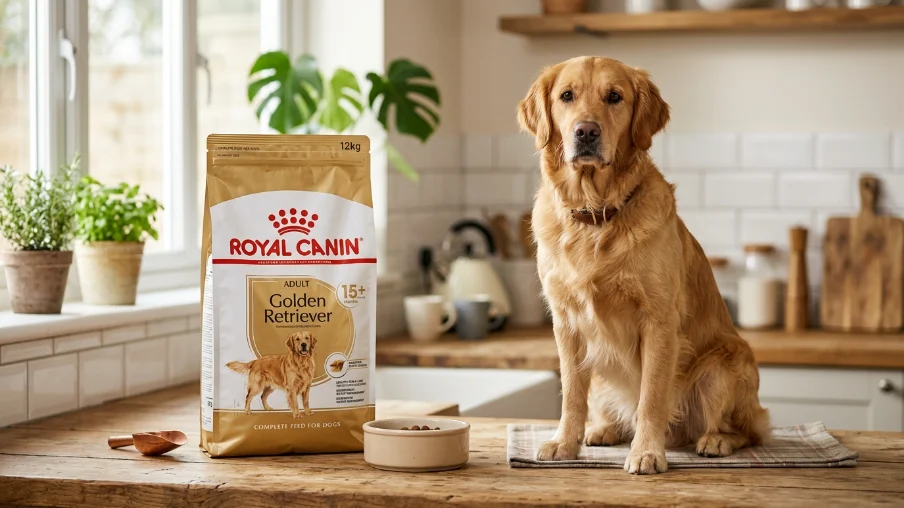
Royal Canin Golden Retriever is a breed-specific dry dog food line designed around the Golden Retriever’s known vulnerabilities skin and coat health, cardiac support, joint protection, and obesity prevention. Unlike general premium kibbles, it uses targeted nutrient profiles including omega fatty acids, glucosamine, chondroitin, and taurine to address conditions statistically common in this breed. It is a strong choice for owners who want science-backed breed-specific nutrition but understanding what is and is not in the formula helps you decide if it is right for your dog.
Quick Snapshot Table
| Feature | Details |
|---|---|
| Brand | Royal Canin |
| Product Line | Breed Health Nutrition – Golden Retriever |
| Product Type | Dry Dog Food |
| Available Formulas | Puppy, Adult, Adult Wet/Loaf |
| Life Stage Coverage | Puppy (Up to 15 Months) + Adult (15 Months+) |
| Breed Focus | Golden Retriever |
| Primary Protein Source | Chicken By-Product Meal, Chicken |
| Secondary Ingredients | Rice, Corn, Wheat Gluten, Beet Pulp, Fish Oil |
| Key Functional Nutrients | Omega-3 & 6, EPA, DHA, Glucosamine, Chondroitin, Taurine, L-Carnitine |
| Joint Support | Yes |
| Heart Health Support | Yes |
| Skin Health Support | Yes |
| Coat Health Support | Yes |
| Weight Management Support | Yes |
| Digestive Health Support | Yes |
| Immune System Support | Yes |
| Antioxidant Blend | Included |
| Omega Fatty Acid Content | High |
| Taurine Included | Yes |
| L-Carnitine Included | Yes |
| Glucosamine Included | Yes |
| Chondroitin Included | Yes |
| Kibble Shape | Tailor-Made for Golden Retriever Jaw Structure |
| Chewing Encouragement | Designed to Promote Slower Eating |
| Calorie Density | Moderate |
| Protein Level | Moderate |
| Fat Level | Moderate |
| Grain-Free | No |
| Veterinary Diet | No (Breed-Specific Maintenance Formula) |
| AAFCO Compliance | Yes |
| Feeding Method | Complete and Balanced Daily Diet |
| Puppy Formula Age Range | 2–15 Months |
| Adult Formula Age Range | 15 Months and Older |
| Senior Formula Availability | Varies by Market |
| Suitable for Active Dogs | Yes |
| Suitable for Show Dogs | Yes |
| Suitable for Family Pets | Yes |
| Suitable for Working Dogs | Moderate to Good |
| Coat Enhancement Focus | Strong |
| Joint Health Focus | Strong |
| Breed-Specific Research | Yes |
| Manufacturer | Royal Canin |
| Parent Company | Mars Incorporated |
| Manufacturing Standards | Global Quality Control Program |
| Recall History | Buyers Should Check Current Recall Databases Periodically |
| Average Bag Size Options | 17 lb, 30 lb (varies by region) |
| Average Price (Adult 30 lb) | $80–$95 |
| Cost Per Day (Adult Dog) | Approximately $2–$4 |
| Where to Buy | Veterinary Clinics, Chewy, Amazon, PetSmart, Royal Canin Website |
| Prescription Required | No |
| Customer Rating Range | Typically 4–4.5/5 Across Major Retailers |
| Overall Rating | 4.1 / 5 (Expert Assessment) |
| Main Advantages | Breed-Specific Formula, Joint Support, Skin & Coat Benefits |
| Potential Drawbacks | Premium Price, Contains Grains and By-Products |
| Best For | Golden Retrievers Needing Breed-Focused Nutrition |
| Not Ideal For | Owners Seeking Grain-Free or Limited-Ingredient Diets |
What Is Royal Canin Golden Retriever Food?
Royal Canin Golden Retriever is a breed-specific dry kibble formulated exclusively for Golden Retrievers. It is part of Royal Canin’s Breed Health Nutrition line a range of products designed around the documented physiological and genetic tendencies of individual breeds rather than using a single formula for all large dogs.
The premise is straightforward: Golden Retrievers are not just large dogs. They are a breed with well-established tendencies toward skin conditions, joint problems, cardiac issues, and weight gain. General large-breed formulas address some of these concerns, but not always at the levels or ratios a Golden Retriever specifically requires.
Here is where most people get it wrong: they assume “breed-specific” is purely a marketing term. For some products, that is true. With Royal Canin’s Golden Retriever line, the nutrient targeting is specific and verifiable the omega fatty acid profiles, the EPA and DHA levels, the inclusion of taurine and L-carnitine for cardiac support are all present at meaningful concentrations, not trace amounts.
What Royal Canin breed-specific food does not do is use premium whole-meat ingredients as the first listed items. If your primary purchase criterion is ingredient quality over nutrient function, this is an honest limitation of the product worth understanding before you buy.
The Royal Canin Philosophy Why Breed-Specific Nutrition?
Royal Canin was founded in France in 1968 by veterinarian Henri Laborit, who believed that dog nutrition should be built around biological function rather than ingredient aesthetics. The brand has since become one of the most extensively studied pet food companies in the world, with significant investment in breed-specific research.
The Golden Retriever formula was developed based on:
- Breed-specific morphology (jaw shape, body structure, weight range)
- Documented health data from Golden Retriever populations globally
- Consultation with veterinary cardiologists, dermatologists, and orthopedic specialists
- Nutritional science research into breed-specific metabolism
This is not the same as a boutique brand choosing ingredients based on consumer perception. It is a different approach function-first rather than ingredient-first.
Whether that approach is preferable depends on your priorities as an owner. This guide will help you decide.
Product Line Overview
Royal Canin offers two primary Golden Retriever-specific formulas, with additional format options.
1. Royal Canin Golden Retriever Puppy
Designed for: Golden Retriever puppies up to 15 months of age
Key features:
- Supports the puppy’s developing immune system with a patented antioxidant complex
- Promotes healthy digestion with highly digestible proteins
- EPA + DHA from fish oil for brain and vision development
- Supports healthy skin and the beginning of coat development
- Kibble size and texture adapted for puppy jaws
Available sizes: 6 lb, 13 lb, 30 lb
2. Royal Canin Golden Retriever Adult
Designed for: Golden Retrievers from 15 months of age onward
Key features:
- Omega-3 and omega-6 fatty acids with EPA + DHA for coat and skin
- Glucosamine and chondroitin for joint cartilage support
- Taurine and L-carnitine for cardiac muscle support
- L-carnitine to support healthy weight and lean muscle mass
- Tailored kibble shape designed for the Golden Retriever’s scissor bite
Available sizes: 6 lb, 13 lb, 30 lb
3. Royal Canin Golden Retriever Adult Loaf in Sauce (Wet)
Designed for: Adult Golden Retrievers; supplemental or sole feeding
Key features:
- Same targeted nutrient profile as the adult dry formula
- Higher moisture content beneficial for hydration and urinary health
- Useful for dogs transitioning off dry food or with reduced appetite
- Can be mixed with dry kibble for palatability boost
Ingredients Analysis What Is Actually In It?
This is the section most Golden Retriever owners want answered directly.
Royal Canin Golden Retriever Adult Ingredient List (Top Ingredients):
- Chicken by-product meal
- Brown rice
- Chicken fat
- Oat groats
- Corn
- Wheat gluten
- Natural flavors
- Fish oil
- Dried plain beet pulp
- Sodium silico aluminate
Honest breakdown:
| Ingredient | What It Is | Why It Is There |
| Chicken by-product meal | Rendered chicken parts excluding feathers, hair, horns high protein concentration | Primary protein source; high digestibility in rendered form |
| Brown rice | Whole grain carbohydrate | Digestible energy source; gentler on digestion than refined grains |
| Chicken fat | Rendered fat from chicken | Concentrated energy; carrier for fat-soluble vitamins; palatability |
| Oat groats | Whole oat kernels | Digestible carbohydrate; some fiber benefit |
| Corn | Grain carbohydrate | Energy source; controversial among owners but digestible for dogs |
| Wheat gluten | Concentrated wheat protein | Boosts protein percentage; not ideal for gluten-sensitive dogs |
| Fish oil | Omega-3 fatty acid source | Key for EPA + DHA delivery; coat and cardiac support |
| Beet pulp | Prebiotic fiber | Supports digestive health and stool quality |
What you will not find:
- Whole chicken or chicken as the first ingredient
- Grain-free formula (Royal Canin uses grains intentionally and does not offer grain-free Golden Retriever specific formulas)
- Artificial colors or preservatives in the functional formulas
The ingredient concern most worth addressing:
Chicken by-product meal as the first ingredient is the most common owner objection. By-product meal is not the low-quality ingredient its reputation suggests it is a high-protein, highly concentrated ingredient that often provides better amino acid profiles per gram than whole muscle meat alone. The “by-product” label refers to organ meats, carcass remnants, and non-skeletal components, not feathers or hooves (those are specifically excluded by AAFCO definitions).
That said, owners who prioritize named whole proteins (chicken, salmon, turkey) as primary ingredients will find this formula does not meet that preference.
Nutritional Profile The Numbers That Matter
Royal Canin Golden Retriever Adult (Guaranteed Analysis):
| Nutrient | Guaranteed Analysis | Why It Matters for Golden Retrievers |
| Crude Protein | 25% min | Adequate for adult maintenance; supports lean muscle |
| Crude Fat | 14% min | Mid-range fat; appropriate for weight management |
| Crude Fiber | 3.5% max | Supports digestive health without excessive bulk |
| Moisture | 10% max | Standard for dry kibble |
| Omega-6 Fatty Acids | 2.9% min | Skin and coat health; Golden Retrievers are prone to skin issues |
| Omega-3 Fatty Acids | 0.55% min | Anti-inflammatory; joint and cardiac support |
| EPA + DHA | 0.30% min | Most critical omega-3s for anti-inflammatory function |
| Glucosamine | 270 mg/kg | Joint cartilage support |
| Chondroitin Sulfate | 50 mg/kg | Cartilage health; works synergistically with glucosamine |
| Taurine | 0.25% min | Cardiac muscle health increasingly important in Golden Retrievers |
| L-Carnitine | 50 mg/kg | Fat metabolism; cardiac function; weight management |
Caloric content: Approximately 3,552 kcal/kg (361 kcal per 8 oz cup) moderate caloric density appropriate for a large breed prone to weight gain.
Why These Specific Nutrients Matter for Golden Retrievers
Skin and Coat Health
Golden Retrievers are genetically predisposed to skin conditions including environmental allergies, hot spots, and seborrhea. The breed’s dense double coat requires consistent lipid support from within. The omega-3 to omega-6 ratio in Royal Canin’s formula is specifically calibrated to reduce inflammatory skin response while supporting the coat’s natural barrier function.
EPA and DHA from fish oil are the active anti-inflammatory components not all omega supplements deliver meaningful EPA + DHA concentrations. At 0.30% minimum, this formula provides a clinically relevant dose.
Joint Health
Hip and elbow dysplasia affect Golden Retrievers at higher-than-average rates. Glucosamine and chondroitin sulfate provide substrate for cartilage maintenance they are not a cure for dysplasia but they support cartilage integrity in dogs with genetic predisposition and in aging dogs. Starting joint support at the adult food stage not waiting until problems develop is the preventative logic behind their inclusion here.
Cardiac Health The Most Important Section for Golden Retriever Owners
This deserves more attention than most dog food reviews give it.
Golden Retrievers have a documented elevated risk for dilated cardiomyopathy (DCM). Beginning around 2018, the FDA began investigating a potential link between grain-free diets and DCM in dogs with Golden Retrievers disproportionately represented in reported cases.
The current research suggests that grain-free diets relying heavily on legumes (peas, lentils, chickpeas) as primary ingredients may impair taurine synthesis or absorption in some dogs, including Golden Retrievers. The mechanism is not fully established, but multiple veterinary cardiologists now recommend grain-inclusive diets and taurine supplementation for the breed as a precautionary measure.
Royal Canin Golden Retriever Adult is grain-inclusive and contains supplemental taurine and L-carnitine specifically because of this breed-specific cardiac concern. For Golden Retriever owners who have been considering grain-free kibbles, this is the context that matters most.
Weight Management
Golden Retrievers are one of the most food-motivated, obesity-prone breeds in veterinary practice. Excess weight accelerates joint deterioration, increases cardiac load, and reduces lifespan. The inclusion of L-carnitine at a functional level supports fat metabolism and lean muscle preservation not dramatically, but measurably.
Feeding Guide
Royal Canin Golden Retriever Puppy Daily Feeding Chart:
| Age | Weight of Puppy | Daily Amount (cups, approx.) |
| 2–4 months | 6–15 lbs | 1¾ – 2½ cups |
| 4–6 months | 15–30 lbs | 2½ – 3½ cups |
| 6–9 months | 30–45 lbs | 3½ – 4 cups |
| 9–12 months | 45–60 lbs | 3¾ – 4¼ cups |
| 12–15 months | 55–75 lbs | 3½ – 4 cups |
Divide daily amount into 3 meals for puppies under 4 months; 2 meals from 4 months onward.
Royal Canin Golden Retriever Adult Daily Feeding Chart:
| Dog Weight | Low Activity | Moderate Activity | High Activity |
| 55 lbs | 2½ cups | 2¾ cups | 3¼ cups |
| 65 lbs | 2¾ cups | 3¼ cups | 3¾ cups |
| 75 lbs | 3¼ cups | 3¾ cups | 4¼ cups |
| 85 lbs | 3½ cups | 4 cups | 4¾ cups |
Feed in two divided meals daily. Adjust based on body condition you should feel the ribs without pressing hard but not see them. Reduce portions if weight gain is visible; increase if ribs feel too prominent.
Important: These are guidelines, not guarantees. Individual metabolism varies significantly. Weigh your dog monthly and adjust accordingly.
Transitioning to Royal Canin Golden Retriever Food
Switching dog food too quickly causes digestive upset loose stools, gas, and vomiting. A 7–10 day transition is standard.
| Day | Old Food | Royal Canin |
| Days 1–2 | 75% | 25% |
| Days 3–4 | 50% | 50% |
| Days 5–6 | 25% | 75% |
| Day 7+ | 0% | 100% |
If digestive upset occurs at any stage, hold at that ratio for 2–3 additional days before progressing.
Royal Canin vs. Competitors Honest Comparison
| Feature | Royal Canin Golden Retriever | Hill’s Science Diet Large Breed | Purina Pro Plan Large Breed | Orijen Large Breed |
| Breed-Specific Formula | Yes (Golden Retriever) | No (large breed general) | No (large breed general) | No (large breed general) |
| First Ingredient | Chicken by-product meal | Chicken | Chicken | Deboned chicken |
| Grain-Free | No | No | No | No |
| Taurine Added | Yes | No | No | No |
| L-Carnitine | Yes | Yes | Yes | No |
| Glucosamine | 270 mg/kg | 300 mg/kg | 400 mg/kg | Not specified |
| EPA + DHA | 0.30% min | Not specified | 0.46% | Not specified |
| Omega-6 | 2.9% | 1.0% | 2.2% | Not specified |
| Kibble Tailored to Breed | Yes | No | No | No |
| Average Price (30lb) | $85–$95 | $65–$75 | $65–$80 | $100–$120 |
| Vet Recommended | Very frequently | Frequently | Frequently | Occasionally |
What this comparison tells you:
Royal Canin’s standout advantages are taurine inclusion (unique among this group for cardiac support), breed-specific kibble design, and the highest documented omega-6 fatty acid level relevant for Golden Retriever skin and coat. Its main competitive weakness is the first ingredient (chicken by-product meal vs. whole chicken in competitors) and premium pricing relative to formulas with whole-meat primaries.
Purina Pro Plan Large Breed offers a higher glucosamine and EPA + DHA level at a lower price point worth considering for owners focused on joint support over coat nutrition.
Pros and Cons Honest Assessment
Pros:
- Breed-specific nutrient targeting not available in general large-breed formulas
- Taurine and L-carnitine for cardiac support particularly important given Golden Retriever DCM risk and the ongoing grain-free/taurine research
- High omega-6 level (2.9%) among the highest available for skin and coat support in large-breed formulas
- Grain-inclusive aligns with current veterinary cardiologist recommendations for the breed
- Tailored kibble shape supports natural chewing behavior and slows eating in food-motivated dogs
- Consistent formula Royal Canin does not frequently change formulas, allowing dietary stability
- Extensive research and veterinary endorsement genuinely science-backed, not marketing-backed
Cons:
- Chicken by-product meal as first ingredient not a dealbreaker nutritionally, but a preference issue for many owners
- Corn and wheat gluten in formula concerns for dogs with grain sensitivities or wheat intolerance
- Higher price than most large-breed alternatives $85–$95 for a 30lb bag vs. $65–$80 for comparable non-breed-specific formulas
- Not available everywhere primarily through vet offices, specialty pet retailers, and online; not stocked in all grocery stores
- No wet formula with matching puppy nutrients the loaf option is adult only
Who Should Buy Royal Canin Golden Retriever Food?
It is a strong choice if:
- Your Golden Retriever has a history of skin issues, hot spots, or dull coat
- You have a Golden Retriever with diagnosed or suspected joint problems
- Your vet has recommended monitoring for cardiac issues or taurine levels
- You prefer a grain-inclusive diet and want breed-specific taurine support
- Your dog is prone to weight gain and benefits from L-carnitine metabolic support
- You want a vet-endorsed formula with verifiable research backing
Consider alternatives if:
- Ingredient quality (whole named meats first) is your primary purchase criterion
- Your dog has confirmed grain or wheat sensitivity
- Budget is a primary constraint there are well-formulated alternatives at lower price points
- Your dog is thriving on a current formula and has no breed-specific health concerns
Common Owner Mistakes With This Food
1. Overfeeding based on bag guidelines Feeding charts on dog food bags are starting points, not prescriptions. Golden Retrievers are notoriously enthusiastic about food. Use body condition scoring monthly the ribs-should-be-felt-not-seen test rather than defaulting to maximum recommended amounts.
2. Mixing with a second protein-heavy food without adjusting portions Adding toppers, wet food, or a second dry food without reducing the Royal Canin portion leads to caloric excess. If you mix in the loaf formula, reduce the dry portion accordingly.
3. Switching to grain-free alternatives after reading ingredient criticism This is the reversal mistake. Royal Canin’s grain-inclusive formula is specifically recommended over grain-free for Golden Retrievers given the DCM/taurine research. If you are switching away from Royal Canin due to by-product meal concerns, switching to a legume-heavy grain-free alternative may trade one imperfect ingredient for a legitimately higher cardiac risk.
4. Not transitioning gradually Golden Retrievers have sensitive digestive systems. A sudden switch to any new food including this one commonly produces 2–5 days of loose stools. This is misread as “the food doesn’t agree with my dog” when it is simply rapid diet change.
5. Continuing puppy formula past 15 months The puppy formula’s caloric density and calcium levels are calibrated for growth. Continuing it past 15 months in a full-grown dog can contribute to obesity and excess calcium intake. Transition to the adult formula at 15 months as recommended.
Insights Most Reviews Miss
The DCM and taurine situation is still evolving but Royal Canin’s position is clear
As of 2026, the FDA investigation into grain-free diets and dilated cardiomyopathy in dogs remains ongoing, with no definitive causal conclusion published. However, the veterinary cardiology community has broadly shifted toward recommending grain-inclusive diets and taurine supplementation for Golden Retrievers specifically. Royal Canin’s formula was already designed with this in mind. For owners navigating this issue, the grain-inclusive, taurine-supplemented formula is the lower-risk choice based on current evidence not a definitive answer, but a sensible precaution.
Kibble shape is not just marketing
Royal Canin’s breed-specific kibble shapes are based on bite mechanics research. The Golden Retriever kibble is designed to be held and chewed in a way that reduces gulping in a breed known to eat quickly. Eating speed matters more in large breeds than most owners realize rapid consumption is a known bloat risk factor, and any design element that encourages chewing over swallowing helps.
The omega-6 level is genuinely high
At 2.9% minimum guaranteed omega-6, this formula provides significantly more skin-relevant fatty acid support than most large-breed foods. For Golden Retrievers that present to dermatologists repeatedly, owners switching from a general large-breed formula often report visible coat improvement within 6–8 weeks. This is the functional nutrition delivering a result not a placebo.
Veterinary endorsement is real, not just promotional
Royal Canin is one of the most recommended brands by board-certified veterinary internists, dermatologists, and cardiologists globally. This is not because of marketing relationships it is because the nutrient profiles are documented, reproducible, and clinically validated at research institutions. That does not make it the only good option, but the endorsement reflects genuine scientific credibility.
Price Guide and Value Analysis
Royal Canin Golden Retriever Adult Price by Size (2026 Estimates):
| Size | Average Price | Cost Per Pound | Days of Feeding (75lb Dog, Moderate Activity) |
| 6 lb | $28–$32 | $4.70–$5.30 | ~8–9 days |
| 13 lb | $52–$60 | $4.00–$4.60 | ~18–20 days |
| 30 lb | $85–$95 | $2.83–$3.17 | ~40–45 days |
Monthly feeding cost estimate (75lb adult Golden Retriever, moderate activity): Approximately $57–$72/month on 30lb bags higher than general large-breed formulas by $15–$25/month.
Is the premium justified?
For dogs with active skin issues, joint problems, or cardiac risk factors yes, the breed-specific nutrient targeting provides measurable value that a general formula does not replicate. For a healthy, young Golden Retriever with no current health concerns, the premium is more debatable. A well-formulated general large-breed formula from Purina Pro Plan or Hill’s Science Diet at a lower price point is a legitimate alternative.
Where to buy for best price:
- Chewy Autoship typically 35% off first order + 5% on recurring
- Amazon Subscribe & Save 10–15% discount on subscription
- Royal Canin official website often has vet-clinic pricing direct
- PetSmart price matches online competitors with verification
Frequently Asked Questions
Q: Is Royal Canin Golden Retriever food vet recommended? Yes. Royal Canin is one of the most commonly recommended pet food brands by veterinarians and veterinary specialists globally. The Golden Retriever-specific formula is frequently recommended by veterinary dermatologists, cardiologists, and internists for breed-relevant health support.
Q: Is Royal Canin Golden Retriever grain-free? No, and intentionally so. Royal Canin uses grains in this formula brown rice, oat groats, corn partly because grain-free, legume-heavy diets have been associated with taurine deficiency and dilated cardiomyopathy in Golden Retrievers. The grain-inclusive formula aligns with current veterinary cardiologist guidance for the breed.
Q: Can I feed Royal Canin Golden Retriever food to my mixed-breed dog? Technically yes the food will not harm a non-Golden Retriever. However, it is formulated around Golden Retriever-specific nutrient needs and kibble morphology. A general large-breed formula would be more cost-effective for a mixed-breed without Golden Retriever-specific health concerns.
Q: At what age should I switch from Royal Canin Golden Retriever Puppy to Adult? At 15 months of age, per Royal Canin’s recommendation. This aligns with the typical growth plate closure timeline for Golden Retrievers. Do not continue the puppy formula past this point the caloric and calcium levels are calibrated for active growth, not adult maintenance.
Q: Why is chicken by-product meal the first ingredient? By-product meal is a concentrated rendered protein source with a higher protein percentage per gram than whole muscle meat. Royal Canin prioritizes nutrient function over ingredient aesthetics. By-product meal is not harmful and has high digestibility but it does not satisfy owner preferences for whole named meats as the first listed ingredient.
Q: Does Royal Canin Golden Retriever food help with shedding? It supports coat health through omega-3 and omega-6 fatty acids, which can improve coat quality and reduce excessive shedding caused by poor skin health. It will not eliminate seasonal shedding, which is a normal biological process. Many owners report improved coat texture and reduced dry skin flaking within 6–8 weeks of transition.
Q: Is Royal Canin Golden Retriever good for dogs with allergies? It depends on the allergy. The formula contains chicken and corn, which are among the more common food allergens in dogs. If your Golden Retriever has a diagnosed food allergy confirmed through elimination diet, not just suspected consult your vet about a hydrolyzed or novel protein diet instead. For environmental allergies affecting the skin, the omega fatty acid profile may help, but it is not a treatment.
Q: How does Royal Canin Golden Retriever compare to raw feeding? Raw feeding and Royal Canin represent fundamentally different approaches one prioritizes whole fresh ingredients and moisture content, the other prioritizes documented nutrient delivery and consistency. Both can support healthy dogs when properly implemented. For Golden Retrievers specifically, ensuring taurine adequacy in raw diets requires careful formulation. The kibble provides a consistent, tested taurine level without additional supplementation.
Q: Is this food good for overweight Golden Retrievers? The adult formula’s caloric density and L-carnitine content support weight management, but it is not a dedicated weight-loss formula. For actively overweight Golden Retrievers, Royal Canin’s Satiety or Weight Management formulas, or Hill’s Metabolic, may produce faster results under veterinary guidance. Portion control and increased exercise remain the primary tools.
Q: Where is Royal Canin Golden Retriever food manufactured? Royal Canin manufactures its U.S. dog food at facilities in Missouri and South Dakota. The brand maintains its own manufacturing facilities rather than co-packing, which contributes to formula consistency and quality control.
Preparation and Transition Checklist
Before switching your Golden Retriever to Royal Canin:
- [ ] Confirm your dog’s current weight and body condition score
- [ ] Select correct formula: Puppy (under 15 months) or Adult (15 months+)
- [ ] Choose appropriate bag size 30lb offers best per-pound value
- [ ] Set up Chewy Autoship or Amazon Subscribe & Save for consistent pricing
- [ ] Begin 7–10 day transition: 25/50/75/100% schedule
- [ ] Note current coat condition, stool quality, and energy level for comparison at 8 weeks
- [ ] Measure portions with an actual measuring cup do not estimate by eye
- [ ] Adjust portion based on body condition monthly, not based on bag guidelines alone
- [ ] If mixing with wet loaf, reduce dry portion to maintain caloric balance
- [ ] Schedule veterinary weight check at 60 days post-transition
Conclusion
Royal Canin Golden Retriever food is one of the most genuinely targeted breed-specific formulas on the market not because of its ingredient panel, which is not the most impressive in its price range, but because of its nutrient targeting, which is.
For Golden Retriever owners navigating a breed that is statistically vulnerable to skin disease, joint problems, cardiac issues, and obesity, a formula that addresses all four of those concerns with documented, functional nutrient levels is worth serious consideration.
The real issue is not whether by-product meal is in the bag. The real issue is whether your dog is getting EPA + DHA at a clinically relevant concentration, taurine for cardiac protection, omega-6 for a coat that does not itch, and glucosamine for joints that hold up into middle age. Royal Canin Golden Retriever Adult delivers all four.
If ingredient quality is your primary criterion, there are better-sourced formulas available. If breed-specific, science-backed nutrition is your primary criterion, Royal Canin Golden Retriever is difficult to beat at its price point.
The right answer depends on your dog, your priorities, and ideally the guidance of a veterinarian who knows your Golden Retriever’s individual health history.