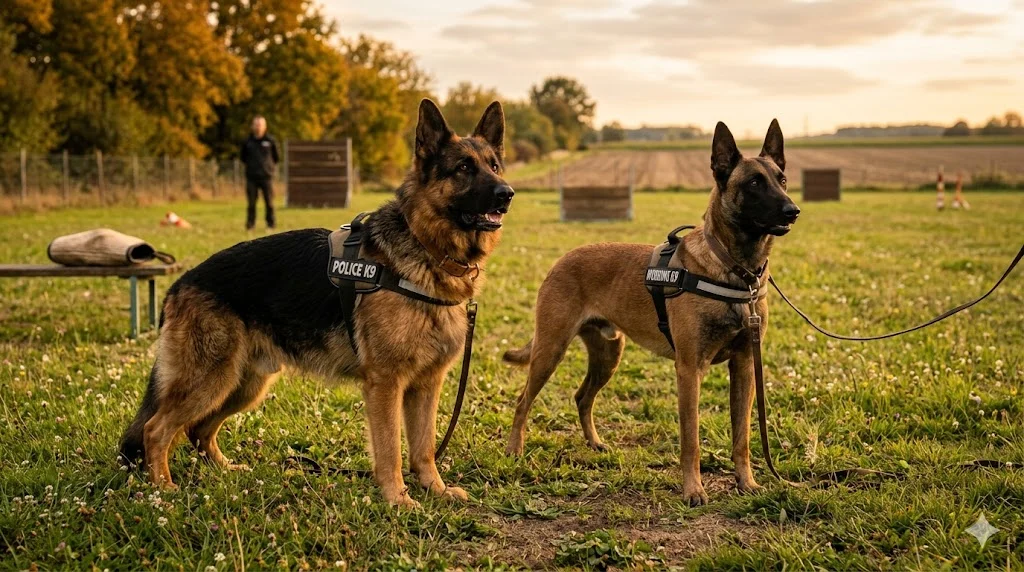
German Shepherd vs Belgian Malinois compares two elite working breeds with different drive intensity and handling demands. German Shepherds are more balanced and forgiving; Malinois are higher drive and more demanding under pressure. Experienced handlers emphasize that success depends more on structure and training consistency than breed choice alone.
Quick Snapshot Table
| Trait | German Shepherd | Belgian Malinois |
|---|---|---|
| Energy Level | High | Very High |
| Intelligence | Very High | Extremely High |
| Trainability | High | Extremely High |
| Drive Type | Balanced working + protection drive | Intense prey/work drive |
| Family Suitability | Good with structure | Only experienced homes |
| First-Time Owners | Sometimes suitable | Not recommended |
| Exercise Needs | 1.5–2 hrs/day | 2–3+ hrs/day |
| Training Difficulty | Moderate | Advanced |
| Socialization Requirement | High | Very High |
| Protective Instinct | High | Very High |
| Aggression Risk (if untrained) | Moderate | Higher potential if unmanaged |
| Off-Leash Reliability | Moderate to High | High but advanced training required |
| Mental Stimulation Needs | Very High | Extremely High |
| Working Roles | K9, service, family protection | Military, police K9, sport, elite protection |
| Barking Level | Moderate | Moderate to High |
| Prey Drive | Moderate to High | Very High |
| Adaptability | High | Moderate |
| Independence Level | Moderate | High |
| Sensitivity to Handler | Moderate | Very High |
| Grooming Needs | Moderate | Low to Moderate |
| Shedding | Heavy | Moderate |
| Heat Tolerance | Moderate | High |
| Cold Tolerance | High | Moderate |
| Health Concerns | Hip/elbow dysplasia, DM, bloat | Hip dysplasia, eye issues, stress-related conditions |
| Lifespan | 9–13 years | 10–14 years |
| Puppy Price Range | $800–$3,500+ | $1,200–$4,500+ |
| Overall Suitability | Versatile family + working dog | Elite working dog, sport-focused |
What Is German Shepherd vs Malinois?
The German Shepherd and Belgian Malinois are both purpose-bred working dogs developed for intelligence, obedience, and task performance. The German Shepherd is a more structurally robust, versatile breed used in family protection and service roles. The Malinois is a lighter, faster, higher-drive working dog primarily used in military, police, and sport environments. Both require structured training and are not casual pets.
Breed History and Origin
German Shepherds were developed in Germany in the late 19th century by Captain Max von Stephanitz, originally bred for herding intelligence, structure, and control. Over time, the breed was refined into one of the world’s leading police, military, and service dogs due to its balance of intelligence, stability, and versatility.
Belgian Malinois originated in Belgium as a regional herding dog selected primarily for endurance, speed, responsiveness, and intense work drive. Unlike the German Shepherd, the Malinois was shaped more strongly by performance-based selection, favoring agility and high-energy working capability.
Modern breeding has shifted both breeds away from pure historical function toward specialized working lines, where behavior, nerve stability, and drive intensity are more influenced by selective breeding than origin alone. As a result, experienced handlers prioritize current working lines and temperament testing over historical background, since modern genetics and training selection have a much stronger impact on real-world behavior than origin history.
Appearance Differences
| Feature | German Shepherd | Belgian Malinois |
|---|---|---|
| Body Structure | Larger, heavier-boned, more substantial frame | Lean, athletic, lightweight frame |
| Overall Build | Strong, robust, and muscular | Slim, agile, and highly athletic |
| Size Category | Large breed | Medium-large breed |
| Weight Range | 50–90+ lbs | 40–80 lbs |
| Height | 22–26 inches | 22–26 inches (slightly finer frame) |
| Bone Density | Heavy | Light to moderate |
| Chest Depth | Deep and broad | Deep but narrower |
| Head Shape | Broader skull, stronger muzzle | Narrower, more refined muzzle |
| Ears | Upright, thicker set | Upright, thinner and more alert set |
| Coat Type | Dense double coat | Short, dense double coat |
| Coat Thickness | Heavier undercoat | Lighter undercoat |
| Seasonal Shedding | Very heavy | Moderate |
| Movement Style | Powerful, grounded gait | Fast, explosive, high-drive movement |
| Agility | Strong but less explosive | Extremely high agility |
| Speed | Moderate | Very high |
| Endurance | High | Very high (often superior stamina) |
| Overall Impression | Solid, protective working dog appearance | Sleek, high-performance working dog appearance |
| Visual Presence | Intimidating, classic guardian look | Sharp, alert, high-drive working athlete look |
| Function vs Form Note | Built for versatility and endurance work | Built for speed, precision, and rapid response |
German Shepherds are larger, heavier-boned, and have a dense double coat. Belgian Malinois are medium-sized, lean, and built for speed and agility with a short coat.
Appearance does not predict suitability structure reflects function, not temperament quality.
Genetics and Structural Differences
German Shepherd genetics vary widely between show and working lines. Show lines may emphasize structure at the cost of working drive, while working lines prioritize stability and performance.
Belgian Malinois tend to have more consistent working structure but can show higher stress sensitivity in unsuitable environments.
Key breeder insight: structure and temperament must be evaluated together never separately.
Temperament and Behavior (Critical Difference)
German Shepherds are naturally more stable and handler-oriented. They tend to resolve pressure situations with controlled guarding behavior.
Belgian Malinois are more reactive, faster in response, and less forgiving of unclear handling. This is not aggression it is high sensitivity to stimulation and task demand.
Where most owners struggle:
- German Shepherd → becomes over-protective if under-structured
- Malinois → becomes over-stimulated if under-worked
The real issue is not temperament quality, but environment mismatch.
Intelligence and Trainability
Both breeds are highly intelligent. German Shepherds are easier to shape for first-time handlers because they tolerate mistakes. Malinois learn faster but also develop habits faster good or bad.
Experienced trainers often say:
Malinois require precision; German Shepherds allow adjustment.
Exercise and Mental Work Requirements
German Shepherds require structured daily activity, not just free running. Malinois require significantly higher physical and mental workload.
- German Shepherd: 1.5–2 hours structured activity
- Malinois: 2–3+ hours intensive engagement
Without mental stimulation, both breeds develop behavioral issues, but Malinois typically escalate faster.
Health Problems and Genetic Risks
German Shepherds:
- Hip dysplasia
- Elbow dysplasia
- Degenerative myelopathy
- Bloat (GDV risk)
Belgian Malinois:
- Generally fewer structural issues
- Stress-related behavioral strain in poor environments
- Sport-related joint injuries in high-performance dogs
Important breeder perspective:
German Shepherd issues are often structural; Malinois issues are often environmental.
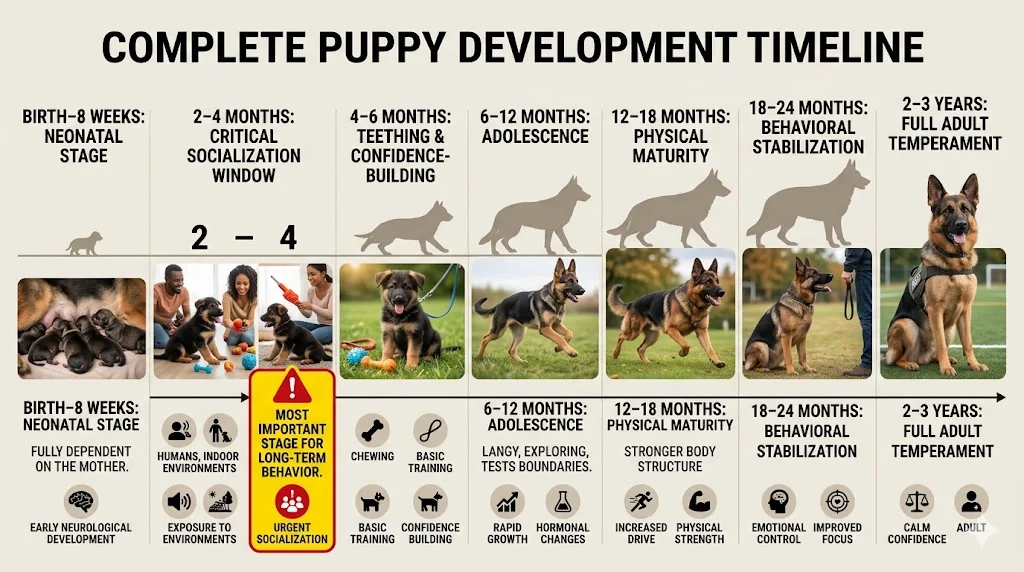
Puppy Development Timeline
| Trait | Puppy Development Insight |
|---|---|
| Breed Context | Applies to most working breeds (e.g., German Shepherd, Malinois, Rottweiler) |
| Development Window | Birth–3 Years (critical behavioral shaping occurs early) |
| Birth–8 Weeks | Neonatal phase; full dependency on mother; early neurological development |
| 2–4 Months | Critical socialization window begins; rapid learning and bonding |
| 4–6 Months | Teething phase; confidence building; early rule learning |
| 6–12 Months | Adolescence begins; hormonal changes; boundary testing |
| 12–18 Months | Physical maturity increases; strength and drive develop |
| 18–24 Months | Behavioral stabilization phase; emotional regulation improves |
| 2–3 Years | Full adult temperament and working reliability established |
| Socialization Priority | Extremely High during 8–12 weeks |
| Training Impact Window | First 6 months shapes lifelong obedience patterns |
| Fear Imprint Period | 8–12 weeks and again around 6–9 months |
| Owner Responsibility Level | High during entire first year |
| Training Consistency Need | Daily, structured reinforcement required |
| Mental Stimulation Requirement | High from 3 months onward |
| Exercise Introduction | Controlled in early months; increases after growth plates close |
| Risk of Poor Socialization | Fear, reactivity, anxiety, aggression tendencies |
| Positive Outcome Factors | Early exposure, structured training, stable environment |
| Breed Influence Note | Genetics matter, but early environment is the strongest predictor of adult behavior |
Early socialization quality determines long-term stability more than breed alone.
Feeding and Nutrition
Both breeds require high-quality protein diets. Malinois typically have faster metabolism. Overfeeding during growth increases orthopedic risk in German Shepherds.
Grooming Requirements
German Shepherds shed heavily year-round and require regular brushing. Malinois are low-maintenance with minimal grooming needs.
Step-by-Step Care Approach
- Start obedience training early (8–12 weeks)
- Prioritize socialization with structure, not chaos
- Establish daily routine and rules consistency
- Balance mental work with physical exercise
- Reinforce calm behavior, not just activity
Common Owner Mistakes
- Treating working dogs like casual pets
- Over-exercising without structure
- Inconsistent household rules
- Underestimating mental stimulation needs
- Choosing Malinois based on appearance or popularity
Insights Most Articles Miss (EEAT Core)
Experienced breeders evaluate:
- stress recovery speed after stimulation
- curiosity vs avoidance balance
- impulse control under distraction
- handler engagement consistency
A key truth:
A confident puppy is not the same as a high-energy or hyperactive puppy.
Price Guide and Ownership Costs (2026)
- German Shepherd: $800–$3,500
- Belgian Malinois: $1,000–$4,000
Long-term costs:
- Training (significant for Malinois)
- Veterinary joint care (GSD higher risk)
- Equipment and structured activity tools
How to Find a Reputable Breeder
Look for:
- health-tested parents (OFA or equivalent)
- proven working or sport titles
- stable temperament across lineage
- early socialization protocols
Avoid breeders focusing only on appearance or color trends.
Buyer Warning Section
Neither breed is suitable without structure.
Avoid Malinois if:
- you are a first-time owner
- you lack daily training commitment
Avoid German Shepherd if:
- you want a low-maintenance pet
- you cannot provide leadership consistency
Most failures come from mismatch, not genetics.
Lifestyle Compatibility
| Factor | German Shepherd | Malinois |
|---|---|---|
| Families | Suitable with training | Only experienced homes |
| Children | Good supervision needed | Not ideal for beginners |
| Apartments | Limited suitability | Very challenging |
| Active Owners | Excellent match | Excellent match |
| Working Homes | Excellent | Excellent |
| First-Time Owners | Conditional | Not recommended |
Breed Comparison Summary
German Shepherds are balanced working guardians with adaptability. Belgian Malinois are high-drive specialists requiring precision handling and intense engagement. Neither breed is “better” they serve different levels of handler experience and lifestyle structure.
Preparation Checklist
- structured daily routine ready
- fenced secure environment
- professional trainer access
- mental stimulation tools prepared
- consistent household rules established
FAQs
What is the main difference between German Shepherd and Malinois?
German Shepherds are more balanced and adaptable, while Malinois are higher-drive and require advanced handling.
Is a Malinois good for beginners?
No, most beginners struggle with the intensity and drive management requirements.
Are German Shepherds easier to train?
Yes, they are generally more forgiving and easier to correct during training.
Which breed is more aggressive?
Neither is inherently aggressive; behavior depends on training and environment.
Which dog needs more exercise?
Belgian Malinois typically require more physical and mental stimulation.
Are German Shepherds good family dogs?
Yes, with proper structure and socialization.
Do Malinois have health problems?
Fewer structural issues, but they can develop stress-related behavior problems in poor environments.
Which is smarter?
Both are highly intelligent; Malinois learn faster, German Shepherds are easier to manage.
Can either live in apartments?
Only with experienced handlers and strict exercise routines.
Which is better for protection work?
Both excel, but Malinois are more commonly used in high-intensity operational roles.
Conclusion
German Shepherd vs Belgian Malinois is ultimately a question of handler capability, not breed superiority. German Shepherds offer balance and adaptability, making them suitable for structured families and working homes.
Belgian Malinois deliver unmatched intensity and performance but require experienced, consistent handlers. The right choice depends on lifestyle honesty not preference or appearance.