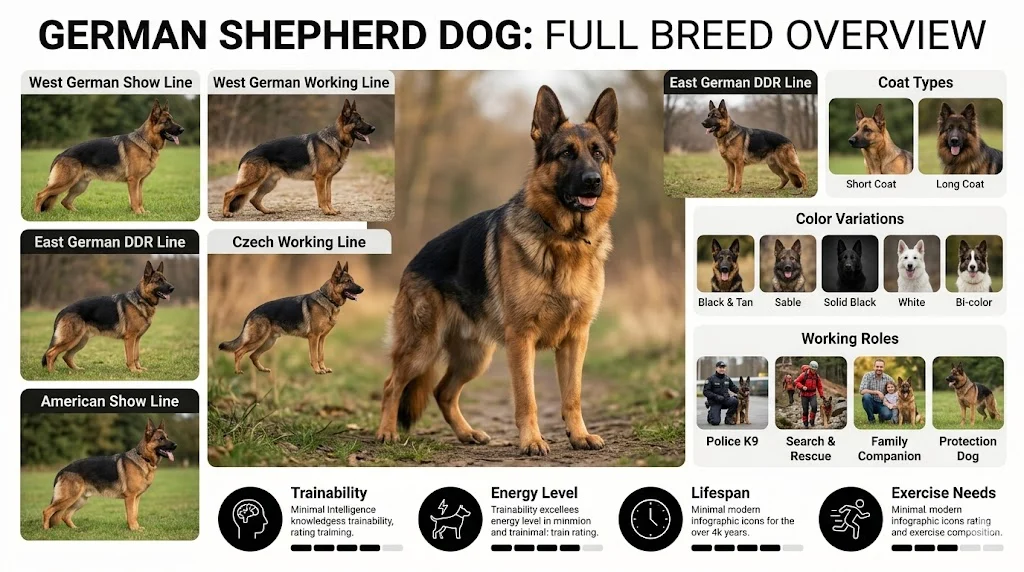
A full breed German Shepherd is a purebred dog with two registered German Shepherd parents and no mixed ancestry, verified through pedigree or DNA testing. Purebred status guarantees predictable size, temperament, and working traits but it does not guarantee health, which depends entirely on the breeding behind the dog. Most buyers overpay for “purebred” claims with no paperwork to back them registration and health testing matter more than the label itself.
Quick Snapshot Table
| Feature | Details |
|---|---|
| Breed Type | Purebred German Shepherd Dog (GSD) |
| Origin | Germany, formalized 1899 |
| Founder Line | Captain Max von Stephanitz |
| AKC Group | Herding Group |
| FCI Classification | Group 1 – Sheepdogs and Cattle Dogs |
| Breed Purpose | Herding, protection, working roles |
| Average Weight (Adult) | Males: 65–90 lbs / Females: 50–70 lbs |
| Height | Males: 24–26 inches / Females: 22–24 inches |
| Lifespan | 9–13 years |
| Coat Type | Double coat, medium or long |
| Undercoat | Dense seasonal undercoat |
| Common Colors | Black and tan, sable, black, bi-color |
| Rare Colors | White, blue, liver, panda (varies by registry) |
| Temperament | Loyal, intelligent, confident, protective |
| Intelligence Level | Extremely High |
| Energy Level | High |
| Trainability | Excellent |
| Working Drive | Very High |
| Protective Instinct | Strong |
| Loyalty Level | Exceptional |
| Good With Children | Yes, with proper socialization |
| Good With Other Pets | Generally yes, with early exposure |
| Stranger Behavior | Reserved and watchful |
| Shedding Level | Heavy, year-round |
| Seasonal Shedding | Very Heavy (“coat blow” periods) |
| Grooming Needs | Moderate to High |
| Brushing Frequency | 3–5 times per week |
| Drooling | Low |
| Barking Level | Moderate |
| Exercise Needs | 90+ minutes daily |
| Mental Stimulation Needs | Very High |
| Off-Leash Reliability | Moderate to High with training |
| Apartment Friendly | Possible but not ideal |
| First-Time Owner Friendly | Moderate |
| Experience Level | Beginner to Intermediate |
| Training Difficulty | Moderate |
| Socialization Importance | Critical (8–16 weeks especially important) |
| Guard Dog Ability | Excellent |
| Watchdog Ability | Excellent |
| Service Dog Potential | Excellent |
| Search & Rescue Potential | Excellent |
| Police/Military Use | Very Common Worldwide |
| Herding Ability | Excellent |
| Adaptability | High |
| Heat Tolerance | Moderate |
| Cold Tolerance | High |
| Climate Preference | Cool to moderate climates |
| Common Health Concerns | Hip dysplasia, elbow dysplasia, degenerative myelopathy, bloat |
| Health Screening Importance | Extremely High |
| Lifelong Training Need | Moderate to High |
| Maintenance Level | Moderate to High |
| Puppy Development Speed | Rapid first 18–24 months |
| Bite Inhibition Training | Essential during puppy stage |
| Escape Artist Potential | Moderate |
| Average Puppy Price | $1,000–$3,000+ (reputable breeders) |
| Adoption Availability | High in rescues and shelters |
| Popularity Rank | Consistently Top 5 globally |
| Original Purpose | Herding livestock and farm protection |
| Modern Roles | Family companion, service dog, police K9, search & rescue, protection work |
| Distinguishing Feature | Strong, athletic build with erect ears and confident posture |
| Overall Suitability | Highly versatile working breed suited for active families and experienced owners |
What Is a Full Breed German Shepherd?
A full breed German Shepherd also called a purebred German Shepherd is a dog whose lineage traces back exclusively to registered German Shepherd Dogs on both sides of the pedigree, with no crossbreeding at any generation.
This distinction matters more than most buyers realize. “Full breed” is not a formal kennel club term, but it is widely used by buyers to mean the same thing as purebred: verifiable parentage, consistent breed standard conformity, and registration eligibility with a recognized body such as the AKC, the SV (Verein für Deutsche Schäferhunde, the German parent club), or another national kennel club.
Here is where most people get it wrong: they assume any dog that “looks like” a German Shepherd is full breed. Appearance alone tells you very little. A German Shepherd mix can carry 80% or more visual resemblance to a purebred dog while having significantly different temperament, size, and health predispositions. The only reliable way to confirm full breed status is through registration papers, a verified pedigree, or DNA ancestry testing.
A full breed German Shepherd is not inherently better than a mixed-breed dog but it is more predictable. Breed standard traits, working drive, size range, and known health risks are all more consistently inherited in a purebred line with documented ancestry.
Breed History and Origin
The German Shepherd was developed in Germany in 1899 by Captain Max von Stephanitz, who combined various German herding dog lines to create a single standardized working breed. His priority was function over form: structure, intelligence, and working ability came first, appearance second.
The breed quickly proved versatile beyond herding serving in police work, military service, search and rescue, and guide dog work within decades of its formal recognition. This working heritage is central to understanding the full breed German Shepherd today: every purebred GSD carries genetics selected for trainability, drive, and physical capability, not simply companionship.
Two major genetic lines emerged over the 20th century:
- Working lines (German working line, Czech line, DDR line): Bred primarily for drive, stamina, and performance in protection sport, police, and military work
- Show lines (American show line, German show line): Bred primarily for conformation standard, with more emphasis on the breed’s visual structure
Both are full breed German Shepherds. The distinction is about breeding purpose and resulting temperament, not purity of lineage. Buyers should understand which line a breeder is working with, because the practical difference in daily ownership between a working-line and show-line GSD puppy can be significant.
Appearance
The AKC breed standard defines the full breed German Shepherd’s physical structure precisely. Deviations from this standard do not necessarily indicate poor health, but they do indicate a dog bred outside conformation priorities.
Key physical traits:
- Head: Strong, chiseled, slightly domed forehead, clean stop, strong jaw
- Eyes: Medium-sized, almond-shaped, dark brown preferred
- Ears: Large, erect, moderately pointed, set high on the skull
- Body: Slightly longer than tall, well-muscled, deep chest, level back (working line) or sloped topline (some American show lines)
- Coat: Double coat dense, straight or slightly wavy outer coat with thick undercoat; medium length standard, long-coat variant occurs
- Tail: Bushy, reaches to hock, carried low or in a slight curve when relaxed, never curled over the back
- Gait: Smooth, efficient, ground-covering trot considered a hallmark of correct structure
Common colors in full breed German Shepherds:
| Color | Description |
| Black and Tan | Most recognized color; black saddle over tan/cream base |
| Sable | Agouti-patterned, banded hairs, ranges from light to dark |
| Solid Black | Recessive trait, fully black coat |
| Bi-Color | Mostly black with limited tan points (legs, face) |
| Blue/Liver/White | Diluted or recessive colors, rarer, sometimes considered faults in conformation |
Color does not affect a German Shepherd’s status as full breed. AKC registration accepts all genetically GSD colors, though some colors are disqualified specifically from conformation showing.
Genetics and Pedigree Verification
Full breed status is established through documentation, not appearance. Buyers should understand exactly what verifies a German Shepherd as purebred.
Verification methods:
| Method | What It Confirms | Reliability |
| AKC/SV Registration Papers | Lineage on record with the registering body | High, if paperwork is verified independently |
| Pedigree Certificate | Documented ancestry across generations | High, when cross-checked against registry database |
| DNA Ancestry Test | Genetic breed composition | High for detecting mixed breeding |
| Microchip and Breeder Records | Traceability to litter and parents | Moderate, depends on breeder record-keeping |
| Visual Appearance Alone | Nothing reliable | Low many mixes resemble purebred GSDs |
Responsible breeders provide AKC registration paperwork (in the US) at the time of sale, along with a pedigree showing at least three to four generations. If a seller cannot produce this documentation, or claims the dog is “purebred” with no verifiable paperwork, the claim should not be taken at face value.
DNA testing (Embark, Wisdom Panel, and similar services) has become a practical secondary verification tool, particularly for adult dogs acquired without full paperwork, such as rescues claimed to be purebred.
Temperament and Personality
Experienced breeders focus on something beyond pedigree paperwork: they evaluate nerve strength, drive levels, and environmental stability in their breeding stock traits that determine whether a full breed German Shepherd will succeed as a family companion, working dog, or both.
Core temperament traits:
- Loyalty: Intensely bonded to their primary family; one-person or one-family oriented more than many breeds
- Intelligence: Ranked among the top breeds for working and obedience intelligence; quick learners with strong memory retention
- Confidence: A correctly bred full breed German Shepherd should be self-assured, not anxious or reactive
- Protectiveness: Natural guardian instinct requiring proper socialization to channel appropriately
- Drive variation: Working lines carry substantially higher prey and defense drive than show lines
What most articles miss about full breed GSD temperament:
Pedigree alone does not guarantee temperament. A dog can have flawless registration paperwork and still carry poor nerve genetics if the breeder selected for appearance or pedigree prestige over working stability. The real issue is this: temperament testing of breeding stock matters more than how many champions appear in a four-generation pedigree.
A correctly bred full breed German Shepherd shows controlled aloofness with strangers alert, assessing, but not fearful or aggressive without cause. Fearful behavior (cowering, excessive avoidance, inappropriate aggression from insecurity) in a purebred dog often traces back to poor breeding selection, not the breed itself.
Intelligence and Trainability
German Shepherds are consistently ranked among the top three most trainable breeds, a reputation earned through over a century of use in police work, military service, search and rescue, and competitive dog sports.
What high trainability means practically:
A full breed German Shepherd learns commands quickly often within a handful of repetitions for simple cues. This intelligence cuts both ways: an under-stimulated or inconsistently trained GSD will apply that same problem-solving ability to behaviors owners do not want, such as opening doors, counter-surfing, or testing fence boundaries.
Training principles for this breed:
- Begin basic obedience at 8 weeks with positive reinforcement methods
- Keep training sessions short (5–10 minutes) but frequent this breed disengages from repetitive drilling
- Incorporate scent work, puzzle toys, and structured problem-solving for mental stimulation
- Establish consistent household rules from day one; adolescence (6–18 months) is when boundary-testing peaks
- Avoid harsh correction-based methods; this breed is sensitive to handler tone and can become defensive or shut down under heavy-handed training
Activities full breed German Shepherds commonly excel in: obedience, rally, Schutzhund/IPO/IGP, agility, tracking, herding trials, search and rescue, narcotics and explosives detection, therapy and service work.
Exercise Requirements
This is consistently where new owners underestimate the commitment a full breed German Shepherd requires.
Minimum daily exercise for an adult GSD:
| Activity | Duration/Frequency |
| Structured walk or run | 45–60 minutes, twice daily |
| Off-leash play or fetch | 20–30 minutes |
| Mental stimulation | 15–20 minutes of training or enrichment |
| Total daily engagement | 90–120+ minutes |
Puppy exercise caution: Growth plates in German Shepherd puppies remain open until 12–18 months. High-impact activity extended running, repeated jumping, intense fetch before that window closes carries real risk of permanent joint damage. Short, varied play sessions are safer than long structured exercise for puppies under a year.
Signs of under-exercise:
- Destructive chewing
- Excessive barking
- Fence running or repetitive pacing
- Hyperactive or unmanageable indoor behavior
- Redirected nipping or mouthing
A working-line full breed German Shepherd typically needs more exercise volume and intensity than a show-line dog of the same breed.
Health Problems and Genetic Risks
A full breed German Shepherd’s health is governed by the quality of breeding decisions, not by pedigree length. Purebred status without health testing offers no real protection against the breed’s known genetic risks.
Primary health concerns:
Hip Dysplasia
The most common orthopedic issue in the breed malformation of the hip joint causing pain, reduced mobility, and eventual arthritis.
- OFA data consistently places German Shepherds among higher-risk breeds for hip dysplasia
- Confirm OFA or PennHIP certification on both parents, not a vet’s informal visual assessment
- Even with certified parents, clear hips in offspring are not guaranteed but risk is meaningfully reduced
Elbow Dysplasia
Affects the elbow joint, frequently alongside hip dysplasia. Causes lameness, particularly in dogs 4–18 months old.
Degenerative Myelopathy (DM)
A progressive spinal cord disease causing gradual hind-limb paralysis, typically appearing in dogs 8 years and older.
- Linked to a mutation in the SOD1 gene
- DNA testing identifies dogs as Clear, Carrier, or At Risk
- Two At Risk parents will produce At Risk puppies request parent DM results
Bloat (Gastric Dilatation-Volvulus)
A life-threatening emergency common in deep-chested large breeds where the stomach fills with gas and twists. Requires immediate veterinary surgery.
Exocrine Pancreatic Insufficiency (EPI)
Pancreatic failure to produce sufficient digestive enzymes, causing weight loss despite large food intake and poor coat condition. German Shepherds are disproportionately affected. Manageable with lifelong enzyme supplementation.
Health testing checklist for breeding stock:
| Test | Purpose |
| OFA Hip Evaluation | Hip dysplasia screening |
| OFA Elbow Evaluation | Elbow dysplasia screening |
| DM (SOD1) DNA Test | Degenerative myelopathy status |
| OFA Cardiac Exam | Heart health |
| Ophthalmologist Exam | Eye health clearance |
The real issue is this: a full breed German Shepherd with an impressive pedigree but no health testing carries the same genetic risks as any unscreened dog. Pedigree prestige and health screening are separate things, and buyers frequently confuse the two.
Puppy Development Timeline
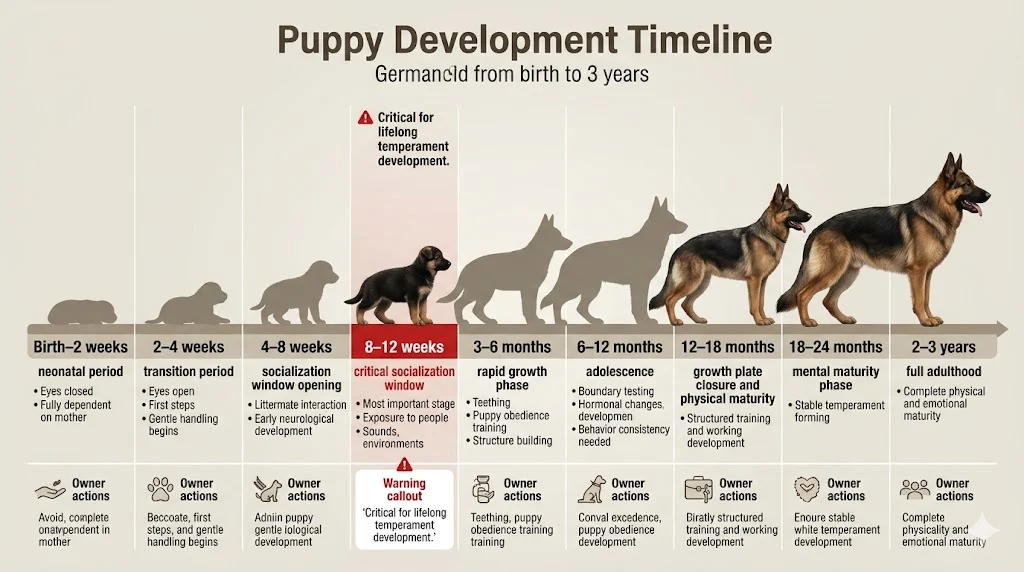
| Age | Development Stage | Key Owner Actions |
| Birth–2 Weeks | Neonatal period; eyes and ears closed; fully dependent on mother | No owner action; leave with mother |
| 2–4 Weeks | Transition period; eyes open; hearing begins; first wobbly steps | Begin gentle, brief daily handling |
| 4–8 Weeks | Socialization window opens; littermate play; learning dog communication | Early neurological stimulation; remain with litter until 8 weeks minimum |
| 8–12 Weeks | Prime socialization window most important period in the dog’s life | Introduce new people, surfaces, sounds, environments daily and positively |
| 3–6 Months | Rapid growth; baby teeth fall out; adolescent behaviors begin | Puppy obedience classes; consistent rules; leash manners |
| 6–12 Months | Adolescence; boundary-testing; ears fully erect; sex hormones emerging | Consistent training; avoid intense exercise; discuss neuter/spay timing with vet |
| 12–18 Months | Growth plates closing; adult body developing; drive levels clarifying | Begin structured training; introduce sport or working activities if planned |
| 18–24 Months | Mental maturity beginning; adult temperament solidifying | Advanced training; stable routine established |
| 2–3 Years | Full mental and physical maturity | Dog should be reliable, trained, and well-integrated |
The 8–12 week socialization window is non-negotiable. German Shepherds that miss broad, positive socialization during this period carry a higher risk of fear-based reactivity as adults one of the most commonly underestimated factors in long-term temperament.
Feeding and Nutrition
A full breed German Shepherd’s nutritional needs scale with size, activity level, and life stage.
General feeding guidelines:
| Life Stage | Food Type | Daily Amount (Approx.) |
| 8–16 weeks puppy | High-quality large-breed puppy kibble | 3–4 small meals daily |
| 4–12 months | Large-breed puppy formula | 2–3 meals daily |
| 12+ months adult | Large-breed adult formula | 2 meals daily |
| Senior (7+ years) | Senior or joint-support formula | 2 meals, adjusted for activity |
Key nutritional considerations:
- Feed large-breed puppy food specifically standard puppy formulas are too calorie-dense and can accelerate growth in ways that increase hip and elbow dysplasia risk
- Avoid free-feeding; scheduled meals reduce bloat risk and allow early monitoring of appetite changes
- Omega-3 fatty acids support coat and joint health look for fish oil or DHA-enriched formulas
- Do not supplement calcium independently during puppyhood unless directed by a veterinarian
Monitoring condition: You should be able to feel the ribs without pressing hard, but not see them clearly. A visible waist from above is correct; a barrel-shaped torso is not. Excess weight significantly increases stress on hips and elbows already predisposed to dysplasia.
Grooming Guide
Full breed German Shepherds are heavy, consistent shedders regardless of coat length or color.
Grooming schedule:
| Task | Frequency |
| Brushing | 3–4 times per week minimum; daily during shedding season |
| Bathing | Every 6–8 weeks or as needed |
| Nail trimming | Every 3–4 weeks |
| Ear cleaning | Monthly; check weekly for redness or odor |
| Teeth brushing | Daily ideally; minimum 3 times per week |
| De-shedding brush-out | Weekly year-round; twice-weekly during spring/fall coat blows |
Recommended tools:
- Slicker brush for surface debris
- Undercoat rake or Furminator for loose undercoat removal
- Pin brush for long-coat individuals
- High-velocity dryer for blowouts significantly reduces loose hair and grooming time
Long-coat full breed German Shepherds (a recessive coat variant) require additional brushing time but are not a separate breed and are still fully purebred when both parents are registered GSDs.
Step-by-Step Daily Care Guide
- Morning exercise 20–30 minute walk or free play in a securely fenced area
- Breakfast measured, scheduled meal; monitor appetite and stool quality
- Training session 5–10 minutes of obedience or new skill work
- Mental enrichment puzzle feeder, Kong, or scatter feeding for one meal per day
- Midday rest puppies need 16–18 hours of sleep; avoid overstimulation
- Afternoon exercise second structured walk or play session
- Evening meal scheduled; no feeding immediately before or after vigorous exercise (bloat prevention)
- Evening brush quick daily brush reduces overall grooming workload
- Quiet wind-down establish a settled sleep routine from day one
Weekly additions: Nail check, ear inspection, teeth brushing, full coat brush-out.
Common Owner Mistakes
1. Assuming “purebred” means “predictable temperament” Pedigree confirms ancestry, not guaranteed temperament. Breeding selection for nerve strength and stability matters more than the number of generations documented.
2. Skipping the socialization window Owners who isolate puppies until vaccines are fully complete often end up with reactive adults. Balance disease risk sensibly with controlled, positive exposure during 8–12 weeks.
3. Treating the breed like a low-energy companion dog This is a working breed first. Under-exercised, under-stimulated full breed German Shepherds are among the most destructive and anxious dogs surrendered to rescue.
4. Buying on pedigree prestige alone, without health testing A long list of champion titles in a pedigree says nothing about hip scores, elbow scores, or DM status. Ask for the actual test results, not just the family tree.
5. Delaying training Every untrained behavior jumping, pulling, resource guarding becomes harder to modify as the dog grows in size and confidence. Training starts at 8 weeks.
6. Inconsistent household rules An intelligent dog that discovers exceptions to rules will test every boundary consistently. Consistency matters more with this breed than most.
Insights Most Articles Miss
Working line vs. show line is a bigger factor than most buyers realize
Two full breed German Shepherds can come from dramatically different temperament profiles depending on whether they descend from working lines (German working line, Czech, DDR) or show lines (American or German show line). Working-line dogs carry substantially higher drive, energy, and handler intensity. Buyers seeking a calmer family companion are often better matched with show-line breeding, while buyers seeking a sport or protection dog typically need working-line genetics. Asking “is this dog full breed” without asking “which line” misses the more important question.
Registration does not equal health screening
AKC or SV registration confirms lineage it does not confirm hip scores, elbow scores, or genetic disease status. A fully registered, pedigreed German Shepherd can still come from completely unscreened breeding stock. Buyers should request OFA or equivalent results separately from registration paperwork.
American show line structure is a point of ongoing debate
Some American show-line German Shepherds have been bred with a more pronounced sloped topline and angulated rear than the original working standard. This has drawn criticism from working-line breeders and some veterinary orthopedic specialists regarding potential strain on hips and rear movement. This is a genuine debate within the breed community, not settled consensus buyers evaluating structure should look at the individual dog’s movement and the breeder’s health testing record rather than assuming either extreme is automatically correct or incorrect.
A four-generation pedigree with no working titles or health certifications is a red flag, not a credential
A pedigree full of show champions without any documented health testing, or a “purebred” claim with no registration at all, should prompt more questions, not fewer.
Price Guide and Ownership Costs
Puppy Price Ranges (2026):
| Source | Price Range | Notes |
| Reputable health-tested breeder | $1,500–$3,500+ | OFA-tested parents, working or show titles, health guarantee |
| Pet-quality registered breeder | $1,000–$1,800 | AKC registered, limited or no health testing |
| Backyard breeder | $600–$1,200 | Variable documentation; buyer beware |
| Rescue / adoption | $50–$400 | Adult dogs more common; purebred GSD rescues exist regionally |
| Imported working-line dogs | $3,000–$10,000+ | Often from established European kennels with titled parents |
Annual ownership costs (estimated):
| Expense | Annual Cost (USD) |
| High-quality food | $800–$1,400 |
| Routine veterinary care | $400–$700 |
| Flea, tick, and heartworm prevention | $200–$400 |
| Grooming tools or professional grooming | $150–$600 |
| Training classes or private sessions | $200–$800 (especially Year 1) |
| Pet insurance | $400–$900 |
| Supplies, toys, enrichment | $200–$400 |
| Total Annual Estimate | $2,350–$5,200 |
One-time startup costs: Crate, bedding, bowls, collar, leash, ID tags, spay/neuter, first vet visit and vaccines approximately $600–$1,200.
Large-breed veterinary emergencies orthopedic surgery, bloat treatment can reach $4,000–$8,000+. Pet insurance is a serious consideration for this breed, not an optional add-on.
How to Find a Reputable Breeder
What a reputable breeder does:
- Health tests both parents: OFA hips, elbows, and DM (SOD1) at minimum
- Provides AKC or SV registration paperwork and a multi-generation pedigree
- Allows OFA results to be independently verified through the public OFA database
- Raises puppies in the home with regular human contact and environmental exposure
- Structures placements around fit, not demand may have a waitlist
- Asks buyers questions about experience level, living situation, and daily routine
- Provides a written health guarantee and a return/rehome policy
- Remains available as a resource after purchase
Red flags:
- No registration paperwork, or vague claims of “purebred” with nothing to verify it
- Multiple breeds available simultaneously with puppies always “in stock”
- Refusal to show OFA paperwork or parent health test results
- Meeting in a parking lot rather than at the breeding facility
- Puppies available at 6 or 7 weeks
- Pressure tactics or “last puppy available” urgency
Where to search:
- German Shepherd Dog Club of America (GSDCA) breeder referrals
- AKC Marketplace (verify registration claims independently)
- Working dog clubs (USCA, DVG, WDA) for working-line breeders with titled dogs
Questions to Ask Before Buying
- Can I see AKC/SV registration and a multi-generation pedigree?
- Can I see OFA test results for both parents hips, elbows, and DM status?
- Is this dog from working lines, show lines, or a mix and what does that mean for temperament?
- How do you socialize the puppies before they leave?
- At what age do puppies go to their new homes?
- What are the terms of your health guarantee?
- What happens if I can no longer keep the dog?
- Can I visit the facility and meet the dam in person?
- What health issues have appeared in your previous litters?
- What do you look for when matching puppies to homes?
Buyer Warning Section
Avoid these situations entirely:
“Purebred” claims with no paperwork. A dog described as full breed or purebred without AKC/SV registration or a verifiable pedigree should be treated as unverified. Ask for documentation, not assurances.
Pet store or broker sales. No legitimate breeder places puppies in pet stores. Puppies sold through brokers frequently come from commercial breeding operations regardless of what paperwork is presented.
Puppies shipped at 6–7 weeks. This is both legally questionable in many states and developmentally harmful the 7th and 8th weeks are when puppies learn critical bite inhibition from littermates.
Sellers who discourage vet checks. A reputable breeder wants a veterinary exam within 72 hours of purchase. A seller who discourages or delays this is protecting themselves, not the puppy.
Pedigree without health testing. A long list of titled ancestors with no OFA or DM documentation tells you about appearance and competition success, not the puppy’s actual health risk.
Extreme low prices for “full breed papers included.” A genuinely health-tested, properly registered German Shepherd puppy is rarely sold for $300–$400. Prices in that range usually indicate no health testing and minimal veterinary care, regardless of what paperwork is promised.
Lifestyle Compatibility
| Lifestyle Factor | Suitable? | Notes |
| Families with children | Yes | Excellent with proper socialization; supervise young children |
| Children under 5 | Caution | Size and energy level can be overwhelming; management required |
| Apartment living | Possible | Daily exercise commitment is essential; yard helpful but not required |
| Active, outdoor owners | Excellent | Thrives with hiking, running, and structured activity |
| Working homes (dog alone 8+ hours) | Not recommended | Separation anxiety risk; significant daily enrichment required |
| Multi-dog households | Generally yes | Early socialization important; same-sex pairs can create conflict |
| Cats or small pets | Possible | Prey drive varies by individual and line; careful introductions needed |
| First-time dog owners | Possible | Manageable with strong commitment to training; not the easiest first breed |
| Experienced dog owners | Excellent | Highly rewarding breed for experienced handlers |
| Working/sport homes | Excellent | Working-line dogs especially suited to structured sport or job-driven outlets |
Breed and Line Comparisons
| Feature | Working Line | American Show Line | German Show Line |
| Primary Selection Focus | Drive, performance, working titles | Conformation appearance | Conformation + working ability (SV requires both) |
| Energy Level | Very high | Moderate to high | High |
| Topline | Level, working structure | More angulated, sloped | Moderate angulation |
| Typical Temperament | Intense, high drive, needs a job | Calmer, more family-companion oriented | Balanced, structured temperament |
| Best Suited For | Experienced handlers, sport/working homes | Families wanting a calmer GSD | Experienced owners wanting balance |
| Price Range | $1,500–$10,000+ | $1,200–$3,000 | $1,500–$4,000 |
Preparation Checklist
Essentials before pickup:
- [ ] Appropriately sized crate
- [ ] Crate bedding or mat
- [ ] Puppy-proofed space or exercise pen
- [ ] Stainless steel food and water bowls
- [ ] Age-appropriate collar, ID tag, and 4–6 foot leash
- [ ] High-quality large-breed puppy food
- [ ] Puppy-safe chew toys and enrichment items
- [ ] Grooming brush and nail trimmer
Appointments and admin:
- [ ] Veterinarian appointment scheduled within 72 hours
- [ ] Puppy training class researched and enrolled
- [ ] Family agreement on rules: sleeping location, furniture access, feeding schedule
- [ ] Emergency veterinary clinic identified
Documentation to collect from breeder:
- [ ] AKC or SV registration application/papers
- [ ] Multi-generation pedigree certificate
- [ ] Health guarantee in writing
- [ ] Parent OFA certification copies
- [ ] DM test results (SOD1)
- [ ] Vaccination and deworming records
- [ ] Feeding schedule and current food brand
FAQs
Q: What does “full breed German Shepherd” actually mean? It means a German Shepherd with documented, verifiable ancestry tracing exclusively to registered German Shepherd Dogs, with no crossbreeding. It is typically confirmed through AKC/SV registration, a pedigree certificate, or DNA ancestry testing not through appearance alone.
Q: How can I tell if a German Shepherd is truly full breed? Request registration papers and a pedigree certificate, then verify them independently through the registering body’s database where possible. DNA ancestry testing is a reliable secondary check, especially for adult dogs without complete paperwork.
Q: Are full breed German Shepherds healthier than mixed breeds? Not automatically. Purebred status improves predictability of traits but does not guarantee health. A full breed German Shepherd from unscreened parents carries the same risk of hip dysplasia, elbow dysplasia, and DM as any unscreened dog. Health testing matters more than purity of lineage.
Q: What’s the difference between working line and show line full breed German Shepherds? Working-line dogs are bred primarily for drive, stamina, and performance in protection sport, police, or military work. Show-line dogs are bred primarily for conformation to the breed standard. Both are equally full breed the difference is breeding purpose and resulting temperament and structure.
Q: How much does a full breed German Shepherd puppy cost? Reputable, health-tested breeders typically charge $1,500–$3,500 in 2026. Imported working-line dogs from titled European kennels can run significantly higher, sometimes $3,000–$10,000 or more.
Q: Do full breed German Shepherds need AKC registration to be considered purebred? No. Registration confirms documented purebred status with a specific organization, but a dog can be genetically purebred without being registered if a breeder did not pursue registration. However, registration paperwork remains the most reliable way for a buyer to verify the claim.
Q: What health tests should I ask for before buying a full breed German Shepherd puppy? At minimum, request OFA hip and elbow evaluations and DM (SOD1) DNA test results for both parents. Cardiac and ophthalmologist clearances are additional indicators of a thorough health testing program.
Q: Is a full breed German Shepherd a good first dog? With serious commitment to training, socialization, and daily exercise, yes. Without that commitment, this breed in any line is a challenging first dog due to its intelligence, drive, and exercise needs.
Q: What is the lifespan of a full breed German Shepherd? Average lifespan is 9–13 years. Health testing of breeding stock, appropriate diet, regular veterinary care, and weight management all contribute meaningfully to longevity.
Q: Can a full breed German Shepherd have a different coat color and still be purebred? Yes. Black and tan, sable, solid black, and bi-color are all genetically purebred GSD colors. Coat color does not determine full breed status pedigree and registration do.
Conclusion
A full breed German Shepherd offers something genuinely valuable: predictability. Predictable size, predictable temperament tendencies, predictable working drive assuming the breeding behind the dog was done responsibly.
That last condition is the one buyers skip too often. A pedigree, no matter how many generations deep, is a record of ancestry not a guarantee of health or temperament. The breeders worth buying from combine documented full breed status with real health testing and honest temperament evaluation, not just paperwork and a price tag.
Prospective owners who approach this breed with realistic expectations serious exercise needs, consistent training requirements, meaningful health costs, and a decade-long commitment will find the full breed German Shepherd to be one of the most capable and rewarding dogs available. Those who buy on pedigree prestige alone, without asking the harder questions, are the ones who end up surprised.
The paperwork tells you what the dog is. It does not tell you who the dog will become. That part is still up to you.