German Shepherd bite force is commonly cited as 238 PSI, but this figure traces back to unverified media claims rather than peer-reviewed measurement. Controlled scientific studies measuring bite force in pounds per square inch for individual dog breeds are extremely limited and methodologically inconsistent. What is well documented is that German Shepherds have a strong, structurally efficient bite suited to grip-and-hold work bite force alone does not determine a dog’s danger level or temperament.
Quick Snapshot Table
| Fact | Detail |
|---|---|
| Commonly Cited Bite Force | 238 PSI (widely repeated, not independently verified) |
| Scientific Verification | No peer-reviewed PSI measurement specific to German Shepherds exists in published literature |
| Jaw Muscle Structure | Strong masseter and temporalis muscles; broad skull built for sustained grip |
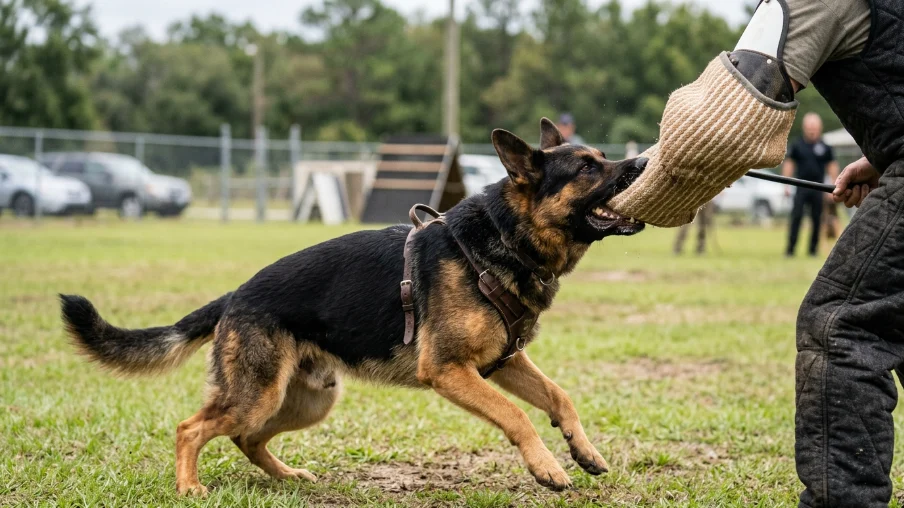
| Primary Working Use of Bite | Controlled grip-and-hold in police, military, and protection work |
| Bite Type | “Full mouth” grip preferred in training rather than snap-and-release |
| Comparable Breeds (commonly cited) | Rottweiler, Mastiff, American Pit Bull Terrier |
| Bite Force vs. Bite Risk | Not directly correlated; temperament, training, and context matter more |
| Bite Inhibition Trainable? | Yes taught from 8 weeks through adolescence |
| Breed Purpose | Designed for control, herding, and protection rather than maximum bite force |
| Working Line Bite Quality | Focuses on grip stability, nerve strength, and control |
| Protection Sport Requirement | Calm, full-mouth grip under handler control |
| Police K9 Application | Suspect apprehension and controlled holding |
| Military Working Dog Use | Detection, patrol, and controlled engagement |
| Herding Heritage | Originally used controlled nipping rather than damaging bites |
| Jaw Endurance | High; capable of maintaining sustained grip |
| Grip Strength Importance | More important in working evaluations than raw PSI estimates |
| Temperament Influence | Strongly affects bite behavior and risk |
| Genetics Influence | Moderate; working lines may display stronger grip drives |
| Socialization Impact | Critical in preventing fear-based biting behaviors |
| Puppy Bite Inhibition Window | Most effective between 8–16 weeks |
| Adolescent Bite Training | Reinforcement continues through 18–24 months |
| Fear-Based Biting Risk | Increases with poor socialization and chronic stress |
| Territorial Biting Risk | Can develop without proper training and management |
| Stranger Reactivity Risk | Varies by genetics and socialization quality |
| Family Bite Risk | Typically low in well-trained, socialized dogs |
| Child Safety Factor | Requires supervision and education on dog interactions |
| Training Requirement | Consistent obedience and impulse-control work |
| Bite Prevention Strategy | Early socialization, obedience training, and environmental exposure |
| Most Important Factor | Stability of temperament, not jaw strength |
| Bite Severity Predictors | Context, arousal level, fear, handling, and training history |
| Professional Evaluation Method | Behavioral assessment rather than bite-force estimation |
| Working Dog Selection Criteria | Nerve stability, confidence, grip quality, trainability |
| Legal Risk Factor | Owner management and training practices |
| Public Misconception | Strong bite force automatically equals dangerous temperament |
| Scientific Consensus | Behavior is a far better predictor of risk than estimated PSI values |
| Veterinary Perspective | Prevention and behavior management are more important than bite-force numbers |
| Expert Training Focus | Control, reliability, and bite inhibition |
| Overall Assessment | German Shepherds possess powerful jaws, but responsible breeding, training, and socialization are the primary determinants of safety and behavior |
What Does “Bite Force” Actually Mean?
Bite force describes the pressure an animal’s jaw can exert when biting down, typically measured in pounds per square inch (PSI) or newtons in scientific contexts.
In practice, measuring bite force accurately is far harder than the numbers floating around the internet suggest. Reliable measurement requires a calibrated force transducer, a controlled environment, and a dog willingly biting down at maximum effort on command conditions that are difficult to standardize and rarely published in veterinary or animal science journals.
Here is where most articles get it wrong: they repeat the same 238 PSI figure for German Shepherds without citing an original scientific source, because no widely accessible peer-reviewed source actually exists for that specific number. The figure appears to originate from older popular media and pet industry content rather than controlled research.
This does not mean German Shepherds have a weak bite they clearly do not. It means the precise PSI figure commonly quoted should be treated as an unverified estimate, not an established scientific fact.
The 238 PSI Claim: Where It Comes From and Why It’s Disputed
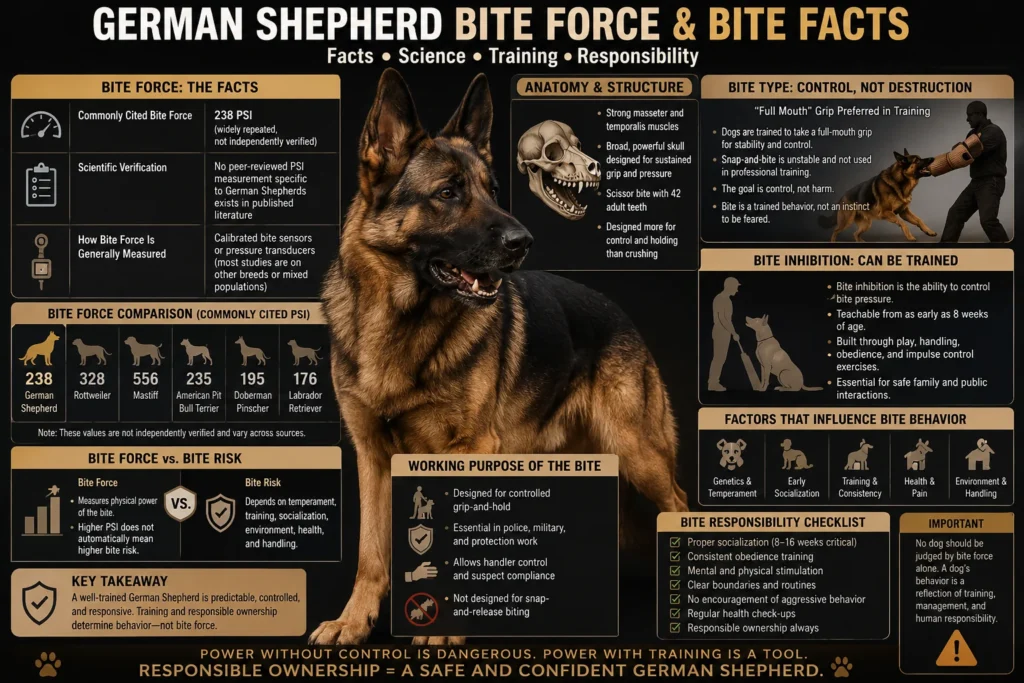
The 238 PSI figure for German Shepherds appears across countless pet websites, but tracing it back reveals a problem: there is no consistently cited original scientific study behind it. Comparable numbers for other breeds Rottweilers at roughly 328 PSI, Pit Bulls at roughly 235 PSI show the same pattern of repetition without a clear primary source.
What actual veterinary and zoological research tells us instead:
- A frequently referenced study by Dr. Brady Barr (National Geographic, non-peer-reviewed field testing) measured bite force across several large carnivores and dogs using a bite sleeve rigged with a pressure sensor, generating widely circulated but informally conducted figures
- Academic studies on canine bite mechanics tend to focus on jaw anatomy, skull shape, and muscle cross-sectional area rather than producing breed-specific PSI rankings
- Bite force in dogs scales strongly with body size and skull width meaning individual variation within a breed can be as significant as variation between breeds
Experienced trainers and working-dog professionals tend to deprioritize PSI numbers entirely. What matters operationally is grip quality, bite calmness, and the dog’s ability to hold a full, controlled bite under stress not a number on a chart.
What We Do Know: German Shepherd Jaw Anatomy
While exact PSI figures are uncertain, the structural anatomy behind the German Shepherd’s bite is well documented and explains why the breed is so effective at grip-and-hold work.
Key anatomical features:
- Broad, strong skull — provides a wide base for jaw muscle attachment
- Well-developed masseter muscle — the primary muscle responsible for closing the jaw with force
- Temporalis muscle development — contributes to sustained bite pressure, important for holding rather than just snapping
- Scissor bite — the AKC breed standard calls for a scissor bite, where the upper teeth closely overlap the lower teeth, contributing to a secure, efficient grip
- 42 teeth — standard for the domestic dog, including prominent canines designed for gripping rather than shearing
This combination produces a bite that is less about peak crushing force and more about sustained, controlled grip strength which is precisely why the breed has been selected for police and military bite-work for over a century.
How German Shepherd Bite Force Compares to Other Breeds
The table below reflects commonly cited figures circulating in popular and pet-industry sources. Readers should treat these as approximate and unverified rather than scientifically established, for the reasons explained above.
| Breed | Commonly Cited PSI (Unverified) | Primary Working Use |
|---|---|---|
| Kangal | ~743 PSI | Livestock guardian |
| Cane Corso | ~700 PSI | Guard, protection |
| Rottweiler | ~328 PSI | Guard, working, herding |
| American Bulldog | ~305 PSI | Working, farm dog |
| German Shepherd | ~238 PSI | Police, military, herding, protection sport |
| Pit Bull Terrier | ~235 PSI | Companion, working |
| Doberman Pinscher | ~228 PSI | Guard, protection |
| Labrador Retriever | ~230 PSI | Sporting, assistance |
The real issue with tables like this one including this version is that they are typically reproduced from the same uncredited original source across hundreds of websites. They are useful for general comparison and widely referenced in casual discussion, but they should not be cited as scientific fact in serious contexts.
Does Bite Force Predict Bite Risk or Aggression?
No. This is one of the most important points missed in most bite force content.
What actually determines whether a dog bites:
- Genetics and individual temperament
- Socialization quality during the 8–16 week critical period
- Training history and consistency
- Fear, pain, or stress in a given moment
- Handler behavior and supervision
- Context resource guarding, territorial triggers, startle response
A German Shepherd with a structurally strong jaw and a stable, well-socialized temperament is not more dangerous than a smaller dog with poor socialization and high fear reactivity. In fact, fear-based bites often from under-socialized dogs of any breed or size are far more common in real-world incidents than calculated aggression from a “powerful” breed.
Appearance and raw physical capability tell you very little about actual bite risk. Behavior and training history tell you almost everything.
Bite Force in Working and Protection Contexts
German Shepherds are widely used in police K9 units, military working dog programs, and protection sports such as Schutzhund/IPO and PSA. In these contexts, bite force is one factor among several that trainers evaluate but it is rarely the deciding one.
What working-dog trainers actually prioritize:
- Full, calm grip — a dog that bites with the full mouth and holds steadily, rather than a shallow or “typewriter” bite (rapid, nervous re-gripping)
- Bite and out reliability — the dog’s ability to release cleanly on command, which is arguably more operationally important than raw force
- Nerve strength — composure under pressure, noise, and physical contact
- Targeting accuracy — biting the intended target (typically a padded sleeve or bite suit in training) rather than redirecting
A dog with exceptional bite force but poor bite-and-out control is a liability in working contexts, not an asset. This is consistently overlooked in popular bite force discussions.
Bite Inhibition: Why Training Matters More Than Jaw Strength

Bite inhibition a dog’s learned ability to control the force of its bite is established primarily during puppyhood, largely through interaction with littermates and consistent owner feedback.
Key bite inhibition training principles:
- Puppies learn bite pressure control from littermates between 4–8 weeks; this is one reason puppies should not leave the litter before 8 weeks
- Owners should redirect hard mouthing to appropriate chew items rather than allowing rough play with hands
- A consistent, calm response to nipping (withdrawal of attention, redirection) is more effective than yelping or punishment-based corrections, which can sometimes increase arousal in high-drive dogs
- Bite inhibition training should continue through adolescence (6–18 months), when adult teeth and jaw strength are fully developing
A German Shepherd with strong natural jaw structure but excellent bite inhibition training poses meaningfully less risk than an undertrained dog of any breed, regardless of theoretical PSI numbers.
Common Myths About German Shepherd Bite Force
Myth: “German Shepherds have the strongest bite of any dog breed.” False. Multiple breeds including Kangals, Cane Corsos, and Rottweilers are commonly cited with higher bite force figures, though all such comparisons share the same sourcing limitations discussed above.
Myth: “A higher bite force PSI means a more dangerous dog.” Misleading. Bite force describes mechanical capability, not likelihood of biting. A dog’s behavior, training, and temperament determine actual risk far more than raw jaw strength.
Myth: “German Shepherds ‘lock’ their jaw when they bite.” False. No dog breed has an anatomical jaw-locking mechanism. This myth, often applied to several powerful-jawed breeds, is not supported by veterinary anatomy. What can appear as “locking” is typically a trained or instinctive full, sustained grip which is a behavioral pattern, not a physical mechanism.
Myth: “Bite force numbers are scientifically settled facts.” False, as detailed earlier in this article. Treat circulating PSI figures as commonly repeated estimates rather than verified data.
Responsible Ownership and Bite Prevention
Owning a breed with strong jaw structure and working-dog drive carries genuine responsibility, separate from whatever the precise PSI figure happens to be.
Practical steps every owner should take:
- Complete structured socialization during the 8–16 week critical window
- Enroll in puppy obedience and continue training through adolescence
- Teach reliable “leave it,” “out,” and recall commands
- Supervise all interactions between the dog and children regardless of how trustworthy the individual dog seems
- Address resource guarding or fear-based reactivity early with a qualified trainer or veterinary behaviorist
- Avoid situations that combine high arousal, restraint, and unfamiliar people or animals
When to seek professional help: Growling, snapping, stiffening, or any bite even an inhibited one toward a person or another animal warrants consultation with a certified professional dog trainer or veterinary behaviorist rather than at-home correction attempts.
FAQs
Q: What is the actual bite force of a German Shepherd in PSI? The widely cited figure is 238 PSI, but this number lacks a clearly documented, peer-reviewed scientific source. It should be treated as a popular estimate rather than an established scientific measurement.
Q: Is a German Shepherd’s bite stronger than a human’s? Yes. Average human bite force is generally cited around 120–160 PSI at the molars, meaningfully lower than commonly cited figures for German Shepherds and most large dog breeds.
Q: Do German Shepherds bite more than other breeds? Bite statistics by breed are difficult to interpret reliably due to inconsistent reporting, breed misidentification in incident data, and confounding factors like population size. Bite likelihood is driven primarily by individual temperament, socialization, and training rather than breed alone.
Q: Can training reduce a German Shepherd’s bite risk? Yes, significantly. Bite inhibition training, socialization, obedience training, and responsible management are the most effective tools for reducing bite risk in any breed, including German Shepherds.
Q: Why do police and military use German Shepherds if the bite force isn’t the strongest? Because working-dog selection prioritizes trainability, nerve strength, scent work ability, physical endurance, and bite-and-out reliability over raw jaw strength alone. German Shepherds excel across this combined skill set, which is why they remain a top choice despite breeds with higher cited bite force figures.
Q: At what age is a German Shepherd’s bite force fully developed? Adult teeth are fully in place by around 6–7 months, but jaw muscle strength continues developing alongside overall physical maturity through 18–24 months.
Q: Is it true that German Shepherds’ jaws can lock? No. This is a persistent myth applied to several strong-jawed breeds. No dog breed has a mechanical jaw-locking structure; sustained grips are behavioral, not anatomical.
Conclusion
The number most people search for 238 PSI turns out to be far less scientifically solid than it appears across the internet. What is solid is the German Shepherd’s genuinely strong jaw anatomy, built over more than a century of selection for grip-and-hold working ability.
But the more useful question for owners isn’t “how strong is the bite” it’s “how well is the dog trained, socialized, and managed.” Those factors determine real-world outcomes far more than any PSI figure, verified or not.
A well-bred, well-socialized, well-trained German Shepherd is a remarkably safe and capable companion. The jaw strength is real. The responsibility that comes with it is what actually matters.