A female Golden Retriever is a loyal, affectionate, and highly trainable companion typically calmer and more independent than males from an earlier age. She weighs 55–65 lbs at maturity, matures mentally faster than males, and is consistently ranked among the best family dogs in the world. The most important decision is not gender it is finding health-tested lines, because Golden Retrievers carry a significant cancer risk that varies by breeding quality.
Quick Snapshot Table
| Feature | Female Golden Retriever |
|---|---|
| Breed Group | Sporting Group (AKC) |
| Gender | Female |
| Average Weight | 55–65 lbs |
| Height | 21.5–22.5 inches at shoulder |
| Lifespan | 10–12 years |
| Coat Type | Dense Double Coat, Wavy or Straight |
| Coat Colors | Light Golden, Golden, Dark Golden |
| Temperament | Affectionate, Loyal, Gentle, Eager to Please |
| Intelligence | Very High |
| Trainability | Excellent |
| Energy Level | Moderate to High |
| Working Drive | Moderate |
| Family Friendly | Outstanding |
| Good With Children | Outstanding |
| Good With Other Pets | Excellent |
| Stranger Friendly | Very Friendly |
| Affection Level | Extremely High |
| Loyalty Level | Exceptional |
| Therapy Dog Potential | Outstanding |
| Service Dog Potential | Excellent |
| Emotional Support Suitability | Excellent |
| Shedding Level | Heavy, Year-Round |
| Seasonal Shedding | Very Heavy |
| Grooming Needs | Moderate to High |
| Brushing Frequency | 3–5 Times Weekly |
| Exercise Needs | 60–90 Minutes Daily |
| Mental Stimulation Needs | High |
| Apartment Friendly | Possible With Adequate Exercise |
| First-Time Owner Friendly | Excellent |
| Barking Level | Low to Moderate |
| Drooling | Low |
| Adaptability | High |
| Socialization Needs | Moderate |
| Off-Leash Reliability | High With Training |
| Recall Potential | Excellent |
| Swimming Ability | Excellent |
| Water Retrieval Instinct | Strong |
| Prey Drive | Low to Moderate |
| Protective Instinct | Low to Moderate |
| Watchdog Ability | Moderate |
| Guard Dog Ability | Poor |
| Heat Tolerance | Moderate |
| Cold Tolerance | High |
| Climate Preference | Cool to Moderate Climates |
| Mental Maturity Age | 18 Months–2 Years (Often Earlier Than Males) |
| Physical Maturity Age | 18–24 Months |
| Maternal Instinct | Often Strong |
| Puppy Price | $1,500–$3,500+ (Reputable Breeders) |
| Adoption Cost | $200–$800 |
| Annual Ownership Cost | $2,000–$4,500+ |
| Lifetime Ownership Cost | $25,000–$40,000+ |
| Common Health Concerns | Cancer, Hip Dysplasia, Elbow Dysplasia, Heart Disease, Allergies |
| Obesity Risk | Moderate to High |
| Health Testing Importance | Extremely High |
| Recommended Health Tests | Hips, Elbows, Heart, Eyes, Genetic Screening |
| Cancer Risk | Higher Than Many Breeds |
| Average Litter Size | 6–10 Puppies |
| AKC Recognition | Yes |
| Popularity Ranking | Consistently Among Top 5 AKC Breeds |
| Original Purpose | Retrieving Waterfowl and Game Birds |
| Modern Roles | Family Companion, Service Dog, Therapy Dog, Search & Rescue |
| Best For | Families, Therapy Work, Service Work, Active Households |
| Not Ideal For | Owners Seeking a Natural Guard Dog |
| Distinguishing Female Trait | Often Slightly Smaller, Earlier-Maturing, and More Focused Than Males |
| Overall Suitability | One of the Best Family and Companion Dogs in the World |
What Is a Female Golden Retriever?

A female Golden Retriever is a female dog of the Golden Retriever breed one of the most popular, widely recognized, and genuinely well-suited family breeds in existence. She is not simply a smaller version of a male. She has a distinct developmental timeline, behavioral tendencies, physical profile, and health considerations that prospective owners should understand clearly before purchasing or adopting.
Golden Retrievers were developed in Scotland in the mid-1800s by Lord Tweedmouth, who crossed a yellow Flat-Coated Retriever with a now-extinct Tweed Water Spaniel. The goal was a skilled hunting retriever suited to the rugged Scottish Highlands reliable, biddable, and steady. Those traits remain the foundation of the breed today.
Here is where most people get it wrong: they spend significant energy debating whether to get a male or female without first evaluating the quality of the breeding behind the dog. Gender is a secondary factor. A well-bred female from health-tested lines will outperform a poorly bred male on every metric that actually matters for long-term ownership temperament stability, health longevity, and trainability.
Breed History and Origin
The Golden Retriever was developed by Sir Dudley Marjoribanks (later Lord Tweedmouth) at his Guisachan estate in the Scottish Highlands beginning around 1864. His breeding records, discovered by the Kennel Club in 1952, documented the crosses that produced the foundation stock including Flat-Coated Retrievers, Irish Setters, Bloodhounds, and Tweed Water Spaniels.
The breed was introduced to North America in the early 20th century, where it flourished both as a working retriever and a family companion. The American Kennel Club recognized the Golden Retriever in 1925. By the late 20th century, it had become one of the top three most registered breeds in the United States a position it has maintained consistently.
The modern Golden Retriever exists in three recognizable types: the American standard (leaner, darker coat), the British/English standard (stockier, broader head, lighter cream to golden coat), and the Canadian standard (taller, thinner coat). These are not separate breeds all are Golden Retrievers but they have meaningful differences in appearance and, to a degree, in drive and energy levels.
Female vs. Male Golden Retriever: Key Differences
This is the question most prospective owners ask first. The honest answer is that both make excellent companions but the differences are real and worth understanding.
| Feature | Female Golden Retriever | Male Golden Retriever |
| Weight | 55–65 lbs | 65–75 lbs |
| Height | 21.5–22.5 inches | 23–24 inches |
| Mental Maturity | 18 months–2 years | 2–3 years |
| Independence | Slightly more independent | More likely to seek constant attention |
| Training Focus | Task-focused, tends to work efficiently | Enthusiastic; can be distracted by environment |
| Hormonal Behavior (intact) | Heat cycles twice yearly; behavioral changes | Marking, roaming, mounting if intact |
| Affection Style | Affectionate but on her terms | Often more overtly demonstrative |
| Same-Sex Conflict | Less common than in males | Males can compete, particularly if intact |
| Recommended For | All owner types | All owner types |
The real issue is this: the behavioral differences between individual dogs within either gender are larger than the average differences between genders. A bold, high-drive female from working lines will be more demanding than a calm, mellow male from show lines. Temperament evaluation of the individual puppy and the breeding program matters far more than gender selection.
Appearance
Female Golden Retrievers are slightly smaller and lighter-boned than males, but they share all the breed’s defining physical characteristics.
Breed standard traits in females:
- Head: Broad, slightly arched, well-defined stop; friendly, intelligent expression
- Eyes: Medium-large, dark brown, close-set with dark rims the “Golden Retriever look” that owners universally recognize
- Ears: Relatively short, hanging close to cheeks, with the front edge level with the eye
- Body: Well-balanced, short-coupled, slightly longer than tall; deep chest
- Coat: Dense, water-repellent double coat; outer coat can be wavy or straight; moderate feathering on neck, chest, back of legs, and tail
- Tail: Carried level with or slightly upward from the back never curled over
Coat colors: The AKC breed standard allows any shade of golden, from light cream to rich dark gold. Extremely pale (near white) and extremely dark (mahogany or red) coats are considered undesirable in the show ring but are not uncommon in pet-bred lines.
Female size context: At 55–65 lbs, a female Golden is still a medium-to-large dog. Owners expecting a smaller, more manageable dog than a male will find the size difference modest in practice.
Genetics and Coat Color
Golden Retriever coat color is determined by the interaction of two gene loci: the E locus (Extension) and the B locus (Brown). All Golden Retrievers express the yellow/golden phenotype at the E locus the wide variation from cream to dark gold occurs through additional modifier genes.
What coat color tells you and what it does not:
- Light cream (English/British lines): Often seen in dogs bred to British standards; no documented health differences from golden-colored dogs
- Dark golden or red: Common in American and Canadian lines; again, no documented health differences linked to color intensity
- White-appearing coats: Some heavily English-type Goldens appear nearly white; still Golden Retrievers; not albinos; no health concerns linked to pale color
Experienced breeders focus on something else entirely when evaluating breeding stock: health clearances, structural correctness, and temperament none of which are predicted by coat shade.
Coat type genetics: Long, silky coats and moderate, water-resistant coats both occur within the breed and are influenced by the FGF5 gene. Show-line dogs often carry the longer, more profuse coat. Field/working-line Goldens tend to carry a shorter, denser, more practical coat.
Temperament and Personality
The Golden Retriever temperament is not an accident. It was deliberately bred across generations a dog that would work closely with humans, tolerate the unpredictability of a hunting environment, and remain steady under pressure. That foundation produces what most owners experience today: a dog that is genuinely, reliably good-natured.
Core female Golden Retriever temperament traits:
- Gentle: Naturally soft in bite inhibition; rarely uses teeth inappropriately after basic socialization
- Patient: Tolerates handling, noise, and unpredictability better than most breeds
- Eager to please: Highly motivated by handler approval; responds exceptionally well to positive reinforcement
- Affectionate: Deep bonding with family members; sensitive to changes in household emotion
- Trustworthy with children: One of the most reliable large breeds around children not because they are passive, but because they are emotionally attuned
- Adaptable: Adjusts to a range of lifestyles more readily than high-drive breeds
What females specifically bring:
Female Goldens tend to mature emotionally faster than males many female owners describe their dog as “sensible” from a relatively early age. They often focus more efficiently in training without the distraction-seeking energy that adolescent male Goldens frequently display.
They can also be more selective about interaction not cold or unfriendly, but not always as relentlessly social as males. This reads as calmness to most owners; it is simply a slightly more independent orientation.
What to watch for:
Some female Goldens exhibit dominant or assertive behavior with other dogs particularly same-sex dogs. This is not common across the breed but occurs more frequently in confident, high-drive females. Early socialization and neutering decisions can influence this.
Intelligence and Trainability

The Golden Retriever ranks fourth in Stanley Coren’s widely referenced canine intelligence research behind only the Border Collie, Poodle, and German Shepherd. In everyday ownership terms, this translates to a dog that learns new commands quickly, generalizes training across environments, and retains learned behaviors reliably.
Female Goldens specifically tend to train with a quality that experienced handlers describe as efficiency. They are not necessarily easier to motivate than males both genders respond enthusiastically to food and praise but females often reach training milestones with less repetition and maintain focus for longer sessions, particularly during adolescence.
Practical training guidance:
- Begin obedience training at 8 weeks using reward-based methods
- Golden Retrievers are highly food-motivated; use high-value treats for new skill introduction
- Transition to life rewards (play, access, attention) once behaviors are established this builds reliability across environments
- The breed is sensitive to handler frustration; keep sessions upbeat and end on success
- Female Goldens particularly benefit from having a “job” even basic daily training sessions satisfy their need for purposeful engagement
Activities females excel in: Obedience competition, rally, agility, therapy and service dog work, hunting and field trials, search and rescue, dock diving, and competitive nose work.
A note on service dog programs: Golden Retrievers particularly females are among the most commonly selected breeds for guide dog and service dog programs internationally. Their combination of trainability, temperament stability, and social sensitivity makes them exceptional candidates.
Exercise Requirements
Golden Retrievers are sporting dogs. They were built for a full day in the field. That heritage has not been designed out of the breed despite decades of family pet breeding it has simply been softened.
Daily exercise needs for an adult female Golden:
| Activity | Recommended Duration |
| Morning structured walk or run | 30–45 minutes |
| Free play, fetch, or swimming | 20–30 minutes |
| Evening walk | 20–30 minutes |
| Mental stimulation/training | 15–20 minutes |
| Total daily engagement | 60–90 minutes minimum |
Swimming: Golden Retrievers have a natural, enthusiastic affinity for water the breed was partially developed for water retrieval. Swimming is excellent exercise for the breed and is joint-friendly, making it particularly valuable for older dogs or those recovering from orthopedic issues.
Puppy exercise guidelines: The same growth plate caution that applies to large breeds applies here. Avoid forced, sustained exercise jogging, repetitive jumping, extended fetch before 12–18 months. Short, varied play sessions and off-leash exploration are age-appropriate. Puppies tire quickly and need frequent rest.
Signs a female Golden is under-exercised:
- Destructive chewing
- Excessive mouthing or jumping
- Counter surfing and resource stealing
- Hyperactivity indoors
- Anxiety behaviors including pacing or excessive vocalization
Health Problems and Genetic Risks
This is the section that matters most for anyone seriously considering a Golden Retriever.
The cancer issue is real and must be addressed directly.
Golden Retrievers have an abnormally high cancer incidence compared to most other breeds. Studies, including the Morris Animal Foundation’s Golden Retriever Lifetime Study the largest and most comprehensive canine health study ever conducted have documented cancer rates approaching 60% in American Golden Retrievers, compared to roughly 25% in dogs overall.
The cancers most commonly affecting the breed include:
Hemangiosarcoma
An aggressive cancer arising from blood vessel walls, most commonly affecting the spleen and heart. It often presents without symptoms until a sudden internal bleed making early detection extremely difficult. Survival after diagnosis is typically measured in months.
Lymphoma
Cancer of the lymphatic system. More treatable than hemangiosarcoma with chemotherapy, but still a significant cause of mortality in the breed. Signs include enlarged lymph nodes, lethargy, and weight loss.
Osteosarcoma
Bone cancer, most commonly affecting the long bones of the limbs. Highly aggressive and painful; typically diagnosed between 7–10 years of age.
Mast Cell Tumors
Skin and subcutaneous tumors. Vary widely in malignancy some are low-grade and surgically manageable; others are aggressive and metastatic.
What this means for buyers:
Health testing does not eliminate cancer risk, but breeding programs that prioritize longevity data, cancer-free bloodlines, and rigorous health screening are meaningfully different from programs that do not. Ask breeders directly about cancer history in their lines across multiple generations not just the parents.
Other significant health concerns:
Hip and Elbow Dysplasia
Golden Retrievers are among the breeds with the highest rates of hip dysplasia recorded by the Orthopedic Foundation for Animals (OFA). Both conditions cause pain, mobility limitation, and arthritis.
- OFA hip and elbow evaluations of both parents are minimum requirements
- PennHIP (a more sensitive radiographic evaluation method) is increasingly used by progressive breeders
- These certifications should be verifiable in the public OFA database
Subvalvular Aortic Stenosis (SAS)
A heart defect involving narrowing of the aortic outflow tract. Can range from mild and manageable to severe and life-threatening. OFA cardiac evaluations by a board-certified cardiologist should be part of reputable breeding programs.
Progressive Retinal Atrophy (PRA)
A genetic eye condition causing progressive vision loss leading to blindness. DNA testing can identify carriers and affected dogs; responsible breeders test and breed accordingly to eliminate the condition from their lines.
Ichthyosis
A genetic skin condition causing excessive scaling of the skin. Not life-threatening but uncomfortable and chronic. DNA testing is available.
Pigmentary Uveitis (Golden Retriever Uveitis)
A painful inflammatory eye condition specific to the Golden Retriever breed. Onset typically in middle age; can lead to glaucoma and blindness if untreated. Currently no DNA test available; breeders should have ophthalmologist clearances on breeding stock and monitor their lines for incidence.
Health Testing Checklist Minimum Requirements:
| Test | Purpose | Certifying Body |
| Hip Evaluation | Hip dysplasia screening | OFA or PennHIP |
| Elbow Evaluation | Elbow dysplasia screening | OFA |
| Cardiac Exam (by cardiologist) | SAS and other heart conditions | OFA |
| Ophthalmologist Exam | PRA, pigmentary uveitis | OFA CAER |
| PRA DNA Test | Progressive retinal atrophy status | DNA laboratory |
| Ichthyosis DNA Test | Skin condition carrier status | DNA laboratory |
Puppy Development Timeline
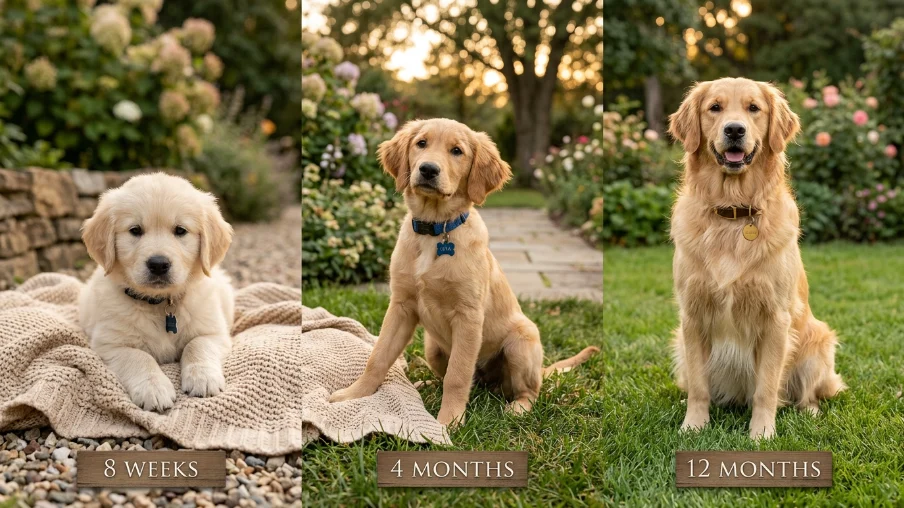
| Age | Stage | Key Milestones | Owner Priorities |
| Birth–2 Weeks | Neonatal | Eyes and ears closed; reflexive responses only | Leave entirely with mother; no disruption |
| 2–4 Weeks | Transitional | Eyes and ears open; first steps; beginning to interact with littermates | Brief daily handling acceptable |
| 4–7 Weeks | Socialization (canine) | Play with littermates; bite inhibition learning; canine communication development | Do not remove early; this period is critical for dog-dog social skills |
| 7–12 Weeks | Prime Human Socialization Window | Peak brain plasticity for human world exposure | Introduce new sounds, surfaces, people, animals, environments daily and positively |
| 3–6 Months | Juvenile Period | Rapid growth; teething; testing rules | Puppy classes; leash training; consistent house rules |
| 6–12 Months | Adolescence | Hormonal changes; testing limits; potential regression in training | Maintain consistent training; avoid intense exercise; discuss spay timing with vet |
| 12–18 Months | Late Adolescence | Growth plates closing; adult coat developing; temperament clarifying | More structured activity; continued socialization |
| 18–24 Months | Emerging Maturity | Mental steadiness improving; female Goldens often notably calmer than males at this stage | Advanced training; establish adult exercise routine |
| 2–3 Years | Full Maturity | Complete physical and mental development | Reliable, trained companion; establish annual health screening |
Note on female maturity: Female Golden Retrievers typically reach behavioral maturity noticeably earlier than males many female Golden owners describe a meaningful calming-down between 18 months and 2 years that male owners often do not experience until 2.5–3 years.
Spay Timing An Important Decision
This is one of the most important health decisions female Golden Retriever owners will make and one of the most frequently mishandled.
Traditional advice: Spay before the first heat (around 6 months). This remains common veterinary guidance.
Current research: A landmark study from the University of California, Davis (Torres de la Riva et al., 2013, updated in subsequent research) found that early spaying (before 12 months) in Golden Retrievers was associated with significantly higher rates of joint disorders and certain cancers including the very cancers the breed is already predisposed to.
What this means practically:
- Many veterinarians now recommend delaying spay in Golden Retrievers until 12–18 months minimum, allowing hormonal development to complete
- This needs to be discussed individually with your veterinarian your dog’s specific circumstances, lifestyle, and risk factors matter
- An intact female in heat requires strict management to prevent unwanted pregnancy this is a real commitment
Avoiding this conversation or defaulting to convenience-based early spay without understanding the research is a mistake. Ask your veterinarian specifically about the UC Davis Golden Retriever spay research.
Feeding and Nutrition
Female Golden Retrievers are notorious for their appetite. They will eat enthusiastically, eat quickly, and, if allowed, eat to obesity which is one of the most preventable causes of joint deterioration and reduced lifespan in the breed.
Feeding guidelines:
| Life Stage | Food Type | Meals Per Day |
| 8–16 weeks | Large-breed puppy kibble | 3–4 meals |
| 4–12 months | Large-breed puppy formula | 3 meals |
| 12 months+ | Large-breed adult formula | 2 meals |
| Senior (8+ years) | Senior formula or vet-recommended | 2 meals |
Key feeding principles:
- Use a large-breed puppy formula specifically controls calcium/phosphorus ratios and caloric density to support healthy skeletal development
- Measure every meal; do not free-feed
- Slow feeder bowls reduce eating speed and lower bloat risk
- Body condition scoring: you should feel ribs easily without pressing, see a visible waist from above, and see a tuck behind the ribcage from the side
- A slim Golden Retriever lives longer than an overweight one the research on this is consistent
Weight management: Female Goldens at 55–65 lbs are at their ideal range. Many pet-owned females trend toward 70–75+ lbs due to overfeeding and under-exercising. Even modest excess weight accelerates hip and elbow degeneration significantly.
Grooming Guide
The Golden Retriever double coat is beautiful and high-maintenance. Owners who underestimate the grooming commitment end up with matted coats, excessive shedding throughout the home, and unnecessary stress for the dog.
Grooming schedule:
| Task | Frequency |
| Full brush-out | 3–4 times per week; daily during shedding seasons |
| Bath | Every 4–6 weeks |
| Nail trimming | Every 3–4 weeks |
| Ear cleaning | Monthly; check weekly for redness, odor, or discharge |
| Teeth brushing | Daily ideally; minimum 3 times per week |
| Feathering tidy (optional) | Every 6–8 weeks |
| Seasonal de-shed | Twice yearly during spring and fall coat blows |
Recommended tools:
- Slicker brush for the outer coat
- Undercoat rake or Furminator for loose undercoat removal
- Pin brush for long feathering
- Steel comb for checking thoroughness if the comb runs through smoothly, the coat is tangle-free
- High-velocity dryer for bath day blowout dramatically reduces drying time and loose hair
Ear care note: Golden Retrievers with their pendulous ears and love of swimming are highly prone to ear infections. Dry ears thoroughly after water exposure. A cotton ball wipe with a vet-recommended ear cleaner monthly helps prevent chronic infections.
To shave or not to shave: Do not shave a Golden Retriever’s coat in summer. The double coat provides insulation against heat as well as cold; shaving disrupts this function and can cause coat texture changes. Regular brushing and de-shedding is the correct summer management approach.
Step-by-Step Daily Care Guide
Daily routine for a female Golden Retriever:
- Morning exercise 30–45 minute walk, run, or play session; swimming where available
- Morning meal measured; use slow feeder if she eats too quickly
- Training session 10–15 minutes of obedience, trick training, or enrichment work
- Mental enrichment mid-day puzzle feeder, Kong, sniff walk, or training game
- Rest period adult Goldens sleep 12–14 hours daily; structure rest into the routine
- Afternoon/evening exercise second structured walk or outdoor play
- Evening meal measured; no vigorous exercise within 30–60 minutes of eating
- Evening brush even a 5-minute daily brush dramatically reduces seasonal shedding buildup
- Calm wind-down structured settle time; prevents demand behaviors in the evening
Weekly additions: Nail check, ear inspection, teeth cleaning, full coat brush-out, and weight check (keep a log).
Common Owner Mistakes
1. Overfeeding and underweighting the health consequences Golden Retrievers are enthusiastic eaters and excellent beggars. An overweight Golden is not a happy, well-loved dog it is a dog being set up for joint problems and a shorter life. Treat amounts count toward daily caloric intake.
2. Skipping early socialization out of caution The 7–12 week window is when the brain is most open to new experiences. Puppy owners who delay exposure until vaccines are complete sometimes 14–16 weeks miss the most critical period. Controlled exposure in safe environments during this window is more important than eliminating all disease risk.
3. Assuming a calm temperament means training is optional Golden Retrievers are gentle enough that owners often feel training is less urgent. It is not. An untrained 65-lb Golden Retriever that jumps on guests, pulls on leash, counter surfs, and ignores recall is a significant management problem and it is avoidable.
4. Incorrect spay timing without research Spaying at 6 months because “that’s what the vet said” without asking about the UC Davis spay timing research is a missed opportunity. This is a decision worth having a detailed conversation about not defaulting to a schedule designed for population control rather than individual health optimization.
5. Neglecting ear maintenance Golden Retriever ear infections are common, painful, and expensive to treat repeatedly. A monthly ear cleaning routine and thorough drying after swimming prevents most of them.
6. Underestimating shedding Golden Retrievers shed year-round and blow their coat heavily twice a year. Owners who are not prepared for significant hair on clothing, furniture, and flooring are frequently caught off guard. There is no low-maintenance version of Golden Retriever coat management.
7. Treating independence as a problem Female Goldens are sometimes described by their owners as “not as cuddly” as expected compared to males. This is not a personality defect it is normal female Golden temperament. She is affectionate but will seek interaction on her own terms more often than a male.
Insights Most Articles Miss
The cancer conversation should happen before purchase not after
Most Golden Retriever content discusses cancer as a footnote. It should be a primary topic in any honest buyer’s guide. Before purchasing a female Golden, ask the breeder for cancer history across three or more generations of their lines. Good breeders track this data. Breeders who cannot or will not answer this question are not tracking longevity and that tells you something important.
English vs. American type differences are real
English-type (British) Golden Retrievers broader heads, stockier bodies, cream to golden coats have been marketed heavily in the US under names like “English Cream Golden Retriever” or “Rare White Golden Retriever.” These are not separate breeds and the coat color is not rare. However, some research does suggest English-type Goldens may have somewhat lower cancer rates than American lines, though this research is ongoing and not conclusive enough to be treated as a guarantee. If a breeder prices English Cream puppies at $4,000–$6,000+ based on “rarity,” they are misleading you.
Field line vs. show line temperament difference
Field-bred (working) Golden Retrievers carry noticeably higher energy, drive, and intensity than show-bred lines. A female from working field lines may retrieve relentlessly, have strong prey drive, and require substantially more exercise than a show-line female. Both are Golden Retrievers. Neither is better but they suit different owner lifestyles. Know which type you are buying.
Female Goldens and separation anxiety
The deep bonding characteristic of the breed beautiful in many contexts can become problematic for owners with demanding work schedules. Female Goldens that are left alone for extended periods without enrichment or companionship routinely develop anxiety behaviors: destructive chewing, vocalization, house soiling, and self-directed behaviors. This is not a training failure; it is a breed characteristic being placed in an incompatible environment.
Price Guide and Ownership Costs
Puppy Prices (2026):
| Source | Price Range | Notes |
| Reputable health-tested breeder | $1,500–$3,500 | Full health clearances, socialized litters, health guarantee, breeder support |
| English/British type breeders | $2,500–$5,000+ | Legitimate health-tested programs exist; also significant price inflation on “rarity” |
| Backyard breeders | $800–$1,500 | Variable health testing; often no OFA certifications |
| Rescue / adoption | $50–$500 | Adult dogs most common; puppies occasionally available |
| Puppy mills / brokers | $1,000–$2,500 | Avoid entirely regardless of price |
Annual ownership costs (estimated):
| Expense | Annual Cost (USD) |
| High-quality food | $900–$1,500 |
| Routine veterinary care | $400–$800 |
| Parasite prevention (flea, tick, heartworm) | $200–$450 |
| Pet insurance | $600–$1,200 (critical for this breed given cancer risk) |
| Grooming supplies or professional grooming | $200–$800 |
| Training (Year 1 especially) | $300–$1,000 |
| Toys, enrichment, supplies | $200–$500 |
| Total Annual Estimate | $2,800–$6,250 |
Pet insurance note: Given the Golden Retriever’s documented cancer rates, pet insurance is not optional it is a financially sound decision for this breed specifically. Cancer treatment (surgery, chemotherapy, radiation) for Golden Retrievers routinely reaches $5,000–$15,000+. Insure before any conditions develop; insurers do not cover pre-existing conditions.
How to Find a Reputable Breeder
What a reputable Golden Retriever breeder does:
- Tests both parents for hips (OFA or PennHIP), elbows, heart (cardiologist exam), eyes (ophthalmologist CAER), and PRA DNA
- Tracks health and longevity data across multiple generations of their lines
- Raises puppies in the home with structured socialization from birth
- Uses a waitlist does not always have puppies available
- Interviews buyers; asks about lifestyle, experience, and daily routine
- Provides a written contract with health guarantee and return policy
- Stays connected with buyers after placement
- Is affiliated with the Golden Retriever Club of America (GRCA) or regional breed clubs
Breeder red flags:
- Puppies always available; no waitlist
- Multiple breeds produced simultaneously
- OFA paperwork unavailable or unverifiable
- Parents not on-site or not available to meet
- Puppies offered at 6–7 weeks
- “English Cream” or “rare white” marketing used to justify extreme prices
- No written contract or health guarantee
- Meeting buyers in parking lots or public locations rather than the breeding home
Where to search:
- Golden Retriever Club of America (GRCA) grca.org breeder referral network
- AKC Marketplace with health testing filter
- Regional Golden Retriever club websites
Questions to Ask Before Buying
- Can I verify both parents’ OFA results in the public OFA database?
- Do you test for PRA, ichthyosis, and pigmentary uveitis in your lines?
- What is the cancer history across multiple generations of your breeding lines?
- How do you socialize puppies before placement?
- What is your minimum placement age?
- What does your health guarantee cover and for how long?
- What is your policy if I can no longer keep the dog?
- How many litters do you produce per year?
- Can I meet the dam and, if available, the sire in person?
- What temperament differences do you see between puppies in this litter, and how do you match them to homes?
Buyer Warning Section
“English Cream” or “Rare White” upcharging. White-appearing Golden Retrievers are not a separate breed, not rare, and do not command a quality premium simply for pale coat color. A $4,000–$6,000 “English Cream” puppy from unhealth-tested parents is worse value than a $2,000 puppy from fully cleared lines. Do not pay for color marketing.
No health clearances “because the parents are healthy.” Visual health does not substitute for OFA certification. Hip dysplasia and heart conditions frequently exist without visible symptoms. A breeder who says “we don’t need tests because our dogs are healthy” is telling you they have not tested not that their dogs are clear.
Puppies available immediately with no waitlist, multiple litters yearly. Reputable breeders have waitlists and produce limited litters. A breeder producing 5–10 litters per year across multiple breeds with puppies always available is operating as a commercial producer, not a responsible hobby breeder.
Shipping newborn puppies across country. Reputable breeders are selective about where their puppies go and typically prefer local or regional placement where they can maintain contact. Breeders who will ship a puppy to anyone, anywhere, immediately, are prioritizing sale volume.
Selling puppies before 8 weeks. The 7th and 8th weeks of life are when bite inhibition and canine social skills develop through littermate interaction. Early removal has documented behavioral consequences. This is non-negotiable.
Lifestyle Compatibility
| Lifestyle Factor | Suitable? | Notes |
| Families with children | Outstanding | One of the very best family breeds; patient, gentle, reliable with children |
| Young children (under 5) | Excellent with supervision | Size and exuberance of a young Golden can knock over toddlers; management appropriate |
| Apartments | Possible | Exercise commitment is essential; yard helpful but not required |
| Active, outdoor owners | Excellent | Thrives hiking, swimming, running; built for active lifestyle |
| Work-from-home owners | Excellent | Loves proximity to family; very content with company |
| Full-time working homes (alone 8+ hours) | Not recommended without support | Separation anxiety risk; needs dog walker, daycare, or companion |
| Multi-dog households | Excellent | Generally social and compatible with other dogs |
| Cats and small pets | Good with early exposure | Retrieving instinct present but typically manageable; early socialization important |
| First-time dog owners | Excellent | One of the best breeds for first-time owners committed to training |
| Senior or low-mobility owners | Caution | Exercise needs are real; requires daily commitment |
| Cold climates | Excellent | Double coat provides good insulation |
| Hot climates | Manageable with care | Avoid midday exercise; provide water and shade; never shave the coat |
Breed Comparisons
| Feature | Female Golden Retriever | Female Labrador Retriever | Female Flat-Coated Retriever |
| Weight | 55–65 lbs | 55–70 lbs | 55–70 lbs |
| Coat | Long, double, high shedding | Short, dense, moderate shedding | Long, dense, moderate maintenance |
| Temperament | Gentle, affectionate, sensitive | Outgoing, energetic, slightly less sensitive | Exuberant, playful, slower to mature |
| Trainability | Excellent | Excellent | Very good |
| Cancer Risk | High (breed-specific concern) | Lower than Goldens | Elevated (histiocytic sarcoma specific risk) |
| Maturity Age | 18 months–2 years | 2–2.5 years | 3–4 years (“Peter Pan breed”) |
| Good For First-Time Owners | Excellent | Excellent | Moderate (energy and maturity timeline) |
| Health Testing Importance | Critical | High | High |
Preparation Checklist
Before your female Golden Retriever puppy comes home:
Essentials:
- [ ] Large-breed crate sized for adult (Golden females: 42-inch crate suitable)
- [ ] Crate pad or washable bedding
- [ ] Puppy exercise pen for supervised freedom
- [ ] Stainless steel food and water bowls (consider slow feeder for meals)
- [ ] Flat collar, ID tag with contact information
- [ ] 4–6 foot leash; front-clip harness for leash training
- [ ] Large-breed puppy food (same brand as breeder uses initially)
- [ ] Selection of chew toys and enrichment items
- [ ] Grooming brush, undercoat rake, nail clippers
Appointments and planning:
- [ ] Veterinarian appointment scheduled within 72 hours of pickup
- [ ] Puppy obedience class enrolled or waitlisted
- [ ] Family rules agreed upon (furniture access, sleeping location, feeding schedule)
- [ ] Emergency veterinary clinic located
- [ ] Pet insurance quotes obtained and policy selected
Documents to collect from breeder:
- [ ] AKC registration paperwork
- [ ] Written health guarantee and contract
- [ ] OFA certification copies for both parents
- [ ] PRA and ichthyosis DNA test results
- [ ] Vaccination and deworming records
- [ ] Feeding schedule and current food information
FAQs
Q: What is a female Golden Retriever’s temperament like compared to a male? Female Golden Retrievers tend to mature earlier, train with slightly more focus during adolescence, and can be a bit more independent in their affection-seeking. Males are often more overtly demonstrative and slower to mature. Both make excellent companions; the individual dog’s temperament and breeding line matters more than gender.
Q: How big do female Golden Retrievers get? The AKC breed standard for females is 21.5–22.5 inches at the shoulder and 55–65 lbs. Pet-bred females occasionally run heavier 70 lbs or more due to overfeeding. Show-bred females from reputable lines typically fall within the standard range.
Q: Are female Golden Retrievers good with children? Yes Golden Retrievers are among the most reliably gentle large breeds with children. Females share this quality fully. Appropriate supervision is always recommended with young children and any large dog, but the breed’s temperament with children is genuinely one of its most consistent traits.
Q: Do female Golden Retrievers have more health problems than males? There is no documented pattern of females having significantly higher health risk than males within the breed. Both genders share the same breed-wide predispositions: cancer, hip and elbow dysplasia, heart conditions, and eye disease. The most important factor is the health testing done on the breeding parents.
Q: When should I spay my female Golden Retriever? Current research suggests waiting until at least 12–18 months and some veterinary specialists recommend waiting until 24 months to allow hormonal development to support joint and immune system maturity. Discuss this specifically with your veterinarian in the context of the UC Davis spay timing research. Do not default to early spay (6 months) without this conversation.
Q: How long do female Golden Retrievers live? Average lifespan is 10–12 years. Dogs from health-tested lines, maintained at healthy weight, given regular veterinary care, and kept active typically reach the higher end of this range. The breed’s cancer rates mean that some dogs are lost earlier; longevity-focused breeding programs are worth seeking out.
Q: Do female Golden Retrievers shed a lot? Yes. Year-round shedding with two heavy seasonal coat blows in spring and fall. This is non-negotiable for the breed. Regular brushing (3–4 times weekly minimum) is the most effective management tool. There is no low-shed Golden Retriever.
Q: Are female Golden Retrievers easy to train? Yes they are among the most trainable breeds available. They respond excellently to positive reinforcement, are food-motivated, and genuinely want to work with their handlers. Female Goldens in particular tend to focus efficiently during training sessions. The ease of training does not mean training can be skipped it means the investment pays off quickly.
Q: Can a female Golden Retriever live in an apartment? Yes, with adequate daily exercise commitment. The breed adapts to a range of living situations if their exercise and mental stimulation needs are met. A Golden Retriever in a small space with a committed owner will thrive; a Golden in a large house with a sedentary owner will not.
Q: What is the difference between an English Golden Retriever and an American Golden Retriever? English (British) type Goldens are stockier, with broader heads and lighter, cream-colored coats. American type Goldens are leaner, with a longer muzzle and darker golden coats. These are not separate breeds they are regional breeding variations of the same breed. Neither type is inherently superior in health or temperament, though some preliminary research suggests English-type lines may have modestly lower cancer rates.
Conclusion
A female Golden Retriever is not just a popular choice she is, for the right owner, a genuinely exceptional companion. The combination of intelligence, trainability, gentleness with children, and emotional attunement to her family is not found in many breeds at this level. She matures earlier than the male, trains efficiently, and brings a calm steadiness to the household that owners consistently describe as irreplaceable.
But there is no responsible way to discuss this breed without being honest about the health landscape. The Golden Retriever’s cancer rates are real, documented, and among the highest of any breed. Choosing a female Golden Retriever means choosing to be proactive: understanding the spay timing research, insuring the dog before conditions develop, selecting a breeder who tracks longevity data across generations and committing to annual health monitoring.
The owners who do this work who choose carefully, train consistently, feed responsibly, and build a real partnership with their dog will tell you the same thing: there is no better dog for family life.
The owners who choose for appearance alone, skip the breeder research, and treat the breed as a passive, low-maintenance companion frequently find themselves overwhelmed, underprepared, or heartbroken earlier than they should be.
Do the work before you bring her home. She will give you everything in return.