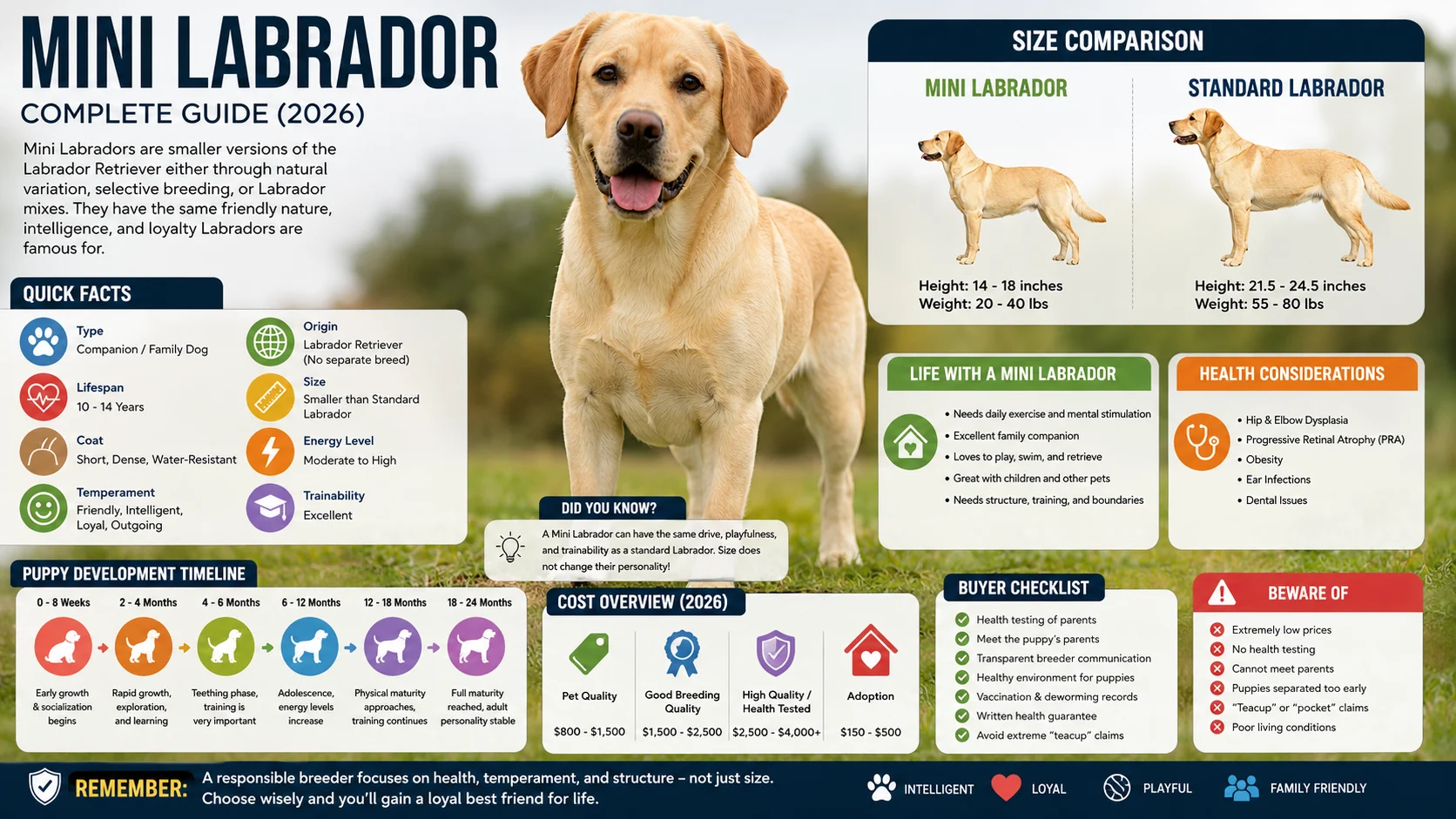
A Mini Labrador is not a separate officially recognized Labrador Retriever breed; the term usually describes an unusually small Labrador, a selectively bred smaller dog, a dwarf Labrador, or sometimes a Labrador mix.
The biggest mistake is assuming “mini” automatically means healthier, easier, or better suited to small homes. Experienced breeders evaluate genetics, structure, temperament, and health before size.
Quick Snapshot Table
| Category | Details |
|---|---|
| Common Name | Mini Labrador |
| Official Breed | No separate Mini Labrador breed |
| Parent Breed | Labrador Retriever |
| Typical Adult Size | Smaller than the standard Labrador |
| Coat | Short, dense, water resistant |
| Temperament | Friendly, intelligent, affectionate |
| Energy Level | Moderate to high |
| Trainability | Excellent |
| Exercise Needs | Daily physical and mental activity |
| Main Health Concern | Depends on how small size was produced |
| Lifespan | Varies with genetics and overall health |
| Best Owner | Active, responsible household |
| Biggest Buyer Risk | Misleading “mini” marketing |
What Exactly Is a Mini Labrador?
The phrase “Mini Labrador” sounds straightforward, but it can describe several very different dogs.
There is no universally recognized separate miniature Labrador breed comparable to how people might describe an established small breed.
Instead, sellers may use “Mini Labrador” to describe:
- A naturally small Labrador Retriever
- A Labrador affected by a genetic growth disorder
- A selectively bred smaller Labrador
- A Labrador mixed with a smaller breed
- A puppy advertised as miniature primarily for marketing purposes
That distinction matters.
A healthy Labrador that happens to mature below the typical size range is very different from a dog deliberately produced through questionable breeding practices.
Here is where most people get it wrong: small size does not tell you how the dog was produced.
Why Are Some Labradors Smaller?
Natural Size Variation
Labrador Retrievers naturally vary in height and weight.
Some healthy dogs simply mature toward the smaller end of the normal range.
Factors include:
- genetics
- sex
- bloodline
- nutrition
- skeletal structure
- overall health
A smaller Labrador is not automatically a “Mini Labrador.”
Dwarfism
Another possibility is genetic dwarfism.
Certain inherited conditions can interfere with normal skeletal development and growth.
This is fundamentally different from having a naturally small Labrador.
A dog with dwarfism may experience additional structural or medical complications, making intentional breeding for extremely small size ethically problematic.
Labrador Mixes
Some dogs marketed as Mini Labradors are actually Labrador crosses.
A breeder may cross a Labrador Retriever with a smaller breed to reduce adult size.
The resulting dog can be a perfectly legitimate mixed breed, but calling it a purebred Mini Labrador is misleading.
Genetics Behind Miniature Labradors
Why Genetics Matter More Than the Label
There is no single “Mini Labrador gene” that automatically produces a healthy miniature version of a standard Labrador.
Small size can arise through several genetic pathways.
Some forms of disproportionate dwarfism involve specific mutations affecting skeletal development, while ordinary size variation results from the combined influence of many genes.
That is why responsible breeders should be able to explain exactly why their dogs are smaller.
A Useful Buyer Question
Instead of asking:
“How small will my Mini Labrador be?”
Ask:
“What genetic and breeding decisions produced this size?”
That question often tells you more about the breeder than the advertised puppy size.
Mini Labrador vs Standard Labrador
| Feature | Mini Labrador | Standard Labrador |
|---|---|---|
| Official Breed Status | Not a separate breed | Established breed |
| Adult Size | Variable | Larger, established breed range |
| Genetics | Depends on individual breeding | Labrador Retriever genetics |
| Temperament | Usually Labrador like if purebred | Friendly, outgoing, trainable |
| Energy | Can still be high | Moderate to high |
| Exercise | Still required | Significant daily exercise |
| Predictability | Depends heavily on breeder | More predictable |
| Buyer Risk | Higher if marketed as “rare” | Lower with responsible breeder |
| Health | Depends on how small size was achieved | Known breed health considerations |
Temperament and Personality
A smaller body does not automatically create a calmer Labrador.
This is another common misconception.
A Mini Labrador can still inherit the classic Labrador personality:
- affectionate
- people oriented
- food motivated
- playful
- intelligent
- energetic
- eager to retrieve
If the dog comes from genuine Labrador genetics, owners should expect Labrador behavior even when the dog is smaller.
Are Mini Labradors Calm?
Not necessarily.
Many Labradors remain enthusiastic well into adulthood.
A smaller Labrador may still:
- carry toys everywhere
- jump when excited
- demand interaction
- retrieve obsessively
- become destructive when bored
The physical size may change.
The underlying temperament does not automatically change with it.
Intelligence and Trainability
Labradors are generally highly trainable dogs, and smaller size does not remove that characteristic.
Positive reinforcement works particularly well because many Labradors are strongly motivated by food and interaction.
Training Priorities
Focus early on:
- recall
- loose leash walking
- impulse control
- polite greetings
- retrieving without possessiveness
- settling indoors
- appropriate chewing
The most important goal is not teaching dozens of tricks.
It is teaching the dog how to behave when excited.
Exercise Requirements
A common marketing claim is that a Mini Labrador needs very little exercise because it is small.
That is unreliable.
A compact Labrador can still have substantial energy.
Daily Activity Should Include
- walks
- retrieving games
- scent activities
- obedience training
- controlled play
- mental enrichment
Puppies should receive age appropriate activity rather than forced running or repetitive jumping.
Small Does Not Mean Low Energy
This distinction is especially important for apartment buyers.
A smaller Labrador may fit physically into a smaller home, but that does not mean it will automatically be content without exercise.
Mental stimulation becomes particularly important when outdoor space is limited.
Puppy Development Timeline
A Mini Labrador puppy should not be judged by appearance alone during the first few weeks.
Growth patterns become much more informative as the puppy matures.
| Age | Normal Development | What Owners Should Watch |
|---|---|---|
| 0–4 Weeks | Rapid early growth | Feeding and general development |
| 5–8 Weeks | Coordination and social behavior improve | Limb development and body proportions |
| 8–12 Weeks | Exploration increases | Confidence, movement and socialization |
| 3–4 Months | Growth becomes more obvious | Weight gain and skeletal proportions |
| 4–6 Months | Major juvenile growth | Body condition and joint comfort |
| 6–12 Months | Adolescence begins | Energy, training and structural development |
| 12–18 Months | Adult structure develops | Final size becomes easier to estimate |
| 18–24 Months | Physical maturity progresses | Adult body condition and muscle development |
The First Few Months Can Be Misleading
A puppy that looks tiny at eight weeks is not necessarily going to remain unusually small.
Experienced breeders use:
- parental size
- pedigree information
- growth history
- genetic testing
- veterinary evaluation
rather than promising an exact adult weight from appearance alone.
When Size Becomes Easier to Predict
By several months of age, growth patterns provide more useful information than the puppy’s appearance at eight weeks.
Even then, responsible breeders should avoid guaranteeing an exact adult weight.
Health and Genetic Considerations
The health of a Mini Labrador depends heavily on why the dog is small.
That is the question buyers should investigate.
Labrador Health Risks
Labradors can be predisposed to several health problems, including:
- hip dysplasia
- elbow dysplasia
- obesity
- certain inherited eye disorders
- exercise related orthopedic problems
The specific risks depend on genetics and breeding quality.
Why Extreme Miniaturization Can Be Concerning
Trying to produce dramatically smaller dogs can create pressure to prioritize body size over structural health.
Potential concerns may include:
- abnormal limb proportions
- joint problems
- skeletal weakness
- dental abnormalities
- reduced athletic ability
The smaller the advertised dog becomes, the more carefully buyers should investigate how that size was achieved.
Health Testing to Ask Breeders About
Parent Health Screening
Responsible Labrador breeders should be willing to discuss health testing relevant to the breed.
Ask about:
- hip evaluations
- elbow evaluations
- ophthalmic examinations
- relevant DNA tests
- family health history
OFA and Other Health Documentation
Do not settle for a breeder saying:
“The parents are healthy.”
Ask for documentation.
A health-tested parent is not a guarantee that every puppy will be disease free, but documented screening provides considerably more information than verbal assurances.
Grooming and Coat Care
The classic Labrador coat is relatively easy to maintain.
Mini Labradors with genuine Labrador coats typically need:
- weekly brushing
- more frequent brushing during shedding seasons
- regular nail trimming
- routine ear checks
- occasional bathing
Shedding Is Still Real
A smaller Labrador can still leave plenty of hair around the house.
Do not choose a Mini Labrador expecting miniature shedding.
The coat may be shorter than that of many breeds, but Labrador shedding can be substantial.
Feeding a Mini Labrador Puppy
Nutrition deserves special attention when a puppy is expected to remain unusually small.
Avoid Overfeeding
Labrador Retrievers have a well known tendency toward weight gain.
Overfeeding a puppy can place unnecessary stress on developing joints.
Feed according to:
- age
- body condition
- activity level
- veterinary guidance
- growth pattern
Do not attempt to manipulate growth simply to keep the dog smaller.
Body Condition Matters More Than the Scale
A healthy dog should not be judged by weight alone.
Look at:
- visible waist
- abdominal tuck
- rib coverage
- muscle development
- overall proportions
A small dog carrying excess body fat can still develop orthopedic problems.
Buyer Warning: The “Teacup Labrador” Problem
Be Careful With Extremely Small Claims
Terms such as:
- teacup Labrador
- micro Labrador
- pocket Labrador
- toy Labrador
should immediately trigger additional questions.
These names are marketing terms rather than established Labrador breed varieties.
Questions to Ask Before Paying a Deposit
Ask the breeder:
- Are both parents Labrador Retrievers?
- What are their adult heights and weights?
- Why are these puppies expected to be smaller?
- Have the parents undergone breed appropriate health testing?
- Can I see veterinary records?
- Are there genetic test results?
- Can I meet the mother?
- How old are the puppies before they leave?
- What health guarantee is provided?
- Are you breeding specifically for extreme small size?
A breeder who becomes defensive about reasonable health questions is worth reconsidering.
Common Mistakes Buyers Make
Mistake 1: Assuming Smaller Means Easier
A smaller Labrador can still be energetic, mouthy, playful, and demanding.
Mistake 2: Paying a Premium for “Rare” Size
Some sellers charge dramatically more because a puppy is advertised as miniature.
Rarity should never replace health evidence.
Mistake 3: Confusing a Mix With a Purebred
Always ask whether the parents are registered Labrador Retrievers or whether another breed has been introduced.
Mistake 4: Choosing Appearance Over Structure
A tiny body may look appealing in photographs.
But sound movement, good joints, stable temperament, and healthy development matter much more.
Mistake 5: Expecting a Puppy to Stay Tiny
Growth is unpredictable.
Do not purchase a puppy solely because someone promises it will remain under a particular weight.
Insights Most Articles Miss
The Word “Mini” Can Hide Several Different Genetic Stories
Two dogs advertised as Mini Labradors could be completely different genetically.
One may simply be a naturally small Labrador.
Another may be a mixed breed.
Another may have a growth disorder.
Treat the label as a starting point, not proof of anything.
Small Size Does Not Remove Labrador Drive
Retrieving instinct, food motivation, playfulness, and social attachment can remain strong.
Owners should prepare for the temperament of a Labrador rather than the expectations associated with a tiny companion dog.
Structure Matters More Than the Final Number on the Scale
A healthy compact dog with balanced proportions is a much better outcome than an extremely small dog with compromised skeletal development.
This is one of the most important distinctions responsible breeders make.
Mini Labrador Cost
Why Prices Vary So Much
The purchase price can depend on:
- breeder reputation
- pedigree
- location
- health testing
- registration
- puppy raising practices
- whether the dog is purebred or mixed
Be especially skeptical when a breeder claims that unusual size alone makes a puppy worth substantially more.
What You Are Really Paying For
A responsible purchase should provide more than a cute puppy.
Look for evidence of:
- appropriate veterinary care
- health screening
- responsible breeding
- early socialization
- transparent records
Lifestyle Compatibility
| Household | Suitability |
|---|---|
| Active family | Excellent |
| Experienced Labrador owner | Excellent |
| Apartment with daily exercise | Possible |
| Sedentary household | Poor |
| First time owner | Usually manageable with training |
| Family wanting a very calm dog | Poor match |
| Owner wanting a “teacup” companion | Consider another breed |
Is a Mini Labrador Right for You?
A Good Match If You Want
- Labrador temperament
- a somewhat smaller dog
- an affectionate companion
- an intelligent trainable dog
- an active family pet
Think Twice If You Want
- a genuinely low energy dog
- guaranteed adult size
- very little shedding
- a dog requiring minimal training
- a miniature dog primarily for appearance
Preparation Checklist
Before Buying
- Confirm exactly what “Mini Labrador” means to the breeder
- Meet the puppy’s mother
- Ask about the father
- Review health testing
- Ask about genetic screening
- Check veterinary records
- Examine the puppy’s movement
- Look for balanced body proportions
- Ask about expected adult size without demanding guarantees
- Avoid extreme miniature marketing claims
Before Bringing the Puppy Home
- Quality age appropriate food
- Secure sleeping area
- Food and water bowls
- Puppy safe toys
- Collar and identification
- Grooming equipment
- Veterinary appointment
- Training plan
- Socialization plan
Frequently Asked Questions
Is a Mini Labrador a real breed?
No. Mini Labrador is not a separate standardized Labrador Retriever breed. The term can refer to a naturally small Labrador, a dog with dwarfism, a smaller selectively bred dog, or a Labrador mix.
How small does a Mini Labrador get?
There is no official size standard. Adult size varies depending on genetics and how the dog was produced. Be cautious of breeders guaranteeing extremely small adult weights.
Are Mini Labradors healthier than normal Labradors?
Not necessarily. Smaller size does not automatically improve health. If extreme size has been prioritized, structural and genetic concerns may actually increase.
Are Mini Labradors good family dogs?
They can be excellent family companions when they have stable Labrador temperament and appropriate health. However, their smaller size does not eliminate the breed’s exercise and training requirements.
Do Mini Labradors shed?
Yes. A smaller Labrador can still shed heavily, particularly during seasonal coat changes.
Are Mini Labradors expensive?
Prices vary widely. A breeder charging a premium solely because a puppy is advertised as “mini” should be approached carefully. Health testing and responsible breeding are more important than unusual size.
Is a Mini Labrador the same as a dwarf Labrador?
No. A naturally small Labrador is not necessarily affected by dwarfism. Dwarfism is a genetic developmental disorder and can involve additional health problems.
Can you breed a Labrador to stay miniature?
There is no simple, reliable method for creating a healthy miniature version of the Labrador Retriever. Breeding specifically for extreme small size can introduce significant ethical and structural concerns.
Conclusion
The Mini Labrador is one of those dog terms that sounds much more official than it actually is.
There is no separate miniature Labrador breed with a standardized size. Instead, the label can describe several different situations, from a naturally small Labrador Retriever to a mixed breed or a dog affected by a genetic growth disorder.
That distinction should guide every buying decision.
If you are considering one, look past the word “mini.” Examine the parents, health testing, structure, temperament, genetics, and breeding practices.
The best small Labrador is not necessarily the smallest one.
It is the one that is healthy, structurally sound, mentally stable, and bred responsibly.