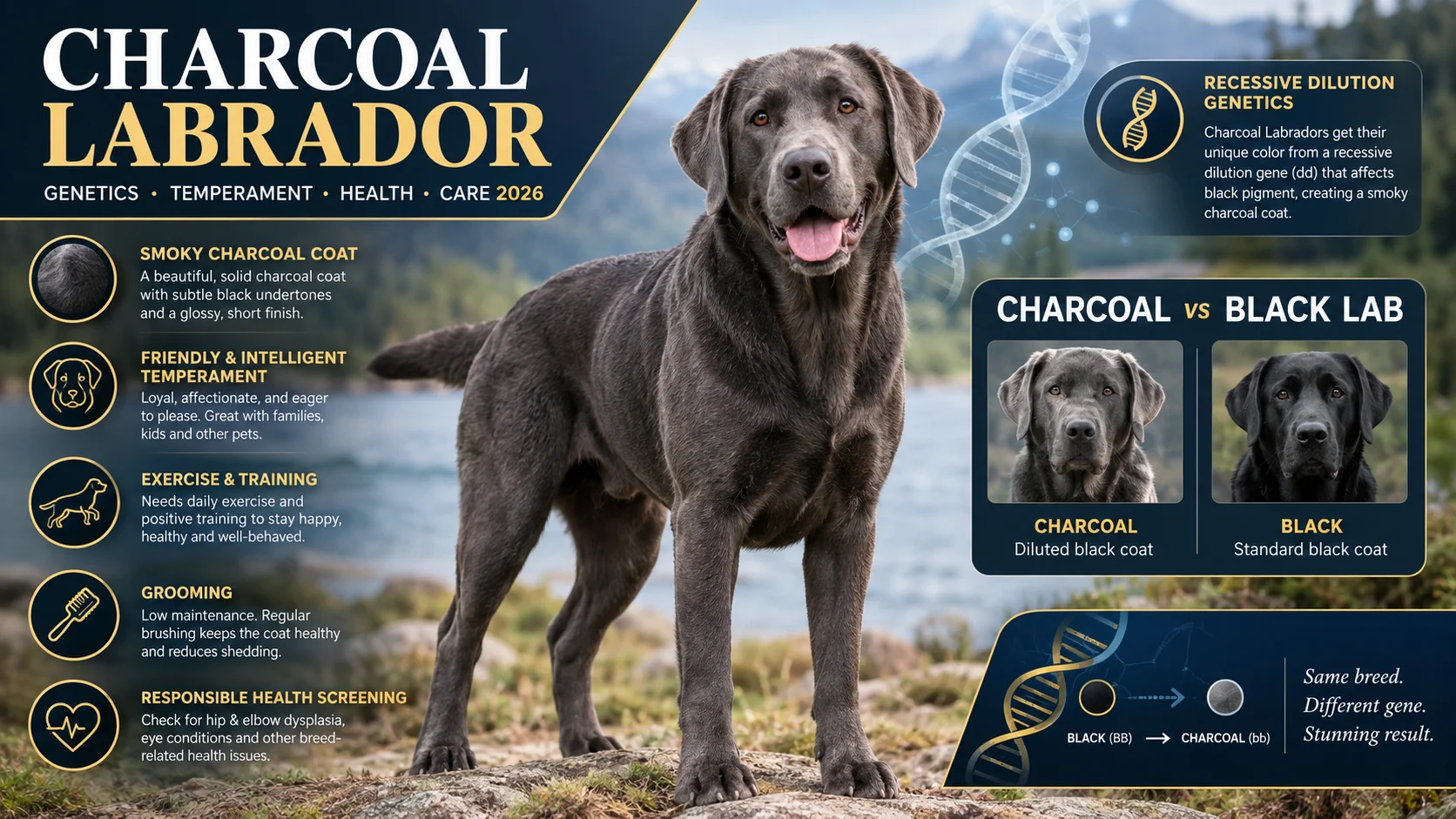
A Charcoal Labrador is a Labrador Retriever with a diluted black coat that gives it a distinctive smoky gray or charcoal appearance. The color is linked to recessive dilution genetics, but charcoal is not a separate Labrador breed or an AKC-recognized standard color. Temperament, health, and working ability depend primarily on genetics, breeding quality, socialization, and care not coat color.
Quick Snapshot Table
| Category | Details |
|---|---|
| Breed | Labrador Retriever |
| Common Name | Charcoal Labrador |
| Coat Appearance | Diluted black, charcoal gray |
| Genetic Basis | Dilution at the D locus |
| Standard AKC Color | Not recognized as a separate standard color |
| Standard Labrador Colors | Black, yellow, chocolate |
| Height | About 21.5 to 24.5 inches |
| Weight | About 55 to 80 lbs |
| Temperament | Friendly, outgoing, intelligent |
| Energy Level | High |
| Trainability | Excellent |
| Grooming | Moderate shedding |
| Lifespan | Commonly around 11 to 13 years |
| Main Concern | Responsible breeding and health testing |
Labrador Retrievers are generally around 21.5 to 24.5 inches tall and 55 to 80 pounds, with a dense short double coat.
What Is a Charcoal Labrador?
A Charcoal Labrador is a Labrador Retriever with a coat that appears diluted from the traditional black color, producing a gray, smoky, or charcoal appearance.
The important distinction is that charcoal is not a fourth AKC-recognized Labrador color. The Labrador breed standard recognizes black, yellow, and chocolate.
The charcoal appearance is generally associated with the D locus, or dilute gene, which can reduce the intensity of black pigment.
This creates the unusual grayish appearance that attracts so much attention.
Is a Charcoal Lab Really a Labrador?
A dog can absolutely be genetically a Labrador Retriever and have a charcoal-looking coat.
However, the word “charcoal” itself does not establish:
- pedigree quality
- health quality
- working ability
- temperament
- registration status
That distinction matters when evaluating breeders.
Why Charcoal Labs Look Different
Normal black pigmentation produces a deep, rich black coat.
With pigment dilution, the black can appear significantly lighter.
Instead of:
Black → deep black pigmentation
you may see:
Diluted black → gray, smoky, charcoal appearance
Genetics are more complicated than a single color label, however. The American Kennel Club notes that Labrador coat color involves several loci, including the E, B, and D loci, and that gene interactions influence the final phenotype.
Does Charcoal Mean Blue?
Not exactly.
“Blue” is commonly used in dog color terminology for dilute black pigmentation, while “charcoal” is the term frequently used by Labrador breeders and sellers for a diluted black Labrador.
The terminology can therefore become confusing.
A buyer should ask for the dog’s:
- pedigree
- registration information
- genetic testing
- health clearances
rather than relying on the marketing name alone.
Charcoal Labrador Genetics Explained
The Role of the D Locus
The D locus is associated with pigment dilution.
A dog carrying two copies of a relevant recessive dilute variant can show diluted pigmentation.
A simplified inheritance example is:
This illustrates why two carrier parents can produce a puppy expressing a recessive trait.
However, real canine coat genetics can involve multiple genes and variants, so a simple Punnett square should not be treated as a complete prediction of a Labrador’s appearance.
The AKC’s Labrador DNA guidance specifically includes testing related to the D locus and explains how different color genes interact.
Can Two Black Labs Produce Charcoal Puppies?
Potentially, if both parents carry the relevant recessive dilution variant.
That is one reason a puppy’s appearance alone cannot tell you what genes its parents carry.
A responsible breeder should be able to explain the genetic testing behind a planned litter.
Charcoal Labrador Appearance
A well built Charcoal Labrador should still look unmistakably like a Labrador.
You should expect:
- broad head
- strong muzzle
- expressive eyes
- compact feet
- dense double coat
- thick otter-like tail
- athletic body
- powerful rear drive
The charcoal coloration changes pigmentation.
It should not be an excuse for poor structure.
Coat Texture Matters More Than Color
The Labrador’s coat is a functional feature.
The breed standard describes a short, straight, dense coat with a weather-resistant undercoat.
Experienced breeders therefore evaluate:
- coat density
- texture
- body structure
- movement
- tail
- head
- temperament
before becoming impressed by unusual color.
Charcoal Labrador Temperament
A Charcoal Labrador should generally have the same fundamental temperament expected from a well-bred Labrador Retriever.
They are typically:
- affectionate
- outgoing
- intelligent
- trainable
- energetic
- people-oriented
- eager to retrieve
The AKC emphasizes that Labrador temperament is friendly, outgoing, intelligent, and eager to please. It also specifically notes that coat color does not determine character.
Does Charcoal Color Change Personality?
There is no good reason to assume that charcoal coloration automatically creates a different personality.
A charcoal Labrador is not inherently:
- calmer
- more aggressive
- smarter
- more stubborn
- more protective
than a black, yellow, or chocolate Labrador.
Here is where many online articles get it wrong.
Color is appearance. Temperament is a combination of genetics, breeding selection, early development, training, and environment.
Family Compatibility
A well-socialized Charcoal Labrador can be an excellent family dog.
They often enjoy:
- children
- outdoor activities
- retrieving games
- swimming
- training
- interactive play
But young Labs can be extremely energetic.
An owner expecting a quiet couch companion may be surprised by the first two years.
Training and Intelligence
Labradors are highly trainable because they tend to combine intelligence with a strong desire to interact with their handlers.
This makes them suitable for:
- obedience
- retrieving
- hunting
- dock diving
- agility
- service work
- detection work
- search and rescue
The breed’s working versatility is well established.
The Biggest Training Challenge
The problem usually isn’t intelligence.
It is enthusiasm.
A young Labrador may understand exactly what you want and still decide that:
- the sock is more interesting
- the visitor deserves attention
- the puddle is irresistible
- running is better than sitting
Consistent reinforcement and impulse-control training are therefore essential.
Exercise Requirements
A Charcoal Labrador should not be selected simply because it looks unusual.
It is still a Labrador.
Expect a dog that needs regular physical and mental activity.
Good Activities
| Activity | Benefit |
|---|---|
| Swimming | Full body exercise |
| Retrieving | Natural working instinct |
| Hiking | Physical conditioning |
| Obedience | Mental stimulation |
| Nose work | Focus and enrichment |
| Dock diving | Athletic outlet |
| Fetch | Simple daily exercise |
Avoid Creating an Overstimulated Dog
More exercise isn’t always the answer.
A young Labrador can become extremely fit without learning how to relax.
A balanced routine should include:
- exercise
- training
- play
- exploration
- quiet time
The goal is not an exhausted dog.
The goal is a physically fulfilled and mentally settled dog.
Charcoal Labrador Health
The charcoal coat itself should not become the main health consideration.
The bigger question is whether the dog comes from health-tested parents.
Labradors can be affected by inherited conditions involving:
- hips
- elbows
- eyes
- muscles
- neurological function
- metabolism
The AKC’s Labrador-specific DNA recommendations include numerous breed-relevant genetic conditions and tests.
Health Testing Matters
Before buying a puppy, ask the breeder about:
- hip evaluation
- elbow evaluation
- eye examinations
- breed-relevant DNA testing
- parent health records
The Orthopedic Foundation for Animals explains that genetic testing and phenotypic evaluations help responsible breeders reduce inherited disease through selective breeding.
OFA and Labrador Health Screening
OFA records can provide useful information about health evaluations.
For example, OFA hip records identify Labrador evaluations using the breed code “LR” and document ratings such as Excellent, Good, or Fair.
A breeder who proudly advertises coat color but cannot provide health documentation deserves extra scrutiny.
Dilution and Skin Health
This is an area buyers should discuss with a veterinarian rather than relying on internet claims.
Dilute pigmentation in dogs has been associated in some breeds with dilute coat color alopecia and other pigment-related skin problems.
However, it is important not to automatically diagnose every charcoal-looking Labrador with a skin disorder.
If a dog develops:
- hair thinning
- recurring skin infections
- scaling
- itching
- bald patches
a veterinarian should investigate the actual cause.
Do not assume the coat color is responsible.
Charcoal Labrador Puppy Development
A Charcoal Labrador puppy develops broadly like other Labrador puppies.
The color may be obvious early, but physical and behavioral maturity take much longer.
Puppy Development Timeline
| Age | Development |
|---|---|
| 8 to 12 Weeks | Socialization and basic training |
| 3 to 4 Months | Curiosity and confidence increase |
| 4 to 6 Months | Teething and impulse-control challenges |
| 6 to 12 Months | Adolescence begins |
| 12 to 18 Months | Strength and independence increase |
| 18 to 24 Months | Better emotional control |
| 2 to 3 Years | Adult temperament becomes more consistent |
What Owners Often Misjudge
A Labrador puppy can look physically mature before becoming emotionally mature.
That is especially important with large, energetic Labs.
A 70-pound adolescent that still behaves like an overexcited puppy can be difficult to manage without early training.
Grooming and Shedding
The charcoal coat does not eliminate normal Labrador shedding.
Expect:
- regular shedding
- seasonal coat changes
- loose undercoat
- muddy paws
- wet dog smell after swimming
Grooming Routine
A practical routine includes:
Several times per week
- brushing
- coat inspection
- checking ears
Regularly
- nail trimming
- dental care
- bathing when necessary
The Labrador’s dense double coat is functional and designed for outdoor work, so excessive shaving is generally unnecessary.
Feeding a Charcoal Labrador
Charcoal Labradors have the same basic nutritional considerations as other Labradors.
The major issue is portion control.
Labs can be enthusiastic eaters, and maintaining a healthy body condition is more important than making the dog look “thick.”
Puppy Feeding
Puppies need nutrition appropriate for:
- age
- growth rate
- expected adult size
- activity level
Avoid trying to accelerate growth.
Fast growth is not automatically healthy growth.
Adult Feeding
Monitor:
- body condition
- weight
- activity
- treats
- meal portions
A lean, athletic Labrador generally has a better long-term foundation than an overweight one.
Common Mistakes Charcoal Lab Owners Make
Mistake 1: Paying Primarily for Color
A rare-looking coat can create emotional buying decisions.
Don’t pay a premium simply because a puppy is gray.
Mistake 2: Assuming Charcoal Is a Separate Labrador Breed
It isn’t.
The dog remains a Labrador Retriever with a particular coat appearance.
Mistake 3: Ignoring Health Testing
This is potentially the biggest mistake.
A beautiful coat cannot compensate for:
- poor hips
- poor elbows
- inherited disease
- unstable temperament
Mistake 4: Expecting a Calm Puppy
Young Labradors are often energetic and mouthy.
Training should begin immediately after bringing the puppy home.
Mistake 5: Choosing a Breeder Based on Instagram Photos
Social media can show you a beautiful dog.
It cannot show you:
- orthopedic results
- genetic health
- temperament across generations
- breeding decisions
Insights Most Articles Miss
Charcoal Is Not the Same as “Rare Breed”
The dog is still a Labrador Retriever.
Calling the coat “rare” does not make the animal a separate variety.
Color Should Never Outrank Structure
A correctly built black Labrador with excellent health and temperament is a better breeding prospect than a poorly structured charcoal dog.
This is a basic principle responsible breeders understand.
Working Ability Still Matters
The Labrador was developed as a retrieving breed.
The best dogs should still possess:
- willingness to work
- trainability
- retrieving instinct
- sound movement
- stable temperament
Color Can Distract Buyers
The more unusual the appearance, the easier it is for buyers to overlook fundamentals.
That is exactly why you should evaluate the entire dog.
Charcoal Labrador vs Black Labrador
| Feature | Charcoal Labrador | Black Labrador |
|---|---|---|
| Breed | Labrador Retriever | Labrador Retriever |
| Coat | Diluted black appearance | Black |
| Genetic Difference | Dilution variants may affect pigmentation | Non-dilute black pigmentation |
| Standard AKC Color | No separate charcoal category | Yes |
| Temperament | Not determined by color | Not determined by color |
| Exercise Needs | Labrador-level | Labrador-level |
| Grooming | Similar | Similar |
| Working Ability | Depends on breeding | Depends on breeding |
The key takeaway is simple: charcoal coloration does not automatically make a Labrador healthier, rarer in a meaningful breeding sense, or better behaved.
Buyer Warning: How to Find a Responsible Breeder
Ask These Questions
Before sending a deposit, ask:
- What health testing has been completed on both parents?
- Can I see the documentation?
- What genetic tests were performed?
- What are the parents like temperamentally?
- What are you breeding for besides color?
- Can I see the pedigree?
- How are puppies socialized?
- What happens if the puppy develops a serious inherited condition?
A breeder who becomes defensive when asked reasonable health questions is worth reconsidering.
What a Good Breeder Talks About
A responsible Labrador breeder should be comfortable discussing:
- temperament
- structure
- health
- pedigree
- working ability
- puppy development
- genetic testing
If the entire sales pitch revolves around “rare charcoal color,” that’s a warning sign.
Lifestyle Compatibility
| Lifestyle | Compatibility |
|---|---|
| Active family | Excellent |
| Hunter | Excellent |
| Outdoor enthusiast | Excellent |
| Runner or hiker | Very good |
| First-time owner | Good with commitment |
| Apartment owner | Possible with serious exercise |
| Sedentary household | Poor |
| Owner wanting a low-shedding dog | Poor |
Charcoal Labrador Preparation Checklist
Before Bringing Your Puppy Home
☐ Research the breeder
☐ Verify parent health testing
☐ Confirm veterinary records
☐ Prepare appropriate puppy food
☐ Purchase a crate
☐ Prepare a secure sleeping area
☐ Puppy-proof the home
☐ Choose a veterinarian
☐ Plan early socialization
☐ Start basic training
☐ Establish a consistent feeding schedule
☐ Prepare for significant shedding
Frequently Asked Questions
Is a Charcoal Labrador a purebred Labrador?
It can be. “Charcoal” generally describes a dilute black coat appearance rather than a separate breed. Buyers should verify pedigree and registration rather than relying on the color name.
Are Charcoal Labradors rare?
They are less commonly seen than standard black, yellow, and chocolate Labradors. However, “rare” should not automatically be interpreted as healthier or more valuable.
Are Charcoal Labs recognized by the AKC?
The AKC Labrador Retriever standard recognizes black, yellow, and chocolate. Charcoal is not listed as a separate standard color.
Are Charcoal Labradors good family dogs?
Yes, when properly bred, socialized, trained, and exercised. Labrador temperament is generally friendly, outgoing, intelligent, and eager to please.
Do Charcoal Labradors shed?
Yes. Their dense double coat sheds, often significantly during seasonal coat changes.
Are Charcoal Labs more aggressive?
There is no sound basis for assuming that charcoal coloration makes a Labrador more aggressive. Temperament depends much more on genetics, breeding, socialization, training, and environment.
Do Charcoal Labradors have health problems because of their color?
Coat dilution can raise specific genetic and dermatological questions, but a charcoal-looking coat alone does not tell you that an individual dog is unhealthy. Health testing and veterinary evaluation are much more useful.
How much does a Charcoal Labrador cost?
Prices vary widely by breeder, pedigree, location, health testing, and demand. A higher price for an unusual coat should not replace evidence of responsible breeding.
Final Verdict
A Charcoal Labrador is visually striking, but the gray coat should be the beginning of your evaluation, not the end of it.
The best Charcoal Labrador is still a good Labrador first.
Look for:
- stable temperament
- correct structure
- healthy parents
- appropriate genetic testing
- sound movement
- responsible breeding
- proper puppy socialization
The color may make people stop and look.
Health, temperament, and structure are what should make you stay.