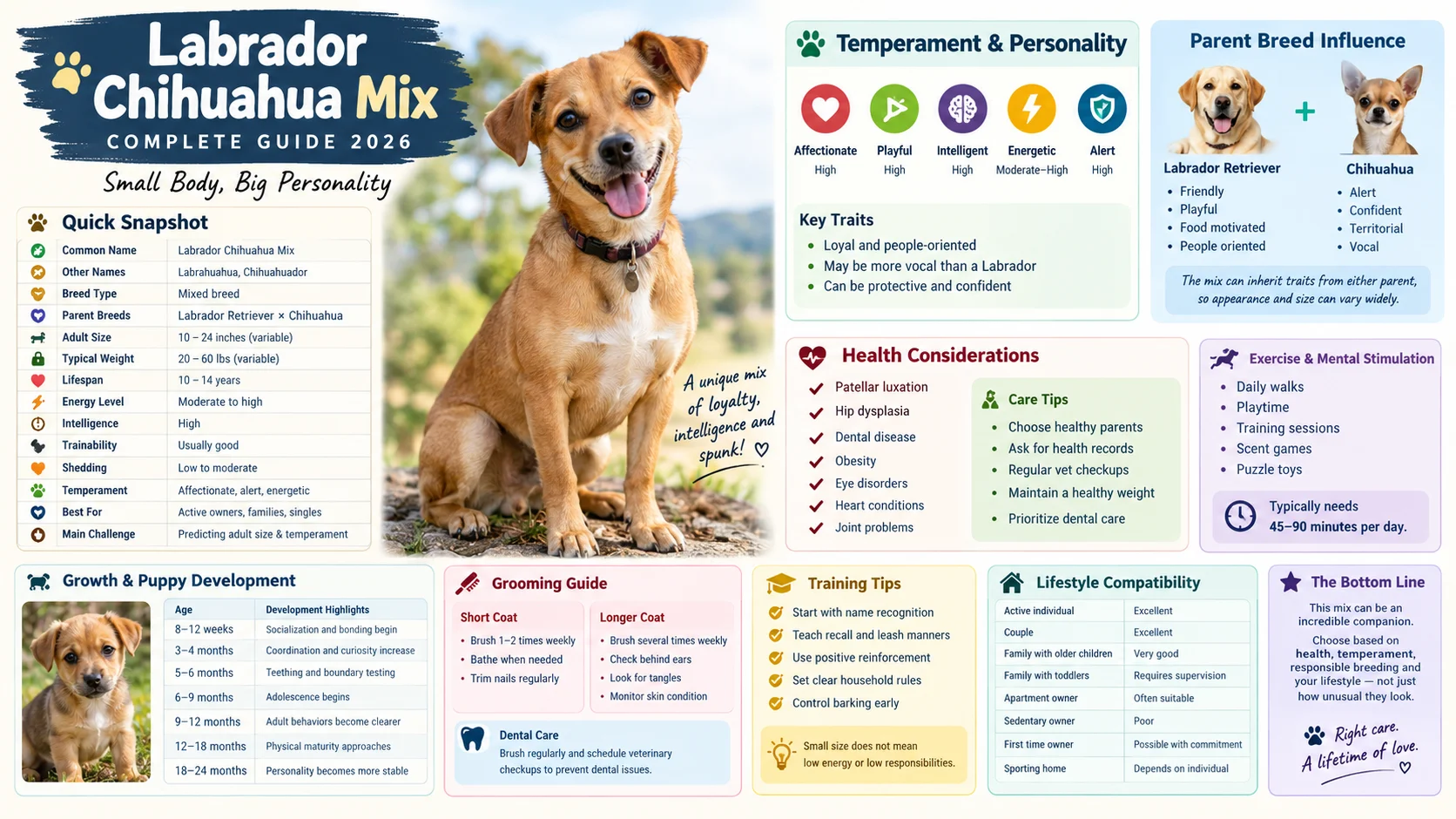
A Labrador Chihuahua Mix is a cross between a Labrador Retriever and a Chihuahua. It can be affectionate, intelligent, playful, and energetic, but its adult size, appearance, and temperament can vary widely depending on which parent’s traits it inherits. Most need regular exercise, training, socialization, and careful weight and dental care.
Quick Snapshot Table
| Category | Details |
|---|---|
| Common Name | Labrador Chihuahua Mix |
| Other Names | Labrahuahua, Chihuahuador |
| Breed Type | Mixed breed |
| Parent Breeds | Labrador Retriever × Chihuahua |
| Adult Size | Highly variable |
| Typical Weight | About 20 to 60 lbs |
| Height | Approximately 10 to 24 inches |
| Lifespan | Around 10 to 14 years |
| Energy Level | Moderate to high |
| Intelligence | High |
| Trainability | Usually good |
| Shedding | Low to moderate, depending on coat |
| Temperament | Affectionate, alert, energetic |
| Best For | Active owners who want an unusual companion |
| Main Challenge | Predicting adult size and temperament |
What Is a Labrador Chihuahua Mix?
A Labrador Chihuahua Mix is a cross between a Labrador Retriever and a Chihuahua.
It is sometimes called a Labrahuahua or Chihuahuador, although these names are informal rather than standardized breed classifications.
This mix is unusual because its parent breeds are dramatically different in size and body structure.
The Labrador Retriever is a medium to large sporting dog, while the Chihuahua is one of the smallest recognized dog breeds.
That difference makes one thing particularly important:
There is no single “standard” Labrador Chihuahua Mix appearance.
A puppy can inherit a surprisingly different combination of traits from either parent.
Why This Mix Is So Unpredictable
Size Can Vary Dramatically
One puppy may mature into a relatively compact dog, while another may be considerably larger.
Genetics determine:
- adult height
- body weight
- bone structure
- head shape
- ear carriage
- coat type
This is why predicting an adult Labrador Chihuahua Mix from a six week old puppy can be misleading.
Appearance Depends on Which Parent Dominates
Some dogs may have:
- Labrador style coloring
- Chihuahua facial features
- compact legs
- a longer muzzle
- large expressive eyes
- semi upright ears
Others may look much more like a small Labrador.
Experienced owners focus on the individual puppy rather than expecting a perfect 50/50 blend.
Labrador Chihuahua Mix Appearance
The most interesting feature of this mix is its lack of a fixed appearance standard.
Body Structure
Common possibilities include:
- compact athletic body
- moderately long legs
- broad chest
- smaller frame
- medium length muzzle
The body should still look functional and comfortable.
Extremely disproportionate structure deserves caution because inherited skeletal problems can become more difficult to manage as the dog grows.
Coat Colors
Depending on genetics, puppies may appear in:
- black
- chocolate
- yellow
- cream
- tan
- white
- combinations of these colors
Coat length can also vary.
Most have short or moderately short coats, but genetics from the Chihuahua side can introduce a different texture.
Temperament and Personality
The Labrador Chihuahua Mix can be affectionate, intelligent, playful, and surprisingly confident.
But the Chihuahua influence can also produce a more watchful and vocal personality than someone expects from a Labrador mix.
Common Personality Traits
| Trait | Likely Expression |
|---|---|
| Affection | High |
| Playfulness | High |
| Intelligence | High |
| Energy | Moderate to high |
| Alertness | High |
| Trainability | Good |
| Stranger Friendliness | Variable |
| Barking | Moderate to high |
| Protective Behavior | Possible |
The Labrador Influence
Labradors are generally known for being:
- social
- playful
- food motivated
- people oriented
- eager to participate
These traits can make training easier.
The Chihuahua Influence
Chihuahuas can contribute:
- alertness
- confidence
- strong attachment
- territorial tendencies
- vocal behavior
This combination can produce a small to medium dog that behaves like it has considerably more confidence than its size suggests.
Here is where most people get it wrong:
Small does not automatically mean easy.
A Labrador Chihuahua Mix can have plenty of energy and mental stimulation needs.
Are Labrador Chihuahua Mixes Good Family Dogs?
They can be excellent companions, but the household matters.
A well socialized individual may enjoy:
- children
- adults
- other dogs
- outdoor activities
However, interactions with very young children should always be supervised.
Best Family Environment
This mix generally does well with owners who:
- enjoy daily walks
- provide training
- respect the dog’s boundaries
- use positive reinforcement
- introduce new experiences gradually
Potential Challenge With Small Children
The Chihuahua side may contribute to a lower tolerance for rough handling.
Children should learn:
- not to grab ears or tails
- not to disturb the dog while eating
- not to carry the dog unnecessarily
- how to recognize stress signals
Intelligence and Trainability
This mix can be highly intelligent, but intelligence does not always mean effortless obedience.
A Labrador Chihuahua Mix may learn commands quickly while also developing stubborn habits if boundaries are inconsistent.
Best Training Strategy
Use:
- short training sessions
- food rewards
- clear household rules
- early socialization
- impulse control exercises
Avoid:
- harsh punishment
- repetitive drilling
- inconsistent commands
- allowing unwanted barking to become a habit
What Should You Train First?
Prioritize:
- Name recognition
- Recall
- Leash manners
- Sit and stay
- Leave it
- Calm greeting behavior
- Barking control
- Handling tolerance
The last two are particularly useful if the dog inherits stronger Chihuahua traits.
Exercise Requirements
The Labrador Chihuahua Mix usually needs more activity than its small size might suggest.
A practical adult routine can include:
- daily walks
- interactive play
- short training sessions
- scent games
- puzzle toys
How Much Exercise Does It Need?
Around 45 to 90 minutes of combined physical and mental activity per day is a reasonable starting point for many healthy adults.
Individual needs can vary considerably.
A more Labrador-like dog may need substantially more activity than a compact Chihuahua-like individual.
Mental Stimulation Matters
Physical exercise alone may not be enough.
Try:
- hide and seek
- scent games
- food puzzles
- retrieve games
- obedience exercises
A mentally satisfied dog is usually easier to live with.
Puppy Development Timeline
Labrador Chihuahua Mix puppies can develop at very different rates because their parent breeds have different growth patterns.
| Age | Development |
|---|---|
| 8–12 Weeks | Socialization and bonding begin |
| 3–4 Months | Coordination and curiosity increase |
| 5–6 Months | Teething and boundary testing |
| 6–9 Months | Adolescence begins |
| 9–12 Months | Adult behaviors become clearer |
| 12–18 Months | Physical maturity approaches |
| 18–24 Months | Personality becomes more stable |
The Most Important Puppy Period
The first few months should focus on confidence and neutrality, not simply teaching tricks.
Expose the puppy gradually to:
- household sounds
- different surfaces
- friendly people
- calm dogs
- car rides
- grooming
- veterinary handling
Do not overwhelm a nervous puppy in the name of “socialization.”
Health and Genetic Considerations
Mixed breeding does not automatically eliminate inherited health problems.
The Labrador and Chihuahua parent breeds each have their own health considerations, and a mixed puppy can inherit problems associated with either lineage.
Potential Health Concerns
Possible concerns include:
- patellar luxation
- hip dysplasia
- dental disease
- obesity
- eye disorders
- heart conditions
- joint problems
Risk depends heavily on the health and genetics of the parents.
Dental Health Deserves Special Attention
The Chihuahua side can contribute to a smaller jaw and crowded teeth.
That makes dental care particularly important.
Regular veterinary dental assessments can help identify:
- retained baby teeth
- crowding
- tartar accumulation
- gum disease
Choosing Healthy Parents
If purchasing a Labrador Chihuahua Mix puppy, ask about both parents rather than focusing only on the puppy.
Look For
Responsible breeders should be willing to discuss:
- veterinary records
- genetic screening
- hip and elbow evaluations where appropriate
- patella evaluations
- eye examinations
- temperament
- family health history
The real issue is not whether the puppy is “mixed.”
The real issue is whether the breeding was planned responsibly.
Feeding and Nutrition
Because adult size varies so much, feeding should be based on the puppy’s expected growth, body condition, and veterinary guidance rather than a generic amount.
Puppy Feeding
Use a complete, balanced puppy diet appropriate for the expected adult size.
Monitor:
- body condition
- growth rate
- stool quality
- appetite
Avoid overfeeding simply because the puppy appears small.
Adult Feeding
Adult dogs should maintain a lean body condition.
This matters because excess weight can place additional stress on:
- knees
- hips
- spine
A Labrador influence can also mean strong food motivation, so portion control becomes important.
Grooming Guide
Grooming requirements are usually manageable.
Short Coat
If the dog inherits a short coat:
- brush once or twice weekly
- bathe when necessary
- trim nails regularly
Longer Coat
If the Chihuahua side contributes longer fur:
- brush several times weekly
- inspect behind ears
- check for tangles
- monitor skin condition
Dental Care
Dental brushing should be introduced gradually.
For this particular mix, oral hygiene is not something to treat as optional.
Common Mistakes Owners Make
Assuming It Will Stay Small
A tiny puppy does not guarantee a tiny adult.
Always consider the size of both parents and, where possible, previous offspring from the same lines.
Treating Small Size as a Personality
Some owners excuse barking, snapping, or poor manners because the dog is small.
That is a mistake.
A 15 pound dog still needs boundaries.
Skipping Socialization
The Chihuahua side can make some individuals more suspicious of unfamiliar people.
Early, controlled exposure helps prevent unnecessary fear and reactivity.
Overfeeding
Extra weight can become especially problematic for a compact dog.
Keep the dog lean rather than simply trying to make it look bigger.
Insights Most Articles Miss
The Size Difference Between Parents Matters
The Labrador Chihuahua pairing is unusual because of the enormous size gap between the parent breeds.
Responsible breeding requires careful planning.
If someone is advertising puppies from an unsafe or poorly managed pairing simply because the cross is unusual, walk away.
Temperament Can Be More Important Than Appearance
A puppy with beautiful Labrador markings is not automatically a good companion.
Look for:
- recovery after startling
- curiosity
- willingness to interact
- stable body language
- appropriate confidence
Barking Can Become a Lifestyle Problem
A dog that looks adorable can still become difficult if alert barking is constantly reinforced.
Teach calm behavior early.
Buyer Warning Section
Be Careful With “Rare” Marketing
You may see Labrador Chihuahua Mix puppies marketed as:
- designer dogs
- rare hybrids
- miniature Labs
- pocket Labradors
These labels can create unrealistic expectations.
A Labrador Chihuahua Mix is not a miniature Labrador Retriever.
It is a mixed breed with unpredictable inherited traits.
Questions to Ask a Breeder
Before paying a deposit, ask:
- Can I meet the mother?
- What is the father’s health history?
- What health testing was performed?
- How are the puppies socialized?
- What veterinary care has been completed?
- What happens if the puppy develops a serious inherited condition?
A responsible breeder should answer clearly rather than becoming defensive.
Lifestyle Compatibility
| Lifestyle | Compatibility |
|---|---|
| Active individual | Excellent |
| Couple | Excellent |
| Family with older children | Very good |
| Family with toddlers | Requires supervision |
| Apartment owner | Often suitable with exercise |
| Sedentary owner | Poor |
| First time owner | Possible with commitment |
| Highly active sporting home | Depends on individual |
Preparation Checklist
Before Bringing the Puppy Home
Prepare:
- appropriately sized crate
- comfortable bed
- puppy food
- food and water bowls
- collar and identification
- harness
- leash
- chew toys
- grooming supplies
- enzymatic cleaner
- veterinary appointment
Establish Rules Immediately
Decide beforehand:
- where the dog sleeps
- whether furniture is allowed
- feeding schedule
- toilet routine
- house boundaries
- training expectations
Consistency from the first day prevents many avoidable behavior problems.
Labrador Chihuahua Mix vs Labrador Retriever
| Feature | Labrador Chihuahua Mix | Labrador Retriever |
|---|---|---|
| Size | Highly variable | More predictable |
| Energy | Moderate to high | High |
| Barking | Potentially higher | Usually moderate |
| Temperament | More variable | Generally predictable |
| Trainability | Good | Excellent |
| Family Suitability | Good with socialization | Excellent |
| Appearance | Highly variable | More standardized |
| Exercise | Moderate to high | High |
Labrador Chihuahua Mix vs Chihuahua
| Feature | Labrador Chihuahua Mix | Chihuahua |
|---|---|---|
| Size | Usually larger | Very small |
| Strength | Moderate | Low to moderate |
| Energy | Moderate to high | Moderate |
| Social Behavior | Variable | Often selective |
| Trainability | Good | Can be stubborn |
| Exercise | Higher | Lower |
| Food Motivation | Often strong | Variable |
Frequently Asked Questions
How big does a Labrador Chihuahua Mix get?
Adult size is highly unpredictable. Many fall somewhere between the size of a Chihuahua and a Labrador, with roughly 20 to 60 pounds being a broad practical range.
What is a Labrador Chihuahua Mix called?
It is commonly called a Labrahuahua or Chihuahuador, although neither name represents a standardized purebred breed.
Is a Labrador Chihuahua Mix a good family dog?
It can be. Early socialization, appropriate supervision with children, training, and adequate exercise are important.
Are Labrador Chihuahua Mixes easy to train?
Usually they are reasonably trainable because both parent breeds can be intelligent and responsive. However, individual temperament and consistency matter greatly.
Do Labrador Chihuahua Mixes shed?
Most shed at least moderately, but the amount depends on which coat traits the puppy inherits.
How long does a Labrador Chihuahua Mix live?
A reasonable general estimate is around 10 to 14 years, although individual lifespan depends on genetics, health, nutrition, weight, and veterinary care.
Are Labrador Chihuahua Mixes rare?
They are considerably less common than many popular Labrador mixes. Their unusual parent combination makes them relatively uncommon.
Is a Labrador Chihuahua Mix hypoallergenic?
No. This mix should not be considered reliably hypoallergenic.
Conclusion
The Labrador Chihuahua Mix is one of those crosses that looks simple on paper but becomes much more interesting once you understand the genetics behind it.
You are combining the friendly, food motivated Labrador with the alert, confident Chihuahua. The result can be an affectionate and intelligent companion, but adult size, appearance, barking tendency, and energy level can vary substantially.
The smartest approach is not to buy this mix because it looks unusual.
Choose based on health, temperament, responsible breeding, and lifestyle compatibility.
That is what ultimately determines whether a Labrador Chihuahua Mix becomes a delightful companion or a difficult household challenge.