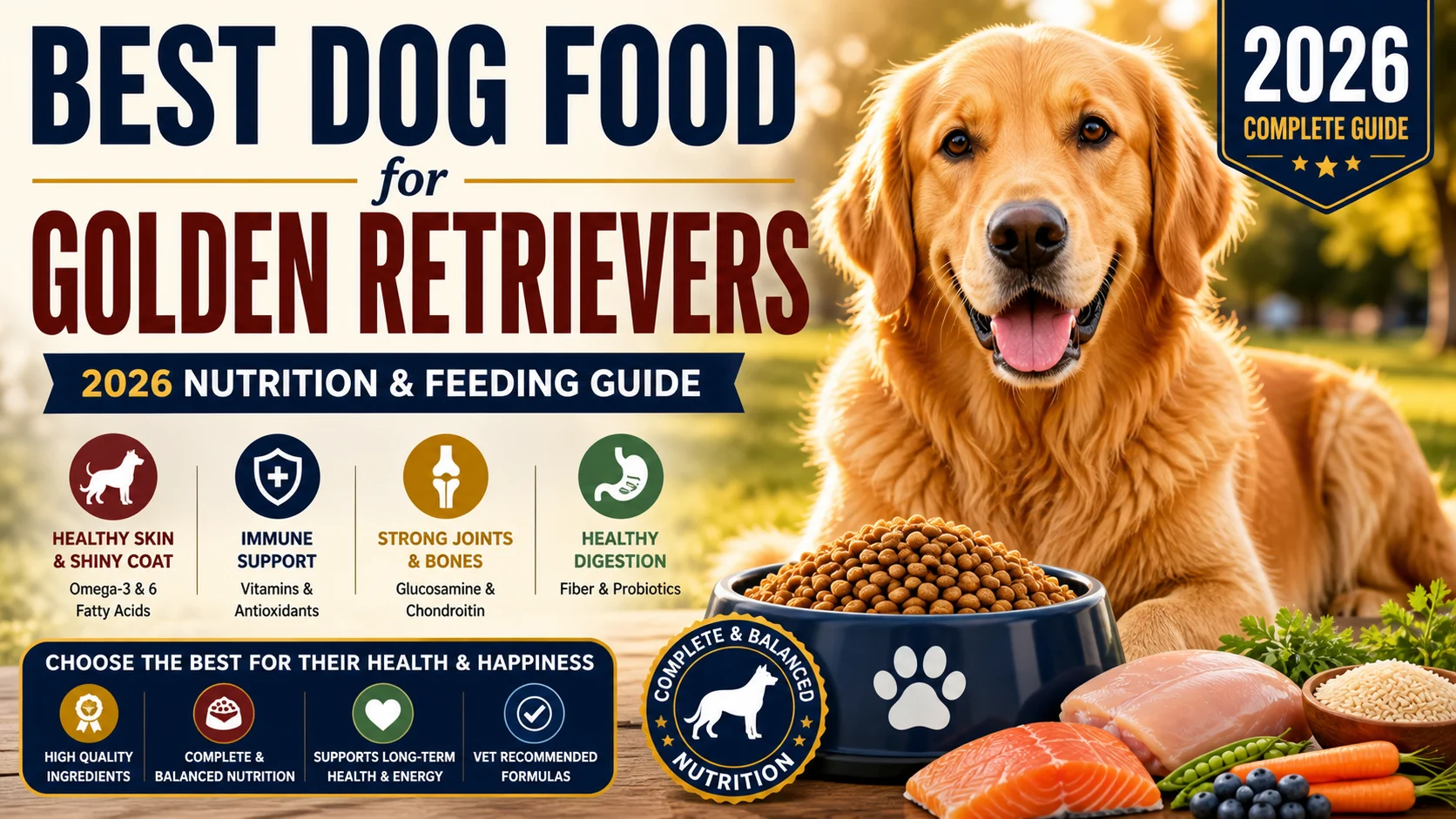
Better food. Healthier Golden.
Quick Snapshot Table
| Category | Key Details |
| Breed | Golden Retriever |
| Size | Large breed |
| Best Overall Food Type | Complete and balanced large breed formula |
| Best Puppy Food | Large breed puppy formula |
| Best Adult Food | Large breed adult maintenance formula |
| Best Senior Food | Complete senior or veterinarian recommended diet |
| Protein Needs | High quality, digestible protein |
| Important Nutrients | Omega 3, calcium, phosphorus, vitamins |
| Common Concerns | Weight gain, joint health, skin sensitivities |
| Feeding Frequency | Depends on age and individual needs |
| Special Consideration | Healthy body weight and controlled growth |
Why Choosing the Right Dog Food Matters for Golden Retrievers
Golden Retrievers are energetic, affectionate dogs with beautiful coats and strong appetites. Their nutritional needs, however, go beyond simply finding a food they enjoy.
As a large breed, Golden Retrievers need balanced nutrition that supports muscle development, healthy joints, skin condition, and a stable body weight.
One issue owners often overlook is weight management. Golden Retrievers can be highly food motivated, making excessive treats and oversized portions easy habits to develop.
Here is where most people get it wrong: expensive food, attractive packaging, and long ingredient lists do not automatically mean better nutrition.
A suitable diet should provide:
• Complete and balanced nutrition for the dog’s life stage.
• Appropriate calories to maintain a healthy body condition.
• Digestible protein to support muscle maintenance.
• Essential fatty acids for skin and coat health.
• Carefully balanced minerals for skeletal development.
Veterinary guidance emphasizes selecting food according to life stage, body condition, health history, and the manufacturer’s nutritional expertise rather than marketing claims alone.
What Is the Best Dog Food for Golden Retrievers?
The best dog food for a Golden Retriever is a complete and balanced formula designed for its current life stage, size, activity level, and health requirements.
There is no single food that is ideal for every Golden Retriever. A growing puppy needs different nutrient levels from an adult dog, while a senior may need adjustments to calories, protein, and overall nutrition.
Best Dog Food Recommendations for 2026
The following options are useful starting points when comparing established commercial diets. The best choice depends on your dog’s age, health, availability, and veterinarian’s advice.
| Dog Food | Best For | Main Advantage |
| Royal Canin Golden Retriever Puppy | Golden Retriever puppies | Breed specific growth formula |
| Royal Canin Golden Retriever Adult | Adult Goldens | Breed specific adult nutrition |
| Purina Pro Plan Large Breed | Active adult Goldens | Large breed nutrition options |
| Hill’s Science Diet Large Breed | Adult and senior dogs | Life stage specific formulas |
| Wellness Complete Health Large Breed Adult | Adult Goldens | Large breed maintenance formula |
1. Best Food for Golden Retriever Puppies
Royal Canin Golden Retriever Puppy
Puppy pick
A breed specific option formulated for Golden Retriever puppies, with attention to growth and digestive needs.
Golden Retriever puppies require controlled growth rather than simply maximum weight gain. Look for a food specifically suitable for large breed puppy development, with appropriate calcium and phosphorus levels.
2. Best Food for Adult Golden Retrievers
Purina Pro Plan Adult Large Breed
Adult pick
A large breed adult formula option for maintaining muscle condition and meeting everyday nutritional requirements.
Adult Golden Retrievers need sufficient protein, appropriate calories, and a balanced nutrient profile. Choose the exact formula according to your dog’s activity and body condition.
3. Best Food for Senior Golden Retrievers
Hill’s Science Diet Large Breed
Senior option
Offers large breed nutrition options, including formulas intended for different life stages.
Senior Goldens may need calorie adjustments as activity decreases. However, age alone does not mean a dog needs less protein. Maintaining muscle mass remains important.
4. Best Alternative for Adult Large Breeds
Wellness Complete Health Large Breed Adult
A large breed adult option that can be considered when comparing ingredient profiles, calorie levels, and nutritional adequacy.
Its suitability still depends on the individual dog’s health and dietary requirements. Check the current nutritional adequacy statement before purchasing.
Important buying note: These are comparison options, not a clinical ranking or a guarantee that one product is best for every Golden Retriever. Always check the exact recipe and life stage statement on the packaging.
Golden Retriever Nutritional Requirements
Protein: Supporting Muscles and Strength
Protein supplies amino acids required for muscle development, tissue repair, and normal body functions.
Golden Retrievers benefit from a complete diet containing digestible, high quality protein sources.
Common sources include:
• Chicken
• Turkey
• Salmon
• Beef
• Lamb
The percentage of protein alone does not establish food quality. Digestibility, amino acid balance, calorie intake, and overall formulation also matter.
Fat: Energy and Skin Health
Dietary fat provides concentrated energy and helps the body absorb fat soluble vitamins.
Essential fatty acids also contribute to healthy skin and coat condition.
Look for appropriately formulated sources such as fish oil and other nutritionally suitable fats.
Omega 3 Fatty Acids
Golden Retrievers are known for their dense, flowing coats. Omega 3 fatty acids, particularly EPA and DHA, support normal skin function and help maintain a healthy coat.
They also play important roles in normal inflammatory regulation.
However, adding fish oil supplements without checking the complete diet is not always necessary. Ask your veterinarian before introducing supplements.
Calcium and Phosphorus
These minerals are especially important during puppyhood.
Growing Golden Retrievers need carefully balanced calcium and phosphorus to support normal skeletal development.
Excessive supplementation or an inappropriate diet can interfere with healthy growth. Avoid adding calcium supplements to a complete puppy food unless your veterinarian recommends them.
Best Dog Food for Golden Retrievers by Age
A dog’s nutritional requirements change throughout its life. Feeding the same formula from puppyhood to old age is not always appropriate.
Puppy Stage: Birth to 15 or 18 Months
Golden Retriever puppies need a complete and balanced large breed growth formula.
Important nutritional priorities include:
• Controlled calorie intake.
• Appropriate calcium and phosphorus balance.
• High quality protein.
• DHA and other essential fatty acids.
• Consistent growth and healthy body condition.
Large breed puppies generally need a growth formula until approximately 15 to 18 months, although individual recommendations may vary.
Adult Stage: Approximately 15 Months to 7 Years
Adult Golden Retrievers need food that supports:
• Lean muscle maintenance.
• Healthy skin and coat.
• Normal digestive function.
• Appropriate energy levels.
• Healthy weight management.
Portions should be adjusted according to activity, metabolism, and body condition rather than relying exclusively on the feeding chart.
Senior Stage: Approximately 7 Years and Older
Older Golden Retrievers may become less active and experience changes in mobility, muscle mass, and digestion.
Consider:
• Appropriate calorie intake.
• Easily digestible complete nutrition.
• Adequate protein to preserve muscle.
• Veterinary assessment of joint and mobility concerns.
Not every senior needs a special senior formula. Some healthy older dogs can continue eating an appropriate adult maintenance diet.
Puppy Development and Feeding Timeline
How Feeding Needs Change as a Golden Retriever Grows
| Age | Development | Feeding Priority |
| Birth to 4 Weeks | Nursing and rapid early growth | Mother’s milk |
| 4 to 8 Weeks | Gradual weaning | Suitable puppy food introduced gradually |
| 8 to 12 Weeks | Rapid development | Complete large breed puppy formula |
| 3 to 6 Months | Skeletal and muscle development | Controlled calories and balanced minerals |
| 6 to 12 Months | Adolescence and continued growth | Consistent large breed puppy nutrition |
| 12 to 18 Months | Approaching adult development | Monitor weight and growth |
| 15 to 18 Months Onward | Transition toward adulthood | Adult maintenance food when appropriate |
How Many Times Should You Feed a Golden Retriever Puppy?
A practical feeding routine generally looks like this:
| Age | Meals Per Day |
| 8 to 12 Weeks | 4 |
| 3 to 6 Months | 3 |
| 6 to 12 Months | 2 to 3 |
| Adult | 2 |
| Senior | Usually 2, depending on individual needs |
The amount of food depends on the puppy’s weight, expected adult size, activity, and calorie density of the formula.
Signs Your Golden Retriever Puppy Is Growing Well
Look for:
• Steady weight gain.
• Good muscle development.
• Healthy coat condition.
• Normal energy and appetite.
• Appropriate body condition.
A puppy should not be encouraged to grow as quickly or become as heavy as possible. Controlled growth is more important than rapid weight gain.
How Much Should You Feed a Golden Retriever?
There is no universal feeding amount for every Golden Retriever. Daily food requirements depend on body weight, age, activity level, metabolism, and the calorie content of the food.
General Daily Feeding Guide
| Life Stage | Approximate Daily Amount |
| Young Puppy | 1 to 2 cups, divided into meals |
| Older Puppy | 2 to 3 cups, depending on growth |
| Adult Female | 2 to 3 cups |
| Adult Male | 3 to 4 cups |
| Senior | Individual calorie requirements |
These are broad starting estimates, not prescribed portions. Different foods have different calorie densities, so check the package and consult your veterinarian.
How to Know If Your Golden Retriever Is Eating Enough
Use body condition rather than appetite alone.
A healthy Golden Retriever should generally have:
• Ribs that can be felt easily without excessive pressure.
• A visible waist when viewed from above.
• An abdominal tuck when viewed from the side.
• Good muscle condition without excessive body fat.
Golden Retrievers can look naturally fluffy, making weight gain difficult to recognize. Regular weighing and body condition checks are more useful than judging appearance alone.
Health Concerns That Should Influence Food Choices
Golden Retrievers have certain health predispositions that make thoughtful nutritional decisions particularly important.
Hip and Elbow Dysplasia
Hip and elbow dysplasia are important orthopedic concerns in Golden Retrievers.
Nutrition cannot prevent every inherited joint condition, but maintaining a healthy weight and providing balanced growth nutrition can help reduce avoidable stress on developing joints.
For puppies, avoid:
• Excessive calorie intake.
• Unnecessary calcium supplementation.
• Rapid weight gain.
• Unsupervised high calorie feeding.
Obesity and Weight Gain
Golden Retrievers are often highly food motivated. Their enthusiasm for treats and meals can make portion control challenging.
Excess weight can place additional pressure on joints and contribute to other health problems.
Helpful habits include:
• Measuring every meal.
• Limiting high calorie treats.
• Monitoring body condition.
• Maintaining regular exercise.
• Adjusting portions when activity changes.
Skin Allergies and Food Sensitivities
Some Golden Retrievers experience skin irritation, itching, or digestive sensitivities.
However, not every itchy Golden Retriever has a food allergy. Environmental allergies, parasites, and other skin conditions can produce similar symptoms.
A veterinarian may recommend a controlled elimination diet using a veterinary therapeutic or appropriately formulated novel protein diet to investigate suspected food allergies.
Changing brands repeatedly without identifying the cause can make diagnosis more difficult.
Heart Health and Diet Associated DCM
Golden Retrievers deserve particular attention when discussing dilated cardiomyopathy (DCM), a condition involving enlargement and weakening of the heart.
Some Golden Retrievers have been reported in investigations of diet associated DCM, including cases involving taurine deficiency. Research has also identified concerns involving certain diets, particularly some formulations containing substantial amounts of peas, lentils, or other legumes.
This does not mean every grain free food causes heart disease or that every dog eating legumes will develop DCM.
The responsible approach is to choose a well formulated diet from a manufacturer with strong nutritional expertise and discuss diet changes with your veterinarian.
Dry Food vs Wet Food for Golden Retrievers
Both dry and wet dog food can provide complete nutrition when appropriately formulated.
The better choice depends on your dog’s preferences, health, dental condition, hydration needs, and feeding routine.
Dry Dog Food
Advantages
• Convenient to measure and store.
• Easy to use in feeding toys.
• Usually more economical per calorie.
• Suitable for everyday feeding when complete and balanced.
Wet Dog Food
Advantages
• Higher moisture content.
• Often appealing to picky eaters.
• Softer texture for dogs with certain chewing difficulties.
• Can be used alongside dry food when portions are balanced.
Which One Is Better?
| Factor | Dry Food | Wet Food |
| Convenience | Excellent | Moderate |
| Moisture | Lower | Higher |
| Storage | Easy | Requires care after opening |
| Cost Per Calorie | Often lower | Often higher |
| Picky Eaters | Depends on dog | Often appealing |
| Complete Nutrition | Available | Available |
Expert tip: You do not have to choose only one. Mixed feeding can work well, provided both products are complete and balanced for the appropriate life stage and the combined portions meet your dog’s calorie requirements.
Best Ingredients to Look for in Golden Retriever Food
High Quality Animal Protein
Look for appropriately formulated protein sources such as chicken, salmon, turkey, or lamb.
The goal is adequate, digestible protein rather than simply choosing the food with the highest advertised protein percentage.
Omega 3 Fatty Acids
EPA and DHA are particularly useful nutrients to look for when evaluating skin, coat, and general health support.
Fish based ingredients and fish oils can provide these fatty acids.
Appropriate Fiber
Fiber supports normal digestive function and stool quality.
Suitable sources may include beet pulp and other carefully formulated fiber ingredients.
Balanced Vitamins and Minerals
A complete diet should provide appropriate levels of:
• Calcium and phosphorus.
• Vitamin D.
• Vitamin E.
• Zinc.
• Essential fatty acids.
The correct balance matters more than adding individual supplements unnecessarily.
Ingredients and Feeding Practices to Approach Carefully
Excessive Treats
Treats are useful for training, but they should not replace balanced meals.
As a general guideline, treats should account for no more than 10% of daily calories, with the remaining calories coming from complete and balanced food.
Unnecessary Supplements
Golden Retrievers do not automatically need additional calcium, vitamins, or joint supplements if they already receive a nutritionally complete diet.
Excess supplementation can create nutritional imbalances.
Grain Free Diets Without a Medical Reason
Grain free food is not automatically healthier or more digestible.
Some grain free diets use substantial amounts of peas, lentils, or other legumes. Given the ongoing investigation into diet associated DCM, discuss the suitability of these diets with your veterinarian before choosing one.
Table Scraps and Unbalanced Homemade Meals
Sharing small amounts of suitable plain foods is different from using household meals as a dog’s primary diet.
Homemade diets require careful formulation by a qualified veterinary nutrition professional to avoid deficiencies and excesses.
Never give dogs chocolate, grapes, raisins, onions, garlic, or foods containing xylitol.
How to Choose the Right Dog Food: Step by Step
Step 1: Identify Your Dog’s Life Stage
Determine whether your Golden Retriever is a puppy, adult, or senior.
Choose a formula appropriate for that stage rather than relying on breed marketing alone.
Step 2: Check Nutritional Adequacy
Look for a nutritional adequacy statement confirming that the food is complete and balanced for the intended life stage.
For a growing Golden Retriever, verify that the formula is appropriate for growth of large size dogs.
Step 3: Research the Manufacturer
Look for manufacturers that can explain:
• Who formulates their diets.
• Their quality control procedures.
• Nutrient testing practices.
• Research and feeding trial evidence.
• How they monitor product safety.
Step 4: Compare Calories
Check calories per cup or per kilogram.
Two foods can have very different calorie densities even when their ingredient lists look similar.
Step 5: Monitor Your Dog
Observe weight, coat quality, stool consistency, appetite, and energy.
A suitable diet should support your dog’s overall condition, not simply produce a shiny coat.
Common Feeding Mistakes Golden Retriever Owners Make
Feeding Too Much Because the Dog Is Always Hungry
A Golden Retriever may happily eat beyond its nutritional requirements. Do not use begging behavior as the main indicator of portion size.
Switching to Adult Food Too Early
Growing Golden Retrievers need appropriately formulated large breed puppy food. Moving to adult maintenance food prematurely can compromise nutritional suitability during development.
Choosing Food Only by Ingredient Lists
An attractive ingredient list does not guarantee balanced nutrition, digestibility, or manufacturing quality.
Ignoring Weight Changes
Even a small amount of excess weight can become a bigger problem when it accumulates over months.
Overlooking the Importance of Water
Always provide clean drinking water, particularly when feeding dry kibble.
Insights Most Golden Retriever Food Guides Miss
A Shiny Coat Does Not Always Mean a Healthy Diet
A beautiful coat can be a positive sign, but it does not prove that a diet meets all nutritional requirements.
A dog may have a shiny coat while still consuming excessive calories or an unbalanced diet.
The Most Expensive Food Is Not Always the Best
Premium pricing does not automatically indicate better nutritional quality.
A reasonably priced formula from a reputable manufacturer may be more appropriate than an expensive product built around marketing claims.
Puppies Need Controlled Growth, Not Maximum Growth
Golden Retriever puppies develop over an extended period.
Feeding too much in an attempt to make a puppy bigger or stronger can contribute to excessive weight gain and unnecessary stress on developing joints.
Food Preferences Can Change With Age
A puppy that enjoys one formula may become less interested in it as an adult.
Changes in appetite should be assessed alongside health, activity, and feeding habits rather than automatically prompting another brand switch.
Buyer Warning: What to Check Before Purchasing Dog Food
Red Flags to Avoid
Be cautious of products that:
• Promise guaranteed joint protection or disease prevention.
• Advertise unusually high protein as proof of superior quality.
• Claim grain free automatically means healthier.
• Do not provide clear nutritional adequacy information.
• Make unsupported medical claims.
• Offer no meaningful information about manufacturing and quality control.
What Responsible Food Manufacturers Should Provide
Look for:
| Evaluation Point | What to Check |
| Nutritional Adequacy | Complete and balanced statement |
| Life Stage | Puppy, adult, or senior suitability |
| Formulation | Qualified nutrition expertise |
| Quality Control | Manufacturing and safety procedures |
| Research | Nutritional studies or feeding trials |
| Product Information | Clear calorie and nutrient details |
Daily Feeding and Care Checklist
Morning Routine
• Measure the appropriate breakfast portion.
• Provide fresh drinking water.
• Check appetite and general energy.
• Include a suitable morning walk.
Afternoon Routine
• Offer appropriate training treats.
• Provide mental stimulation and play.
• Monitor water intake.
• Avoid excessive snacks.
Evening Routine
• Serve the measured dinner portion.
• Provide regular exercise according to age and health.
• Check body condition periodically.
• Maintain a consistent feeding schedule.
Preparation Checklist Before Buying Golden Retriever Food
Food buying checklist
0/8 completed
Food is appropriate for my dog’s life stage
Formula is complete and balanced
Large breed puppy growth suitability checked, if applicable
Calorie content has been reviewed
Manufacturer quality control information checked
My dog’s allergies and medical needs considered
Daily feeding portions calculated
Veterinarian consulted if special dietary needs exist
Reset checklist
Frequently Asked Questions
What is the best dog food for Golden Retrievers in 2026?
A complete and balanced large breed formula appropriate for your dog’s life stage is a good starting point. Royal Canin, Purina Pro Plan, and Hill’s Science Diet offer established options worth comparing.
What is the best food for a Golden Retriever puppy?
Choose a complete and balanced large breed puppy formula with appropriate calcium, phosphorus, protein, and calorie levels. Royal Canin Golden Retriever Puppy is one breed specific option.
Is grain free food better for Golden Retrievers?
Not necessarily. Grain free food offers no automatic health advantage for dogs without a diagnosed dietary requirement. Discuss diet associated DCM concerns with your veterinarian before selecting such a formula.
How many times should I feed my Golden Retriever?
Most adult Golden Retrievers do well with two measured meals daily. Puppies generally need more frequent meals depending on their age and development.
Is chicken or salmon better for Golden Retrievers?
Both can provide suitable protein. Salmon also supplies omega 3 fatty acids, while chicken can be an excellent digestible protein source. The overall nutritional formulation matters more than choosing one ingredient.
What food helps Golden Retrievers maintain a shiny coat?
A complete diet containing appropriate essential fatty acids, protein, zinc, and vitamins supports normal skin and coat health. Fish oil and other supplements should only be added when appropriate.
What is the best dog food for Golden Retrievers with sensitive stomachs?
A highly digestible complete formula may help some dogs. Persistent vomiting, diarrhea, or itching should be evaluated by a veterinarian before changing to a specialized diet.
Can Golden Retrievers eat homemade food?
Yes, but homemade meals must be properly formulated to provide all essential nutrients in appropriate proportions. A recipe designed by a board certified veterinary nutritionist is preferable to an unbalanced homemade mixture.
Should Golden Retrievers take joint supplements?
Not every Golden Retriever needs joint supplements. Discuss glucosamine, chondroitin, omega 3, or other supplements with your veterinarian, particularly if your dog has an existing orthopedic condition.
How do I know if my Golden Retriever is overweight?
Look for an absent waistline, difficulty feeling the ribs, and excessive abdominal fat. Your veterinarian can assess body condition and recommend an appropriate calorie target.
Conclusion
Choosing the best dog food for Golden Retrievers is about more than finding a popular brand or an attractive ingredient list. The right diet should support healthy growth, maintain lean muscle, protect normal body functions, and help your dog maintain an appropriate weight throughout life.
For growing puppies, prioritize balanced large breed nutrition and controlled development. For adults, focus on calorie management, digestible protein, and overall nutritional quality. For seniors, adjust feeding according to mobility, muscle condition, and individual health requirements.
Most importantly, remember that the best dog food is the one that meets your Golden Retriever’s nutritional needs at its current life stage, not necessarily the most expensive or heavily advertised option.
A healthy Golden Retriever needs more than a full food bowl. It needs balanced nutrition, consistent feeding habits, regular exercise, and attentive long term care.