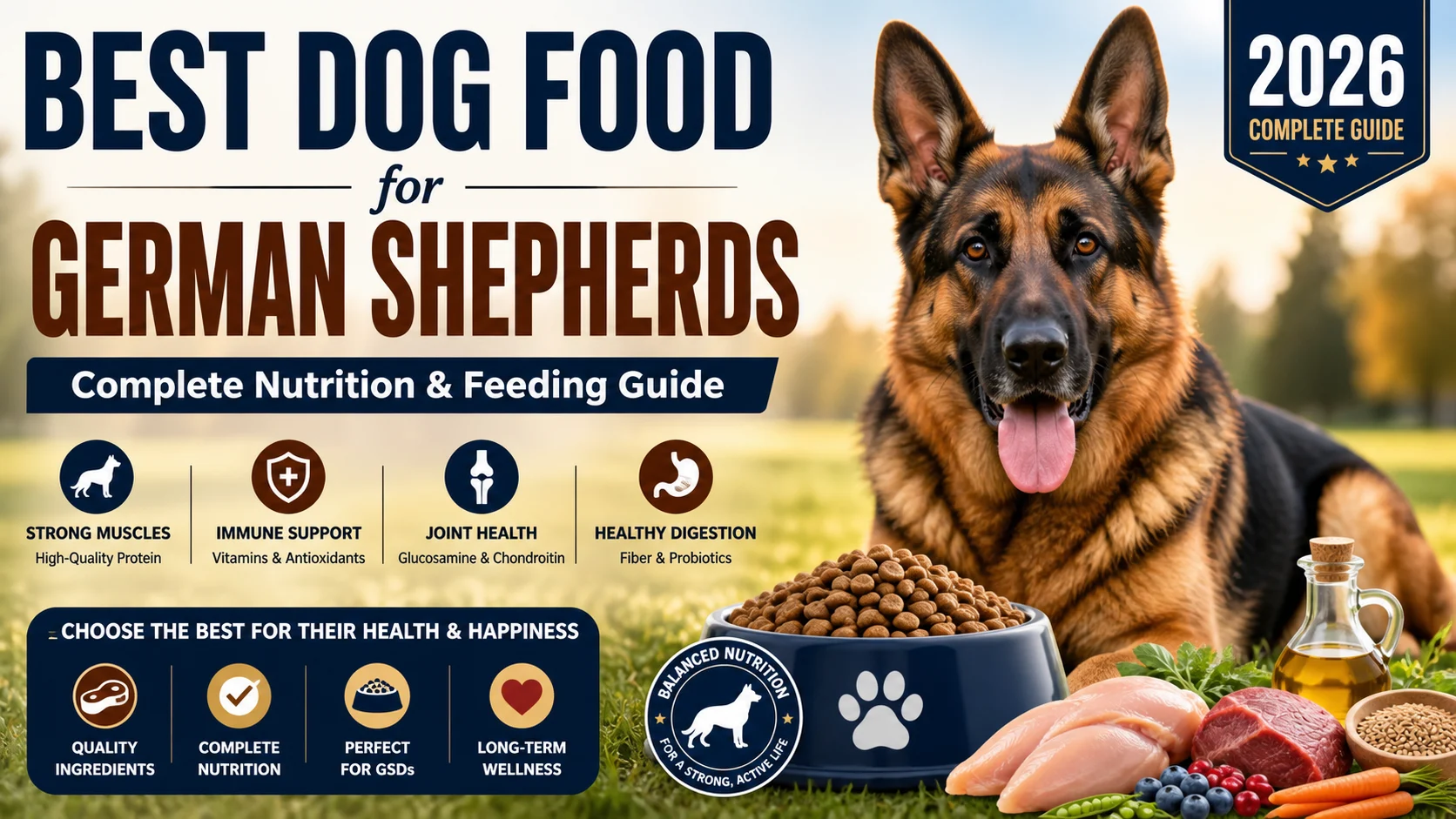
The right food builds a healthier German Shepherd. German Shepherds need balanced, high-quality nutrition that supports muscle development, digestion, joint health, and their demanding energy requirements.
Quick Snapshot Table
| Category | Key Information |
| Best Food Type | Complete and balanced dog food |
| Ideal Protein Source | Animal-based protein |
| Protein Requirement | Depends on life stage and health |
| Fat | Essential for energy and skin health |
| Puppy Nutrition | Large-breed puppy formula |
| Adult Nutrition | Complete adult maintenance formula |
| Senior Nutrition | Age and health appropriate formula |
| Joint Support | Appropriate calcium, phosphorus, and other nutrients |
| Common Sensitivity | Digestive problems and food intolerances |
| Feeding Frequency | Usually 2 meals daily for adults |
| Special Consideration | Bloat risk and sensitive digestion |
| Veterinary Advice | Recommended for individual dietary needs |
What Makes German Shepherd Nutrition Different?
German Shepherds are large, athletic dogs with nutritional needs that change as they grow. Their food must support more than muscle development. It should also maintain healthy digestion, strong bones, joint function, skin condition, and a stable body weight.
Unlike smaller breeds, German Shepherds have a relatively long growth period. Feeding too many calories or using an unsuitable puppy formula can contribute to excessive growth and skeletal problems.
The Main Nutritional Priorities
| Nutritional Priority | Why It Matters |
| High-quality protein | Supports muscle development and tissue repair |
| Healthy fats | Provide energy and support skin and coat health |
| Controlled calories | Help maintain a healthy body condition |
| Balanced calcium and phosphorus | Support proper skeletal development |
| Digestible ingredients | Help maintain digestive comfort |
| Essential fatty acids | Support skin, coat, and normal body function |
| Vitamins and minerals | Support immune function and overall health |
A good German Shepherd diet is not necessarily the one with the highest protein percentage or the most expensive ingredients. Nutritional balance, quality control, and suitability for the dog’s life stage matter more.
Best Types of Dog Food for German Shepherds
There is no single formula that works best for every German Shepherd. The right choice depends on age, activity level, digestive tolerance, body condition, and medical history.
1. Dry Dog Food (Kibble)
Practical everyday option
Dry food is a convenient choice for many German Shepherd owners. Complete and balanced kibble can provide all the essential nutrients a healthy dog needs.
Advantages:
- Convenient to measure and store
- Available in large-breed puppy and adult formulas
- Easy to use during training
- Often more economical per meal than some wet foods
What to check: Look for a complete and balanced formula suitable for your dog’s life stage, with clearly stated nutritional information.
2. Wet Dog Food
Wet food contains more moisture than dry kibble and may be useful for dogs that prefer softer meals or need additional dietary moisture.
Advantages:
- Softer texture
- Often appealing to picky eaters
- Higher moisture content
- Can be combined with appropriate dry food
Check that the product is labeled as a complete meal rather than a complementary food or topper.
3. Fresh or Gently Cooked Dog Food
Fresh dog food can be another option, provided it is properly formulated to meet canine nutritional requirements.
Advantages:
- Different protein and ingredient options
- May suit certain dogs with specific dietary preferences
- Available in professionally formulated complete diets
However, homemade chicken, rice, vegetables, or meat mixtures are not automatically nutritionally complete. A home-prepared diet should be formulated by a qualified veterinary nutritionist.
Comparison of Dog Food Types
| Food Type | Main Benefit | Important Consideration |
| Dry kibble | Convenient and easy to portion | Check nutritional adequacy |
| Wet food | Higher moisture content | Check calorie content |
| Fresh cooked | Different textures and ingredients | Must be nutritionally complete |
| Homemade | Greater ingredient control | Requires professional formulation |
| Raw food | Uncooked ingredient approach | Pathogen and nutritional imbalance risks |
Best Dog Food for German Shepherd Puppies
German Shepherd puppies need carefully controlled nutrition because their bones, muscles, joints, and body systems are still developing.
A large-breed puppy formula is generally the appropriate starting point. It should be formulated specifically for the growth of large-size dogs, including controlled calcium and phosphorus levels.
What Should German Shepherd Puppy Food Contain?
Look for:
- High-quality animal protein
- Appropriate fat and calorie levels
- Balanced calcium and phosphorus
- Essential vitamins and minerals
- Nutritional adequacy for large-breed puppy growth
Avoid adding calcium supplements to a complete large-breed puppy diet unless your veterinarian specifically recommends them. Excess supplementation can interfere with healthy skeletal development.
Puppy Feeding by Age
| Puppy Age | General Feeding Frequency | Nutritional Focus |
| 0 to 4 Weeks | Mother’s milk | Early growth and development |
| 4 to 8 Weeks | Gradual weaning | Transition to puppy food |
| 2 to 3 Months | 3 to 4 meals daily | Rapid growth |
| 4 to 6 Months | 3 meals daily | Bone and muscle development |
| 6 to 12 Months | Usually 2 meals daily | Controlled growth |
| 12 to 18 Months | Usually 2 meals daily | Continued maturation |
| 18 to 24 Months | Individualized adult transition | Maintaining adult condition |
German Shepherds can take longer to finish growing than smaller breeds. Your veterinarian can help determine when to transition from large-breed puppy food to adult maintenance food, often around 18 to 24 months depending on development.
VCA Animal Hospitals+1
Best Dog Food for Adult German Shepherds
Once your German Shepherd reaches adulthood, the nutritional focus changes from supporting growth to maintaining healthy body weight, muscle condition, energy, and overall health.
What to Look for in Adult Dog Food
An appropriate adult formula should provide:
- Adequate animal and plant protein
- Balanced fats for energy
- Essential fatty acids
- Appropriate vitamins and minerals
- Digestible ingredients
- Controlled calorie content
An active working German Shepherd may need more calories than a less active household companion. However, increasing food portions simply because a dog is large can lead to unnecessary weight gain.
Best Food for Active and Working German Shepherds
Working German Shepherds involved in tracking, agility, obedience, or demanding physical activities may require more energy than companion dogs.
Look for a complete diet that can support:
- Sustained physical activity
- Muscle maintenance
- Recovery after exercise
- Healthy body condition
Calorie intake should be adjusted according to actual activity, not just the dog’s breed or appearance.
Best Dog Food for German Shepherds With Sensitive Stomachs
Digestive sensitivity is a common concern among German Shepherd owners. Some dogs experience loose stools, excessive gas, vomiting, or recurring digestive discomfort.
However, these symptoms do not automatically mean that a dog has a food allergy.
What Food May Help a Sensitive German Shepherd?
Depending on the underlying cause, a veterinarian may recommend:
- A highly digestible complete diet
- A controlled-ingredient diet
- A veterinary gastrointestinal formula
- A properly conducted elimination diet
- A veterinary hydrolyzed-protein diet when food allergy is suspected
Signs Your German Shepherd May Have Digestive Problems
Watch for:
- Frequent loose stools
- Repeated vomiting
- Excessive gas
- Changes in appetite
- Unexplained weight loss
- Persistent itching alongside digestive symptoms
Recurring symptoms deserve veterinary evaluation rather than repeated changes between commercial foods.
Best Dog Food for Senior German Shepherds
As German Shepherds get older, their nutritional requirements may change. Some become less active, while others experience joint stiffness, muscle loss, or changes in digestion.
Senior dog food should be selected according to the dog’s actual health and body condition rather than age alone.
Important Nutritional Considerations
| Nutrient or Feature | Potential Benefit |
| High-quality protein | Helps maintain muscle mass |
| Controlled calories | Helps prevent excess weight |
| Omega-3 fatty acids | May support joint and skin health |
| Digestible ingredients | May help dogs with digestive sensitivity |
| Balanced minerals | Supports general health |
| Appropriate fiber | Helps maintain digestive function |
Not every senior German Shepherd needs a low-protein diet. Protein restriction should only be considered when a veterinarian identifies a medical reason.
Understanding German Shepherd Food Ingredients
Reading a dog food label is one of the most useful skills an owner can develop.
Marketing terms such as natural, premium, holistic, and high protein do not automatically prove that a food is nutritionally superior.
Ingredients Worth Looking For
| Ingredient | Nutritional Role |
| Chicken | Provides animal protein |
| Turkey | Provides protein and essential amino acids |
| Salmon | Provides protein and omega-3 fatty acids |
| Beef | Provides protein, iron, and other nutrients |
| Fish oil | Provides EPA and DHA omega-3 fatty acids |
| Rice | Provides digestible carbohydrates |
| Oats | Provide carbohydrates and fiber |
| Beet pulp | Provides fermentable dietary fiber |
The ingredient list is useful, but it does not tell the whole story. Nutritional formulation, digestibility, quality control, and feeding research are also important considerations.
Ingredients and Feeding Practices to Be Careful About
Be cautious with:
- Foods containing ingredients your dog has a confirmed allergy to
- Excessive treats that disrupt nutritional balance
- Unnecessary calcium supplementation
- Unbalanced homemade meat diets
- Raw diets with potential bacterial contamination
- Products marketed as complete meals without appropriate nutritional information
How to Choose the Best Dog Food Brand
Choosing a reliable manufacturer is more important than selecting a product simply because its packaging looks impressive.
The World Small Animal Veterinary Association (WSAVA) provides useful guidance for evaluating pet food manufacturers.
The Five Questions Every Owner Should Ask
- Does the company employ a qualified veterinary nutritionist or animal nutrition specialist?
- Who formulates its dog food recipes?
- Does the manufacturer conduct nutritional testing and quality control?
- Can the company provide detailed nutrient information?
- Is there published research or feeding-trial evidence supporting its products?
A responsible manufacturer should be able to answer reasonable questions about its products and nutritional standards.
What Does Complete and Balanced Mean?
A complete and balanced dog food contains the essential nutrients in appropriate amounts and proportions for its intended life stage.
In the United States, look for an AAFCO nutritional adequacy statement. In other markets, including products following European standards, look for appropriate FEDIAF nutritional compliance.
A food labeled for adult maintenance is not automatically suitable for growing puppies. Similarly, a product labeled for intermittent or supplemental feeding should not be used as the dog’s only food.
How Much Food Should a German Shepherd Eat?
There is no universal daily portion for every German Shepherd. Food requirements depend on body weight, age, activity, metabolism, reproductive status, and the calorie content of the particular food.
General Feeding Guide
| Life Stage | General Routine |
| Young puppies | 3 to 4 smaller meals |
| Older puppies | Usually 2 to 3 meals |
| Adult German Shepherds | Usually 2 meals |
| Senior German Shepherds | Usually 2 meals, adjusted to health needs |
How to Calculate the Right Portion
Start with the feeding guide printed on your dog’s food packaging.
Then consider:
- Your dog’s current weight
- Target healthy body condition
- Daily activity
- Treats and training rewards
- Weight changes over time
For example, two adult German Shepherds weighing the same amount may need different daily calories if one is highly active and the other spends most of the day resting.
Monitor your dog’s body condition regularly and adjust portions with veterinary guidance.
German Shepherd Puppy Development and Nutrition
German Shepherd development is closely connected to proper nutrition. The goal is steady, healthy growth rather than making a puppy gain weight as quickly as possible.
Development Timeline
| Age | Physical Development | Nutritional Priority |
| 0 to 8 Weeks | Early growth and weaning | Mother’s milk and gradual puppy food transition |
| 2 to 4 Months | Rapid skeletal development | Large-breed puppy nutrition |
| 4 to 6 Months | Muscle and coordination development | Balanced protein and minerals |
| 6 to 12 Months | Adolescent growth | Controlled calories and steady development |
| 12 to 18 Months | Continued body maturation | Appropriate growth diet |
| 18 to 24 Months | Adult structure develops | Individualized transition to adult food |
Why Overfeeding Is a Mistake
A heavier German Shepherd puppy is not necessarily a healthier puppy.
Excessive calorie intake can encourage overly rapid growth and unnecessary weight gain, potentially placing additional stress on developing joints.
Experienced breeders and veterinarians focus on maintaining a lean, steadily growing puppy rather than maximizing size.
German Shepherd Health Problems and Dietary Considerations
Nutrition cannot prevent every inherited or breed-associated condition, but an appropriate diet can support general health and help manage certain medical needs.
Hip and Elbow Dysplasia
German Shepherds are predisposed to hip and elbow dysplasia.
Maintaining a healthy weight is particularly important because excess body weight increases mechanical stress on the joints.
Digestive Sensitivity
Some German Shepherds experience recurring gastrointestinal symptoms. A veterinary assessment can help identify whether the cause is dietary intolerance, parasites, infection, or another digestive condition.
Skin and Coat Problems
A balanced diet containing adequate protein, essential fatty acids, vitamins, and minerals helps maintain normal skin and coat health.
Persistent itching, hair loss, or skin inflammation should not automatically be treated with dietary supplements.
Bloat and Gastric Dilatation Volvulus
Veterinary emergency
German Shepherds are among the breeds at increased risk of gastric dilatation volvulus (GDV), commonly called bloat.
This is a potentially life-threatening condition in which the stomach becomes distended and may twist.
Warning signs include:
- A suddenly swollen abdomen
- Repeated attempts to vomit without producing anything
- Excessive drooling
- Restlessness
- Difficulty breathing
- Weakness or collapse
Suspected GDV requires immediate emergency veterinary attention. Do not wait for symptoms to disappear.
Feeding management may include multiple smaller meals and avoiding strenuous activity around mealtimes. Cornell University also recommends discussing preventive gastropexy with a veterinarian for dogs at elevated risk.
Homemade Dog Food vs Commercial Dog Food
Some German Shepherd owners prefer preparing meals at home because they want greater control over ingredients.
However, homemade does not automatically mean healthier.
Comparison
| Factor | Homemade Food | Commercial Complete Food |
| Ingredient Control | High | Depends on manufacturer |
| Nutritional Balance | Requires professional formulation | Formulated for stated life stage |
| Preparation | Time-consuming | Convenient |
| Consistency | Depends on recipe and preparation | Standardized manufacturing |
| Cost | Can be expensive | Varies by product |
| Nutritional Testing | Must be arranged appropriately | Manufacturer-dependent |
Can German Shepherds Eat Chicken and Rice Every Day?
Chicken and rice may be recommended temporarily by a veterinarian for certain digestive problems, but it is not a complete long-term diet.
It does not automatically provide all the vitamins, minerals, essential fatty acids, and other nutrients a German Shepherd requires.
If you prefer home-cooked meals, work with a board-certified veterinary nutritionist or an appropriately qualified professional to formulate a complete recipe.
Common Feeding Mistakes German Shepherd Owners Make
Feeding Too Much
Large dogs do not need unlimited portions. Overfeeding can lead to obesity and additional joint stress.
Changing Food Too Frequently
Repeatedly switching formulas can make it difficult to identify which food suits your dog. Introduce dietary changes gradually unless your veterinarian advises otherwise.
Ignoring Puppy-Specific Nutrition
Regular adult maintenance food is not necessarily suitable for growing German Shepherd puppies.
Adding Unnecessary Supplements
A complete and balanced diet usually provides essential nutrients without additional supplementation. Unnecessary calcium, vitamins, or minerals can create nutritional imbalances.
Choosing Food Only by Protein Percentage
A higher protein percentage does not automatically mean better nutrition. Protein quality, amino acid balance, digestibility, calorie density, and the dog’s individual needs all matter.
Insights Most Dog Food Articles Miss
The Most Expensive Food Is Not Always the Best
Price alone cannot establish nutritional quality. A reasonably priced complete diet from a manufacturer with strong formulation and quality-control practices may be a better choice than an expensive product relying heavily on marketing.
German Shepherds Do Not All Need the Same Formula
A working-line shepherd, a family companion, a growing puppy, and a senior dog can have very different nutritional requirements.
Maintaining a Lean Body Condition Matters
A muscular German Shepherd should not be confused with an overweight one. You should be able to feel the ribs without pressing excessively, and the dog should have a visible waist when viewed from above.
Supplements Cannot Fix an Unbalanced Diet
Joint supplements, probiotics, and fish oil may be useful in selected circumstances, but they are not replacements for complete nutrition. Discuss their use and dosage with your veterinarian.
Buyer Warning: What to Avoid When Purchasing German Shepherd Food
Red Flags on Dog Food Packaging
Be cautious when a product:
- Uses impressive marketing language without nutritional details.
- Does not clearly identify its intended life stage.
- Has no complete and balanced nutritional statement.
- Provides no reliable manufacturer contact information.
- Makes unsupported claims about curing joint or digestive diseases.
What Responsible Manufacturers Provide
Look for manufacturers that can explain:
- Nutritional formulation
- Quality-control procedures
- Ingredient sourcing
- Calorie information
- Nutritional testing
- Research supporting their products
Daily Feeding and Care Guide
Morning Routine
- Provide a measured, balanced meal.
- Make fresh drinking water available.
- Observe appetite and energy levels.
- Avoid strenuous activity immediately around meals.
Afternoon Routine
- Use part of the daily food allowance for training.
- Monitor treats and additional snacks.
- Provide appropriate exercise and mental stimulation.
Evening Routine
- Offer the second measured meal.
- Check your dog’s body condition regularly.
- Maintain a consistent feeding schedule.
Preparation Checklist Before Choosing Dog Food
Your German Shepherd’s Food Should:
- Match its current life stage.
- Be complete and nutritionally balanced.
- Meet appropriate large-breed growth requirements if it is a puppy.
- Provide suitable protein and fat levels.
- Contain balanced minerals.
- Match its activity and calorie requirements.
- Come from a manufacturer with reliable nutritional expertise.
- Be appropriate for any existing medical conditions.
Lifestyle and Food Compatibility
| German Shepherd Type | Suitable Food Choice |
| Growing puppy | Large-breed puppy formula |
| Active adult | Complete adult diet adjusted for activity |
| Working German Shepherd | Energy-appropriate complete working or performance diet |
| Sensitive stomach | Veterinarian-selected digestible formula |
| Senior dog | Age and health appropriate adult or senior formula |
| Overweight German Shepherd | Calorie-controlled complete diet |
| German Shepherd with allergies | Veterinary-directed elimination or hydrolyzed diet |
Frequently Asked Questions
What is the best dog food for German Shepherds?
The best dog food is a complete and balanced formula appropriate for the dog’s age, activity level, and health. Large-breed puppy food is generally recommended during growth, while adult German Shepherds need an appropriate adult maintenance formula.
What is the best dry dog food for German Shepherds?
The best dry food is one formulated to meet the dog’s life-stage requirements, with appropriate protein, fat, minerals, and calorie content. Choose a manufacturer with qualified nutrition expertise and reliable quality control.
What is the best food for German Shepherd puppies?
Choose a complete large-breed puppy formula that supports controlled skeletal development. Avoid excessive calcium supplementation and overfeeding.
How many times should I feed my German Shepherd?
Most adult German Shepherds do well with two measured meals daily. Younger puppies generally require three to four smaller meals, depending on their age and feeding needs.
Is chicken good for German Shepherds?
Yes. Properly prepared chicken can provide high-quality animal protein. However, plain chicken alone is not a complete diet. It should be included in a nutritionally balanced feeding plan.
Is rice good for German Shepherds?
Plain, cooked rice can be included in certain feeding plans and may be recommended temporarily for some digestive problems. However, rice alone does not provide complete nutrition.
Do German Shepherds need joint supplements?
Not every German Shepherd needs joint supplements. Some may benefit from veterinarian-recommended products, but supplements should not replace appropriate nutrition, healthy weight management, or veterinary treatment.
Is grain-free food better for German Shepherds?
Not necessarily. Grain-free diets are not automatically healthier or easier to digest. Some grain-free formulations have been investigated for a potential association with diet-associated dilated cardiomyopathy. Discuss a grain-free diet with your veterinarian before choosing one without a medical reason.
Can German Shepherds eat homemade food?
Yes, provided the diet is professionally formulated to meet all nutritional requirements. Ordinary homemade mixtures of meat, rice, and vegetables are not automatically balanced.
When should I switch my German Shepherd from puppy food to adult food?
Many German Shepherds transition around 18 to 24 months, depending on their growth and body development. Your veterinarian can help determine the appropriate time.
Conclusion
Choosing the best dog food for German Shepherds is about more than selecting an expensive brand or finding a formula with the highest protein percentage. It requires understanding the breed’s nutritional needs at every stage of life.
A healthy feeding plan should prioritize:
- High-quality, balanced nutrition
- Controlled puppy growth
- Healthy muscle development
- Joint and digestive support
- Appropriate calorie intake
- Consistent feeding practices
The most important lesson is that the best food is the one that meets your German Shepherd’s individual nutritional requirements while maintaining a healthy body condition.
Whether you own a growing puppy, an energetic working dog, or a senior companion, thoughtful nutrition can make a meaningful difference to its long-term health and quality of life.