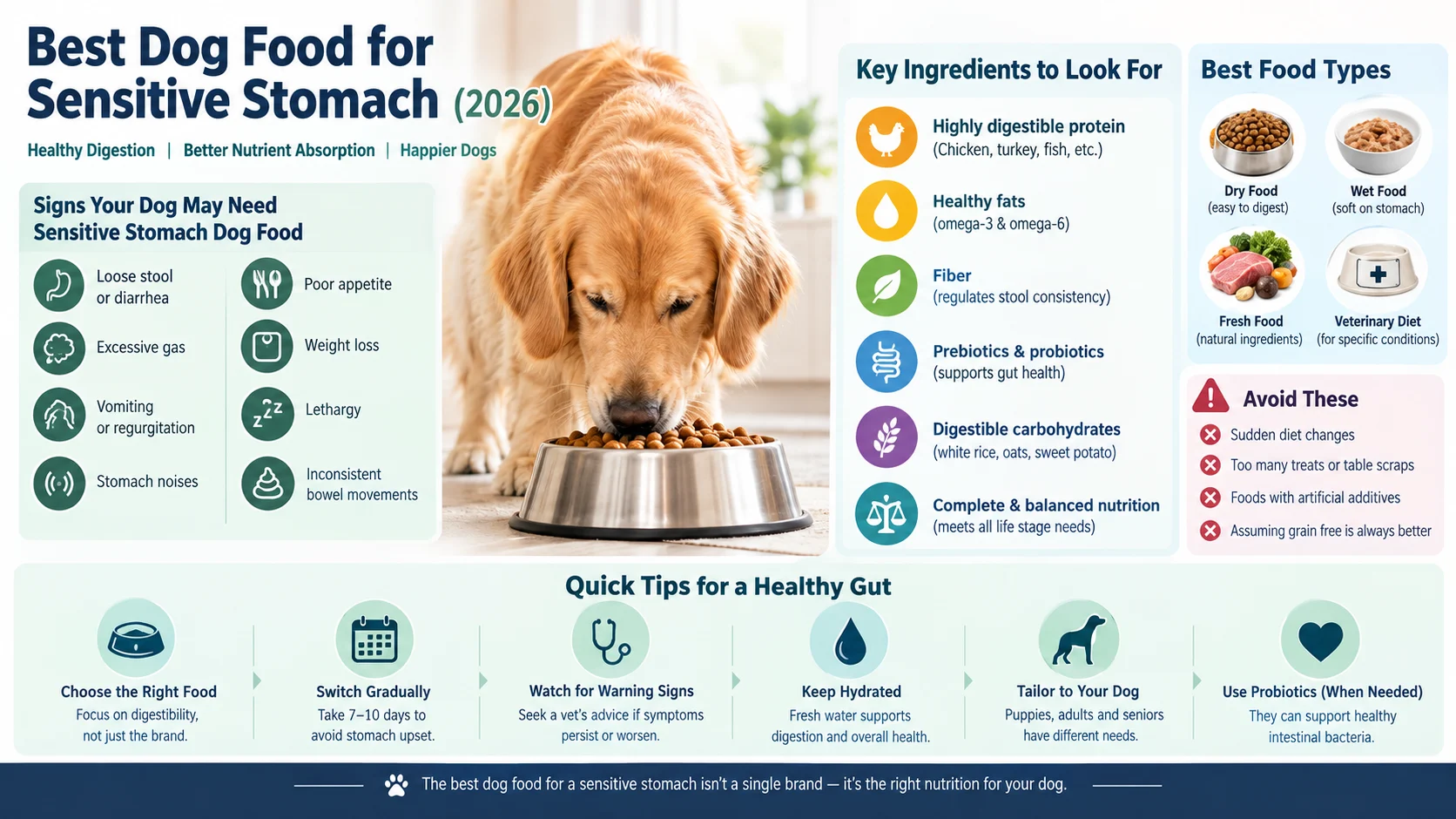
The best dog food for a sensitive stomach is a complete and balanced, highly digestible diet with appropriate protein, fat and fiber. The right choice depends on your dog’s symptoms, age and underlying health needs.
Quick Snapshot Table
| Category | Best Choice for Sensitive Stomachs |
|---|---|
| Primary Goal | Easy digestion and consistent stools |
| Protein | Highly digestible, appropriate protein source |
| Fat | Moderate or lower when medically appropriate |
| Fiber | Appropriate level for the individual dog |
| Probiotics | May support healthy gut bacteria |
| Carbohydrates | Highly digestible sources can work well |
| Food Type | Dry, wet, fresh, or veterinary therapeutic diet |
| Limited Ingredient | Useful in selected cases |
| Hydrolyzed Protein | Often used for suspected food allergies |
| Grain Free | Not automatically better |
| Transition | Gradual rather than sudden |
| Veterinary Diet | Best for diagnosed gastrointestinal conditions |
What Is the Best Dog Food for a Sensitive Stomach?
The best dog food for a sensitive stomach is not one specific brand or ingredient. It is a complete and balanced, highly digestible diet that your individual dog tolerates well and that fits its age, size, activity level, and medical needs.
For many dogs, a suitable sensitive stomach dog food contains a digestible protein, appropriate fat, and enough fiber to support normal stool quality. Dogs with suspected food allergies or chronic gastrointestinal disease may need a veterinary therapeutic diet instead.
That distinction matters.
A food advertised as “gentle,” “natural,” or “limited ingredient” is not automatically the best dog food for sensitive stomach problems.
The right food is the one that solves the underlying nutritional problem without creating another one.
What Does “Sensitive Stomach” Actually Mean?
“Sensitive stomach” is a broad description rather than a specific veterinary diagnosis.
A dog described this way may experience:
- soft or loose stools
- diarrhea
- excessive gas
- occasional vomiting
- stomach noises
- poor appetite
- nausea
- frequent changes in bowel movements
These signs can result from something as simple as a sudden diet change, but they can also occur with parasites, infections, food intolerance, allergies, pancreatitis, inflammatory bowel disease, or other medical problems.
The Important Difference Between Sensitivity and Allergy
Food intolerance and food allergy are not exactly the same.
A food intolerance can cause digestive problems without involving the immune system. A true food allergy involves an immune response to food proteins.
That is why simply switching between five different “sensitive stomach” foods may not solve the problem.
Signs Your Dog May Need Sensitive Stomach Dog Food
Digestive Signs
Watch for recurring:
- loose stool
- diarrhea
- excessive gas
- vomiting
- regurgitation
- stomach rumbling
- straining to defecate
- inconsistent stool quality
Signs That Need More Attention
Do not assume everything is a food issue if your dog has:
- blood in the stool
- repeated vomiting
- significant weight loss
- severe lethargy
- loss of appetite
- abdominal pain
- persistent diarrhea
- dehydration
Prolonged vomiting or diarrhea can require veterinary evaluation because gastrointestinal symptoms can sometimes indicate more serious disease.
What Should You Look for in Dog Food for Sensitive Stomach?
The label deserves more attention than the marketing on the front of the bag.
1. High Digestibility
Digestibility is one of the most important characteristics.
A highly digestible diet allows the dog to absorb more of its nutrients while potentially producing less undigested material in the gastrointestinal tract.
Veterinary gastrointestinal diets are often specifically formulated around high digestibility. Vca
2. Appropriate Fat Levels
Fat is not automatically bad for dogs.
The problem is that some dogs with particular gastrointestinal conditions tolerate high-fat diets poorly.
For dogs with pancreatitis or certain chronic gastrointestinal diseases, veterinarians may recommend a lower-fat diet.
3. Appropriate Fiber
Fiber is more complicated than simply “more is better.”
Different gastrointestinal conditions can respond to different fiber levels.
Some dogs benefit from additional fiber, while others do better on diets with different fiber profiles. Veterinarians consider the type and total amount of dietary fiber when choosing a diet. Vca
4. Complete and Balanced Nutrition
A sensitive stomach does not mean your dog should live indefinitely on plain chicken and rice.
A long-term diet should provide the nutrients your dog needs for its life stage.
Commercial foods labeled complete and balanced are designed to meet established nutritional requirements when fed as directed.
Best Ingredients for Sensitive Stomach Dogs
There is no universal ingredient list that works for every dog.
However, certain nutritional characteristics are often useful.
| Ingredient or Feature | Why It May Help |
|---|---|
| Highly digestible protein | Supports efficient nutrient absorption |
| Appropriate fiber | Can help regulate stool consistency |
| Digestible carbohydrates | Can provide an accessible energy source |
| Prebiotic fibers | Can support beneficial intestinal bacteria |
| Probiotics | May support gastrointestinal microbial balance |
| Moderate fat | May be easier for some dogs to tolerate |
| Adequate moisture | Useful for dogs that need increased water intake |
The key word is appropriate.
A food containing an impressive ingredient list can still be a poor choice if your individual dog cannot tolerate it.
Does Protein Matter for Sensitive Stomachs?
Yes, but the answer is more nuanced than “chicken is bad” or “salmon is best.”
Protein sources can cause problems in dogs with food allergies or intolerances, and individual dogs vary considerably.
Common food allergens include proteins such as chicken, beef, and fish, but that does not mean every dog should avoid them.
When a Novel Protein May Make Sense
A veterinarian may recommend a novel protein when a food allergy is suspected.
A novel protein is one your dog has not previously been exposed to.
Possible examples include:
- venison
- rabbit
- certain less commonly fed proteins
The choice depends on the dog’s dietary history.
Is Limited Ingredient Dog Food Better?
Not automatically.
Limited ingredient dog food can be useful when you are trying to reduce exposure to particular ingredients, especially during a structured dietary trial.
But a retail food labeled “limited ingredient” should not automatically be treated as equivalent to a veterinary elimination diet.
Cross contamination can also matter when diagnosing food allergies. Veterinary diets designed for these situations are manufactured under stricter protocols.
When Limited Ingredient Food Makes Sense
It may be considered when:
- your dog has recurring food-related symptoms
- a particular ingredient is suspected
- your veterinarian recommends an elimination approach
- you need a simpler ingredient profile
Are Grain Free Foods Better for Sensitive Stomachs?
No.
Grain free does not automatically mean easier to digest or healthier for a dog with gastrointestinal sensitivity.
Some veterinary nutrition guidance specifically cautions against assuming grain free diets are preferable for digestive problems.
The better question is:
Does the complete diet provide appropriate nutrition and does your dog tolerate it?
Grains are not automatically harmful to dogs.
Do Probiotics Help Sensitive Stomachs?
They can help some dogs.
Probiotics are intended to support beneficial intestinal bacteria and may be useful in certain gastrointestinal situations. Veterinarians can also recommend specific probiotic products when appropriate.
However, probiotics are not a substitute for diagnosing the cause of chronic vomiting or diarrhea.
Prebiotics vs Probiotics
Probiotics are beneficial microorganisms.
Prebiotics are ingredients that help support beneficial microorganisms already present in the gut.
Some dog foods incorporate one or both.
Best Dog Food for Different Sensitive Stomach Problems
| Situation | Diet Approach Often Considered |
|---|---|
| Occasional mild digestive upset | Highly digestible diet |
| Chronic soft stool | Veterinary assessment plus appropriate fiber |
| Suspected food allergy | Novel or hydrolyzed protein diet |
| Pancreatitis | Often lower fat under veterinary guidance |
| Chronic gastrointestinal disease | Therapeutic veterinary diet |
| Food intolerance | Ingredient avoidance based on individual response |
| Poor appetite | Palatable, energy appropriate diet |
| Puppy with digestive problems | Age appropriate complete and balanced diet |
The correct choice depends on why the stomach is sensitive.
Sensitive Stomach Dog Food for Puppies
Puppies require extra care because they are growing rapidly.
A puppy should not simply be placed on an adult maintenance food because it appears gentler on digestion.
Look for a diet appropriate for:
- growth
- breed size
- developmental stage
Puppy Digestive Problems Need Attention
A puppy with repeated diarrhea or vomiting deserves closer attention than an otherwise healthy adult with one isolated episode.
Puppies can become dehydrated quickly.
If digestive symptoms persist, veterinary evaluation is more important than repeatedly changing foods.
Sensitive Stomach Dog Food for Adult Dogs
Adult dogs generally have more flexibility, but recurring digestive problems still deserve investigation.
For an adult dog, consider:
- stable calorie intake
- healthy body condition
- consistent stool
- appropriate protein
- appropriate fat
- adequate fiber
- complete and balanced nutrition
A food that produces consistently healthy stools and maintains good appetite and body condition is usually more useful than one chosen because its ingredient list looks impressive.
Sensitive Stomach Dog Food for Senior Dogs
Older dogs can develop digestive problems for reasons unrelated to their regular food.
A senior dog with new gastrointestinal symptoms may need an evaluation rather than an immediate food switch.
Nutrition may need to account for:
- body condition
- muscle maintenance
- kidney function
- liver health
- dental condition
- activity level
- existing disease
The “best” senior dog food therefore depends heavily on the individual dog.
How to Switch to a Sensitive Stomach Dog Food
A sudden change can create the exact digestive symptoms you are trying to eliminate.
10 Day Transition Example
| Days | Old Food | New Food |
|---|---|---|
| 1–2 | 80–90% | 10–20% |
| 3–4 | 70–80% | 20–30% |
| 5–6 | 50–60% | 40–50% |
| 7–8 | 30–40% | 60–70% |
| 9 | 10–20% | 80–90% |
| 10 | 0% | 100% |
A gradual transition over roughly 10 days is commonly recommended to reduce the chance of digestive upset.
If your dog develops significant vomiting or diarrhea during the transition, contact your veterinarian rather than repeatedly changing foods.
What About Chicken and Rice?
Chicken and rice are commonly used as bland foods for mild gastrointestinal upset, but they should not automatically become a dog’s permanent diet.
They may help some dogs temporarily, provided the dog does not have an intolerance or allergy to the ingredients.
The problem is nutritional completeness.
A simple homemade chicken and rice meal is not automatically a balanced long-term diet.
For ongoing feeding, use a complete and balanced food or work with a veterinary nutritionist to formulate a homemade diet.
Common Mistakes Owners Make
Changing Food Too Frequently
Constant experimentation can make it impossible to identify what your dog actually tolerates.
Blaming Every Problem on Food
Parasites, infections, stress, pancreatitis, inflammatory disease, and other conditions can all cause gastrointestinal symptoms.
Adding Too Many Supplements
More supplements do not necessarily mean better digestion.
Giving Too Many Treats
A carefully selected dog food cannot compensate for a diet overloaded with:
- table scraps
- fatty treats
- dairy
- rich chews
- frequent food changes
Choosing Food Only by Ingredient Marketing
“Natural,” “premium,” “holistic,” and “grain free” do not by themselves prove that a food is right for a sensitive dog.
Insights Most Articles Miss
Stool Quality Is One of Your Best Practical Clues
You do not need laboratory equipment to notice whether a food agrees with your dog.
Pay attention to:
- stool consistency
- frequency
- color changes
- mucus
- blood
- straining
But remember that abnormal stool can have causes unrelated to food.
Palatability Matters Too
A nutritionally appropriate food is not useful if the dog consistently refuses to eat it.
Veterinary guidance notes that dogs with gastrointestinal upset may have reduced appetite, making palatability an important practical consideration.
The Simplest Diet Is Not Always the Best Diet
A dog does not necessarily need the fewest ingredients.
It needs the right nutritional profile for its particular problem.
That distinction separates evidence-based feeding from internet diet trends.
When You Should See a Veterinarian
Do not rely on sensitive stomach dog food alone if your dog has:
Urgent Warning Signs
- repeated vomiting
- bloody diarrhea
- severe abdominal pain
- marked weakness
- collapse
- significant dehydration
- sudden severe bloating
- inability to keep water down
Chronic Warning Signs
Make an appointment if your dog repeatedly experiences:
- diarrhea
- vomiting
- weight loss
- appetite changes
- poor coat condition
- recurrent gas
- inconsistent stool
The goal should be to determine why the digestive system is struggling.
Buyer Guide: How to Choose the Best Dog Food for Sensitive Stomach
Before buying, check these points.
Food Checklist
Look for:
☐ Complete and balanced nutrition
☐ Correct life stage
☐ Appropriate calorie density
☐ Highly digestible formulation
☐ Appropriate fat level
☐ Suitable fiber profile
☐ Protein your dog tolerates
☐ Reliable manufacturer information
☐ Clear feeding instructions
Ask Your Veterinarian About
If symptoms are persistent:
☐ Food intolerance
☐ Food allergy
☐ Parasites
☐ Pancreatitis
☐ Inflammatory bowel disease
☐ Hydrolyzed protein diets
☐ Novel protein diets
☐ Veterinary gastrointestinal diets
Best Sensitive Stomach Dog Food: What Should You Actually Choose?
There is no single food that deserves the title of best dog food for sensitive stomach for every dog.
For a healthy dog with mild dietary sensitivity, a highly digestible complete and balanced food may be enough.
For a dog with chronic diarrhea, suspected food allergy, pancreatitis, or inflammatory gastrointestinal disease, the best option may be a veterinary therapeutic diet selected around the diagnosis.
That is the most important takeaway.
Choose the diet based on the dog, not the marketing label.
Frequently Asked Questions
What is the best dog food for sensitive stomach?
The best option is generally a complete and balanced, highly digestible diet that your dog tolerates well. The ideal formulation depends on the cause of the digestive problem.
What ingredients are best for dogs with sensitive stomachs?
Highly digestible protein, appropriate fiber, and an appropriate fat level are often more important than simply choosing specific “premium” ingredients.
Is grain free dog food better for sensitive stomachs?
Not necessarily. Grain free does not automatically mean more digestible or healthier for a dog with digestive sensitivity.
Is chicken good for dogs with sensitive stomachs?
Some dogs tolerate chicken very well, while others may have an adverse reaction to it. Chicken should not automatically be considered either good or bad for every sensitive dog.
Can probiotics help a dog’s sensitive stomach?
Probiotics may support healthy intestinal bacteria and can be useful in some gastrointestinal situations, but they should not replace veterinary evaluation for persistent symptoms.
Should I feed my dog rice for a sensitive stomach?
Plain rice may be included in a short-term bland diet for some mild digestive problems, but rice and chicken alone are not automatically nutritionally complete for long-term feeding.
How long does it take for sensitive stomach dog food to work?
Some dogs show improvement within days, while dietary trials for suspected food allergies can take considerably longer. Your veterinarian may recommend a strict elimination diet for a defined period when food allergy is suspected.
Should I keep changing my dog’s food if diarrhea continues?
No. Repeatedly switching foods can make the situation harder to understand. Persistent diarrhea or vomiting should be evaluated by a veterinarian.
Conclusion
The best dog food for a sensitive stomach is not necessarily the most expensive food, the food with the longest ingredient list, or the product marketed as “natural.”
It is the food that provides complete and balanced nutrition, appropriate digestibility, and a formulation your individual dog can consistently tolerate.
For mild sensitivity, a carefully selected sensitive stomach dog food may make a meaningful difference. For recurring or severe symptoms, however, the food is only part of the answer. The underlying cause needs to be identified.
That is where responsible feeding begins: diagnosis first, appropriate nutrition second, and marketing claims last.