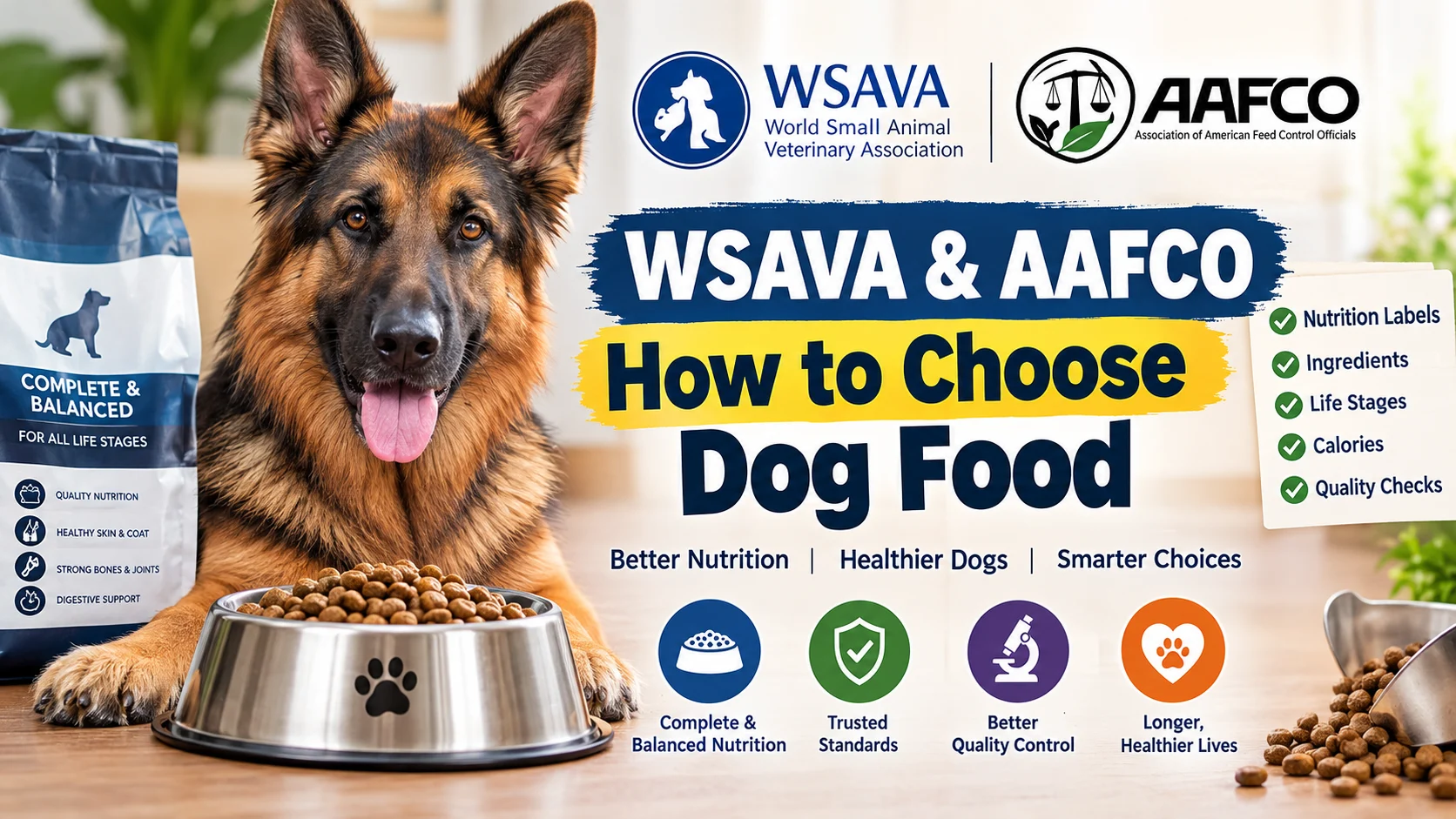
WSAVA does not approve dog food, and AAFCO does not certify individual brands. Use AAFCO’s nutritional adequacy statement to check whether a food is complete and balanced, then use WSAVA guidance to evaluate the manufacturer, formulation, quality control, and research.
What WSAVA and AAFCO Actually Mean
When choosing dog food, you may see phrases such as “WSAVA approved,” “AAFCO approved,” “vet recommended,” or “complete and balanced.”
Here is where many pet owners get confused.
There is no official category of “WSAVA approved dog food” or “AAFCO approved dog food.” AAFCO explicitly states that it does not approve, certify, or endorse individual pet-food products. Instead, AAFCO establishes nutritional profiles and feeding protocols that are referenced in pet-food regulation, while WSAVA provides practical guidance for evaluating nutrition, manufacturers, labels, and your individual dog’s needs.
So the better question is not:
“Is this dog food WSAVA approved?”
It is:
“Does this food meet appropriate nutritional standards, and does the company provide enough evidence and information to trust the product?”
That distinction can save owners from falling for impressive packaging and misleading marketing.
Quick Snapshot Table
| What to Check | Why It Matters |
|---|---|
| AAFCO nutritional adequacy statement | Shows whether the food is complete and balanced for a stated life stage |
| WSAVA guidance | Helps evaluate the company, formulation, quality control and research |
| Life stage | Puppies, adults and reproduction have different nutritional requirements |
| Guaranteed analysis | Shows declared minimum or maximum levels of key nutrients |
| Calorie content | Helps prevent accidental overfeeding |
| Qualified nutritionists | Indicates appropriate nutritional expertise |
| Quality control | Helps assess consistency and safety |
| Feeding trials or formulation | Shows how nutritional adequacy was established |
| Manufacturer contact | Allows owners and veterinarians to obtain additional information |
| Dog’s individual needs | Health, age, activity and body condition affect diet choice |
Is There Such a Thing as WSAVA Approved Dog Food?
No.
WSAVA does not approve individual dog-food brands or products.
The World Small Animal Veterinary Association’s Global Nutrition Committee publishes guidelines and tools designed to help veterinary teams and pet owners make better nutritional decisions. Its pet-food selection guidance emphasizes factors such as qualified nutritionists, formulation expertise, quality-control systems, research and complete nutritional information.
What WSAVA Actually Helps You Evaluate
WSAVA’s guidance encourages owners to look beyond attractive ingredient lists and marketing claims.
Important questions include:
- Does the company employ a qualified nutritionist?
- Who formulates the diet?
- What quality-control procedures are used?
- Does the company conduct nutrition research?
- Can the manufacturer provide nutrient information?
- Is there a nutritional adequacy statement?
- Are calorie levels available?
- Can you easily contact the company?
This is much more useful than simply looking for words such as premium, holistic, or natural.
Is There Such a Thing as AAFCO Approved Dog Food?
No.
AAFCO does not approve individual dog foods.
Instead, AAFCO develops nutritional standards and feeding protocols that are used as part of pet-food regulation in the United States. A dog’s food label can include a nutritional adequacy statement showing that the food meets an AAFCO nutrient profile or that feeding tests substantiate nutritional adequacy.
What AAFCO Actually Tells You
The most important part for an owner is the nutritional adequacy statement.
It helps answer:
Is this food complete and balanced for my dog’s species and life stage?
For example, a product may be intended for:
- growth
- adult maintenance
- reproduction
- all life stages
AAFCO also distinguishes between foods formulated to meet nutrient profiles and those supported by feeding protocols.
WSAVA vs AAFCO: What Is the Difference?
| WSAVA | AAFCO |
|---|---|
| Veterinary association | Association of feed control officials |
| Provides nutrition guidance | Establishes nutritional profiles and protocols |
| Helps evaluate pet-food companies and products | Provides standards referenced in pet-food regulation |
| Does not approve brands | Does not approve individual foods |
| Emphasizes qualified nutrition expertise | Provides nutritional adequacy framework |
| Encourages nutritional assessment | Nutritional statements appear on eligible labels |
The Easy Way to Remember It
AAFCO helps answer:
“Does this food meet an appropriate nutritional standard for its stated use?”
WSAVA helps answer:
“Does this company demonstrate the expertise, quality control and transparency I should expect?”
You ideally want to consider both, rather than treating either name as a magic approval stamp.
How to Choose Dog Food Step by Step
Step 1: Start With Your Dog, Not the Bag
Before comparing brands, identify your dog’s actual nutritional requirements.
Consider:
- age
- size
- activity level
- reproductive status
- body condition
- medical conditions
- food tolerance
AAFCO notes that species, life stage and condition are among the most important factors when selecting food.
A highly active young German Shepherd has different nutritional needs from an elderly, overweight companion dog.
Step 2: Look for the Nutritional Adequacy Statement
This is one of the most valuable pieces of information on the package.
Look for wording indicating that the food is complete and balanced for the appropriate life stage.
Do not automatically assume that a beautiful ingredient panel means the diet is nutritionally complete.
Step 3: Check the Life Stage
A puppy food should be appropriate for growth.
An adult maintenance food is designed differently.
A reproduction diet has different requirements again.
Be particularly careful with “all life stages” foods. WSAVA’s guidance notes that these diets are formulated for reproduction and growth, rather than being simply an average adult-maintenance formula.
Step 4: Look Beyond the Ingredient List
This is one of the biggest mistakes owners make.
The first five ingredients can look impressive, but the ingredient list alone does not tell you everything about nutritional quality, digestibility or nutrient bioavailability. WSAVA specifically cautions against treating the ingredient list as the primary measure of food quality.
Instead, ask:
Who formulated the food?
How is the finished product tested?
Does the manufacturer have strong quality-control procedures?
Those questions reveal considerably more.
What to Look for in a Dog Food Company
Does the Company Employ a Qualified Nutritionist?
WSAVA recommends asking whether a company employs an appropriately qualified nutritionist, such as someone with a PhD in animal nutrition or relevant board certification.
That does not automatically make a food perfect.
But it is a meaningful sign that nutritional formulation is being handled by someone with appropriate expertise.
Who Formulates the Recipe?
Recipe formulation is more complicated than combining ingredients that sound healthy.
A proper formulation considers:
- nutrient requirements
- ingredient variability
- processing
- nutrient interactions
- energy density
- life-stage requirements
WSAVA specifically recommends asking who formulates the diet and what qualifications that person has.
What Quality Control Does the Company Use?
A responsible manufacturer should have systems for evaluating ingredients and finished products.
WSAVA identifies quality-control considerations including:
- ingredient validation
- nutrient analysis
- microbiological testing
- toxicology considerations
- packaging
- shelf-life testing
This is the part of dog food quality that consumers rarely see.
And it matters.
Understanding the Dog Food Label
Guaranteed Analysis
The guaranteed analysis normally provides declared levels for nutrients such as:
- crude protein
- crude fat
- crude fiber
- moisture
AAFCO explains that these are required label guarantees for pet food in the relevant regulatory framework.
But don’t make the mistake of choosing food solely because it has the highest protein percentage.
More is not automatically better.
Calorie Content
Calories are extremely important.
Two foods can have similar protein and fat percentages while delivering very different amounts of energy per cup or kilogram.
Knowing calorie density helps you avoid accidental overfeeding.
WSAVA recommends considering calorie information when evaluating diets and managing body condition.
Ingredient Statement
Ingredients are listed in descending order by weight under AAFCO labeling requirements.
But ingredient order should be interpreted alongside the complete nutritional information.
A food with a flashy ingredient panel is not automatically superior to a less glamorous formula.
Does “Premium” Mean Better?
Not necessarily.
Words such as:
- premium
- holistic
- natural
- ancestral
- human-grade
can influence purchasing decisions, but they should not replace nutritional evaluation.
WSAVA specifically notes that some marketing terms provide limited practical value when assessing nutritional quality.
The better approach is to ask:
What evidence supports this food?
That question is far more useful than asking how attractive the packaging looks.
Feeding Trials vs Formulated to Meet Nutrient Profiles
This distinction is worth understanding.
Formulated to Meet AAFCO Nutrient Profiles
The manufacturer formulates the recipe to meet specified nutrient levels.
Animal Feeding Tests
The company may use feeding protocols designed to substantiate that the food provides complete and balanced nutrition for a stated life stage.
Neither phrase should be interpreted as a guarantee that the food is perfect for every individual dog.
WSAVA notes that feeding trials have benefits but also limitations, while formulated diets should be interpreted within the broader context of manufacturing and nutritional expertise.
Puppy Food vs Adult Dog Food
This distinction becomes especially important with large-breed puppies.
Puppy Food Should Match Growth Requirements
Growing dogs need carefully balanced nutrition for:
- skeletal development
- muscle growth
- healthy body composition
For large-breed puppies, uncontrolled growth and inappropriate nutrient intake can be particularly concerning.
Don’t choose puppy food simply because the label says “high protein.”
Choose a complete diet appropriate for the puppy’s life stage and size, then follow veterinary guidance when there are breed-specific or medical concerns.
What About German Shepherds?
German Shepherds are active, large dogs with specific nutritional considerations.
For a healthy German Shepherd, owners should pay particular attention to:
- body condition
- calorie intake
- life stage
- digestive tolerance
- joint and skeletal development during growth
- activity level
A working-line German Shepherd doing several hours of physical activity will not necessarily need the same feeding strategy as a sedentary adult living in an apartment.
The dog’s condition and lifestyle should guide the final feeding decision.
Common Dog Food Mistakes
Choosing Food Because of the First Ingredient
A single ingredient does not tell you whether the finished diet is nutritionally appropriate.
Assuming Expensive Means Better
Price can reflect many factors and does not independently prove nutritional superiority.
Searching for “WSAVA Approved”
This terminology is inaccurate.
WSAVA provides guidelines and nutritional tools; it does not maintain a list of WSAVA-approved dog foods.
Searching for “AAFCO Approved”
This is also inaccurate.
AAFCO itself says there is no such thing as an AAFCO-approved pet food. Look for the nutritional adequacy statement instead.
Ignoring Calories
Even a complete and balanced food can contribute to obesity if a dog consistently receives more calories than it needs.
Ignoring Body Condition
The measuring cup is not the final judge.
Your dog’s:
- weight
- body condition
- muscle condition
- activity
- overall health
matter just as much.
How to Evaluate a Dog Food in 60 Seconds
Use this quick checklist before buying.
Label Check
☐ Correct species
☐ Appropriate life stage
☐ Complete and balanced statement
☐ Calorie information available
☐ Guaranteed analysis reviewed
☐ Manufacturer clearly identified
Company Check
☐ Qualified nutrition expertise
☐ Experienced food formulation
☐ Strong quality-control process
☐ Research or nutrition data available
☐ Easy company contact information
Dog Check
☐ Appropriate body condition
☐ Suitable calorie intake
☐ Good stool quality
☐ Healthy coat and skin
☐ Good appetite and energy
☐ No unexplained weight changes
If several answers are missing, investigate the product more carefully.
What About “Vet Recommended” Dog Food?
“Veterinarian recommended” is not a substitute for nutritional evidence.
A recommendation becomes more meaningful when it considers the individual dog’s:
- age
- weight
- health
- activity
- body condition
- dietary history
For dogs with medical conditions, a veterinarian or veterinary nutrition professional should guide the diet rather than relying on general online rankings.
Can You Trust Online Dog Food Reviews?
Reviews can tell you about:
- palatability
- packaging
- delivery
- stool changes
- individual experiences
But they cannot establish whether a food is the right nutritional choice for your dog.
One dog’s excellent experience does not prove universal suitability.
This is especially important with sensitive dogs or dogs receiving therapeutic diets.
What Most Dog Food Articles Get Wrong
They Focus Too Much on Ingredients
Ingredient lists are easy to read and easy to market.
Nutritional formulation is much harder to evaluate.
They Treat AAFCO Like a Certification Organization
AAFCO does not certify or approve individual foods.
They Treat WSAVA Like a Brand Rating System
WSAVA provides nutritional guidance rather than a “best dog food” certification list.
They Ignore the Individual Dog
There is no single food that is automatically best for every dog.
A nutritionally complete food still needs to be appropriate for the individual animal.
Buyer Warning: Don’t Pay for Marketing Hype
Be cautious when a product relies heavily on:
- celebrity endorsements
- dramatic health promises
- “miracle” ingredients
- fear-based marketing
- unsupported claims
- extreme anti-grain or anti-meat messaging
The strongest food companies should be able to answer practical questions about formulation, nutrition expertise and quality control.
If a company cannot provide meaningful information, that is worth considering before making the purchase. WSAVA specifically recommends caution when manufacturers cannot or will not provide relevant information about their products.
Best Way to Choose Dog Food
The simplest reliable approach is:
1. Identify your dog’s nutritional needs.
2. Choose the correct life-stage food.
3. Confirm a complete and balanced nutritional adequacy statement.
4. Evaluate the manufacturer’s expertise and quality control.
5. Check calories and feeding guidance.
6. Monitor your dog’s body condition and overall response.
7. Consult your veterinarian when health problems or special dietary needs are involved.
That is a much stronger process than choosing a food because its ingredient list looks impressive.
Frequently Asked Questions
Is WSAVA dog food approved?
No. WSAVA does not approve or certify individual dog foods. It provides nutritional guidelines and tools to help veterinary professionals and owners evaluate pet nutrition and food manufacturers.
Is AAFCO dog food approved?
No. AAFCO explicitly states that it does not approve, certify, or endorse individual pet foods. Instead, its nutritional profiles and feeding protocols are used in the regulatory framework for pet-food labeling.
What does AAFCO approved mean on dog food?
Technically, the phrase is misleading. Look instead for the food’s AAFCO nutritional adequacy statement, which indicates whether the diet is complete and balanced for a specified species and life stage.
What does WSAVA recommend when choosing dog food?
WSAVA guidance encourages owners to evaluate factors such as qualified nutritionists, experienced formulation, quality control, research, nutritional adequacy, calorie information and manufacturer transparency.
Is the ingredient list the most important part of dog food?
No. The ingredient list is useful, but it does not by itself establish nutritional quality, digestibility or nutrient bioavailability.
Is expensive dog food automatically better?
No. Price alone cannot establish nutritional quality. Evaluate nutritional adequacy, formulation expertise, manufacturing controls and your dog’s individual needs.
What is the most important thing on a dog food label?
For most owners, the nutritional adequacy statement is one of the first things to check because it tells you whether the food is intended to provide complete and balanced nutrition for a particular life stage.
Final Verdict
The smartest way to choose dog food is not to hunt for a mythical “WSAVA approved” or “AAFCO approved” label.
Instead, use the two organizations for what they actually provide.
AAFCO: check the nutritional adequacy framework and statement.
WSAVA: use its guidance to investigate the company, formulation expertise, quality control, research and label information.
Then bring the most important factor back into the equation: your dog.
Age, life stage, body condition, activity level and health status should ultimately determine whether a particular diet makes sense.
That approach is less flashy than choosing food from a beautiful ingredient list, but it is far more useful for making a responsible nutrition decision.