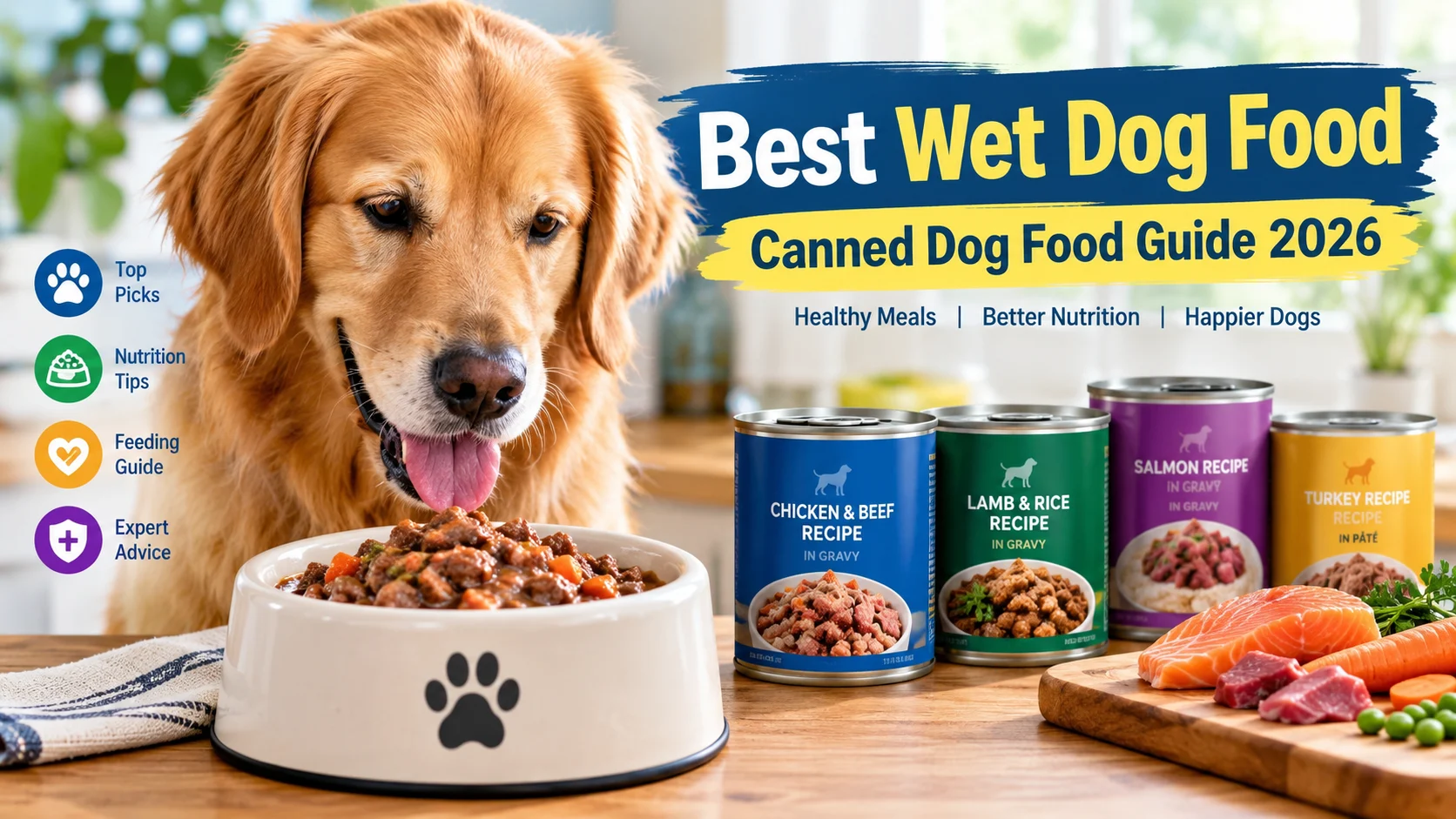
The best wet dog food is a complete and balanced canned diet that meets your dog’s nutritional needs and life stage. Look for appropriate calories, quality nutrition, and a formula your dog tolerates well.
Quick Snapshot Table
| Category | Best Wet Dog Food Guidance |
|---|---|
| Best Overall | Complete and balanced wet food matched to your dog |
| Best Canned Dog Food | A nutritionally complete formula for the correct life stage |
| Best for Puppies | Food formulated for growth |
| Best for Adult Dogs | Adult maintenance formula |
| Best for Seniors | Senior appropriate calories and nutrients |
| Best for Picky Eaters | Highly palatable pâté, stew, or chunks in gravy |
| Main Advantage | High moisture and strong palatability |
| Main Disadvantage | Usually more expensive per calorie |
| Storage | Refrigerate after opening |
| Key Label Check | Nutritional adequacy statement |
| Feeding Method | Wet only or combined with dry food |
| Veterinary Diets | Use when medically indicated |
What Is Wet Dog Food?
Wet dog food is commercially prepared dog food containing substantially more moisture than traditional dry kibble. It is commonly sold in cans, trays, pouches, pâté textures, stews, and chunks with gravy.
The term canned dog food is often used interchangeably with wet dog food, although not every wet food comes in a metal can.
The most important distinction is not whether the food looks premium.
It is whether the product is complete and balanced for your dog’s life stage and nutritional needs. AAFCO recommends checking the nutritional adequacy statement on the label rather than assuming a food is nutritionally complete because of its ingredients or marketing claims.
Why Do Dogs Like Wet Food So Much?
Wet food often wins dogs over because of its aroma, texture, and moisture.
Some dogs that ignore kibble will immediately eat:
- pâté
- meat chunks
- stews
- gravy based recipes
Canned food can also be gently warmed to increase its aroma, which may make meals more appealing to selective eaters.
But palatability should not be confused with nutritional quality.
A dog can love a food that is not appropriate as its primary diet.
That is why the best wet dog food has to satisfy both nutrition and preference.
What Makes the Best Wet Dog Food?
There is no single canned dog food that is automatically best for every dog.
The right choice depends on:
- age
- body weight
- activity level
- health status
- calorie requirements
- food preferences
- veterinarian recommendations
AAFCO specifically notes that the most important factors when choosing pet food include the animal’s species, life stage, and condition.
Look for a Complete and Balanced Formula
This is the first filter.
A primary diet should have a nutritional adequacy statement indicating that it is complete and balanced for the appropriate life stage.
“Complete” means the food provides required nutrients, while “balanced” means those nutrients are supplied in appropriate proportions.
Match the Food to Life Stage
A puppy and an adult dog should not automatically receive the same diet.
Common categories include:
- growth
- adult maintenance
- all life stages
- gestation and lactation
Growing puppies have different nutritional requirements from mature dogs, so the label should match the animal’s developmental stage.
Check Calories, Not Just Ingredients
This is one of the biggest mistakes owners make.
A food can look extremely meaty while still providing a different amount of energy than expected.
Canned food naturally contains a lot of water, so its calorie density can look lower than dry food when compared on an as fed basis.
For weight management, compare the calories per can, tray, or specified serving, not just the percentage of protein or fat.
Best Wet Dog Food by Dog Type
| Dog Type | What to Prioritize |
|---|---|
| Puppies | Growth appropriate complete nutrition |
| Adult Dogs | Maintenance formula and appropriate calories |
| Senior Dogs | Calorie control and individual health needs |
| Active Dogs | Adequate energy for activity |
| Picky Eaters | Texture and aroma they consistently accept |
| Overweight Dogs | Controlled calories and measured portions |
| Dogs With Medical Conditions | Veterinary guided diet |
Best Wet Dog Food for Puppies
Puppies are growing rapidly, so their food needs to support developing bones, muscles, organs, and tissues.
Look for canned dog food specifically formulated for:
- puppies
- growth
- or an appropriate all life stages claim
Large breed puppies deserve particular attention because their growth rate and nutrient requirements differ from small breeds.
How Much Wet Food Should a Puppy Eat?
There is no universal number of cans per day.
Feeding amounts depend on:
- current weight
- expected adult size
- age
- calorie density
- activity
- body condition
Start with the manufacturer’s feeding guidance and monitor body condition rather than blindly following a fixed number.
Best Wet Dog Food for Adult Dogs
For a healthy adult dog, a complete and balanced adult maintenance food is usually the sensible starting point.
The goal is not to find the food with the longest ingredient list.
The goal is to provide appropriate nutrition while maintaining a healthy body condition.
What About Active Dogs?
Working, sporting, or highly active dogs may need more calories than sedentary pets.
A highly active German Shepherd, for example, may require a very different feeding strategy from a less active companion dog of the same weight.
Nutrition should follow workload, not simply breed reputation.
Best Canned Dog Food for Senior Dogs
Older dogs do not all need the same diet.
A healthy senior dog may need:
- carefully controlled calories
- adequate protein
- appropriate fat levels
- nutrients suited to individual health needs
A senior dog with kidney disease, obesity, arthritis, or another medical condition may need something very different.
This is where a veterinarian’s nutritional assessment becomes more useful than a generic “best senior wet food” list. Veterinary teams can consider body condition, muscle condition, lifestyle, age, and medical needs when recommending a diet.
Wet Food vs Dry Food
| Factor | Wet Dog Food | Dry Dog Food |
|---|---|---|
| Moisture | High | Low |
| Palatability | Often high | Usually moderate to high |
| Storage | Requires refrigeration after opening | Easier to store |
| Cost Per Calorie | Usually higher | Usually lower |
| Portion Size | Larger because of moisture | More calorie dense |
| Texture | Pâté, stew, chunks | Kibble |
| Hydration Contribution | High | Low |
| Convenience | Moderate | Excellent |
Neither form is universally superior.
Veterinary nutrition guidance recognizes that dogs can do well on dry food, canned food, or a combination when the diet is appropriate and nutritionally complete.
Why Canned Dog Food Can Be a Good Choice
Higher Moisture
One of the biggest advantages of wet food is its high water content.
This can help increase total water intake, which may be useful for some dogs and particularly relevant in certain medical situations where increased water intake is recommended.
Fresh drinking water should still remain available.
Better Acceptance for Some Dogs
Some dogs simply prefer wet textures.
This can be especially useful when:
- appetite is reduced
- a dog is extremely selective
- medication needs to be hidden
- a different texture encourages eating
Larger Looking Portions
Because canned food contains substantial moisture, dogs may receive a larger physical portion for a similar calorie intake compared with dry food.
That can be helpful for dogs that seem hungry despite needing calorie control.
The Downsides of Wet Dog Food
Wet food is not perfect.
It Can Cost More
Because of its high moisture content and packaging, canned food is generally more expensive per calorie than kibble.
It Requires Refrigeration
Once opened, unused canned food should be refrigerated.
VCA guidance recommends discarding unused canned food after three days and removing uneaten food from the bowl after about 30 minutes.
It Does Not Automatically Improve Dental Health
Wet food does not provide the same mechanical chewing action associated with some dry foods designed for dental purposes.
That does not mean kibble alone guarantees dental health.
Dental care should be considered separately.
How to Read a Wet Dog Food Label
This is arguably more important than choosing between “premium” and “natural” marketing claims.
Step 1: Check the Nutritional Adequacy Statement
Look for wording indicating the product is:
complete and balanced
Then verify the appropriate life stage.
Step 2: Check the Calorie Content
Compare calories with your dog’s daily needs.
Do not assume:
“More protein = better food.”
Nutritional quality involves the entire nutrient profile.
Step 3: Check the Feeding Directions
Feeding instructions are starting guidelines rather than absolute rules.
AAFCO notes that feeding amounts may need adjustment according to a dog’s activity and body condition.
Step 4: Look Beyond Marketing Words
Words such as:
- natural
- premium
- holistic
- gourmet
- grain free
do not automatically tell you whether a food is appropriate for your dog.
The nutritional adequacy statement is much more useful.
Best Wet Dog Food Ingredients
What Should You Look For?
A quality formula should provide appropriate amounts of:
- protein
- fat
- essential fatty acids
- vitamins
- minerals
- amino acids
- calories
Dogs require balanced nutrients, not simply recognizable meat ingredients.
Is Meat Always the First Ingredient?
Not necessarily.
Ingredient lists can be useful, but they should not be the only method used to judge nutritional quality.
A food formulated to meet established nutrient requirements can be nutritionally appropriate even when its ingredient list does not resemble a homemade meal.
This is one reason veterinary nutritionists caution against judging food quality solely from the ingredient panel.
How to Choose the Best Canned Dog Food for a Picky Eater
Picky dogs often respond to texture more than owners expect.
Try comparing:
- pâté
- minced formulas
- chunks in gravy
- stew textures
Some dogs prefer strong aromas, while others reject foods with certain textures.
A Better Strategy
Do not immediately buy ten different foods.
Instead:
- Choose a complete and balanced formula.
- Offer a suitable texture.
- Monitor appetite and stool quality.
- Make changes gradually.
- Keep the option that your dog consistently tolerates and enjoys.
Sudden food changes can cause gastrointestinal problems. VCA recommends transitioning to a new diet gradually over roughly a couple of weeks when practical.
Mixing Wet and Dry Dog Food
You do not have to choose only one.
A combination of canned and dry food can work very well.
For example:
- measured kibble for convenience
- wet food as a palatability boost
- water added to either food when appropriate
The important part is accounting for the calories from both foods.
Adding a full can of wet food on top of a complete daily ration of kibble can quietly increase calorie intake.
Wet Food for Weight Management
Wet food can sometimes make portion control easier because its high moisture content reduces calorie density.
But “wet” does not automatically mean “low calorie.”
Always check the actual calorie content.
Signs Your Dog May Be Getting Too Much
Watch for:
- gradual weight gain
- loss of waist definition
- reduced activity
- difficulty feeling ribs
Body condition is more useful than judging portions by eye.
Wet Dog Food for Dogs With Health Problems
This is where generic “best wet food” articles become misleading.
A dog with:
- kidney disease
- urinary disease
- food allergies
- gastrointestinal disease
- pancreatitis
- diabetes
- obesity
may need a specific nutrient profile rather than an ordinary supermarket canned food.
For dogs with medical conditions, veterinary guidance should come before switching diets.
Common Mistakes Dog Owners Make
Choosing Food Because the Ingredients Look Fancy
A long list of recognizable ingredients does not automatically mean superior nutrition.
Ignoring the Life Stage
Puppy, adult, and senior nutritional requirements are not interchangeable.
Feeding by Can Count Alone
Two cans from different formulas can contain very different amounts of calories.
Switching Food Too Quickly
Rapid diet changes can trigger digestive upset.
Treating Wet Food as a Treat
Some canned products are intended only for intermittent or supplemental feeding.
They should not automatically replace a complete diet.
Assuming Grain Free Means Better
There is no universal reason that every dog needs a grain free diet.
The right formula depends on the individual dog.
Insights Most Wet Dog Food Articles Miss
“Best” Is Individual
The best wet dog food for one dog may be a poor choice for another.
A healthy young Labrador, an overweight senior Chihuahua, and a working German Shepherd have very different nutritional circumstances.
Moisture Is Not the Same as Nutrition
A food can contain a lot of water without being nutritionally complete.
Always separate:
hydration benefit from nutritional adequacy.
More Expensive Does Not Automatically Mean Better
Price can reflect packaging, ingredients, formulation, marketing, and distribution.
It is not a nutritional score.
The Dog’s Response Matters
After choosing a nutritionally appropriate food, monitor:
- body weight
- stool quality
- appetite
- coat condition
- energy
- muscle condition
A food that looks excellent on paper still needs to work for the individual dog.
Storage and Feeding Safety
After Opening
Keep unused wet food refrigerated in a suitable covered container.
Follow the manufacturer’s storage instructions.
At Mealtime
Do not leave wet food sitting out indefinitely.
VCA recommends discarding uneaten canned food that has remained in the food dish for around 30 minutes.
Water
Fresh, clean drinking water should always be available, even when feeding moisture rich canned food.
Preparation Checklist
Before buying the best wet dog food, check:
Nutrition
☐ Complete and balanced statement
☐ Correct life stage
☐ Appropriate calorie density
☐ Suitable nutrient profile
Your Dog
☐ Age
☐ Current weight
☐ Activity level
☐ Body condition
☐ Food preferences
☐ Known medical requirements
Practical Factors
☐ Can size or serving size
☐ Storage requirements
☐ Refrigeration space
☐ Feeding cost
☐ Transition plan
Frequently Asked Questions
What is the best wet dog food?
The best wet dog food is a complete and balanced formula that matches your dog’s life stage, calorie needs, health status, and individual tolerance. There is no single product that is best for every dog.
Is canned dog food better than dry food?
Not universally. Wet and dry foods can both be appropriate when nutritionally complete and correctly matched to the dog. Wet food has the advantage of higher moisture and may be more appealing to some dogs.
Is wet dog food good for everyday feeding?
Yes, provided the product is labeled complete and balanced for the appropriate life stage. Foods intended only for intermittent or supplemental feeding should not be used as the sole diet.
Can I feed wet and dry dog food together?
Yes. Combining wet and dry food can be practical, but the calories from both should be included in the dog’s total daily intake.
Is canned dog food good for picky eaters?
It can be. Many dogs find wet food more palatable because of its aroma and texture, and canned foods are available in pâté, stew, and chunks with gravy.
Does wet dog food help dogs drink more water?
It can contribute substantially more moisture to the diet than dry food. However, dogs should still have access to fresh drinking water at all times.
How long can opened canned dog food stay in the refrigerator?
A practical guideline from VCA is to refrigerate opened canned food and discard unused portions after three days.
Is expensive wet dog food automatically better?
No. Price is not a reliable measure of nutritional adequacy. Start with the nutritional adequacy statement, life stage, calorie content, and your dog’s individual needs.
Conclusion
The best wet dog food is not necessarily the most expensive can on the shelf or the recipe with the most impressive ingredient list.
The better approach is to look for a complete and balanced diet, match it to your dog’s life stage and condition, check calorie content, and then evaluate how your dog actually responds.
Canned dog food can be an excellent everyday option because of its high moisture, appealing textures and palatability. It can also be combined with dry food when portions are properly measured.
The smartest buyer is not the one who chooses the trendiest label.
It is the one who asks a simpler question:
Does this food provide the right nutrition for this particular dog?
That is the standard that matters most.