Strong nutrition for bigger, healthier dogs.
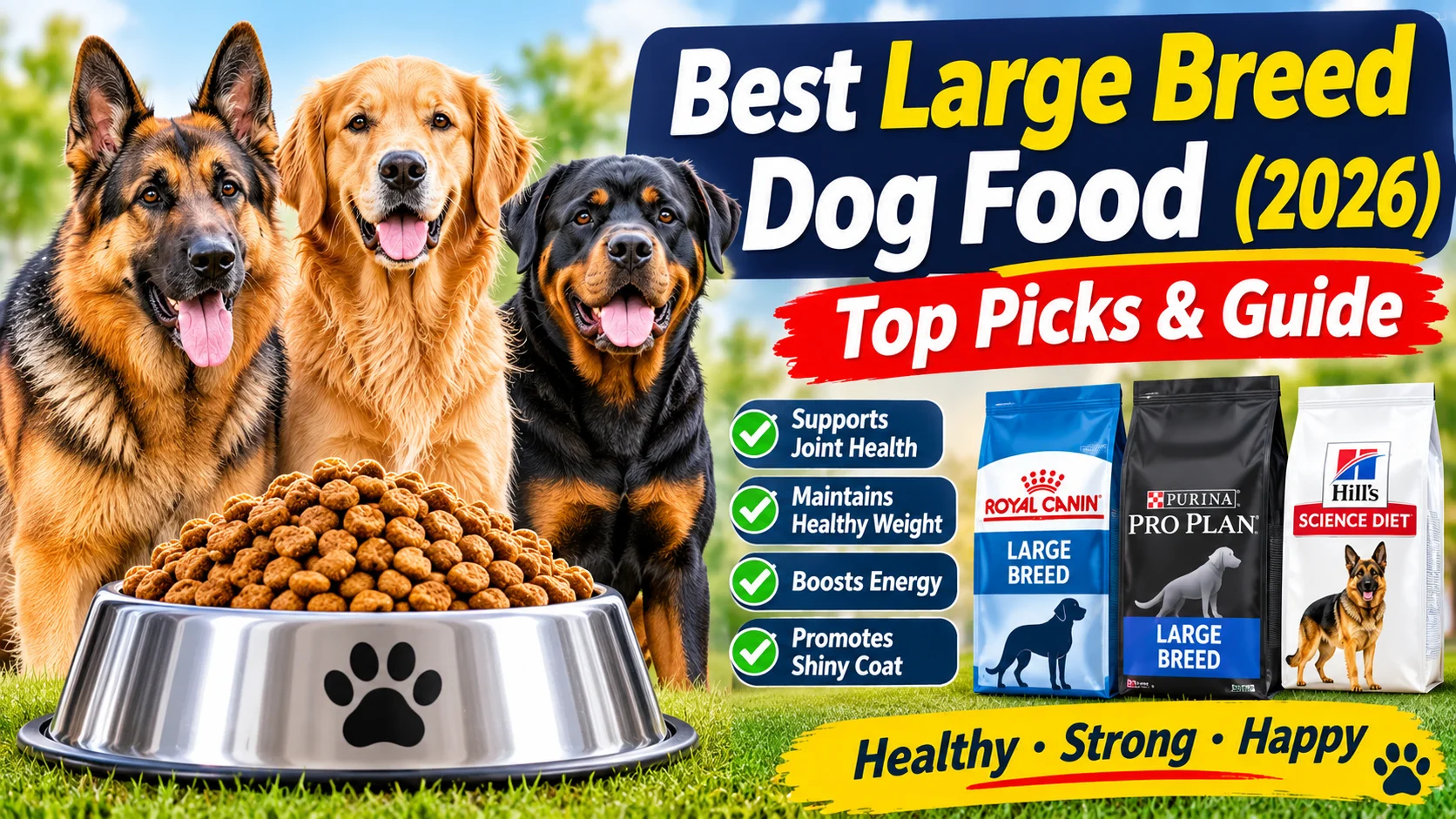
Large breed dogs need more than simply bigger portions of regular dog food. Their size, body structure, activity levels, and nutritional requirements make food selection especially important. German Shepherds, Golden Retrievers, Labrador Retrievers, Rottweilers, Great Danes, Mastiffs, and other large breeds benefit from diets that support healthy muscles, maintain an ideal body weight, and provide balanced nutrition for their life stage.
The best large breed dog food should provide high-quality protein, appropriate calories, essential fatty acids, and carefully balanced minerals. Growing puppies have additional nutritional requirements because excessive calorie intake or improper mineral balance can contribute to skeletal development problems.
Adult and senior large dogs also need attention to weight management and mobility. Carrying excess weight can place additional stress on their joints, while inadequate nutrition may contribute to muscle loss.
This guide compares popular large breed dog foods, explains important nutrients, explores puppy and senior formulas, and shares practical feeding advice to help you choose the right diet.
What Is the Best Dog Food for Large Breeds?
The best dog food for large breeds is a complete and balanced formula designed for the dog’s current life stage, body condition, and nutritional needs.
Large dogs generally need more total calories than small dogs, but they often need fewer calories per pound of body weight. Their food should provide sufficient nutrients without encouraging excessive weight gain.
Some popular formulas worth comparing include:
| Dog Food | Best For | Main Feature |
| Hill’s Science Diet Adult Large Breed | Everyday adult nutrition | Large-breed-focused formulation |
| Purina Pro Plan Large Breed | Active adult dogs | Protein-rich recipe options |
| Royal Canin Large Adult | Size-specific nutrition | Large-breed formula |
| Eukanuba Adult Large Breed | Adult maintenance | Large-breed nutrition |
| IAMS ProActive Health Large Breed | Budget-conscious owners | Everyday large-breed feeding |
| Blue Buffalo Life Protection Large Breed | Conventional adult nutrition | Large-breed recipe options |
These products are comparison options, not universal winners. Formulas, availability, and ingredient lists may differ by country and product version.
When selecting food, check the nutritional adequacy statement, calorie content, manufacturer quality standards, and suitability for your dog’s age.
Best Large Breed Dog Food in 2026
Hill’s Science Diet Adult Large Breed
<text>Hill’s Science Diet Adult Large Breed is an option for owners seeking a formula specifically designed for adult large dogs.</text>
Potential benefits:
- Designed for adult large-breed nutritional needs.
- Provides a complete and balanced diet when the specific recipe carries the appropriate adequacy statement.
- Includes nutrients intended to support healthy mobility.
- Offers a convenient dry-food option.
It may suit healthy adult dogs that need a regular maintenance diet. Compare the calorie content with your dog’s activity level, particularly if your dog is prone to weight gain.
Purina Pro Plan Large Breed
Purina Pro Plan offers several large-breed formulas for dogs with different preferences and nutritional needs.
Potential benefits:
- Large-breed-specific product options.
- Different protein and recipe choices.
- Selected formulas include nutrients intended to support joint health.
- Options for different life stages and dietary preferences.
It may be worth comparing for active large dogs that need a nutrient-dense diet. Check the exact formula because adult, puppy, and specialized recipes are not interchangeable.
Royal Canin Large Adult
Royal Canin Large Adult is formulated for dogs within a specified large-breed size and age range.
Potential benefits:
- Size-specific nutrition.
- Kibble designed for larger mouths.
- Formulas developed around large-dog nutritional requirements.
- Different life-stage options within the product range.
This can be a useful option for owners who prefer size-specific feeding. Always check the package for the appropriate weight and age range.
Eukanuba Adult Large Breed
Eukanuba Adult Large Breed is another option for owners comparing complete adult diets for larger dogs.
Potential benefits:
- Large-breed-focused formulation.
- Dry kibble format.
- Nutritional features intended to support adult maintenance.
- Convenient portioning for daily feeding.
Review the current label for calorie content, protein levels, and nutritional adequacy before choosing it.
IAMS ProActive Health Large Breed
IAMS ProActive Health Large Breed is an option for owners looking for a more budget-conscious large-dog formula.
Potential benefits:
- Designed for large-breed adult dogs.
- Convenient dry-food format.
- Easy portion measurement.
- An option to compare for everyday feeding.
As with other foods, compare the current nutritional profile rather than choosing based only on price.
Blue Buffalo Life Protection Large Breed
Blue Buffalo Life Protection Large Breed offers another option for owners comparing conventional large-breed adult foods.
Potential benefits:
- Large-breed product options.
- Different recipe variations.
- Dry kibble convenience.
- Formulas designed for adult maintenance.
Check the exact recipe and nutritional adequacy statement. Marketing terms alone do not establish whether a food is suitable for an individual dog.
Why Large Breed Dogs Need Specialized Nutrition
Large dogs have nutritional considerations that can differ from those of smaller breeds.
Controlled Calorie Intake
Large dogs need more food overall than small dogs, but their calorie requirements per pound of body weight are generally lower.
Overfeeding can cause excessive weight gain and place additional pressure on joints. This is particularly important for dogs already predisposed to hip or elbow problems.
Choose a food with an appropriate calorie density and measure meals consistently.
Healthy Muscle Maintenance
Large dogs need sufficient protein to maintain lean muscle mass, support tissue repair, and perform normal body functions.
Look for a complete diet that provides high-quality, digestible protein. Chicken, turkey, beef, fish, and eggs are examples of ingredients that can contribute useful amino acids.
Do not assume that the highest-protein food is automatically the best choice. Overall nutrient balance and calorie intake matter.
Joint and Mobility Support
Large breeds can be more prone to orthopedic conditions, including hip dysplasia, elbow dysplasia, and arthritis.
Some large-breed formulas include:
- Omega-3 fatty acids.
- EPA and DHA.
- Glucosamine.
- Chondroitin.
These ingredients may support joint health, but they do not prevent or cure every orthopedic condition. Maintaining a healthy body weight and providing appropriate exercise are also important.
Balanced Calcium and Phosphorus
Calcium and phosphorus are essential minerals for bones and teeth. However, their proportions and total amounts are particularly important during large-breed puppy growth.
Excessive calcium intake during development can contribute to skeletal problems. Large-breed puppies should receive a properly formulated growth diet rather than extra calcium supplements.
Digestive Health
Some large dogs experience digestive sensitivity, gas, or loose stools.
A suitable formula should provide an appropriate fiber profile and digestible ingredients. Avoid changing food repeatedly without identifying the reason for digestive symptoms.
Best Dog Food for Large Breed Puppies
Large-breed puppies grow rapidly, but faster growth is not necessarily healthier growth.
Their diet should support steady development rather than encourage maximum growth speed. A specially formulated large-breed puppy food helps provide suitable calories and carefully balanced minerals.
Look for:
- A complete and balanced formula for large-breed growth.
- Appropriate calcium and phosphorus levels.
- Controlled calorie density.
- Adequate high-quality protein.
- DHA for brain and eye development.
- Suitable essential fatty acids.
Popular options to compare include:
| Puppy Food | Main Feature |
| Hill’s Science Diet Puppy Large Breed | Large-breed growth nutrition |
| Purina Pro Plan Puppy Large Breed | Puppy-focused formula options |
| Royal Canin Large Puppy | Size-specific puppy nutrition |
| Eukanuba Puppy Large Breed | Large-breed growth formula |
| IAMS ProActive Health Smart Puppy Large Breed | Growth-focused nutrition |
Important: Check the nutritional adequacy statement on the package. It should specifically cover growth, including growth of large-size dogs expected to reach approximately 70 pounds or more as adults, where applicable under the relevant labeling standard.
Why Large Breed Puppies Need Controlled Growth
Large-breed puppies have developing bones and joints. Excessive calorie intake can cause them to grow too quickly, increasing the risk of developmental orthopedic problems.
Avoid:
- Feeding unrestricted amounts.
- Adding calcium supplements without veterinary advice.
- Using adult maintenance food during growth.
- Choosing puppy food simply because it has the highest protein percentage.
- Encouraging excessive weight gain.
A lean, steadily growing puppy is generally a better goal than the fastest-growing puppy.
Best Dog Food for Adult Large Breeds
Adult large dogs need a diet that maintains muscle, supports healthy body weight, and provides balanced daily nutrition.
Consider:
- Adequate high-quality protein.
- Appropriate calories.
- Essential fatty acids.
- Balanced vitamins and minerals.
- Digestible ingredients.
- Kibble that is comfortable to eat.
An adult large-breed formula may be useful because its calorie density and kibble size are designed with bigger dogs in mind.
However, not every large adult dog needs a specialized formula if an alternative complete and balanced food already meets its needs.
Best Dog Food for Senior Large Breeds
Senior large dogs may become less active and experience changes in muscle mass, appetite, and mobility.
Some older dogs gain weight, while others gradually lose muscle or become underweight.
A suitable diet should consider:
- Protein intake for muscle maintenance.
- Calorie needs based on activity.
- Digestibility.
- Joint-supportive nutrients.
- Dental comfort.
- Any diagnosed medical conditions.
A senior label does not automatically make a food appropriate for every older dog. Dogs with kidney disease, diabetes, heart disease, or other medical problems may need a veterinarian-directed diet.
Best Large Breed Dog Food for Joint Health
Joint health is an important consideration for large dogs because their size places substantial mechanical demands on their bodies.
Some foods include omega-3 fatty acids, glucosamine, or chondroitin as part of their nutritional profile.
Omega-3 Fatty Acids
EPA and DHA are marine omega-3 fatty acids that may help support normal inflammatory responses and joint function.
Potential sources include:
- Fish oil.
- Salmon oil.
- Fish-based ingredients.
- Certain marine oils.
The amount of EPA and DHA matters more than simply seeing fish oil listed on the package.
Glucosamine and Chondroitin
These ingredients are commonly included in joint-support formulas.
They may be considered as part of an overall mobility plan, but evidence for their benefits varies. Their presence in dog food does not mean the product treats arthritis or hip dysplasia.
Weight Management
Maintaining a healthy body condition is one of the most useful ways to reduce unnecessary stress on joints.
If your dog is overweight, ask your veterinarian to establish a safe weight-management plan rather than drastically reducing food portions.
Best Large Breed Dog Food for Sensitive Stomachs
Some large dogs experience digestive sensitivity, including gas, soft stools, vomiting, or inconsistent bowel movements.
A suitable food may contain digestible ingredients and an appropriate fiber balance.
When comparing sensitive-stomach formulas, consider:
- A consistent protein source.
- Appropriate fat levels.
- Digestibility.
- Suitable fiber.
- Complete and balanced nutrition.
Purina Pro Plan Sensitive Skin & Stomach and veterinary gastrointestinal diets may be options to discuss with your veterinarian, depending on the symptoms.
Persistent vomiting, diarrhea, blood in the stool, or unexplained weight loss should be evaluated by a veterinarian.
Wet Food vs. Dry Food for Large Dogs
Both wet and dry food can provide complete nutrition when properly formulated.
| Feature | Dry Food | Wet Food |
| Moisture | Low | High |
| Storage | Convenient | Refrigerate after opening |
| Portioning | Easy to measure | Requires careful measurement |
| Chewing | Requires chewing | Usually softer |
| Aroma | Usually milder | Often stronger |
| Cost per calorie | Often lower | Often higher |
| Feeding convenience | Usually easier for large daily portions | May require more storage space |
Benefits of Dry Food
Dry food is convenient for feeding large dogs because it is easy to measure and store. Large-breed kibble is often designed for bigger mouths.
Some veterinary dental diets are designed to help reduce plaque or tartar, but ordinary dry kibble should not be considered a replacement for tooth brushing or professional dental care.
Benefits of Wet Food
Wet food contains more moisture and may be more appealing to picky eaters.
It can also be helpful for dogs with chewing difficulties. However, large dogs may need several cans or trays to meet their daily calorie requirements, depending on the product.
Can You Mix Wet and Dry Food?
Yes. Wet and dry foods can be combined when both are nutritionally appropriate.
Calculate the combined calories and adjust portions accordingly. Adding wet food on top of a full dry-food serving can contribute to weight gain.
Grain-Free vs. Grain-Inclusive Food for Large Breeds
Grain-free food is not automatically healthier for large dogs.
Grain-inclusive foods may contain:
- Rice.
- Oats.
- Barley.
- Corn.
- Wheat.
Grain-free formulas may use:
- Potatoes.
- Peas.
- Lentils.
- Chickpeas.
- Other alternative carbohydrate ingredients.
Both types can provide complete nutrition when properly formulated.
There have been concerns about a possible association between some diets and canine dilated cardiomyopathy, particularly diets containing substantial amounts of certain legumes or potatoes. The relationship is complex and has not been fully established for every food or dog.
Do not switch to grain-free food simply because your dog is large or has itchy skin. Discuss suspected food allergies and dietary changes with your veterinarian.
How Much Should You Feed a Large Breed Dog?
The correct daily amount depends on:
- Current body weight.
- Ideal body weight.
- Age.
- Activity level.
- Metabolism.
- Neutering status.
- Health conditions.
- Calories per cup or serving.
A large, active working dog may need considerably more food than a less active dog of the same breed and weight.
Use the package feeding guide as a starting point. Measure portions consistently and adjust them according to body condition and weight changes.
Feeding Considerations by Dog Type
| Dog’s Situation | Feeding Approach |
| Active adult | Match calories to exercise and work level |
| Less active adult | Monitor portions to prevent weight gain |
| Growing puppy | Use a large-breed growth formula |
| Senior dog | Monitor weight and muscle condition |
| Overweight dog | Establish a safe calorie target |
| Underweight dog | Investigate the cause before increasing portions |
Avoid relying on a universal number of cups because foods differ in calorie density.
How Often Should You Feed a Large Dog?
Feeding frequency depends on age, health, and individual needs.
| Life Stage | Common Feeding Pattern |
| Young puppy | 3–4 smaller meals daily |
| Older puppy | Usually 2–3 meals daily |
| Adult | Usually 2 meals daily |
| Senior | Often 2 meals, adjusted if needed |
Large and giant breeds are at increased risk of gastric dilatation-volvulus, commonly called bloat. This is a life-threatening emergency.
To support safer feeding habits:
- Avoid one enormous daily meal.
- Feed measured portions.
- Avoid vigorous exercise immediately before and after meals.
- Discuss individual risk with your veterinarian.
- Ask whether preventive gastropexy is appropriate for your dog’s breed and circumstances.
Signs such as a swollen abdomen, repeated unproductive retching, restlessness, excessive drooling, or sudden weakness require emergency veterinary care.
How to Transition to a New Large Breed Dog Food
A gradual transition can help reduce digestive upset when changing foods.
A seven-day schedule is a useful starting point for many healthy dogs.
| Days | Current Food | New Food |
| Days 1–2 | 75% | 25% |
| Days 3–4 | 50% | 50% |
| Days 5–6 | 25% | 75% |
| Day 7 onward | 0% | 100% |
Some dogs need a slower transition, especially those with sensitive digestion.
Monitor appetite, stool consistency, vomiting, itching, and energy. Contact your veterinarian if concerning symptoms develop.
Common Mistakes When Choosing Large Breed Dog Food
Feeding Regular Adult Food to Large Breed Puppies
Large-breed puppies have specific growth requirements. Choose a formula that explicitly covers growth of large-size dogs.
Overfeeding During Growth
Excess calories can encourage rapid growth and increase the risk of developmental orthopedic problems.
Adding Extra Calcium
Large-breed puppies should not receive extra calcium supplements unless specifically directed by a veterinarian.
Choosing Food Only by Protein Percentage
Protein is important, but the highest percentage does not automatically mean the best food. Overall nutritional balance, digestibility, and calorie intake matter.
Ignoring Body Condition
A large dog can become overweight gradually without an obvious change in appearance. Monitor body weight and body condition regularly.
Relying on Joint Supplements Alone
Joint ingredients in food cannot replace veterinary assessment, appropriate exercise, pain management, and weight control.
Changing Food Too Quickly
Sudden dietary changes may upset digestion. Transition gradually unless your veterinarian recommends otherwise.
Overlooked Insights About Large Breed Nutrition
Lean Dogs May Have Better Long-Term Health
Keeping a large dog at a healthy body condition can reduce unnecessary stress on joints and support mobility.
Puppy Growth Should Be Steady, Not Maximum
A large-breed puppy does not need to reach adult size as quickly as possible. Controlled growth and appropriate mineral balance are more important.
Kibble Size Is a Convenience, Not a Nutritional Guarantee
Large kibble may be easier for some dogs to pick up and chew, but the size of the pieces does not determine the overall quality of the food.
Joint Health Begins During Puppyhood
Appropriate growth nutrition, controlled feeding, and suitable activity during development can help support healthy skeletal development.
Giant Breeds May Need Longer Puppy Feeding
Some giant breeds continue growing beyond the first year. They may need an appropriate large-breed growth formula for longer than smaller dogs. Ask your veterinarian when to transition to adult food.
Large Breed Dog Food Buying Checklist
Before purchasing a new food, check the following:
- The food is complete and balanced for my dog’s life stage.
- Puppy food specifically covers large-size growth when applicable.
- The calorie content matches my dog’s activity level.
- The protein level supports healthy muscle maintenance.
- The food provides appropriate essential fatty acids.
- The mineral profile is suitable for my dog’s life stage.
- The kibble size is comfortable to eat.
- The manufacturer has reliable quality-control practices.
- The food is suitable for any diagnosed medical conditions.
- Portions are measured consistently.
- My dog’s weight and body condition are monitored regularly.
Frequently Asked Questions
What is the best dog food for large breeds?
Hill’s Science Diet Adult Large Breed, Purina Pro Plan Large Breed, and Royal Canin Large Adult are examples worth comparing. The best choice depends on your dog’s age, activity level, body condition, and health.
Do large breed dogs need special food?
A large-breed formula can help provide appropriate calorie density, kibble size, and nutritional balance. Large-breed puppies especially need food formulated for controlled growth.
What is the best food for large breed puppies?
Hill’s Science Diet Puppy Large Breed, Purina Pro Plan Puppy Large Breed, and Royal Canin Large Puppy are options to compare. Check that the nutritional adequacy statement specifically includes growth of large-size dogs.
How long should large breed dogs eat puppy food?
Many large breeds need a growth formula until approximately 12–18 months. Giant breeds may need it until around 18–24 months, depending on development and veterinary advice.
Do large breed dogs need more protein?
Large dogs need adequate protein to maintain muscle and support normal body functions. However, the highest-protein food is not necessarily the best choice. Nutritional balance is more important.
Is grain-free food better for large dogs?
No. Grain-free food is not automatically healthier. Choose a complete and balanced formula based on your dog’s needs and veterinary advice.
Is wet or dry food better for large breed dogs?
Both can be suitable. Dry food is often more convenient and economical for large daily portions, while wet food may be more appealing or easier to chew.
How many times a day should I feed my large dog?
Many adult large dogs do well with two measured meals per day. Puppies need more frequent meals, while senior dogs may benefit from smaller portions depending on their health.
Can large breed dogs eat regular dog food?
Healthy adult large dogs can eat a complete and balanced adult maintenance diet. However, a large-breed formula may offer more appropriate calorie density and kibble size. Growing puppies need a suitable large-breed growth formula.
What food helps large dogs with joint problems?
A complete diet containing appropriate EPA and DHA may support joint health. Some foods also include glucosamine and chondroitin. Dogs with arthritis or mobility problems may need additional veterinary treatment.
Should I give my large dog calcium supplements?
Do not give calcium supplements without veterinary advice. Excess calcium can be particularly harmful to growing large-breed puppies when their diet is already balanced.
What is the best food for a large dog with a sensitive stomach?
A digestible formula with an appropriate fiber profile may help. Persistent digestive problems should be evaluated by a veterinarian before making repeated food changes.
Conclusion
Choosing the best large breed dog food means finding a formula that supports healthy muscles, appropriate weight, digestion, and mobility throughout your dog’s life. Large-breed puppies need carefully balanced growth nutrition, adult dogs benefit from controlled calories and adequate protein, and seniors may need adjustments based on muscle condition and health.
Hill’s Science Diet Adult Large Breed, Purina Pro Plan Large Breed, Royal Canin Large Adult, Eukanuba Adult Large Breed, IAMS ProActive Health Large Breed, and Blue Buffalo Life Protection Large Breed are options worth comparing.
For puppies, consider formulas specifically designed for large-breed growth, such as Hill’s Science Diet Puppy Large Breed or Purina Pro Plan Puppy Large Breed. Always check the nutritional adequacy statement and avoid unnecessary calcium supplements.
The best food is ultimately the one that meets your dog’s individual needs, maintains a healthy body condition, and provides complete nutrition at every life stage. Combine suitable feeding with regular veterinary care, appropriate exercise, and consistent weight monitoring to help your large dog enjoy a healthy and active life.