Chocolate Labs: Loyal, Playful & Smart
Chocolate Labrador Retrievers are known for their rich brown coats, friendly personalities, intelligence, and strong retrieving instincts. Chocolate Labrador puppies can make excellent family companions, but responsible breeding and early training matter more than coat color alone.
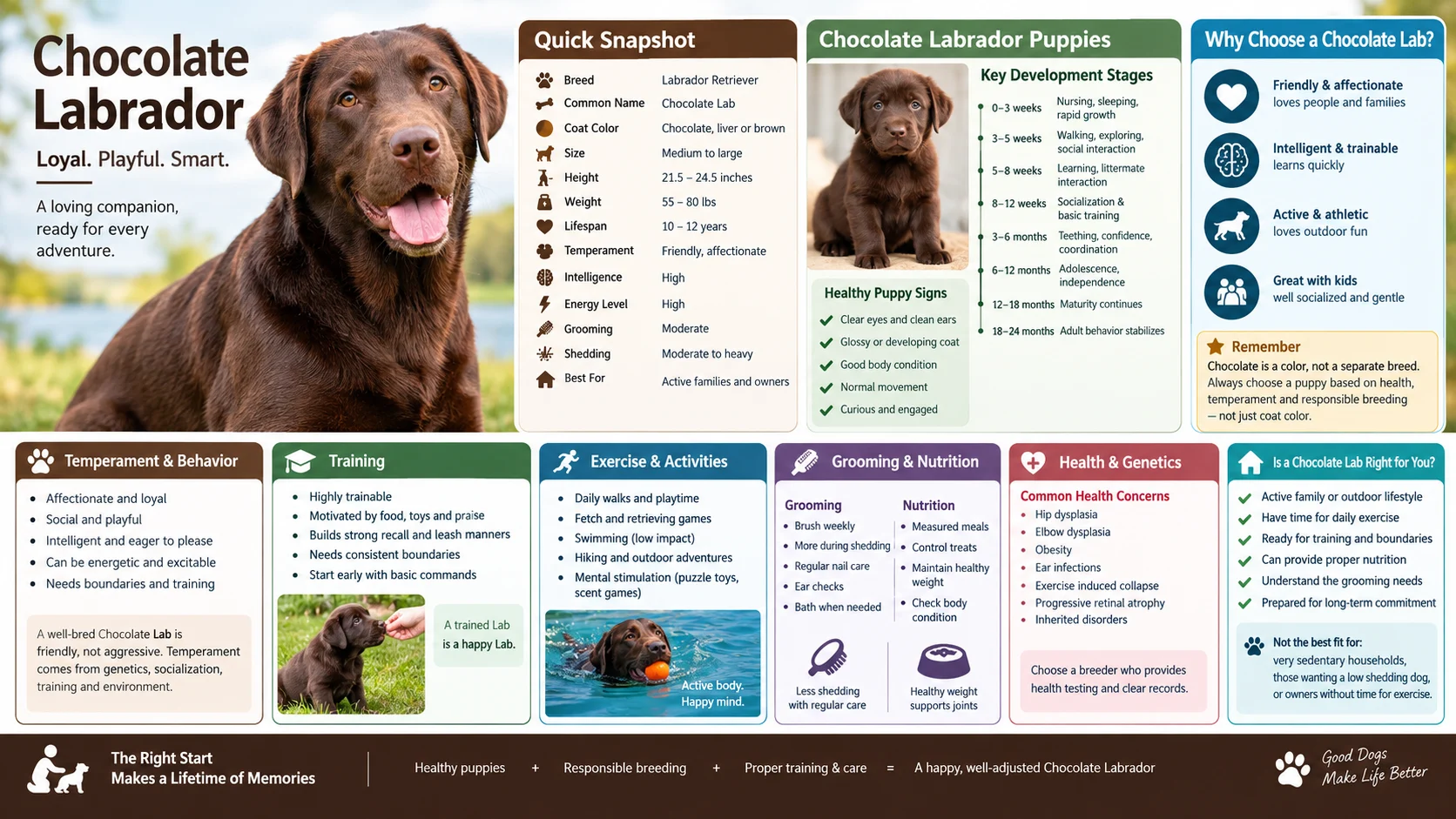
Quick Snapshot Table
| Category | Details |
|---|---|
| Breed | Labrador Retriever |
| Common Name | Chocolate Lab |
| Coat Color | Chocolate, liver or brown |
| Size | Medium to large |
| Height | About 21.5 to 24.5 inches |
| Weight | Commonly 55 to 80 lbs |
| Lifespan | Around 10 to 12 years |
| Temperament | Friendly, affectionate, outgoing |
| Intelligence | High |
| Trainability | Excellent |
| Energy Level | High |
| Exercise Needs | High |
| Grooming | Moderate |
| Shedding | Moderate to heavy |
| Best For | Active families and owners |
| Common Health Concerns | Obesity, joint disease, ear problems, some inherited disorders |
What Makes a Chocolate Labrador Different?
The easiest answer is simple: a Chocolate Labrador is a Labrador Retriever with a genetically determined brown coat.
Its coat color does not make it a separate breed.
Chocolate Labs share the same fundamental breed characteristics as black and yellow Labradors, including their retrieving ability, athletic build, affectionate nature, and strong desire to interact with people.
But there is an important distinction buyers sometimes miss.
Chocolate is a color, not a personality type.
A well bred Chocolate Labrador should be evaluated for:
• temperament
• structure
• health
• working ability
• trainability
• genetic background
rather than choosing a puppy simply because its coat looks unusual or luxurious.
Understanding Chocolate Labrador Genetics
Why Are Labradors Chocolate?
Chocolate coloration occurs because of recessive b alleles at the B locus, combined with the appropriate genotype at the E locus that permits pigment expression.
In simplified genetic terms, a Labrador needs two copies of the recessive brown allele to express a chocolate coat.
This is why two Labrador parents can produce puppies of different colors depending on their genetic makeup.
Can Two Chocolate Labs Have Chocolate Puppies?
Yes.
When both parents are genetically chocolate, their puppies inherit the brown pigment genotype.
However, coat color inheritance becomes more complicated when black or yellow Labradors are involved because multiple genes interact to determine the final coat color.
Does Chocolate Color Affect Temperament?
Not by itself.
This is one of the most important points for prospective owners.
A Chocolate Labrador is not automatically:
• calmer
• more energetic
• more affectionate
• less intelligent
because it is chocolate.
Temperament is influenced much more strongly by genetics, breeding selection, socialization, training, and environment.
Chocolate Labrador Puppies
Chocolate Labrador puppies are particularly popular because their dark brown coats often look striking against their expressive eyes and floppy ears.
But puppy appearance can be misleading.
A healthy puppy should be evaluated beyond:
• coat shade
• head shape
• eye color
• size
What Healthy Chocolate Lab Puppies Should Look Like
A well developing puppy should generally have:
• clear eyes
• clean ears
• healthy skin
• a glossy or appropriately developing coat
• good body condition
• normal movement
• curiosity about its surroundings
• appropriate energy for its age
A puppy does not need to be the biggest or most energetic one in the litter to be healthy.
Chocolate Labrador Puppy Development Timeline
| Age | Typical Development |
|---|---|
| 0 to 3 Weeks | Nursing, sleeping and rapid early growth |
| 3 to 5 Weeks | Walking, exploring and beginning social interaction |
| 5 to 8 Weeks | Rapid learning and littermate interaction |
| 8 to 12 Weeks | Major socialization and foundation training period |
| 3 to 6 Months | Teething, coordination and confidence development |
| 6 to 12 Months | Adolescence and increased independence |
| 12 to 18 Months | Continued physical and emotional maturity |
| 18 to 24 Months | Adult behavior becomes more consistent |
The Most Important Puppy Window
The first few months are not simply about teaching “sit.”
This is when puppies learn what the world feels like.
Good Chocolate Lab puppy development includes controlled exposure to:
• different surfaces
• household noises
• friendly people
• appropriate dogs
• car rides
• grooming
• handling
• basic veterinary experiences
The goal is not to overwhelm the puppy.
The goal is to build confidence without creating unnecessary fear or overstimulation.
Chocolate Labrador Temperament
The typical Labrador temperament is one of the breed’s biggest strengths.
A well bred Chocolate Labrador is usually:
• affectionate
• social
• playful
• intelligent
• food motivated
• eager to please
• people oriented
They often form strong relationships with their families and generally enjoy being involved in everyday activities.
Are Chocolate Labs Good Family Dogs?
Yes, when their exercise and training needs are properly managed.
They can be excellent companions for families because Labradors generally enjoy interacting with people and participating in activities.
However, puppies can be extremely energetic.
A young Chocolate Lab may:
• jump on people
• chew household objects
• steal food
• pull on the leash
• mouth during play
These behaviors are normal puppy challenges, but they require consistent management.
Chocolate Lab Energy Level
Do not mistake friendliness for calmness.
A Labrador can be extremely affectionate while also being physically demanding.
Most adult Chocolate Labs benefit from:
• daily walks
• retrieving games
• swimming
• obedience training
• scent activities
• interactive play
Mental stimulation is especially useful because intelligent Labradors can become destructive when they have nothing appropriate to do.
Training a Chocolate Labrador
Labradors are generally highly trainable, particularly when training is reward based and consistent.
Why They Learn Quickly
Many Labradors are strongly motivated by:
• food
• toys
• retrieving
• social interaction
That gives owners several effective ways to reinforce desirable behavior.
The Biggest Training Mistake
One of the most common mistakes is assuming a friendly Labrador does not need boundaries.
A puppy that is allowed to:
• jump on visitors
• drag people on walks
• steal food
• ignore recall
can become a difficult adult despite having a naturally pleasant temperament.
Start early.
Focus on:
• name recognition
• recall
• loose leash walking
• impulse control
• leave it
• place training
• polite greetings
Exercise Requirements
Chocolate Labs are athletic dogs.
They generally need substantially more activity than a purely companion oriented breed.
Suitable Activities
| Activity | Benefit |
|---|---|
| Walking | Everyday physical conditioning |
| Fetch | Uses natural retrieving instincts |
| Swimming | Excellent low impact exercise |
| Hiking | Physical and environmental enrichment |
| Obedience | Mental stimulation |
| Scent games | Problem solving |
| Retrieving drills | Breed appropriate work |
Avoid Excessive Puppy Exercise
Growing puppies should not be treated like adult athletes.
Too much repetitive high impact exercise can place unnecessary stress on developing joints.
For puppies, prioritize:
• free movement
• exploration
• short training sessions
• age appropriate play
rather than forcing long-distance running.
Grooming and Shedding
Chocolate Labradors have short, dense double coats.
That does not mean they are low shedding.
Grooming Routine
Most owners should expect:
• weekly brushing
• increased brushing during shedding periods
• regular nail care
• routine ear checks
• occasional bathing when needed
Their ears deserve particular attention because Labrador ears can reduce airflow around the ear canal.
Nutrition and Weight Management
This is an area Chocolate Lab owners should take seriously.
Labradors are well known for being enthusiastic eaters.
Some individuals also have genetic factors associated with increased food motivation.
Keeping a Chocolate Lab Lean
Use:
• measured meals
• appropriate calorie intake
• controlled treats
• regular body condition checks
Do not judge weight only by the number on the scale.
A healthy Labrador should have a noticeable waist and appropriate abdominal tuck.
Why Weight Matters
Excess weight places additional stress on:
• hips
• elbows
• knees
• spine
Keeping a Labrador lean is one of the simplest ways an owner can support long term mobility.
Chocolate Labrador Health and Genetics
Chocolate Labs are not automatically unhealthy because of their coat color.
However, prospective owners should understand the health conditions that can occur in the Labrador Retriever breed.
Common Health Concerns
| Health Concern | Why It Matters |
|---|---|
| Hip dysplasia | Can cause pain and mobility problems |
| Elbow dysplasia | May affect movement and comfort |
| Obesity | Increases strain on joints |
| Ear infections | Floppy ears can contribute to moisture retention |
| Exercise induced collapse | Genetic condition seen in some Labradors |
| Progressive retinal atrophy | Can affect vision |
| Certain inherited disorders | Risk varies by pedigree |
What Responsible Breeders Test
A serious breeder should be willing to discuss health screening for breeding dogs.
Depending on the breeding program, evaluations can include:
• hips
• elbows
• eyes
• relevant genetic conditions
• cardiac health
Experienced breeders do not simply ask, “What color puppies will we get?”
They ask whether the parents are worth breeding in the first place.
Chocolate Labrador vs Black Labrador vs Yellow Labrador
| Feature | Chocolate Lab | Black Lab | Yellow Lab |
|---|---|---|---|
| Coat | Brown | Black | Yellow shades |
| Breed | Labrador Retriever | Labrador Retriever | Labrador Retriever |
| Trainability | Excellent | Excellent | Excellent |
| Typical Temperament | Friendly, energetic | Friendly, energetic | Friendly, energetic |
| Shedding | Moderate to heavy | Moderate to heavy | Moderate to heavy |
| Working Ability | High | High | High |
| Family Suitability | Excellent | Excellent | Excellent |
The biggest difference is appearance.
Do not choose between them based on assumptions that one color automatically has a better personality.
Chocolate Labrador vs Other Brown Dogs
“Chocolate Lab” is sometimes confused with other brown retriever breeds.
| Dog | Key Difference |
|---|---|
| Chocolate Labrador | Brown Labrador Retriever |
| Chesapeake Bay Retriever | Different breed with distinctive coat texture |
| Curly Coated Retriever | Curly coat and different body structure |
| Flat Coated Retriever | Longer coat and different breed characteristics |
| Mixed breed Lab | May have Labrador ancestry but is not necessarily purebred |
This distinction matters when buying a puppy.
Common Mistakes Chocolate Lab Owners Make
Choosing Color Over Health
A beautiful chocolate coat should never compensate for poor health screening.
Underestimating Puppy Energy
Chocolate Lab puppies are adorable, but they can be chaotic.
Prepare for:
• chewing
• jumping
• mouthing
• accidents
• constant exploration
Overfeeding
Those pleading eyes are extremely effective.
Unfortunately, extra food can quickly become excess weight.
Assuming Friendly Means Trained
A naturally social Labrador still needs:
• recall training
• leash manners
• impulse control
• household boundaries
Insights Most Articles Miss
The Coat Is Not the Most Important Part of the Dog
This sounds obvious, but puppy buyers frequently make decisions based almost entirely on appearance.
The better question is:
What kind of Labrador produced this puppy?
Look at:
• parental temperament
• health records
• working ability
• structure
• breeder goals
Labrador Puppies Mature Slowly
A six month old Labrador may look physically impressive while still behaving like a puppy.
Mental maturity takes considerably longer.
This is why owners need patience during the adolescent period.
Food Motivation Can Be Both a Gift and a Problem
Food driven Labradors are often fantastic to train.
But without portion control, that same enthusiasm can contribute to weight gain.
A Calm Labrador Is Usually a Trained Labrador
Do not expect a young Lab to automatically become a calm house dog.
Calm behavior needs to be taught and reinforced.
Buyer Warning: Choosing Chocolate Labrador Puppies
Questions to Ask the Breeder
Before placing a deposit, ask:
• What health testing was performed on both parents?
• Can I see the relevant documentation?
• How are the puppies socialized?
• What are the parents like at home?
• What are the parents like around strangers?
• What happens if the puppy develops a significant inherited condition?
• What support is available after purchase?
Red Flags
Be cautious if a breeder:
• focuses almost entirely on rare shades
• refuses health documentation
• cannot explain the parents’ temperament
• constantly has puppies available
• pressures you to pay immediately
• treats “English,” “American,” or “rare chocolate” labels as proof of quality
A good breeder should be interested in whether you are suitable for the puppy, too.
Is a Chocolate Labrador Right for Your Lifestyle?
| Lifestyle | Compatibility |
|---|---|
| Active family | Excellent |
| Outdoor enthusiast | Excellent |
| First time owner | Good with preparation |
| Apartment owner | Possible with substantial exercise |
| Sedentary household | Poor |
| Owner wanting a low shedding dog | Poor |
| Active children | Often excellent with supervision |
| Competitive retrieving or obedience | Excellent |
Preparation Checklist for Chocolate Labrador Puppies
Before Bringing Your Puppy Home
Prepare:
• appropriately sized crate
• puppy safe sleeping area
• food and water bowls
• age appropriate food
• chew toys
• collar and identification
• leash
• enzymatic cleaner
• grooming supplies
• veterinary appointment
During the First Weeks
Prioritize:
• sleep
• routine
• toilet training
• gentle handling
• positive socialization
• bite inhibition
• short training sessions
Do not try to teach twenty commands at once.
A confident, well mannered puppy is more valuable than one that knows a long list of tricks.
Frequently Asked Questions
What is a Chocolate Labrador?
A Chocolate Labrador is a Labrador Retriever with a genetically determined brown coat. It is not a separate breed.
Are Chocolate Labrador puppies good family dogs?
Yes. Well bred and properly socialized Chocolate Labrador puppies can become excellent family companions, especially in active households.
How much does a Chocolate Labrador puppy cost?
Prices vary considerably depending on location, pedigree, health testing, breeder reputation, and whether the puppy comes from a working or show focused program. Avoid choosing a breeder solely because the puppy is cheap or unusually expensive.
Are Chocolate Labs more aggressive?
No. There is no reason to assume aggression simply because a Labrador has a chocolate coat. Temperament depends primarily on genetics, socialization, training, and environment.
Do Chocolate Labradors shed?
Yes. Their short double coat sheds throughout the year and can become heavier during seasonal shedding periods.
Are Chocolate Labs easy to train?
Generally, yes. Labradors are intelligent and often highly food motivated, making them responsive to positive reinforcement training.
Do Chocolate Labs have more health problems?
The breed can be affected by several inherited and acquired health problems. Rather than assuming coat color determines health, buyers should investigate the health testing and pedigree behind the puppy.
When does a Chocolate Labrador become an adult?
Physical and behavioral maturity do not happen simultaneously. Many Labradors continue developing mentally and physically well beyond their first birthday, with full maturity often taking longer.
Conclusion
A Chocolate Labrador is much more than a beautiful brown coat.
The best representatives of the breed combine sound structure, stable temperament, intelligence, athletic ability, and a strong desire to work with people.
For anyone searching specifically for Chocolate Labrador puppies, the smartest approach is to reverse the usual buying process. Do not start with color. Start with the breeder, health testing, temperament, and quality of the parents.
The chocolate coat is the finishing detail.
The dog underneath it is what you are actually bringing home.