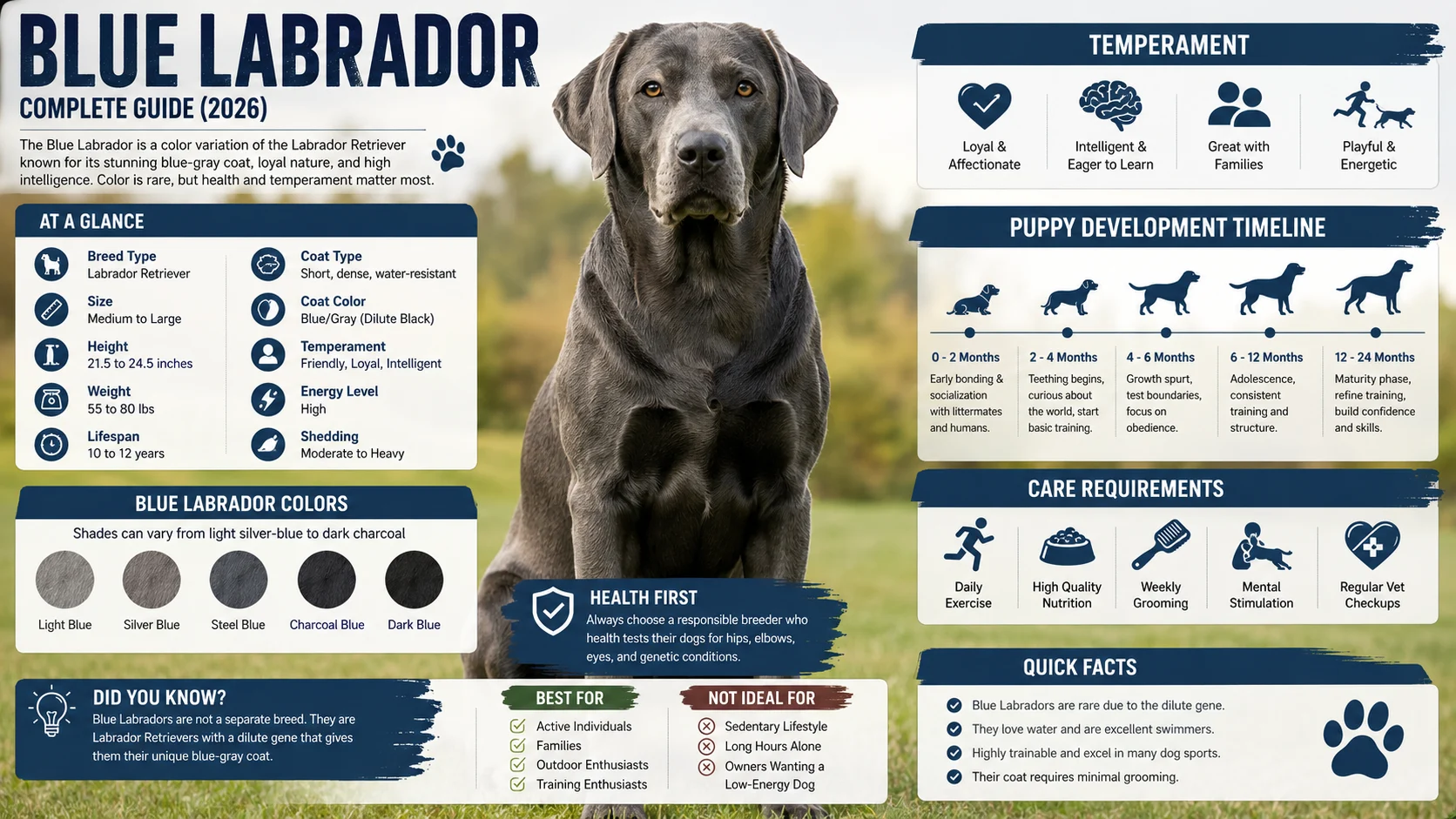
A Blue Labrador is a Labrador Retriever with a distinctive blue gray coat, usually created by dilute pigmentation rather than a separate breed.
The color is uncommon and eye catching, but responsible breeders prioritize health, temperament, and Labrador structure over coat color.
Quick Snapshot Table
| Feature | Blue Labrador |
|---|---|
| Breed | Labrador Retriever |
| Coat Color | Blue gray or charcoal gray |
| Genetic Basis | Dilute pigmentation |
| Breed Status | Not a separate breed |
| Size | Medium to large |
| Height | About 21.5 to 24.5 inches |
| Weight | About 55 to 80 lbs |
| Temperament | Friendly, intelligent, outgoing |
| Energy Level | High |
| Trainability | Excellent |
| Shedding | Moderate to heavy |
| Grooming | Relatively easy |
| Lifespan | Generally around 10 to 12 years |
| Main Concern | Health and breeding quality should matter more than color |
What Is a Blue Labrador?
A Blue Labrador is generally described as a Labrador Retriever with a diluted black-based coat that appears blue gray, charcoal, slate, or smoky gray.
It is important to understand one thing immediately: Blue Labrador is a color description, not a separate Labrador breed.
The Labrador Retriever is traditionally recognized in three standard colors by major kennel organizations:
- Black
- Yellow
- Chocolate
“Blue,” “silver,” or “charcoal” Labradors are therefore controversial terms because they describe dilute coat colors rather than an officially separate breed variety.
Why the Color Looks Blue
The coat does not contain literal blue pigment.
Instead, dilution affects how black pigmentation is expressed, producing a softer gray appearance.
Depending on genetics, lighting, age, and coat condition, the dog may look:
- slate gray
- charcoal
- blue gray
- smoky gray
This explains why photographs of supposedly “blue” Labradors can look surprisingly different from one another.
Blue Labrador Genetics Explained
The Dilution Gene
Coat dilution is associated with variants of the MLPH gene, which affects the distribution of pigment within individual hairs.
A Labrador carrying two copies of a relevant recessive dilution variant can show visibly diluted pigmentation.
In simplified genetic terms:
This is only a simplified inheritance example. Actual Labrador coat genetics are more complicated because several genes influence pigmentation and the final appearance.
Is Blue the Same as Silver?
Not necessarily in everyday breeder terminology.
“Blue,” “silver,” and “charcoal” are sometimes used interchangeably in advertisements, even though they can refer to different descriptions or genetic backgrounds.
This is one area where buyers should ask the breeder for the actual genetic explanation rather than relying on a color label.
Why Blue Labradors Are Controversial
The controversy is not simply about whether a gray looking Labrador is attractive.
The bigger question is how the color was produced and whether health was sacrificed to obtain it.
Some breeders heavily market dilute colors because unusual coats command premium prices.
Here is where most buyers get it wrong: rarity does not automatically mean quality.
An ethical breeder should be able to discuss:
- parent health testing
- pedigree
- temperament
- orthopedic screening
- genetic disease testing
- breeding goals
The coat should be one of the least important factors in that conversation.
Blue Labrador Appearance
A healthy Labrador should still look unmistakably like a Labrador regardless of coat shade.
Typical Physical Characteristics
You can expect:
- broad head
- expressive eyes
- muscular body
- deep chest
- thick tail
- short dense coat
- strong bone
- athletic movement
A color change should not fundamentally alter the breed’s characteristic structure.
Eyes and Nose Color
Blue gray pigmentation can be accompanied by lighter pigmentation around the nose and other areas.
However, eye and nose color can vary, and these traits should not be used alone to determine whether a dog is genuinely a Labrador or whether its breeding is responsible.
Temperament and Personality
A Blue Labrador should generally have the same basic temperament expected from a well bred Labrador Retriever.
Typical traits include:
- affectionate
- outgoing
- intelligent
- food motivated
- playful
- people oriented
- eager to retrieve
Color does not make a Labrador calmer, smarter, more protective, or more aggressive.
What Experienced Owners Look For
The most valuable temperament traits are often less dramatic:
Recovery.
A good Labrador may become excited by something new, but it should be able to settle again.
Look for a puppy that:
- investigates new situations
- accepts handling
- recovers after mild startling
- engages with people
- can eventually settle
That tells you considerably more than coat color.
Are Blue Labradors Good Family Dogs?
A well bred Labrador can be an excellent family companion.
However, young Labradors are famously energetic and mouthy.
Families should be prepared for:
- chewing
- jumping
- retrieving everything
- prolonged puppy energy
- adolescent boundary testing
With Children
Labradors can be wonderful with children when appropriately socialized and supervised.
Their enthusiasm can become a problem with toddlers because a young Labrador may accidentally knock over a small child.
The solution is not to expect the dog to “know better.”
Instead:
- supervise interactions
- teach impulse control
- give the dog an appropriate outlet
- teach children respectful handling
Intelligence and Trainability
Labradors are generally highly trainable because they combine intelligence with a strong desire to interact with people and food motivation.
A Blue Labrador can excel in:
- obedience
- retrieving
- scent work
- assistance work
- detection
- dock diving
- field activities
The Training Mistake Many Owners Make
Because Labradors learn quickly, owners sometimes give them too much freedom too early.
A clever puppy can learn unwanted behaviors just as efficiently as desirable ones.
If jumping gets attention, jumping becomes rewarding.
If stealing socks creates a chase game, sock stealing becomes entertainment.
Training should therefore begin with household rules, not just sit and stay.
Exercise Requirements
Blue Labradors are not naturally low energy dogs.
A healthy adult generally benefits from a combination of:
- daily walks
- retrieving games
- training
- sniffing opportunities
- controlled off leash activity where safe
Mental Exercise Matters
A tired Labrador is not simply one that has run several miles.
Mental work can be equally valuable.
Try:
- scent searches
- food puzzles
- structured retrieving
- obedience exercises
- hide and seek
- beginner gundog training
Avoid turning every exercise session into frantic ball chasing.
Repeated high impact activity can place unnecessary stress on developing joints, particularly in puppies.
Blue Labrador Puppy Development Timeline
Blue Labrador puppies develop through the same broad stages as other Labradors.
| Age | Development Stage | What Owners Should Focus On |
|---|---|---|
| 8 to 12 Weeks | Early socialization | Handling, confidence, household routines |
| 3 to 4 Months | Curiosity increases | Recall, bite inhibition, calm exposure |
| 5 to 6 Months | Teething and independence | Impulse control and boundaries |
| 6 to 12 Months | Adolescence | Consistency and controlled exercise |
| 12 to 18 Months | Physical maturity develops | Advanced training and settling |
| 18 to 24 Months | Adult behavior becomes clearer | Reliable routines and continued enrichment |
The Most Important Puppy Window
The first few months should not become a race to teach dozens of commands.
Instead, build:
- confidence
- neutrality
- handling tolerance
- recall
- calmness
- appropriate play
A Labrador that learns how to settle is often much easier to live with than one that knows 30 tricks but never switches off.
Health and Genetic Considerations
This is the section buyers should read more carefully than the color discussion.
Labradors can be predisposed to several inherited or breed associated conditions.
Important Health Concerns
Potential concerns include:
- hip dysplasia
- elbow dysplasia
- obesity
- progressive retinal atrophy
- exercise induced collapse
- certain inherited eye disorders
The actual risk depends heavily on genetics, breeding practices, nutrition, exercise, and overall management.
What Responsible Breeders Test
A serious Labrador breeder should be willing to discuss health screening for breeding dogs, including relevant:
- hip evaluations
- elbow evaluations
- eye examinations
- DNA tests for inherited conditions
Organizations such as OFA can provide useful health certification information for breeding dogs.
Dilution and Skin Health
One concern frequently discussed with dilute coat colors is color dilution alopecia, a condition associated with abnormal hair follicle pigmentation.
It does not mean every dilute-colored dog will develop the condition.
However, buyers should understand that unusual coat color should never be pursued without considering potential genetic consequences.
Signs Worth Watching
Possible coat or skin problems can include:
- thinning hair
- patchy hair loss
- dry skin
- recurrent skin irritation
- poor coat quality
A veterinarian should evaluate persistent skin or coat abnormalities rather than assuming they are simply cosmetic.
Grooming and Shedding
One advantage of the Labrador coat is that grooming is relatively straightforward.
The disadvantage is shedding.
A Blue Labrador can leave noticeable hair on:
- carpets
- furniture
- clothing
- car seats
Simple Grooming Routine
Brush approximately:
- once or twice weekly during normal periods
- more frequently during heavy shedding seasons
Also maintain:
- nail trimming
- ear checks
- dental care
- regular bathing when necessary
Do not shave the Labrador’s coat to reduce shedding.
Nutrition and Weight Management
Labradors are notorious food lovers.
That creates a very real health issue: obesity.
A healthy body condition is more important than simply reaching a particular number on the scale.
Practical Feeding Rules
Measure meals rather than free feeding.
Use treats strategically during training.
Monitor:
- waistline
- rib coverage
- activity level
- growth rate
A growing puppy should not be deliberately overfed to make it look bigger.
Blue Labrador vs Black Labrador
| Feature | Blue Labrador | Black Labrador |
|---|---|---|
| Breed | Labrador Retriever | Labrador Retriever |
| Main Color | Blue gray/dilute black | Black |
| Temperament | Should be Labrador typical | Should be Labrador typical |
| Energy | High | High |
| Trainability | High | High |
| Shedding | Moderate to heavy | Moderate to heavy |
| Standard Color Status | Controversial/nonstandard terminology | Standard |
| Buyer Priority | Health and temperament | Health and temperament |
The biggest difference is appearance.
Not personality.
Blue Labrador vs Silver Labrador
These terms are often confused online.
| Point | Blue Labrador | Silver Labrador |
|---|---|---|
| Appearance | Blue gray | Silver gray |
| Genetic Discussion | Often linked to dilution | Often linked to diluted chocolate pigmentation |
| Separate Breed? | No | No |
| Standard Labrador Color? | No | No |
| Main Buyer Concern | Breeding quality | Breeding quality |
Because terminology varies between breeders, ask for documentation rather than relying on marketing labels.
Common Mistakes Buyers Make
Choosing Color Before Health
This is probably the biggest mistake.
Start with:
- health
- temperament
- structure
- breeder reputation
- pedigree
- color
Not the other way around.
Paying a Huge Premium for Rarity
An unusual coat can make a puppy more expensive, but rarity is not evidence of superior genetics.
Assuming Every Gray Labrador Is Purebred
A gray coat alone cannot establish pedigree.
Ask for:
- registration documentation where applicable
- pedigree information
- parent information
- health records
Ignoring Adult Temperament
A beautiful puppy eventually becomes an adult dog.
Meet the parents whenever possible.
The adult dogs can provide valuable clues about:
- confidence
- energy
- sociability
- structure
- behavior
Insights Most Articles Miss
Coat Color Can Distract From Structure
Two puppies can have equally attractive coats but very different structural quality.
Watch how the puppy:
- stands
- walks
- turns
- interacts
- recovers from unfamiliar situations
A Calm Puppy Is Not Necessarily a Low Energy Adult
Puppy temperament changes.
The breeder’s assessment of the litter and parent dogs can therefore be more informative than a single five minute interaction.
Labrador Drive Comes in Different Forms
One Labrador may want to retrieve all day.
Another may be more food motivated.
Another may excel at scent work.
“High energy” does not mean every Labrador needs the exact same lifestyle.
Buyer Warning: How to Evaluate a Breeder
Ask These Questions
Before putting down a deposit, ask:
- What health tests have been completed on both parents?
- Can I see the parents?
- What are their temperaments like?
- What genetic testing has been performed?
- Why are you producing this particular coat color?
- What happens if the puppy develops a health problem?
- How are puppies socialized?
- At what age do puppies leave the mother?
Red Flags
Walk away if the breeder:
- guarantees perfect health
- refuses health documentation
- cannot explain the puppy’s genetics
- heavily pushes “rare color” marketing
- refuses to show the mother
- pressures you to pay immediately
A responsible breeder should be comfortable with questions.
Blue Labrador Lifestyle Compatibility
| Owner Lifestyle | Compatibility |
|---|---|
| Active family | Excellent |
| Outdoor enthusiast | Excellent |
| Retriever/sport enthusiast | Excellent |
| First time owner willing to train | Good |
| Sedentary household | Poor |
| Owner wanting a low shedding dog | Poor |
| Owner choosing primarily for rare color | Not recommended |
Preparation Checklist
Before bringing home a Blue Labrador puppy, prepare:
Home
- secure sleeping area
- puppy proofed rooms
- chew toys
- food and water bowls
- safe crate if desired
Training
- veterinarian selected
- puppy class researched
- reward system established
- house training routine planned
Health
- breeder health records
- vaccination records
- parasite prevention plan
- veterinary examination
Lifestyle
- daily exercise schedule
- enrichment activities
- alone time plan
- grooming routine
Frequently Asked Questions
Is a Blue Labrador a real Labrador?
The dog may be a Labrador Retriever, but “Blue Labrador” refers to a coat color description rather than a separate recognized breed.
Are Blue Labradors rare?
Blue gray Labradors are uncommon compared with traditional black, yellow, and chocolate Labradors. Their rarity is one reason some breeders market them heavily.
Are Blue Labradors healthy?
They can be healthy, but coat color should never be treated as evidence of health. Parent health testing and responsible breeding are much more important.
Are Blue Labradors good family dogs?
A well bred Labrador can be an excellent family dog. However, young Labradors require substantial exercise, training, supervision, and socialization.
Do Blue Labradors shed?
Yes. Labradors are moderate to heavy shedders, and regular brushing can help manage loose hair.
Are Blue Labradors aggressive?
Coat color does not determine aggression. Temperament is influenced much more by genetics, early development, socialization, training, and environment.
How much does a Blue Labrador cost?
Prices vary widely by breeder, location, pedigree, health testing, and demand. A higher price for an unusual coat should not automatically be interpreted as higher quality.
What should I look for when buying one?
Prioritize health-tested parents, stable temperament, sound structure, transparent breeding practices, and proper puppy socialization before considering coat color.
Conclusion
The Blue Labrador is visually unusual, but the most important part of the dog is not the gray coat.
It is the Labrador underneath it.
A good Labrador should have sound structure, stable temperament, strong health foundations, and the willingness to work and connect with people. Those qualities remain valuable regardless of whether the coat is black, yellow, chocolate, or an unusual dilute shade.
If you are considering a Blue Labrador puppy in 2026, look past the photographs and ask harder questions about genetics, health testing, temperament, and the breeder’s priorities.
The best Labrador is not the rarest one. It is the one bred responsibly and raised to become a healthy, stable companion.