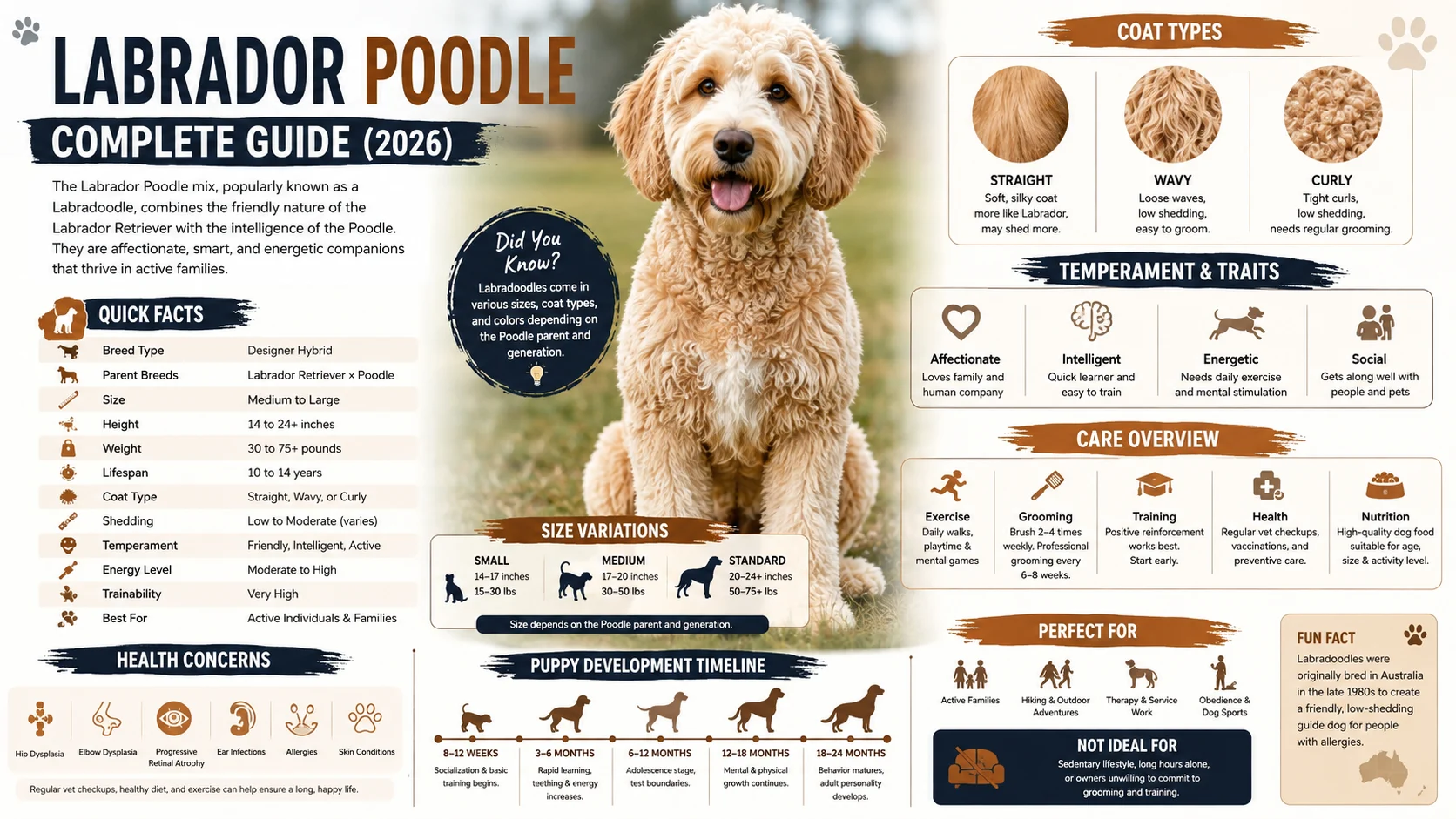
The Labrador Poodle mix, commonly called a Labradoodle, combines the friendly, trainable nature of the Labrador Retriever with the intelligence and coat characteristics of the Poodle.
Its personality, size, shedding, and coat can vary considerably depending on the parents and generation, so “Labradoodle” does not guarantee a predictable dog.
Experienced breeders prioritize health, temperament, structure, and stable behavior over the popular idea of a guaranteed hypoallergenic or non shedding coat.
Quick Snapshot Table
| Category | Details |
|---|---|
| Common Name | Labradoodle |
| Parent Breeds | Labrador Retriever × Poodle |
| Breed Type | Designer crossbreed |
| Size | Small to large depending on Poodle parent |
| Typical Weight | About 30 to 75+ lbs |
| Height | About 14 to 24+ inches |
| Lifespan | Around 10 to 14 years |
| Temperament | Friendly, intelligent, social, energetic |
| Energy Level | Moderate to high |
| Trainability | High |
| Shedding | Highly variable |
| Grooming | Moderate to high |
| Family Compatibility | Usually excellent with proper socialization |
| Main Health Concerns | Hips, elbows, eyes, allergies, ear problems |
| Best For | Active families and involved owners |
What Is a Labrador Poodle Mix?
A Labrador Poodle mix is a cross between a Labrador Retriever and a Poodle.
The most common name for this cross is Labradoodle.
It is important to understand that Labradoodles are not simply “half Labrador and half Poodle” in appearance or behavior. Genetics can produce considerable variation between puppies, even within the same litter.
One puppy may have:
- a loose wavy coat
- a strong Labrador body
- moderate shedding
- an outgoing personality
Another may have:
- a curlier Poodle type coat
- a lighter build
- less shedding
- greater sensitivity
That unpredictability is one of the most important things prospective owners should understand.
Why Labrador Poodle Mixes Became So Popular
The appeal is easy to understand.
The Labrador brings:
- friendliness
- willingness to cooperate
- retrieving instincts
- family orientation
- enthusiasm
The Poodle contributes:
- exceptional intelligence
- trainability
- athleticism
- problem solving ability
- a different coat type
Put those traits together and you can get a remarkably engaging companion.
But there is a catch.
The combination can also produce a dog that is very intelligent, very social, and very demanding of attention.
A Labradoodle that does not receive enough physical and mental stimulation can invent its own entertainment.
That usually means barking, chewing, jumping, stealing objects, or becoming excessively demanding.
Labrador Poodle Mix Size
How Big Does a Labradoodle Get?
There is no single adult size for the Labrador Poodle mix.
The biggest factor is the size of the Poodle parent.
| Labradoodle Type | Approximate Adult Height | Typical Weight |
|---|---|---|
| Smaller type | 14 to 17 inches | 15 to 30 lbs |
| Medium type | 17 to 20 inches | 30 to 50 lbs |
| Standard type | 20 to 24+ inches | 50 to 75+ lbs |
These ranges are general rather than guarantees.
A breeder should be able to explain the expected adult size using the actual parents and pedigree rather than promising an exact puppy weight.
When Does a Labradoodle Stop Growing?
Most Labradoodles reach much of their adult height during the first year.
Larger dogs may continue filling out until roughly:
- 18 months
- sometimes longer
Muscle development and body composition can continue changing after the dog reaches its final height.
Labrador Poodle Mix Coat Types
This is where many buyers receive misleading information.
A Labradoodle can have a coat that is:
- straight
- wavy
- curly
The amount of shedding can also vary substantially.
Are Labradoodles Hypoallergenic?
No dog can honestly be guaranteed to be completely hypoallergenic.
Some Labradoodles shed considerably less than typical Labradors, particularly those with more Poodle influenced coats.
However, allergies can be triggered by:
- dander
- saliva
- skin proteins
- urine proteins
So choosing a Labradoodle solely because someone promised it would not cause allergies is risky.
A better approach is to spend time around the specific dog and observe how an allergy sufferer responds.
Labrador Poodle Mix Temperament
The typical Labradoodle is:
- affectionate
- intelligent
- playful
- people oriented
- energetic
But temperament is not determined by breed labels alone.
The Labrador parent may contribute an outgoing, enthusiastic personality, while the Poodle side may contribute greater sensitivity and environmental awareness.
This can create a dog that learns incredibly quickly.
It can also create a dog that learns your bad habits just as quickly.
Intelligence and Trainability
Labradoodles can be exceptionally easy to train when training is consistent.
They often respond well to:
- reward based training
- retrieving games
- scent activities
- obedience exercises
- trick training
- structured socialization
Their intelligence means repetitive training can become boring.
Short, purposeful sessions generally work better than drilling the same command for long periods.
Are Labradoodles Good Family Dogs?
Usually, yes.
Their social nature often makes them excellent companions for active families.
However, there is an important distinction between being friendly and being easy.
A young Labradoodle can be:
- energetic
- mouthy
- excitable
- jumpy
- easily distracted
Families with young children need to teach both the dog and children appropriate boundaries.
Supervision is particularly important with puppies.
Labrador Poodle Mix Energy Level
This is not a couch potato cross.
Both parent breeds can be active and highly responsive to their owners.
A healthy adult Labradoodle generally benefits from a combination of:
- daily walks
- free movement
- retrieving
- training
- mental enrichment
The exact amount depends on age, size, health, and individual temperament.
Mental Exercise Matters
Physical exercise alone may not be enough.
Try:
- puzzle feeders
- scent games
- retrieving drills
- obedience challenges
- hide and seek
- food searching
A tired body is useful.
A mentally satisfied dog is often much easier to live with.
Labrador Poodle Mix Training Guide
Start Training Early
The first months are particularly important for teaching:
- name recognition
- recall
- loose leash walking
- calm greetings
- impulse control
- appropriate chewing
Focus on Calmness
One overlooked issue with Labradoodles is excitement.
Their friendliness can become excessive greeting behavior.
Teach the puppy that attention does not always mean:
- jumping
- barking
- pawing
- racing toward people
Rewarding calm behavior from an early age can make a dramatic difference.
Puppy Development Timeline
| Age | Typical Development |
|---|---|
| 8 to 12 Weeks | Socialization and basic household training |
| 3 to 4 Months | Rapid learning, exploration and teething |
| 5 to 6 Months | Increased independence and boundary testing |
| 6 to 12 Months | Adolescence and rising energy |
| 12 to 18 Months | Greater physical coordination and emotional maturity |
| 18 to 24 Months | Adult personality becomes more consistent |
| 2 to 3 Years | Many dogs reach full behavioral maturity |
The Adolescent Stage
This is where inexperienced owners sometimes think training has “stopped working.”
It usually has not.
The dog has simply become:
- more confident
- more independent
- more energetic
- more easily distracted
Consistency matters enormously during this stage.
Grooming Requirements
This is one area where Labradoodle ownership can become unexpectedly expensive.
A curly or woolier coat can develop mats quickly if neglected.
Grooming Routine
Depending on coat type, owners may need:
- brushing several times per week
- professional grooming every 6 to 10 weeks
- ear cleaning
- nail trimming
- regular coat inspections
Why Matting Happens
The combination of:
- dense hair
- curls
- moisture
- friction
can cause tangles close to the skin.
A coat that looks beautiful from the outside may already be severely matted underneath.
Regular brushing is therefore a health issue, not just a cosmetic one.
Health and Genetic Considerations
The Labrador Poodle mix can inherit health risks associated with either parent breed.
Responsible breeding should therefore involve more than a basic veterinary check.
Common Health Concerns
| Health Concern | Why It Matters |
|---|---|
| Hip dysplasia | Can affect mobility and comfort |
| Elbow dysplasia | Particularly relevant in larger dogs |
| Progressive retinal atrophy | Can affect vision |
| Ear infections | More likely with certain ear and coat characteristics |
| Allergies | Can cause chronic skin irritation |
| Exercise induced issues | Relevant to Labrador ancestry |
| Patellar problems | More relevant in smaller varieties |
What Responsible Breeders Test
A serious breeder should be willing to discuss health screening for both parents.
Depending on the lines involved, this may include:
- hips
- elbows
- eyes
- inherited eye diseases
- relevant genetic disorders
- breed specific health evaluations
The real issue is not whether a breeder says the parents are “healthy.”
Ask what was actually tested.
Breeder Evaluation Guide
Questions Worth Asking
Before putting down a deposit, ask:
- Can I see the health testing for both parents?
- What are the parents’ adult temperaments like?
- How are the puppies socialized?
- What coat type do you realistically expect?
- What health problems occur in this bloodline?
- What happens if the puppy develops a serious inherited condition?
- Can I meet the mother?
- Why were these particular dogs bred together?
A good breeder should be comfortable answering uncomfortable questions.
Buyer Warning Section
Do Not Buy a Labradoodle Based Only on Coat Claims
Be cautious with phrases such as:
- “100% hypoallergenic”
- “zero shedding guaranteed”
- “perfect family dog”
- “no health problems”
- “guaranteed temperament”
Dogs are biological organisms, not predictable products.
The “Designer Dog” Price Trap
A high price does not automatically mean high quality.
The more important indicators are:
- health testing
- breeding goals
- puppy raising practices
- temperament
- pedigree transparency
- lifetime breeder support
A beautiful website can tell you almost nothing about the quality of the breeding program.
Common Mistakes Owners Make
Choosing Based on Appearance
That fluffy puppy face is temporary.
Adult coat, size, energy level, and temperament matter much more.
Assuming Less Shedding Means Less Grooming
This is one of the biggest misconceptions.
A low shedding coat can require more grooming because loose hair remains trapped within the coat.
Underestimating Intelligence
A clever dog needs appropriate outlets.
Without them, intelligence becomes a liability.
Over Exercising Puppies
Young joints and growing bones need appropriate activity.
Avoid treating a developing puppy like an adult running partner.
Insights Most Articles Miss
Labradoodle Generations Matter
Terms such as:
- F1
- F1B
- F2
- multigenerational
describe different breeding combinations.
They can influence coat characteristics and predictability, but they do not magically guarantee a particular temperament or allergy response.
The Individual Dog Matters More Than the Label
Two Labradoodles from different breeding programs can be dramatically different.
One may be:
- calm
- focused
- easygoing
Another may be:
- highly energetic
- sensitive
- demanding
Pedigree and parent temperament therefore matter.
“Low Shedding” Is Not the Same as “Low Maintenance”
This deserves repeating.
Some of the lowest shedding Labradoodle coats are among the most maintenance intensive.
Step by Step Care Guide
Daily
- Provide age appropriate physical activity
- Practice short training sessions
- Offer mental enrichment
- Reinforce calm behavior
- Check paws after outdoor activity
Weekly
- Brush thoroughly
- Check ears
- Inspect skin
- Trim nails when needed
- Review training progress
Every Few Weeks
- Assess coat condition
- Schedule grooming according to coat growth
- Check weight and body condition
Throughout the Year
Keep veterinary examinations and preventive care up to date.
Lifestyle Compatibility
| Lifestyle | Compatibility |
|---|---|
| Active family | Excellent |
| Family with older children | Excellent |
| First time dog owner | Possible with preparation |
| Apartment owner | Possible with sufficient exercise |
| Sedentary household | Poor |
| Owner wanting zero grooming | Poor |
| Owner wanting guaranteed non shedding | Poor |
| Outdoor and hiking lifestyle | Excellent |
Is a Labrador Poodle Mix Right for You?
Good Match If You Want
- An intelligent companion
- A highly trainable dog
- An active family pet
- A social and affectionate personality
- A dog that enjoys learning
Think Twice If You Want
- Minimal grooming
- Guaranteed allergy friendliness
- A naturally calm puppy
- Very low exercise requirements
- A completely predictable adult coat
Preparation Checklist
Before bringing home a Labrador Poodle mix, prepare:
Home
- crate or safe sleeping area
- puppy proofed rooms
- chew toys
- food and water bowls
- grooming equipment
Training
- veterinarian selected training plan
- puppy socialization strategy
- reward treats
- appropriate walking equipment
Grooming
- quality brush
- comb
- professional groomer
- ear care supplies
Health
- veterinary appointment
- vaccination plan
- parasite prevention
- breeder health records
Frequently Asked Questions
What is a Labrador Poodle mix called?
The most common name is Labradoodle.
Is a Labrador Poodle mix a good family dog?
Yes. Most are affectionate and social, but they need training, exercise, supervision, and consistent household boundaries.
Do Labradoodles shed?
Some shed very little, while others shed moderately. Coat type and genetics make shedding highly variable.
Are Labradoodles hypoallergenic?
No dog is completely hypoallergenic. Some Labradoodles may be better tolerated by certain allergy sufferers, but there is no universal guarantee.
How big does a Labrador Poodle mix get?
Adult size varies significantly according to the Poodle parent. Labradoodles can range from relatively small dogs to large dogs over 50 pounds.
Are Labradoodles easy to train?
Generally, yes. Their Labrador and Poodle ancestry can produce excellent trainability, although their energy and excitement can make consistency essential.
How often does a Labradoodle need grooming?
Coat dependent grooming can range from frequent home brushing to professional grooming approximately every 6 to 10 weeks.
How long do Labradoodles live?
A commonly expected lifespan is around 10 to 14 years, although genetics, size, health, nutrition, and veterinary care all influence longevity.
Conclusion
The Labrador Poodle mix is appealing for good reason: it can combine the Labrador’s sociable nature with the Poodle’s remarkable intelligence and athleticism.
But the best Labradoodle is not necessarily the fluffiest, smallest, or most expensive puppy.
Experienced breeders look deeper.
They evaluate health, structure, temperament, parent behavior, genetic screening, and how the puppy is raised.
If you are considering a Labradoodle, choose the breeder before you choose the color or coat. A predictable breeding program gives you a much better chance of getting the companion you actually want.
The coat may be what makes you stop scrolling.
Temperament and health are what determine whether you will still be happy with that dog ten years later.