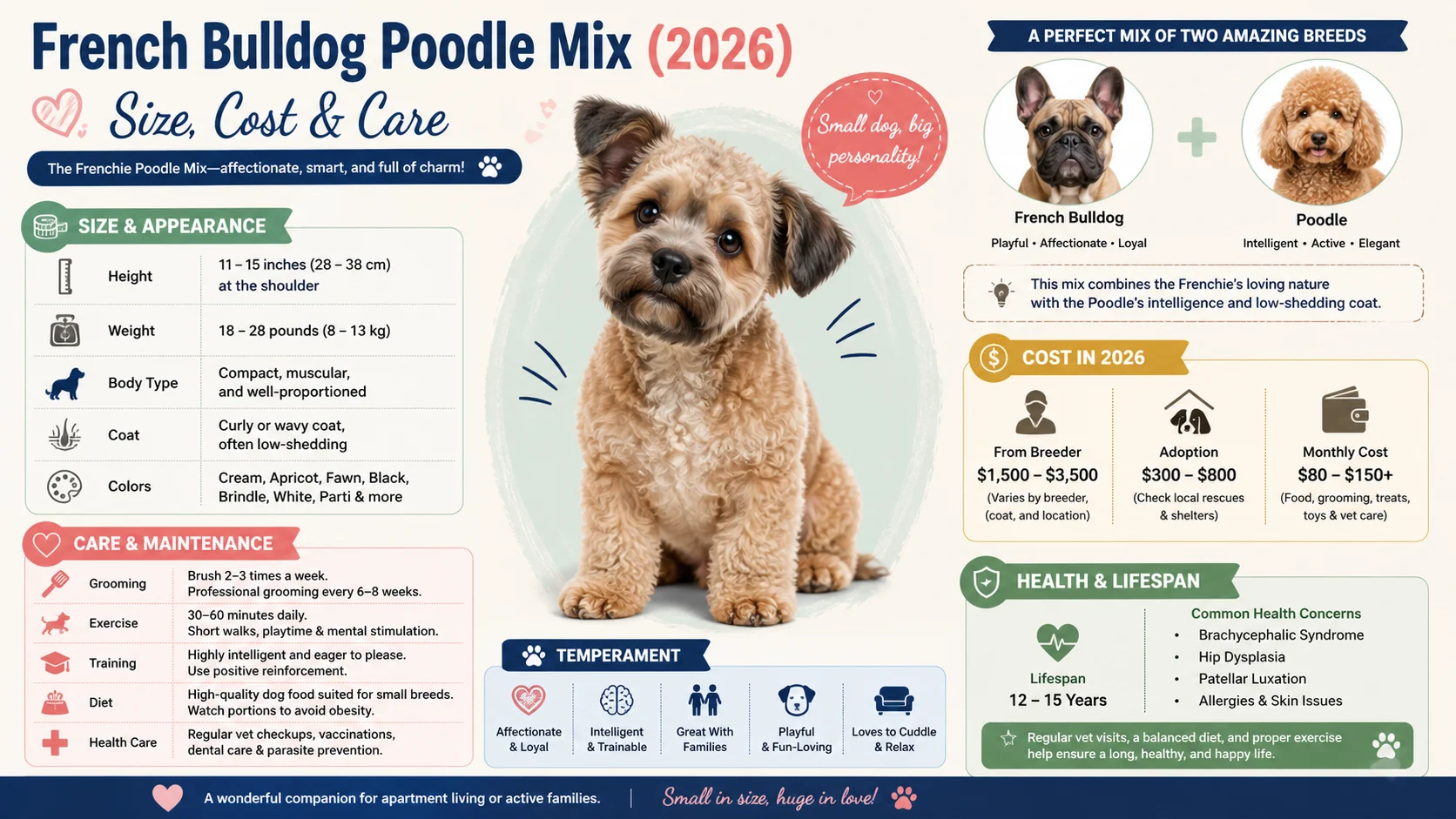
The French Bulldog Poodle Mix is a small, affectionate, intelligent companion with a playful personality and variable coat. Its size, shedding, and appearance can differ depending on whether the Poodle parent is Toy or Miniature. Health matters most: responsible breeding should prioritize breathing, structure, temperament, and genetic health over looks.
Quick Snapshot
| Feature | French Bulldog Poodle Mix |
|---|---|
| Common Names | French Boodle, Froodle, Frenchie Doodle |
| Parent Breeds | French Bulldog × Poodle |
| Poodle Type | Usually Toy or Miniature |
| Size | Small |
| Approximate Weight | About 15 to 30+ lb, depending on parents |
| Height | Roughly 11 to 15 inches, depending on generation |
| Coat | Smooth, wavy, curly, or mixed |
| Shedding | Low to moderate, highly variable |
| Energy | Moderate |
| Intelligence | High |
| Trainability | Generally good |
| Temperament | Affectionate, playful, people oriented |
| Grooming | Moderate to high with curly coats |
| Apartment Suitability | Usually good |
| Major Health Concern | Airway structure if the Frenchie traits are pronounced |
| Typical Lifespan | Variable |
| Breed Status | Mixed breed, not a standardized purebred |
The French Bulldog Poodle Mix is commonly produced using a Toy or Miniature Poodle rather than a Standard Poodle, although the exact size can vary between breeding programs. Because it is a mixed breed, puppies do not have a standardized appearance or temperament.
What Is a French Bulldog Poodle Mix?
French Boodle, Froodle or Frenchie Doodle?
A French Bulldog Poodle Mix is a cross between a French Bulldog and a Poodle.
You may see this dog advertised under several names:
- French Boodle
- Froodle
- Frenchie Doodle
- Frenchie Poo
- Floodle
The names vary by breeder and region, but they generally refer to the same basic cross.
The appeal is easy to understand.
The French Bulldog contributes its compact build, affectionate personality, expressive face and companion focused nature. The Poodle contributes intelligence, trainability and a coat that may be more curly and lower shedding.
But genetics do not work like a shopping menu.
A puppy does not automatically receive the “best half” of each parent. Some puppies may strongly resemble the French Bulldog, others may look considerably more Poodle like, and some fall somewhere in between.
Is It a Recognized Breed?
No.
The French Bulldog Poodle Mix is a crossbreed rather than a standardized purebred breed recognized by major kennel organizations in the same way as the French Bulldog and Poodle.
That distinction matters because there is no single official breed standard defining exactly how a French Boodle should look or behave.
Appearance and Size
How Big Does a French Bulldog Poodle Mix Get?
Size depends heavily on the Poodle parent.
A mix produced from a Toy Poodle can remain particularly small, while a Miniature Poodle parent can produce a somewhat larger and more substantial dog.
A reasonable adult range is approximately:
| Measurement | Typical Range |
|---|---|
| Weight | 15 to 30+ lb |
| Height | 11 to 15 inches |
| Build | Compact to moderately athletic |
| Body Shape | Highly variable |
These numbers should be treated as practical estimates rather than a formal breed standard.
What Does a French Boodle Look Like?
The most interesting feature is its unpredictability.
One puppy may have:
- French Bulldog style bat ears
- a short muzzle
- broad chest
- compact body
- wavy coat
Another may have:
- longer muzzle
- narrower head
- curly Poodle coat
- longer legs
- lighter athletic structure
This variation is particularly noticeable in first generation puppies.
French Bulldog vs Poodle Influence
| Trait | French Bulldog Influence | Poodle Influence |
|---|---|---|
| Face | Shorter muzzle | Longer muzzle possible |
| Ears | Upright bat ears | Drop ears |
| Body | Compact and muscular | More athletic |
| Coat | Short and smooth | Curly or wavy |
| Shedding | Moderate | Usually lower |
| Energy | Moderate | Moderate to high |
| Trainability | Good | Very high |
Coat Types and Shedding
What Kind of Coat Does a French Boodle Have?
There is no guaranteed coat type.
Possible coats include:
- short and smooth
- wavy
- curly
- shaggy
- soft and fleece like
- mixed texture
A curly or wavy coat is usually the feature buyers are looking for when they choose a Poodle mix.
However, an F1 puppy does not come with a guarantee that it will develop a highly curly, low shedding coat.
Is a French Bulldog Poodle Mix Hypoallergenic?
No dog should be advertised as completely hypoallergenic.
A curly Poodle influenced coat may shed less visibly, but allergens come from sources including dander and saliva rather than simply the amount of hair a dog drops.
If allergies are a major concern, spend time around the actual puppy and, ideally, adult dogs from the same breeding line before making a decision.
Grooming Requirements
Curly coats require considerably more maintenance than the short French Bulldog coat.
Expect to manage:
- brushing several times per week
- professional grooming approximately every 4 to 8 weeks depending on coat
- ear cleaning
- nail trimming
- facial and skin care
The more Poodle like the coat becomes, the more important regular grooming becomes.
Temperament and Personality
What Is a French Bulldog Poodle Mix Like?
The typical French Boodle is affectionate, playful, people oriented and intelligent.
But the exact personality depends on which parent contributes more strongly to the individual puppy.
A well socialized dog may be:
- affectionate without being constantly demanding
- playful indoors
- curious around new environments
- responsive to training
- strongly attached to its family
Both parent breeds can become overly dependent on their owners, so early independence training is important.
Are French Boodles Good Family Dogs?
They can be excellent companion dogs for the right household.
They often fit well with:
- singles
- couples
- families with older children
- apartment households
- owners who want an interactive companion
Young children still need supervision.
The biggest mistake is assuming that a small dog requires less training.
A 20 pound dog can still develop:
- barking
- resource guarding
- separation problems
- leash reactivity
- poor impulse control
Small does not mean behaviorally simple.
Intelligence and Training
Are French Boodles Easy to Train?
Generally, yes.
The Poodle side can contribute considerable intelligence and responsiveness, while the French Bulldog can contribute a more independent and occasionally stubborn personality.
That combination creates an interesting training profile.
The dog may understand what you want quickly but decide that it has other ideas.
Best Training Method
Use:
- short sessions
- food rewards
- praise
- consistency
- impulse control exercises
- calm socialization
Avoid relying on harsh corrections.
The goal should not simply be obedience.
You want a dog that can:
- settle indoors
- walk calmly
- tolerate handling
- respond around distractions
- remain comfortable around unfamiliar people
Training Priorities by Age
| Age | Main Training Goal |
|---|---|
| 8 to 12 Weeks | Socialization and handling |
| 3 to 4 Months | House training and basic cues |
| 4 to 6 Months | Leash manners and impulse control |
| 6 to 12 Months | Reliability around distractions |
| 12+ Months | Advanced obedience and lifestyle manners |
Exercise and Energy Requirements
How Much Exercise Does a French Boodle Need?
Most French Bulldog Poodle Mixes have moderate exercise needs.
A healthy adult may do well with:
- daily walks
- interactive indoor play
- short training sessions
- puzzle toys
- controlled outdoor exploration
They generally do not require the same workload as a high drive working breed.
However, the French Bulldog influence creates an important limitation.
Heat and Breathing Matter
If the puppy inherits a very short muzzle, exercise tolerance can be reduced.
French Bulldogs are specifically associated with brachycephalic obstructive airway syndrome, and responsible breeding programs place substantial emphasis on respiratory health screening.
Watch for:
- excessive panting
- noisy breathing
- struggling during exercise
- unusually slow recovery
- heat intolerance
- blue or pale gums
- collapse
Heavy breathing should not simply be dismissed as “normal for a Frenchie.”
Health and Genetics
Does Mixing a French Bulldog With a Poodle Make It Healthier?
Not automatically.
This is one of the biggest misconceptions surrounding designer dogs.
Crossbreeding can change the distribution of inherited risks, but it does not erase genetic disease.
A French Boodle can inherit health concerns from either parent.
Health Concerns to Discuss With a Breeder
| Potential Concern | Parent Influence | Why It Matters |
|---|---|---|
| Brachycephalic airway disease | French Bulldog | Can affect breathing and exercise tolerance |
| Hip or joint problems | Both possible | May affect movement |
| Eye disorders | Both possible | Requires appropriate screening |
| Patellar problems | Both possible | More relevant in small dogs |
| Skin allergies | French Bulldog/Poodle | Can become chronic |
| Ear problems | Both possible | Curly coats can trap moisture |
| Dental crowding | French Bulldog | Small or shortened skulls can contribute |
| Thyroid disorders | Poodle side possible | Requires veterinary evaluation |
The exact risk profile depends on the parents, pedigree, structure and testing rather than the word “mix” alone.
Structural Health Is More Important Than a Cute Face
Experienced breeders should not select puppies solely for:
- extremely flat faces
- oversized eyes
- exaggerated wrinkles
- tiny body size
- unusual coat colors
The better question is whether the puppy can breathe comfortably, move normally and live an active, comfortable life.
Puppy Development Timeline
8 to 12 Weeks
This is the foundation stage.
Priorities include:
- gentle handling
- household sounds
- safe environmental exposure
- name recognition
- toilet training
- short training sessions
Do not overwhelm the puppy with constant stimulation.
3 to 6 Months
The puppy becomes more independent.
You may see:
- increased chewing
- stronger curiosity
- boundary testing
- increased play drive
Continue reinforcing calm behavior.
6 to 12 Months
Adolescence can expose weaknesses in training.
A previously obedient puppy may suddenly:
- ignore cues
- become more distracted
- bark at unfamiliar things
- become more independent
Consistency matters.
12 Months and Beyond
Adult personality becomes easier to evaluate.
At this stage, focus on:
- reliable recall
- calm greetings
- leash manners
- household settling
- long term grooming habits
Grooming and Daily Care
Brushing
Curly and wavy coats can mat surprisingly quickly.
Brush thoroughly rather than simply running a brush over the surface.
Pay particular attention to:
- ears
- armpits
- chest
- legs
- collar area
Ear Care
Poodle influenced ears can retain moisture and reduce airflow.
Regular checks help identify:
- odor
- redness
- excessive wax
- scratching
Do not aggressively clean healthy ears without veterinary guidance.
Facial and Skin Care
If your puppy inherits French Bulldog facial folds, those areas may require regular monitoring.
Keep folds:
- clean
- dry
- free from accumulated debris
Feeding and Nutrition
What Should a French Boodle Eat?
Choose a complete and balanced diet appropriate for:
- age
- size
- activity
- body condition
Puppies should not be intentionally overfed to make them grow faster.
Rapid weight gain can place unnecessary stress on developing joints.
Weight Management
This is especially important for French Bulldog influenced dogs.
Extra body fat can worsen:
- exercise intolerance
- breathing difficulty
- joint stress
- heat sensitivity
A lean, healthy body condition is much more useful than a “chunky cute” appearance.
Common Mistakes Owners Make
Expecting a Guaranteed Poodle Coat
The puppy may not develop the curly, low shedding coat you expected.
Assuming Mixed Means Healthier
A crossbreed can still inherit significant health problems from either parent.
Ignoring Breathing
Snoring, noisy breathing and exercise intolerance should not automatically be accepted as normal.
Overfeeding
Small companion dogs can gain excess weight quickly.
Undertraining Because the Dog Is Small
Small dogs still need boundaries, socialization and impulse control.
Choosing Color Over Health
Unusual colors and coat patterns can become marketing tools.
Health should come first.
What Experienced Breeders Look For
Health Testing
Ask for documentation rather than verbal assurances.
Depending on the breeding program, this may include relevant orthopedic, eye, respiratory and genetic evaluations.
For French Bulldogs specifically, respiratory health screening is increasingly emphasized by responsible breed health programs.
Breathing Quality
Observe the parents at rest and after mild activity.
Ask:
- Does the dog breathe quietly?
- Does it recover quickly?
- Does it struggle in warm weather?
- Has it undergone respiratory evaluation?
Temperament
Look for parents that are:
- confident
- social but not frantic
- responsive
- emotionally stable
Coat Claims
Do not accept “hypoallergenic” as a guarantee.
Ask what coat genetics the parents carry and, more importantly, look at adult offspring if the breeder has them.
French Bulldog Poodle Mix Cost
How Much Does a French Boodle Cost?
Prices vary widely based on:
- breeder reputation
- location
- parental health testing
- generation
- Poodle size
- pedigree
- coat characteristics
A high price does not automatically mean a healthier puppy.
The more useful question is:
What is included in the price?
Look for:
- veterinary examination
- vaccination records
- microchip
- health documentation
- appropriate genetic testing
- contract
- breeder support
Be suspicious of breeders charging premium prices simply because a puppy has a rare color.
Lifestyle Compatibility
| Lifestyle | Suitability |
|---|---|
| Apartment living | Usually good |
| Active family | Good |
| First time owner | Possible with preparation |
| Elderly owner | Potentially good if exercise needs are manageable |
| Young children | Possible with supervision |
| Very hot climate | Requires extra caution |
| Owner away all day | Potentially difficult |
| Allergy sensitive household | Must test individual response |
| High intensity sports home | Usually not ideal |
Is a French Bulldog Poodle Mix Right for You?
A Good Match If You Want
- a small companion
- an affectionate household dog
- moderate exercise requirements
- an intelligent training partner
- a potentially lower shedding coat
Think Carefully If You Want
- a guaranteed hypoallergenic dog
- a guaranteed curly coat
- a long-distance running companion
- a completely maintenance-free pet
- a dog without inherited health concerns
The individual puppy matters enormously.
Preparation Checklist
Before Bringing Your Puppy Home
Prepare:
- appropriately sized crate
- comfortable bed
- food and water bowls
- puppy safe toys
- grooming tools
- collar and identification
- secure harness
- enzymatic cleaner
- veterinary appointment
Questions to Ask the Breeder
Ask:
- What health testing was performed on both parents?
- What respiratory evaluation has been performed on the French Bulldog parent?
- What type of Poodle was used?
- What generation are the puppies?
- Can I meet the parents?
- Can I see health records?
- What coat type do adult offspring develop?
- What happens if the puppy develops a serious inherited condition?
- What socialization has been provided?
- Will you take the dog back if I can no longer keep it?
A responsible breeder should be comfortable discussing these questions.
Insights Most Articles Miss
The Coat Is Not the Main Decision
Many buyers begin with:
“Will my French Boodle be curly?”
A better first question is:
“Can this dog breathe, move and function comfortably?”
The coat can be groomed.
A structural health problem is much harder to solve.
Generation Matters
An F1 French Boodle is the first generation from a French Bulldog and Poodle pairing.
An F1B is generally an F1 crossed back to one parent breed, commonly the Poodle when breeders are trying to increase Poodle coat traits.
An F2 comes from two F1 dogs.
These generations can affect predictability, but none guarantees a specific appearance or health outcome.
The Frenchie Face Deserves Special Attention
If a puppy inherits an extremely shortened muzzle, its health profile may be substantially different from a puppy with a more moderate facial structure.
This is why buying purely for the “Frenchie look” can be a poor decision.
Frequently Asked Questions
What is a French Bulldog Poodle Mix called?
The cross is commonly called a French Boodle, Froodle or Frenchie Doodle.
How big will a French Bulldog Poodle Mix get?
Most are small, but adult size depends heavily on whether the Poodle parent is Toy or Miniature and on the individual puppy’s genetics.
Is a French Boodle hypoallergenic?
No. Some have low shedding Poodle influenced coats, but no dog can be guaranteed completely hypoallergenic.
Do French Boodles shed?
They can. Curly coats may shed less visibly, while short or mixed coats can shed considerably more.
Are French Boodles easy to train?
Usually, yes. Poodle intelligence can make training rewarding, although French Bulldog stubbornness can occasionally make consistency necessary.
Are French Boodles good apartment dogs?
Many are well suited to apartments because of their small size and moderate exercise requirements. Daily walks and mental stimulation are still necessary.
Can a French Boodle have breathing problems?
Yes. If the puppy inherits a significantly shortened French Bulldog style muzzle, it may be susceptible to brachycephalic airway problems. Responsible breeding should place strong emphasis on respiratory health.
How long does a French Bulldog Poodle Mix live?
There is no single reliable lifespan standard for the cross. Lifespan depends on genetics, size, structural health, weight, veterinary care and inherited conditions.
Is a French Bulldog Poodle Mix healthier than a French Bulldog?
Not automatically. Crossbreeding does not eliminate inherited disease, and the puppy can still inherit health concerns associated with either parent.
Final Verdict
The French Bulldog Poodle Mix can be an affectionate, intelligent and entertaining companion, but it should not be sold as a guaranteed “perfect hybrid.”
The most attractive puppy is not necessarily the healthiest puppy.
Look beyond the curly coat and cute face. Evaluate:
- breathing
- body structure
- movement
- temperament
- parent health
- genetic testing
- grooming requirements
- long term veterinary needs
The best French Boodle is not the one with the most exaggerated appearance. It is the one bred and raised with enough attention to health, stable temperament and functional structure to enjoy a comfortable life with its family.