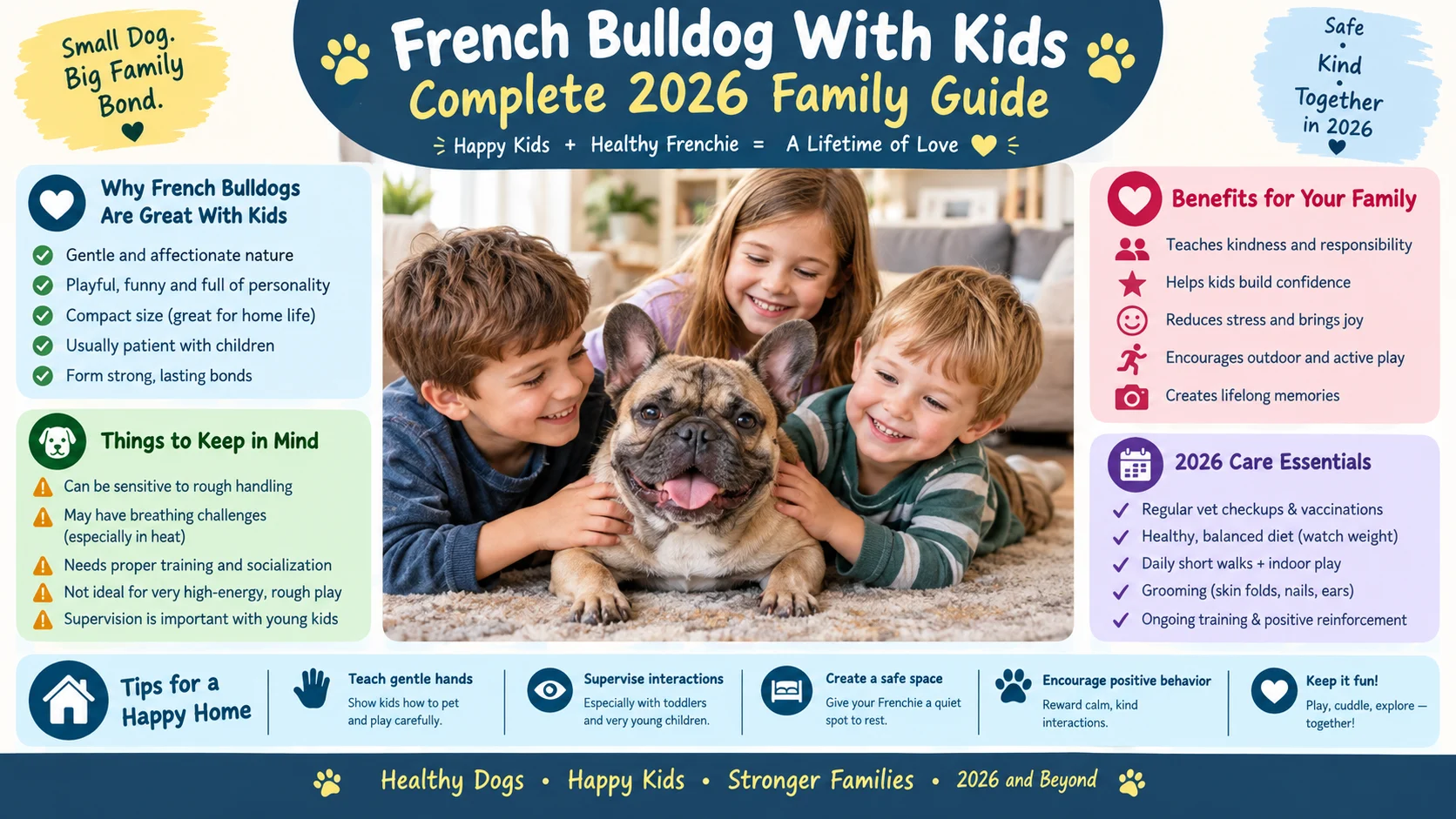
Yes, French Bulldogs can be good with kids when properly socialized, trained, and supervised. Their affectionate, playful, and adaptable temperament can suit family life, but children should never be allowed to rough handle, disturb, or interact with a French Bulldog without appropriate adult supervision.
Are French Bulldogs Good With Kids?
Yes, French Bulldogs can be excellent family companions, particularly because they are generally affectionate, playful, adaptable, and people-oriented. The American Kennel Club describes French Bulldogs as affectionate, social, playful, and suitable for families, including households with young children.
But there is an important distinction between being good with children and being automatically safe around children.
No dog should be expected to tolerate grabbing, climbing, teasing, chasing, or rough handling. Young children also cannot reliably interpret subtle canine stress signals without adult guidance. The safest French Bulldog and child relationships are built through supervision, boundaries, socialization, and teaching both sides how to interact.
Quick Snapshot
| Question | Answer |
|---|---|
| Good with kids? | Generally yes |
| Good with toddlers? | Yes, with close supervision |
| Good with babies? | Can be, but never unsupervised |
| Temperament | Affectionate, playful, adaptable |
| Energy level | Moderate |
| Exercise needs | Moderate |
| Size | Small but muscular |
| Training | Usually responsive but can be stubborn |
| Child safety | Adult supervision essential |
| Best family environment | Calm, structured household |
| Main concern | Rough handling, overheating, overexcitement |
Why French Bulldogs Often Work Well With Families
French Bulldogs were developed primarily as companion dogs, and their modern temperament reflects that role.
They tend to enjoy staying close to their people rather than spending long periods working independently. They are also adaptable to different living environments and generally do not require the intense daily exercise associated with high-drive working breeds.
That combination can work particularly well in a family environment.
Their Biggest Family Strengths
French Bulldogs are often:
- affectionate with their owners
- playful without requiring extreme exercise
- adaptable to smaller homes
- interested in human interaction
- entertaining and socially engaging
- relatively easy to include in everyday family routines
Their compact size can also make them easier for adults to manage than a large, powerful breed.
However, small does not mean fragile-proof or maintenance-free.
A French Bulldog has a sturdy body and powerful jaws, while its short muzzle and compact build create specific health and environmental considerations.
French Bulldog Temperament Around Children
A well-socialized French Bulldog is generally friendly and affectionate rather than naturally aggressive.
The breed standard describes the French Bulldog as well-behaved, adaptable, affectionate, even-tempered, active, alert, and playful without being excessively boisterous. Aggressive behavior is not considered appropriate for the breed.
What a Family Frenchie May Be Like
At home, a French Bulldog may:
- follow children from room to room
- participate in short play sessions
- sit beside children while they watch television
- seek attention from multiple family members
- sleep near the family
- become particularly attached to one person
This companionship is one of the breed’s strongest qualities.
But Individual Temperament Still Matters
Breed tendencies are not guarantees.
Two French Bulldogs from different breeding programs can have noticeably different personalities.
One may be:
- outgoing
- confident
- highly playful
Another may be:
- quieter
- more independent
- sensitive to handling
This is why selecting a puppy based purely on appearance is a mistake.
Experienced breeders evaluate temperament, health, structure, and behavior rather than simply choosing the most attractive puppy.
French Bulldog With Babies
French Bulldogs can live successfully with babies, but this requires much more management than simply asking whether the breed is “good with babies.”
A newborn cannot interact with a dog appropriately.
The responsibility therefore falls entirely on the adults.
What Parents Should Understand
Never allow a French Bulldog and infant to interact without active adult supervision.
The dog should have a separate resting area where the baby cannot disturb it.
Useful household boundaries include:
- dog bed is a no-disturb zone
- crate is a private space
- feeding time is quiet time
- baby should never be placed on the dog
- the dog should never be allowed to sleep directly beside an unattended infant
The goal is not to make the dog avoid the baby.
The goal is to create predictable, calm interactions.
Introducing a French Bulldog to a New Baby
Before the baby arrives, gradually introduce:
- baby sounds
- new household routines
- nursery furniture
- changes in walking schedules
- new scents
- supervised changes in attention
Reward calm behavior rather than allowing frantic excitement around the baby.
This gives the dog a clear message: the baby is part of normal family life.
French Bulldogs With Toddlers
Toddlers present a different challenge.
They can walk, run, grab, shout, fall, and suddenly change direction.
To a dog, that behavior can be unpredictable.
Why Supervision Matters
A toddler may unintentionally:
- pull an ear
- grab the tail
- poke the face
- take away a toy
- disturb the dog while sleeping
- approach during feeding
- climb onto the dog
Even a tolerant dog can eventually become uncomfortable.
The American Kennel Club recommends close supervision around children and specifically advises teaching children not to disturb dogs while they are eating, sleeping, resting, or chewing.
The Rule Every Child Should Learn
If the dog walks away, let it go.
That simple rule prevents many unnecessary conflicts.
A dog choosing to leave is communicating that it needs space.
Adults should respect that communication rather than forcing the interaction to continue.
French Bulldog With Older Kids
Older children can often develop a much more meaningful relationship with a French Bulldog because they can understand basic canine boundaries.
They can participate in:
- feeding routines
- basic obedience
- supervised play
- grooming
- preparing enrichment toys
- calm walking
Good Activities for Kids
French Bulldogs generally do well with short, controlled activities rather than prolonged intense exercise.
Children can teach simple behaviors such as:
- sit
- stay
- come
- touch
- leave it
Positive reinforcement works particularly well because French Bulldogs are often eager to please but can also have a stubborn streak.
Teaching Kids How to Behave Around a French Bulldog
Training the dog is only half of the equation.
The child needs training too.
Five Family Rules
Teach children to:
- Never pull the dog’s ears or tail.
- Never disturb the dog while eating.
- Never climb onto the dog.
- Never chase a dog that walks away.
- Always ask an adult before starting rough play.
Children should also understand that a dog’s crate or bed is private space.
These rules should apply consistently, including when friends visit.
French Bulldog Body Language Around Kids
Parents should learn to recognize when the dog wants a break.
Signs of Stress Can Include
- turning the head away
- lip licking
- yawning outside normal tiredness
- moving away
- hiding
- becoming unusually still
- repeated avoidance
- growling
A growl should not be treated as the dog being “bad.”
It is communication.
The correct response is to calmly separate the dog and child and determine what caused the discomfort.
The American Kennel Club recommends teaching children basic canine body language and stepping in when a dog signals that it has had enough interaction.
French Bulldog Play Style With Children
Frenchies can be surprisingly playful.
They may enjoy:
- short games of tug
- gentle fetch
- toy-based games
- training games
- indoor play
But their physical limitations matter.
Avoid Overheating
French Bulldogs have a short muzzle and can struggle with heat and strenuous activity.
The French Bull Dog Club of America advises careful management in warm conditions and notes that French Bulldogs should never be left unattended around water because their body structure makes them poor swimmers.
This is especially important when children are playing outside.
A child may want to keep playing long after the dog should stop.
The adult needs to make that decision.
Is a French Bulldog Safe for Young Children?
A French Bulldog can be a suitable family dog for young children, but supervision is the deciding factor.
The breed’s generally affectionate temperament is helpful, but no breed removes the need for responsible management.
The American Kennel Club specifically emphasizes that children should not be left unsupervised with dogs, regardless of breed or size.
What Makes the Situation Safer?
The combination of:
- stable dog temperament
- early socialization
- basic obedience
- child education
- adult supervision
- predictable household rules
matters far more than simply choosing a breed labeled “good with kids.”
French Bulldog Puppy With Kids
A French Bulldog puppy can be wonderful with children, but puppies create additional challenges.
Puppy Problems Parents Should Expect
A young Frenchie may:
- nip during play
- chew toys and household objects
- jump for attention
- become overexcited
- have accidents
- resist handling
- become stubborn during training
None of these automatically indicate a bad temperament.
They are developmental behaviors that require consistent guidance.
Puppy and Child Interaction
Children should not be responsible for correcting puppy behavior.
Adults should redirect inappropriate behavior and teach the puppy what is expected.
For example:
Puppy bites hands → redirect to a toy.
Puppy jumps → wait for four paws on the floor.
Puppy becomes overexcited → pause the game and allow calmness.
This teaches the dog that calm behavior keeps the interaction going.
Socialization Is Especially Important
A French Bulldog that grows up around children should have controlled exposure to:
- different ages
- different voices
- movement
- visitors
- household sounds
- gentle handling
- different environments
Socialization should not mean overwhelming the puppy.
The goal is to teach the dog that children’s unpredictable movements are normal and manageable.
The American Kennel Club recommends early exposure to people, places, and situations as part of a dog’s development.
Common Mistakes Families Make
Mistake 1: Assuming a Small Dog Needs Less Supervision
Small dogs can still bite, become frightened, or react defensively.
Size does not eliminate risk.
Mistake 2: Letting Children Roughhouse
Rough play can teach a puppy that chasing, grabbing, and biting people is part of the game.
Mistake 3: Ignoring the Dog’s Escape Signals
If the dog repeatedly leaves, hides, or avoids a child, the interaction should stop.
Mistake 4: Allowing Children to Take Toys Away
Resource guarding can develop when dogs repeatedly feel that people will steal valuable items.
Teach children to call an adult instead.
Mistake 5: Treating the Dog Like a Toy
This is perhaps the biggest problem.
A French Bulldog may look like a funny, cuddly companion, but it still needs:
- sleep
- personal space
- predictable routines
- respectful handling
French Bulldog With Kids: Age Compatibility
| Children’s Age | Compatibility | Main Consideration |
|---|---|---|
| Babies | Possible | Constant adult supervision |
| Toddlers | Good with management | Prevent rough handling |
| Preschoolers | Generally good | Teach boundaries |
| School age | Very good | Can participate in training |
| Teenagers | Excellent | More independent responsibility |
This table should be viewed as a practical guide, not a guarantee. Individual child behavior and individual dog temperament vary.
Family Lifestyle Compatibility
Good Match
A French Bulldog may fit particularly well into a family that:
- spends plenty of time at home
- wants a companion dog
- prefers moderate exercise
- can supervise children
- values indoor companionship
- is prepared for breed-specific health considerations
More Difficult Match
Consider the situation carefully if your family:
- expects a running partner
- wants a highly athletic dog
- has very young children with no adult supervision
- frequently leaves the dog alone
- expects the dog to tolerate rough handling
The French Bulldog’s adaptability makes it suitable for many homes, but adaptability does not mean every environment is equally appropriate.
Health Considerations for Families
Parents should understand one important point before buying a French Bulldog:
Family compatibility is not just about temperament.
Health affects everyday life.
French Bulldogs can have breed-specific respiratory and heat-management concerns associated with their short-muzzled structure.
Why This Matters With Children
Children may want to:
- run with the dog
- play outside for long periods
- take the dog on extended walks
- play vigorously in warm weather
The adult needs to recognize when the Frenchie has reached its physical limit.
A family-friendly dog still needs appropriate physical management.
Choosing a French Bulldog Puppy for a Family
Do not choose the puppy simply because it is:
- the smallest
- the cutest
- the most unusual color
- the most energetic
- the quietest
Instead, ask the breeder about:
- parental temperament
- health screening
- respiratory history
- structure
- socialization
- puppy development
- behavior around people
A Better Breeder Question
Instead of asking:
“Which puppy is best with kids?”
Ask:
“Which puppy has the most stable, confident temperament for our household?”
An experienced breeder who knows the litter well can often provide more useful information than choosing based on a few minutes of interaction.
Family Preparation Checklist
Before bringing a French Bulldog home, prepare:
For the Dog
- comfortable sleeping area
- secure crate or safe zone
- appropriate toys
- food and water bowls
- grooming supplies
- veterinary plan
- temperature-controlled environment
For the Children
Teach them:
- how to approach the dog
- when to leave the dog alone
- how to offer a toy
- why grabbing is not allowed
- why sleeping and eating dogs need privacy
For the Adults
Adults should be prepared to:
- supervise interactions
- manage play intensity
- provide training
- recognize stress signals
- control exercise in warm weather
- provide veterinary care
The Biggest Insight Parents Should Remember
A French Bulldog does not need to love every interaction with children.
It needs to feel safe enough to communicate when it wants space.
That distinction is important.
A dog that calmly walks away from an annoying situation is demonstrating useful communication. Adults should reinforce that choice rather than forcing the dog to remain involved.
This is how a healthy child-dog relationship develops over time.
Frequently Asked Questions
Are French Bulldogs good with kids?
Generally, yes. French Bulldogs are typically affectionate, playful, adaptable companion dogs and can fit well into families with children. Individual temperament and socialization still matter.
Are French Bulldogs good with toddlers?
They can be, but toddlers require particularly close supervision because they may accidentally pull, poke, chase, or disturb the dog.
Can a French Bulldog live with a baby?
Yes, but the dog and baby should never be left together without active adult supervision. The dog should also have a quiet area where it can retreat.
Are French Bulldogs aggressive toward children?
Aggression is not considered appropriate breed temperament. However, any individual dog can react defensively if frightened, hurt, overwhelmed, or repeatedly disturbed.
Do French Bulldogs like children?
Many do. Their affectionate and social nature often makes them enjoy family interaction, although individual dogs vary.
Can children train a French Bulldog?
Older children can participate in supervised positive-reinforcement training. Adults should remain responsible for the dog’s overall training and behavior management.
Should kids be allowed to hug a French Bulldog?
It is better to teach children not to hug dogs tightly. Dogs can interpret restraint differently from humans, so calm petting is generally a better interaction.
Can children play roughly with a French Bulldog?
No. Roughhousing can encourage unwanted behaviors and may make the dog uncomfortable. Short, controlled games are a safer choice.
Are French Bulldogs good family dogs?
They can be excellent family companions when their temperament, health needs, exercise limitations, and supervision requirements are properly managed.
Conclusion
French Bulldogs can form remarkably close bonds with children. Their affectionate personality, manageable exercise needs, and adaptable companion-dog nature make them a popular choice for family homes.
But the phrase “French Bulldog with kids” should never mean simply putting a dog and child together and hoping they get along.
The strongest family relationships come from three things:
A stable dog, educated children, and responsible adult supervision.
When those pieces are in place, a French Bulldog can become much more than a child’s pet. It can become a genuine member of the family.