Alaskan for speed. Siberian for breed consistency.
Quick Snapshot
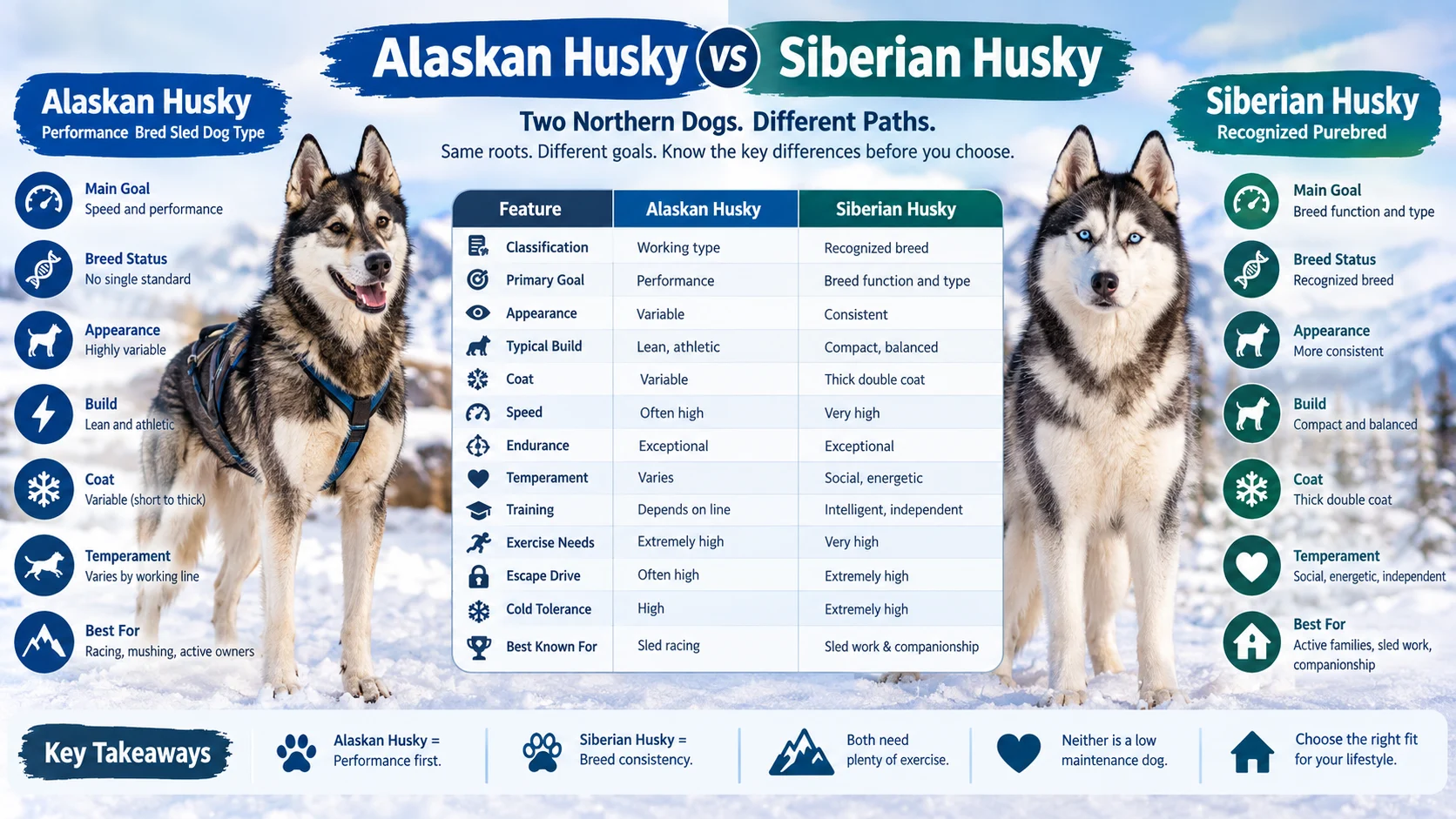
| Feature | Alaskan Husky | Siberian Husky |
|---|---|---|
| Classification | Working sled dog type | Recognized purebred |
| Primary Development | Performance and racing | Sled work and breed preservation |
| Breed Standard | No single formal standard | Defined breed standard |
| Appearance | Highly variable | More consistent |
| Typical Build | Lean, athletic, performance focused | Compact, balanced, athletic |
| Coat | Variable | Dense double coat |
| Speed | Often bred for high speed | Strong endurance and speed |
| Endurance | Very high | Very high |
| Temperament | Varies by working line | Social, energetic, independent |
| Exercise Needs | Extremely high | Very high |
| Trainability | Depends on individual and line | Intelligent but independent |
| Escape Drive | Often high | Extremely high |
| Cold Tolerance | Generally high | Extremely high |
| Best Known For | Sled racing and performance | Sled work, companionship and performance |
The biggest distinction is simple: Siberian Husky is a standardized dog breed, while Alaskan Husky generally refers to a performance bred sled dog type or population rather than a single standardized breed.
Alaskan Husky vs Siberian Husky: What Is the Difference?
The Alaskan Husky and Siberian Husky share a history rooted in northern sled work, but their breeding goals are different.
The Siberian Husky was developed from sled dogs associated with the Chukchi people of northeastern Siberia and was selected for efficient transportation, endurance and the ability to pull relatively light loads over long distances. The modern Siberian is a recognized breed with a defined standard.
The Alaskan Husky is different.
It is generally a working sled dog type developed primarily around performance. Alaskan Huskies can have varied ancestry and appearance because breeders and mushers have historically selected dogs for traits such as speed, endurance, efficiency, attitude and trail performance rather than maintaining one fixed appearance.
The Short Answer
If you want the simplest distinction:
Alaskan Husky: performance first.
Siberian Husky: breed type and working ability together.
That difference explains much of what you see when comparing the two.
What Is an Alaskan Husky?
Alaskan Husky Classification
The term “Alaskan Husky” does not describe one standardized purebred dog in the same way “Siberian Husky” does.
Instead, it generally describes working sled dogs developed in Alaska and elsewhere for performance.
Their genetics can vary considerably.
Depending on the racing program, an Alaskan Husky may have ancestry from different northern or sporting breeds. The goal is not to produce puppies that all look identical.
The goal is to produce dogs that perform exceptionally well in harness.
What Alaskan Huskies Are Bred to Do
Performance breeding can emphasize:
• speed
• endurance
• efficient movement
• recovery
• willingness to run
• team cooperation
• cold weather performance
• competitive trail ability
This is why two Alaskan Huskies from different kennels can look surprisingly different.
One might look very similar to a Siberian Husky.
Another might have a narrower head, shorter coat, longer legs or a more athletic racing build.
What Is a Siberian Husky?
Siberian Husky Breed Background
The Siberian Husky is a recognized purebred working dog with a defined breed identity.
The breed originated in northeastern Siberia and was developed by the Chukchi people for transportation and survival in an extremely cold environment. Their traditional work emphasized moving relatively light loads efficiently over long distances.
The American Kennel Club describes the Siberian Husky as a medium sized, compact sled dog with a thick coat, considerable endurance and a history of working in packs.
Why Siberians Have Such a Consistent Look
Unlike Alaskan Huskies, Siberian Huskies are bred according to a breed standard.
That creates greater consistency in:
• body proportions
• coat characteristics
• ear shape
• head structure
• movement
• size
• overall appearance
This does not mean every Siberian looks identical.
It means there is a defined physical and functional blueprint breeders are expected to work toward.
Alaskan Husky vs Siberian Husky Appearance
This is one of the easiest areas to notice a difference.
Alaskan Husky Appearance
Alaskan Huskies can vary considerably.
Common characteristics include:
• lean athletic bodies
• long legs
• narrow or moderate heads
• practical coats
• varied colors
• brown, blue or mixed eye colors
• performance oriented structure
Some have a classic Husky appearance.
Others look more like purpose bred racing dogs.
Siberian Husky Appearance
Siberians are generally more visually predictable.
They commonly have:
• medium sized compact bodies
• erect triangular ears
• thick double coats
• almond shaped eyes
• curled or sickle shaped tails
• distinctive facial markings
• strong but efficient movement
Their eyes may be blue, brown or combinations of both.
Appearance Comparison
| Characteristic | Alaskan Husky | Siberian Husky |
|---|---|---|
| Appearance | Highly variable | More standardized |
| Body | Lean performance build | Compact athletic build |
| Coat | Variable | Thick double coat |
| Eye Color | Variable | Brown, blue or mixed |
| Facial Markings | Highly variable | More predictable |
| Overall Look | Racing sled dog | Classic Husky |
Size and Weight Comparison
The Siberian Husky has a relatively consistent size range because it is a standardized breed.
The AKC describes Siberians as medium sized dogs, with males generally around 45 to 60 pounds and females around 35 to 50 pounds.
Alaskan Husky size is much less predictable because the term covers a broader performance population.
Typical Comparison
| Feature | Alaskan Husky | Siberian Husky |
|---|---|---|
| Height | Variable | About 20 to 23.5 inches |
| Weight | Variable | About 35 to 60 lbs |
| Build | Lean and performance focused | Compact and balanced |
| Size Predictability | Lower | Higher |
A buyer should therefore be cautious when someone gives one exact “Alaskan Husky standard weight.”
There isn’t one universal size standard for the type.
Speed and Endurance
Which Is Faster?
Alaskan Huskies are often bred specifically for competitive sled performance, so speed can be a major selection goal.
Siberian Huskies are also extremely capable sled dogs, but their historical development emphasized efficient long distance transportation and endurance.
The difference is not that one can run and the other cannot.
Both can be extraordinarily athletic.
The distinction is the selection pressure behind them.
Why Alaskan Huskies Excel in Racing
Performance breeders may select dogs according to:
• running speed
• efficient gait
• cardiovascular endurance
• recovery ability
• appetite
• foot quality
• trail attitude
Modern sled racing places enormous demands on working dogs. Even seemingly small physical advantages can matter over long distances.
Temperament and Personality
This comparison becomes more complicated because Alaskan Huskies are not one uniform genetic population.
An individual Alaskan Husky’s personality can depend heavily on its breeding program and working background.
Alaskan Husky Temperament
Many performance bred Alaskan Huskies are:
• energetic
• highly motivated
• social with other working dogs
• extremely active
• focused on movement
• eager to run
They may be difficult companions for owners who simply want a dog that receives a couple of short walks each day.
Siberian Husky Temperament
Siberians are commonly described as social, energetic and independent.
The AKC notes their strong desire to run and their tendency to become escape artists if given the opportunity. They can also be friendly toward strangers rather than naturally acting as traditional guard dogs.
This is an important distinction.
A Siberian Husky may be extremely loyal to its family without being strongly protective of the property.
Training Differences
Neither dog should be confused with a naturally obedient, handler dependent breed.
Huskies were bred to work independently while traveling long distances.
That independence remains important today.
Training an Alaskan Husky
Performance bred Alaskan Huskies may have tremendous work motivation but can be less interested in repetitive obedience exercises.
Their strongest reinforcement may simply be:
Run.
Training should therefore be practical, engaging and consistent.
Training a Siberian Husky
Siberians are intelligent, but intelligence does not automatically produce obedience.
They can learn quickly while still deciding whether following a command is worthwhile.
Positive reinforcement, consistency and secure management are particularly important. The AKC specifically highlights their tendency to run, dig and escape when their physical and mental needs are not adequately managed.
Exercise Requirements
Both types demand significantly more activity than the average companion dog.
Alaskan Husky Exercise
A performance bred Alaskan Husky may need substantial daily physical work.
Suitable outlets include:
• running
• pulling sports
• hiking
• skijoring
• bikejoring
• structured conditioning
• sled work
Siberian Husky Exercise
Siberians also require substantial exercise.
Good activities include:
• hiking
• running
• canicross
• sledding
• agility
• scent games
• structured walks
The goal is not simply to exhaust the dog.
A better approach combines physical exercise with mental engagement and calmness training.
Alaskan Husky vs Siberian Husky Coat and Grooming
Alaskan Husky Coat
Because Alaskan Huskies do not follow one uniform breed standard, their coats can vary considerably.
Some have dense northern coats.
Others have shorter, more performance oriented coats.
Siberian Husky Coat
Siberians have a thick double coat designed for harsh northern conditions.
They also shed heavily, particularly during seasonal coat changes.
Weekly brushing can help manage the coat, while heavier shedding periods may require substantially more grooming.
Health Considerations
There is no single health profile that applies identically to every Alaskan Husky because their genetic backgrounds vary.
For an Alaskan Husky, health evaluation should consider:
• breeding history
• orthopedic health
• working ability
• feet and gait
• inherited conditions relevant to the specific line
For Siberian Huskies, buyers should work with breeders who perform appropriate health screening and provide transparent pedigree information.
A Major Buyer Lesson
Do not judge either dog by appearance alone.
A beautiful Husky can still have poor structure, inadequate conditioning or unsuitable temperament.
Experienced working dog breeders pay attention to what the dog can actually do.
Puppy Development
Alaskan Husky Puppies
Development can vary considerably between working lines.
Important early priorities include:
• appropriate socialization
• controlled environmental exposure
• developing confidence
• basic handling
• age appropriate conditioning
Puppies should not be pushed into extreme endurance work simply because their parents are racing dogs.
Siberian Husky Puppies
Siberian puppies also need early socialization and consistent training.
Their independent nature can become challenging if owners wait too long to establish household boundaries.
During adolescence, owners may notice:
• increased roaming attempts
• stronger prey drive
• selective obedience
• greater physical energy
• increased independence
This is often the stage when inexperienced owners realize that a Husky is much more demanding than its appearance suggests.
Family Compatibility
Alaskan Husky as a Family Dog
An Alaskan Husky from a highly performance focused line may be an exceptionally demanding household companion.
Before buying one, ask:
Can your lifestyle accommodate a dog bred to run?
If the answer is no, the problem will not be solved by simply providing a larger backyard.
Siberian Husky as a Family Dog
Siberians can make excellent family companions in active households.
The AKC describes them as social dogs that generally enjoy people and other dogs, while also emphasizing their need for exercise and companionship.
However, secure fencing is essential.
A Siberian that sees an open gate may see an opportunity rather than a boundary.
Alaskan Husky vs Siberian Husky: Lifestyle Comparison
| Lifestyle | Alaskan Husky | Siberian Husky |
|---|---|---|
| Competitive mushing | Excellent fit | Excellent fit |
| Distance running | Excellent | Excellent |
| Active family | Potentially excellent | Often suitable |
| Sedentary household | Poor fit | Poor fit |
| Apartment living | Usually difficult | Usually difficult |
| First time owner | Often challenging | Often challenging |
| Secure fenced yard | Strongly recommended | Strongly recommended |
| Outdoor enthusiast | Strong fit | Strong fit |
Common Misconceptions
“Alaskan Husky Is Just a Bigger Siberian”
Not necessarily.
The term Alaskan Husky refers to a broader performance bred population rather than one standardized breed.
“Siberian Huskies Are Slow”
Incorrect.
Siberians are highly capable endurance sled dogs. Their historical purpose emphasized efficient movement over long distances.
“Blue Eyes Mean Siberian Husky”
No.
Eye color alone cannot reliably identify the dog.
“Every Alaskan Husky Looks Like a Husky”
Not at all.
Appearance can vary dramatically between working lines.
“Huskies Are Easy Because They Are Friendly”
Friendliness does not equal easy ownership.
A dog can be social, affectionate and still require extensive daily exercise, secure containment and consistent training.
What Most Comparison Articles Miss
The Real Difference Is Breeding Purpose
This is the key.
The Siberian Husky developed as a defined sled dog breed with a recognizable physical and functional standard.
The Alaskan Husky evolved more heavily around performance selection.
That distinction explains their different appearances, predictability and working characteristics.
Performance Can Matter More Than Appearance
In working sled programs, a dog that looks ordinary but runs efficiently can be much more valuable than a visually spectacular dog that cannot maintain performance.
That mindset is very different from show ring selection.
The Word “Husky” Creates Confusion
“Husky” is often used casually to describe several northern sled dog populations.
That is why asking for the exact type and breeding background matters before purchasing a puppy.
Buyer Warning
Be Careful With “Rare Alaskan Husky” Marketing
Because Alaskan Husky is not one standardized breed, sellers can use the label loosely.
Ask for:
• parent information
• health records
• working background
• photographs of adult relatives
• explanation of the breeding program
• realistic adult size expectations
Do not pay a premium simply because a seller calls a puppy an “Alaskan Husky.”
Siberian Husky Buyer Checklist
A responsible breeder should be able to discuss:
• pedigree
• health testing
• temperament
• structure
• socialization
• expected adult size
• breed specific health concerns
The puppy should be evaluated as a whole dog rather than sold primarily because of blue eyes, unusual markings or a fashionable appearance.
Final Comparison
| Category | Alaskan Husky | Siberian Husky |
|---|---|---|
| Breed Status | Working type | Recognized breed |
| Main Selection Goal | Performance | Breed function and type |
| Appearance | Variable | Consistent |
| Speed | Often exceptional | Very high |
| Endurance | Exceptional | Exceptional |
| Coat | Variable | Thick double coat |
| Temperament | Depends on working line | Social, energetic, independent |
| Predictability | Lower | Higher |
| Exercise | Extremely demanding | Extremely demanding |
| Companion Potential | Depends heavily on line | Strong in active homes |
| Best Known For | Sled racing | Sled work and companionship |
Preparation Checklist
Before Getting an Alaskan Husky
Make sure you can provide:
☐ Daily high intensity activity
☐ Secure containment
☐ Mental stimulation
☐ Consistent training
☐ Appropriate conditioning
☐ Social interaction
☐ Veterinary care
Before Getting a Siberian Husky
Prepare for:
☐ Heavy shedding
☐ High exercise needs
☐ Escape attempts
☐ Independent behavior
☐ Secure fencing
☐ Consistent training
☐ Regular mental stimulation
Frequently Asked Questions
What is the main difference between an Alaskan Husky and Siberian Husky?
The Siberian Husky is a recognized purebred breed with a defined standard, while Alaskan Husky generally refers to a performance bred sled dog type without one universal breed standard.
Is an Alaskan Husky faster than a Siberian Husky?
Alaskan Huskies are often specifically selected for racing performance and speed. Siberian Huskies are also fast and highly athletic but were historically developed for efficient long distance sled transportation.
Which Husky is bigger?
There is no universal Alaskan Husky size because the type is variable. Siberian Huskies have a more predictable medium sized build.
Are Alaskan Huskies mixed breeds?
Many Alaskan Huskies have ancestry from multiple dog populations selected for sled performance. However, calling every Alaskan Husky simply a “mixed breed” can oversimplify the specialized working populations behind them.
Are Siberian Huskies good family dogs?
They can be excellent family companions for active households. They are social and energetic but require significant exercise, companionship and secure containment.
Which Husky sheds more?
Siberian Huskies have a dense double coat and are substantial seasonal shedders. Alaskan Huskies vary because their coats are not standardized.
Can an Alaskan Husky be a pet?
Yes, but the individual dog’s breeding and activity requirements matter enormously. A highly performance bred sled dog may be substantially more demanding than a typical companion dog.
Are Siberian Huskies easier to train?
They are intelligent and capable of learning quickly, but their independence and strong desire to run can make training challenging. Consistency and positive engagement are important.
Conclusion
The Alaskan Husky vs Siberian Husky comparison becomes much clearer once you understand their different histories.
The Siberian Husky is a standardized breed, developed from northern sled dogs and recognized for its distinctive appearance, endurance, athleticism and social personality.
The Alaskan Husky is primarily a performance focused sled dog type, where working ability can matter more than maintaining a consistent physical appearance.
Neither should be chosen simply because of blue eyes, a wolf like appearance or a reputation for being athletic.
The better question is whether the dog’s energy, working drive, temperament and exercise requirements fit your actual lifestyle.
That is what separates a beautiful Husky purchase from a successful long term match.