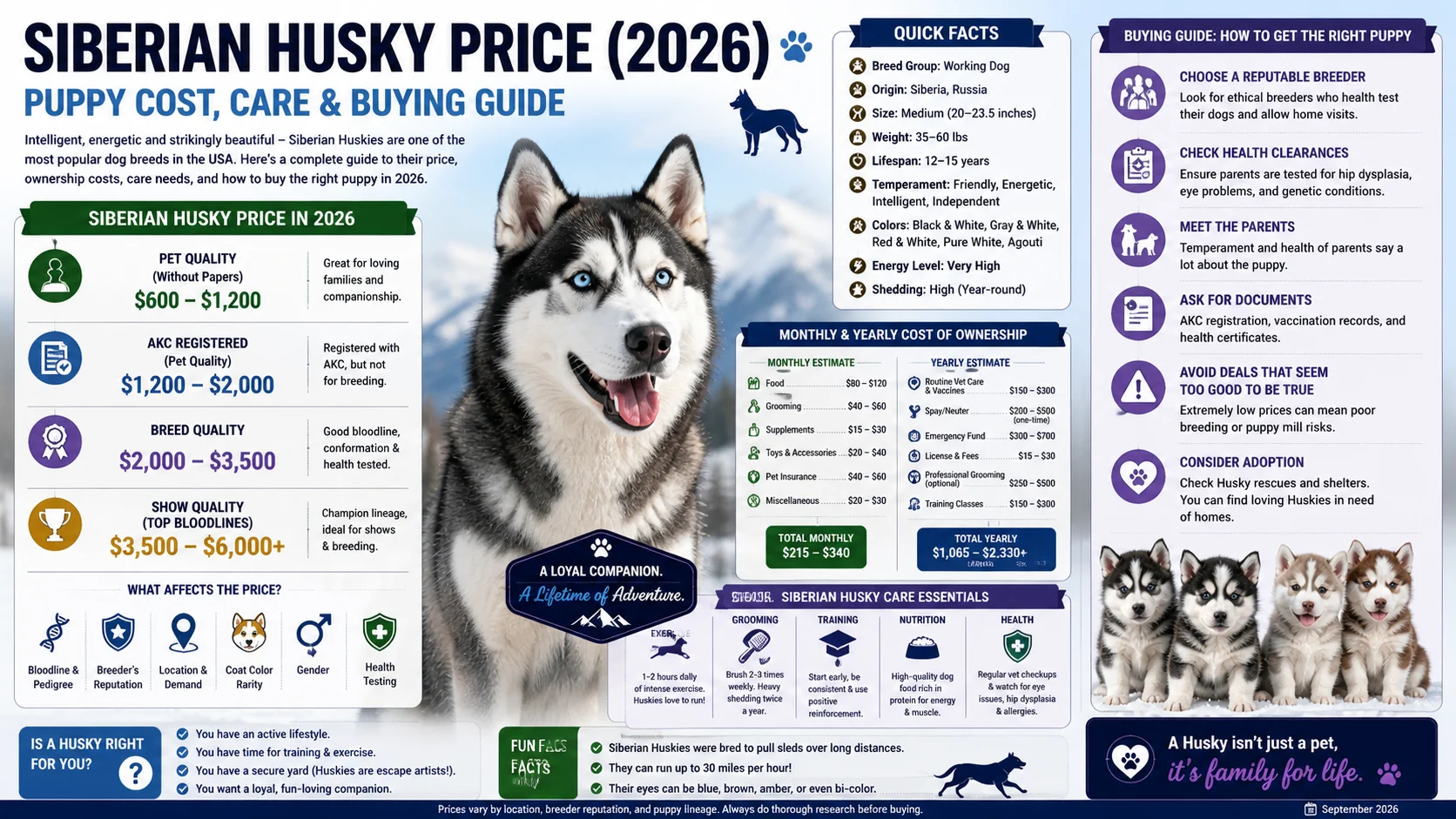
Siberian Husky price: $600–$3,000+ in 2026, depending on breeder, pedigree, health testing, location, and puppy quality.
Quick Snapshot Table
| Cost Factor | Typical 2026 Range |
|---|---|
| Siberian Husky puppy from breeder | About $600 to $3,000+ |
| Adoption or rescue fee | Often substantially lower than breeder purchase |
| Premium health tested breeder | Usually toward the higher end |
| Initial supplies | $200 to $500+ |
| Food | Depends heavily on size, activity and diet |
| Routine veterinary care | Varies by location and insurance |
| Grooming | Moderate, with heavy seasonal shedding |
| Training | Highly recommended |
| Lifespan | About 12 to 14 years |
| Overall ownership | Moderate to high commitment |
Current published estimates vary considerably by breeder, bloodline, health testing, location and demand. For example, a 2026 price guide reports roughly $600 to $3,000+, while PetMD notes that breeder puppies can cost up to around $1,500 depending on bloodline, health and location. Treat online price ranges as market estimates rather than fixed prices.
How Much Does a Siberian Husky Cost in 2026?
A Siberian Husky puppy can cost anywhere from several hundred dollars to more than $3,000, depending on where you buy, the breeder’s practices, pedigree, health testing, location and whether the puppy is bred primarily as a companion or from a more carefully selected show or working program.
The important part is understanding why one Husky costs $800 while another costs $2,500 or more.
Price alone does not prove quality.
A responsible breeder may charge more because they invest in:
- health testing
- veterinary care
- appropriate puppy raising
- quality nutrition
- genetic screening
- responsible breeding selection
- socialization
- registration and pedigree documentation
Here is where many buyers get it wrong: they compare puppy prices without comparing what is included in those prices.
Siberian Husky Puppy Price by Source
Siberian Husky Breeder Price
A professionally bred Siberian Husky puppy commonly falls somewhere in the broad $600 to $3,000+ range, although the exact market varies significantly by country and region.
Higher prices may reflect:
- established bloodlines
- health testing
- show potential
- breeder reputation
- carefully planned litters
- veterinary screening
- early socialization
But an expensive puppy is not automatically a healthy puppy.
The breeder’s evidence matters more than the number on the price tag.
Siberian Husky Adoption Price
Adoption can cost considerably less than purchasing from a breeder.
Shelters and breed rescues may charge an adoption fee that helps cover:
- vaccinations
- sterilization
- veterinary examinations
- microchipping
- parasite treatment
- shelter or foster care
Adult Huskies can also be available through rescue organizations, and adopting an adult gives buyers the opportunity to see more of the dog’s established personality before committing.
Siberian Husky Price From a Backyard Breeder
This is where buyers need to slow down.
A puppy advertised for a surprisingly low price may appear financially attractive, but the initial saving can disappear quickly if the puppy arrives with:
- parasites
- poor vaccination history
- inherited problems
- inadequate socialization
- behavioral instability
- unclear parentage
A cheap Husky is not necessarily a bargain.
The real question is what you are actually receiving for the money.
What Determines Siberian Husky Price?
Bloodline and Pedigree
Pedigree can influence price, especially when the parents have documented achievements or come from established breeding programs.
However, pedigree should never replace health evaluation.
A long list of famous ancestors means little if the breeder cannot explain the health and temperament of the actual parents.
Health Testing
Responsible breeders should be able to discuss breed relevant health screening.
The American Kennel Club currently lists hip evaluation, ophthalmologist evaluation, Siberian Husky Shaking Puppy Syndrome Type 1 testing and Siberian Husky Polyneuropathy Type 1 testing among recommended health tests for the breed.
This is one of the clearest differences between a carefully planned litter and a casual breeding operation.
Location
Siberian Husky prices vary considerably by location.
The same quality puppy may cost differently because of:
- local demand
- breeder availability
- veterinary expenses
- transportation
- registration costs
- regional economic conditions
That is why there is no single universal “Siberian Husky price.”
Coat Color and Eye Color
Huskies come in several recognized colors and patterns, including black and white, gray and white, red and white, sable and white, agouti and white, and white. Brown, blue and mixed eye colors can also occur.
Blue eyes can increase buyer demand, but they should not be treated as proof of superior quality.
The same applies to unusual facial markings.
Appearance can influence market price, but it does not tell you whether the dog has stable temperament or good health.
Siberian Husky Price vs Cost of Ownership
The purchase price is only the beginning.
A buyer who spends $1,500 on a puppy may ultimately spend much more over the dog’s lifetime on:
- food
- veterinary care
- preventatives
- training
- equipment
- grooming
- emergency treatment
- boarding
- transportation
First Year Expenses
| Expense | Possible Cost |
|---|---|
| Puppy purchase | $600 to $3,000+ |
| Initial veterinary care | $200 to $600+ |
| Crate | $50 to $150 |
| Bed | $30 to $100 |
| Collar and leash | $30 to $100 |
| Food | $300 to $800+ |
| Training | $100 to $500+ |
| Toys and enrichment | $50 to $200 |
| Miscellaneous supplies | $100+ |
These are planning estimates rather than fixed national prices. Veterinary and service costs can vary substantially.
Is a Siberian Husky Expensive to Own?
A Siberian Husky is not necessarily one of the most expensive breeds to feed because it is a medium sized dog rather than a giant breed.
The bigger challenge is often time and management.
The Siberian Husky was developed as an endurance sled dog and has strong instincts for running, social interaction and independent decision making. The AKC describes the breed as energetic, social and capable of developing unwanted behaviors when its physical and mental needs are not met.
The Hidden Cost Most Buyers Ignore
The biggest hidden cost can be behavioral management.
A bored Husky may:
- dig
- howl
- chew
- escape
- become destructive
- develop unwanted habits
Training and secure containment are therefore not optional luxuries for many owners.
Siberian Husky Puppy Development and Cost
8 to 12 Weeks
This is the period when most puppies leave the breeder for their new homes.
Important expenses include:
- first veterinary visits
- vaccinations
- quality food
- crate
- collar and identification
- puppy training
3 to 6 Months
The puppy becomes more energetic and curious.
This is a critical period for:
- socialization
- leash training
- recall foundations
- bite inhibition
- household boundaries
6 to 12 Months
The adolescent stage can expose the true difficulty of owning a Husky.
You may see:
- increased independence
- selective listening
- stronger running instincts
- more intense play
- escape attempts
This is where consistent training becomes especially valuable.
12 Months and Beyond
A young adult Husky may still have enormous energy.
Do not assume that reaching one year means the dog suddenly becomes calm.
The breed was developed for endurance, and its physical design reflects that history. The AKC standard describes Siberians as medium sized working dogs built for efficient movement and long distance pulling.
Siberian Husky Temperament and Its Effect on Ownership Cost
A Siberian Husky can be affectionate, social and entertaining, but it is not typically a low effort companion.
The breed was developed to work in groups and travel long distances.
That history still matters.
Social Personality
Huskies are generally social dogs and often enjoy interaction with people and other dogs. The AKC notes their friendly nature and strong social tendencies.
This can make them excellent companions for active households.
Independence
The other side of the personality is independence.
A Husky may understand a command perfectly and still decide that something else is more interesting.
That is not necessarily stubbornness in the simple sense.
It is part of the breed’s working history.
Escape Behavior
This deserves special attention.
Huskies are famous for trying to get out of unsecured areas.
Owners should think seriously about:
- fence height
- gate security
- digging prevention
- leash management
- identification
- microchipping
The cost of secure containment should be part of your original Husky budget.
Siberian Husky Exercise Requirements
Physical Exercise
A Husky needs regular physical activity.
Good options include:
- long walks
- hiking
- controlled running
- structured play
- canine sports
- safe outdoor exploration
The exact amount depends on age, health and individual temperament.
Mental Exercise
Physical exercise alone may not be enough.
Include:
- scent games
- obedience sessions
- puzzle feeders
- recall practice
- controlled problem solving
A tired body without mental engagement can still leave you with a frustrated dog.
Grooming and Shedding Costs
Siberian Huskies have thick double coats.
They are also known for substantial seasonal shedding. The AKC recommends regular brushing and notes heavier shedding periods when the undercoat is released.
Grooming Budget
You may spend money on:
- undercoat brushes
- deshedding tools
- shampoo
- professional grooming
- cleaning supplies
The breed is naturally clean and typically has relatively little doggy odor, but that does not mean the coat is low maintenance.
Health and Veterinary Costs
Common Health Considerations
Siberian Huskies are generally considered a relatively healthy breed, but no breed is free from health problems. The AKC notes concerns including cancer and arthritis while also describing hip dysplasia and eye disease as relatively uncommon compared with some breeds.
Recommended Health Testing
Before purchasing from a breeder, ask about:
- hip evaluation
- eye examination
- SPS1 testing
- SHPN1 testing
These are among the health tests listed by the AKC for Siberian Huskies.
Siberian Husky Price by Quality Level
| Buyer Option | Typical Price Position | What to Investigate |
|---|---|---|
| Rescue | Lower | Medical and behavioral history |
| Casual seller | Lower to mid | Parent health and breeding conditions |
| Established breeder | Mid to high | Health testing and puppy raising |
| Show or specialized program | Higher | Pedigree, testing and purpose |
| Extremely expensive “rare” puppy | Variable | Whether premium is actually justified |
There is no reliable rule that a higher price equals a better dog.
What You Should Actually Pay For
A responsible buyer should prioritize:
- Healthy parents
- Stable temperament
- Appropriate genetic screening
- Proper puppy raising
- Veterinary documentation
- Transparent breeder communication
Color should come much later on the list.
How to Spot a Responsible Siberian Husky Breeder
Ask About the Parents
You should be able to see information about:
- sire
- dam
- health history
- temperament
- pedigree
- relevant testing
Ask for Health Documentation
Do not settle for:
“The parents are healthy.”
Ask what testing was actually performed.
Documentation is more useful than reassurance.
Observe the Puppies
Healthy puppies should generally appear:
- alert
- curious
- appropriately active
- clean
- well nourished
- comfortable around normal human handling
A puppy that looks beautiful in photographs still needs proper evaluation.
Buyer Warning: When a Cheap Husky Becomes Expensive
A very low purchase price can be attractive, particularly when buyers are searching for a Siberian Husky puppy on a limited budget.
But ask what has been excluded.
Potentially missing items include:
- health testing
- veterinary care
- quality nutrition
- socialization
- proper housing
- responsible breeding selection
The difference may not become visible until months later.
Red Flags
Be cautious when a seller:
- refuses to show the mother
- cannot provide veterinary records
- has many breeds constantly available
- pressures you to pay immediately
- offers puppies unusually young
- has no health testing information
- markets “rare” features as the main reason for an inflated price
Siberian Husky vs Other Common Costs
| Factor | Siberian Husky |
|---|---|
| Purchase Cost | Moderate to high depending on source |
| Food Cost | Moderate |
| Grooming | Moderate |
| Exercise Requirement | High |
| Training Requirement | High |
| Veterinary Costs | Variable |
| Containment Needs | High |
| Time Commitment | High |
The Siberian Husky’s purchase price is therefore only one part of affordability.
A household with enough money to buy a Husky but not enough time to exercise and train one may still be poorly prepared.
Lifestyle Compatibility
Active Family
Usually a strong match if the household enjoys outdoor activities and can provide daily engagement.
Apartment Owner
Possible in some circumstances, but considerably more demanding because of exercise, vocalization and escape tendencies.
Runner or Hiker
Potentially a good lifestyle match, provided exercise is age appropriate and weather conditions are managed safely.
Sedentary Household
Usually a difficult match.
A Husky was developed for endurance rather than inactivity.
First Time Dog Owner
Possible, but the breed’s independence, energy and escape instincts can make the learning curve steeper.
Siberian Husky Preparation Checklist
Before Buying
Check:
- breeder reputation
- parent health records
- genetic testing
- puppy vaccination records
- microchip information
- contract
- return policy
- feeding instructions
Before Bringing the Puppy Home
Prepare:
- secure crate
- durable leash
- properly fitted collar or harness
- identification tag
- puppy food
- safe toys
- grooming tools
- veterinarian appointment
- secure outdoor area
Budget for the Unexpected
Keep an emergency veterinary fund.
The goal is not simply to afford the puppy.
It is to afford the dog.
Frequently Asked Questions
How much does a Siberian Husky cost in 2026?
A Siberian Husky puppy can range broadly from around $600 to more than $3,000 depending on breeder, location, bloodline, health testing and other factors. Published estimates vary, so buyers should compare what each price actually includes.
What is the cheapest way to get a Siberian Husky?
Adoption or rescue is often less expensive upfront than purchasing a puppy from a breeder, although adoption fees and included veterinary care vary by organization.
Why are some Siberian Huskies so expensive?
Higher prices may reflect health testing, pedigree, breeder investment, veterinary care, puppy raising and demand. A high price alone does not guarantee responsible breeding.
Are blue eyed Siberian Huskies more expensive?
They can attract stronger buyer demand, but blue eyes are a normal characteristic of the breed and should not be treated as evidence of superior health or temperament.
Is a Siberian Husky expensive to maintain?
The financial cost can be moderate to high depending on food, veterinary care and services, but the bigger commitment is often time. Huskies need substantial physical and mental engagement.
How much does a Siberian Husky eat?
Food requirements depend on age, body condition, activity level and the specific diet. Because Huskies were historically bred for efficient endurance work, simply feeding according to another breed’s expectations can be misleading.
Do Siberian Huskies need professional grooming?
Not necessarily. Regular home brushing can manage much of the coat, although professional grooming can be useful during heavy shedding periods.
Is a Siberian Husky a good family dog?
They can be excellent family companions for active households. The AKC describes Siberians as friendly and social, including with families and other dogs.
Final Thoughts
The true Siberian Husky price is not the number written beside a puppy advertisement.
It is the combination of purchase price, health, training, exercise, containment, veterinary care and years of responsible ownership.
A $700 puppy can ultimately cost far more than a carefully bred $2,000 puppy if the first purchase comes with poor health screening or inadequate early care.
Experienced Husky owners look beyond the blue eyes and beautiful coat.
They ask better questions:
- Are the parents health tested?
- Is the temperament stable?
- Was the puppy raised properly?
- Is the breeder transparent?
- Can I provide the exercise this breed needs?
- Can I afford the dog for its entire life?
That is the right way to evaluate Siberian Husky price in 2026.