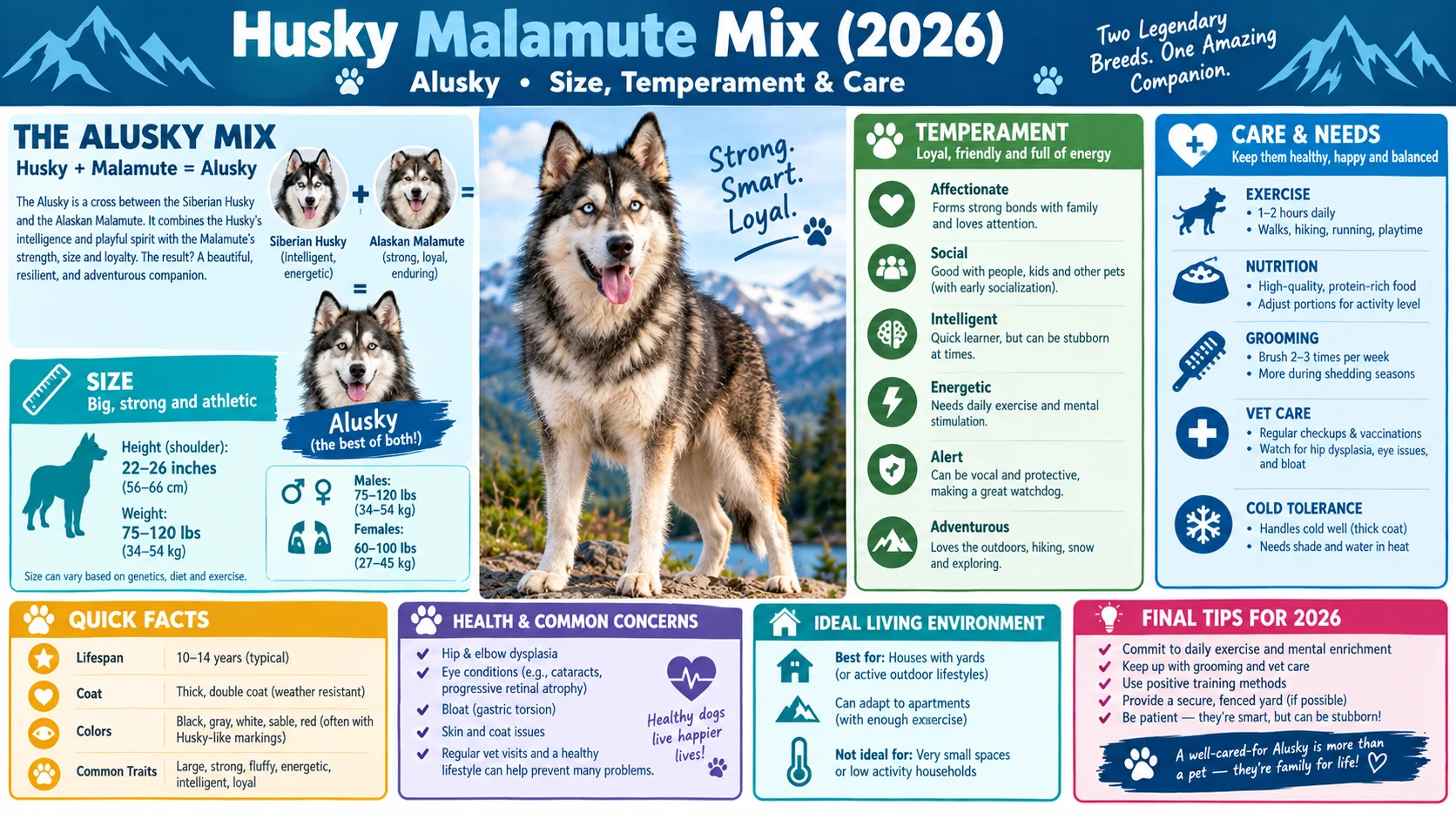
A Husky Malamute Mix (Alusky) is a cross between a Siberian Husky and an Alaskan Malamute, known for its strength, intelligence, high energy, and thick double coat. Most weigh about 45–85+ pounds and need substantial daily exercise, training, and mental stimulation.
Quick Snapshot
| Trait | Details |
|---|---|
| Common Name | Husky Malamute Mix |
| Also Called | Alusky |
| Parent Breeds | Siberian Husky × Alaskan Malamute |
| Type | Mixed breed |
| Size | Medium to large |
| Approx. Weight | About 45–85+ lbs |
| Height | Often around 20–25+ inches |
| Lifespan | Commonly around 10–14 years |
| Energy Level | Very high |
| Intelligence | High |
| Trainability | Moderate to high |
| Shedding | Heavy |
| Coat | Thick double coat |
| Temperament | Social, independent, energetic |
| Exercise | High |
| Best For | Active, experienced owners |
The exact size and temperament can vary considerably because a mixed puppy can inherit more physical or behavioral traits from either parent. The Siberian Husky standard describes a medium-sized endurance sled dog, while the Alaskan Malamute is heavier boned and built for strength and freight pulling.
What Is a Husky Malamute Mix?
The Husky Malamute Mix is a cross between the Siberian Husky and Alaskan Malamute. It is commonly called an Alusky.
Both parent breeds were developed as Arctic working dogs, but they were designed for somewhat different jobs.
The Siberian Husky was developed to carry lighter loads at moderate speed over long distances, while the Alaskan Malamute was built for strength, endurance, and heavier freight.
That combination can produce a dog that is:
- athletic
- powerful
- energetic
- intelligent
- independent
- highly social
- physically demanding
The biggest mistake is assuming this is simply a “larger Husky.”
It is not.
Some puppies inherit the lighter, faster Husky build. Others become substantially heavier and more muscular like the Malamute.
Husky vs Malamute: What Can You Expect From the Mix?
Understanding the parents is the best way to understand the puppy.
| Trait | Siberian Husky | Alaskan Malamute | Possible Mix |
|---|---|---|---|
| Build | Athletic and lighter | Heavy boned and powerful | Medium to large |
| Weight | 35–60 lbs | Around 75–85 lbs in AKC weight references | Highly variable |
| Main Strength | Speed and endurance | Strength and endurance | Both |
| Personality | Mischievous, social, independent | Affectionate, strong-willed | Social and independent |
| Exercise | Very high | Very high | Very high |
| Vocalization | Often high | Can be vocal | Frequently vocal |
| Prey Drive | Often strong | Can be strong | Potentially strong |
| Trainability | Intelligent but self-willed | Intelligent but independent | Requires consistency |
The AKC describes Siberian Huskies as energetic dogs with a strong instinct to run and notes that secure running space is important. The Malamute standard emphasizes strength, endurance, sound structure, and efficient movement.
Appearance and Size
A mature Husky Malamute Mix can look dramatically different from another dog of the same cross.
One may look:
- lean and athletic
- narrow headed
- distinctly Husky-like
Another may be:
- broad chested
- heavily boned
- muscular
- more Malamute-like
How Big Does a Husky Malamute Mix Get?
There is no official breed standard for the mix, so there is no guaranteed adult size.
A practical expectation is roughly:
45–85+ pounds and around 20–25+ inches, although individual dogs can fall outside that range.
The parents explain the variation. Siberian Huskies are officially much smaller, with males at 45–60 pounds and females at 35–50 pounds. The AKC’s Alaskan Malamute reference gives desirable freighting sizes of 85 pounds for males and 75 pounds for females.
What Determines Adult Size?
Major factors include:
- sex
- parental size
- genetics
- nutrition
- overall health
- growth rate
Do not buy a puppy based on a breeder’s promise that it will reach an exact adult weight.
Mixed breed genetics simply do not work that predictably.
Coat, Colors and Grooming
The Husky Malamute Mix usually has a thick double coat designed for cold environments.
Possible appearances include:
- gray and white
- black and white
- red and white
- agouti
- sable
- cream or lighter shades
Eye color can also vary, particularly when Husky genetics are strong.
A puppy may have:
- blue eyes
- brown eyes
- one blue and one brown eye
However, appearance should never be confused with temperament or quality.
How Much Does an Alusky Shed?
A lot.
Both parent breeds have substantial double coats, and Siberian Huskies are particularly well known for heavy seasonal shedding.
Expect:
- regular brushing
- seasonal coat blowouts
- significant loose fur
- frequent vacuuming
Weekly brushing is a useful baseline, with more frequent grooming during major shedding periods.
Temperament and Personality
The Husky Malamute Mix can be one of the most entertaining dogs to live with.
It can also be one of the most exhausting.
Expect a combination of:
- affection
- independence
- curiosity
- stubbornness
- playfulness
- intelligence
- high energy
The Husky side can contribute speed, mischief, and a strong desire to explore.
The Malamute side can contribute physical strength, confidence, and independent decision-making.
The result is often a dog that understands what you want but occasionally decides it has a better idea.
That is the part inexperienced owners underestimate.
Is the Husky Malamute Mix Aggressive?
Not inherently.
Neither parent breed should be defined simply by aggression.
A properly socialized Alusky can be:
- friendly
- affectionate
- playful
- highly people oriented
However, individual dogs can have strong prey drive, territorial behavior, dog selectivity, or guarding tendencies.
Genetics, early socialization, training, environment, and individual temperament all matter.
Stranger Behavior
Many Aluskies are more interested in greeting people than acting as serious guard dogs.
That trait is consistent with the Siberian Husky, which the AKC describes as naturally friendly and relatively indifferent to strangers.
If your primary goal is a dedicated protection dog, this cross should not automatically be treated as one.
Training a Husky Malamute Mix
This is where the breed mix becomes particularly interesting.
Both parent breeds are intelligent.
But intelligence does not automatically mean obedience.
A Husky Malamute Mix may learn a command quickly and then decide whether it is worth following.
Training Priorities
Focus on:
- recall
- loose leash walking
- impulse control
- crate training
- place training
- calm behavior
- handling exercises
- reliable boundaries
Start Early
The best time to establish household rules is during puppyhood.
Do not wait until a 70 pound dog has discovered that pulling, jumping, escaping, or ignoring recall is rewarding.
Consistency matters more than harshness.
Puppy Development Timeline
8 to 12 Weeks
The puppy is developing rapidly and learning what the world is like.
Prioritize:
- gentle handling
- household sounds
- controlled socialization
- basic recall
- name recognition
- crate training
Avoid overwhelming the puppy with chaotic environments.
3 to 6 Months
Physical coordination improves quickly.
You may see:
- increased independence
- stronger chewing
- more confidence
- greater curiosity
- early leash challenges
This is an excellent period for building reliable habits.
6 to 12 Months
Adolescence starts becoming obvious.
The puppy may become:
- stronger
- more energetic
- more independent
- more interested in exploration
This is often when owners realize how demanding the adult dog could become.
12 to 24 Months
Physical maturity continues.
Mental maturity may take longer.
Do not assume that reaching adult size means the dog has become an emotionally mature adult.
Exercise Requirements
This is not a breed mix for owners who want a dog that is satisfied with a short neighborhood walk.
Both parent breeds were developed for demanding work and endurance.
A healthy adult may need substantial daily activity combining:
- brisk walking
- hiking
- structured play
- obedience
- scent games
- pulling activities where appropriate
- problem-solving
The Exercise Mistake That Causes Problems
More running is not always the answer.
If you constantly exercise a young dog to exhaustion, you may create exceptional physical stamina without teaching the dog how to settle.
A balanced Alusky needs both:
activity + calmness training
That distinction matters.
Mental Stimulation
Physical exercise alone will rarely satisfy this mix.
Useful activities include:
Scent Work
Hide food or toys and encourage the dog to search.
Obedience Games
Use short training sessions rather than repetitive drilling.
Puzzle Feeding
Make the dog work for part of its food.
Structured Exploration
Hiking and new environments can provide both physical and mental stimulation.
The goal is not to keep the dog exhausted all day.
The goal is to teach it how to use its brain.
Husky Malamute Mix With Children
An appropriately socialized Alusky can live successfully with children, particularly in an active family.
But size and energy matter.
A large adolescent can accidentally knock over a small child simply by running past.
Children should learn:
- not to disturb the dog while eating
- not to climb on the dog
- not to chase the dog
- how to recognize stress signals
Adult supervision remains essential.
Husky Malamute Mix With Other Dogs
This depends heavily on the individual.
Many are social because both parent breeds have histories involving working around other dogs.
However, some individuals may show:
- same sex conflict
- resource guarding
- rough play
- prey drive
Early controlled socialization is far more useful than simply throwing a puppy into a busy dog park.
Health and Genetic Considerations
Because this is a mixed breed, health outcomes can vary.
Potential concerns associated with the parent breeds may include:
- hip dysplasia
- eye disorders
- inherited neurological conditions
- obesity
- orthopedic problems
- skin issues
A breeder should be able to explain the health history of both parents rather than simply showing you attractive puppy photographs.
Health Testing Matters
Ask about:
- hip evaluation
- elbow evaluation where appropriate
- ophthalmic examination
- breed relevant genetic testing
- veterinary records
The exact testing should reflect the health risks of both parent breeds.
Breeder Evaluation
Questions Worth Asking
Before buying an Alusky puppy, ask:
- What health testing was performed on both parents?
- Can I see veterinary records?
- What are the parents like temperamentally?
- How are puppies socialized?
- What happens if the puppy develops a serious inherited condition?
- What adult size are the parents?
- Why were these two dogs bred together?
A breeder who talks only about:
- blue eyes
- wolf appearance
- huge size
- rare colors
is giving you incomplete information.
Experienced breeders focus on health, structure, temperament, and suitability.
Common Mistakes New Owners Make
Choosing the Puppy Only for Appearance
The most dramatic puppy is not necessarily the best match.
Temperament should matter more than eye color or coat pattern.
Underestimating Escape Ability
A Husky influenced dog may be extremely determined when it wants to explore.
A secure yard is important.
Providing Only Physical Exercise
A tired dog is not automatically a mentally balanced dog.
Training and calmness work are essential.
Assuming a Large Dog Needs a Large Amount of Food
Food should be based on body condition, age, activity, and veterinary guidance rather than size alone.
Expecting Perfect Recall
Independent northern breeds can be challenging off leash.
Secure areas are much safer than relying on obedience alone.
Insights Most Articles Miss
The Mix Can Be More Demanding Than Either Parent in Your Household
Not because mixed breeds automatically have more energy, but because you can inherit different combinations of traits.
You might get:
- Husky speed
- Malamute strength
- Husky independence
- Malamute determination
That combination can be impressive.
It can also be difficult to manage.
Adult Size Is Not the Only Important Variable
Two puppies can reach similar weights but have very different:
- energy levels
- prey drive
- sociability
- independence
- trainability
Temperament should be evaluated separately from physical size.
Cold Weather Is Not a Substitute for Exercise
Their thick coats make them well adapted to cold environments, but that does not mean they should simply be left outdoors.
They still need:
- companionship
- training
- interaction
- controlled exercise
These are working dogs, not outdoor decorations.
Daily Care Routine
Morning
- structured exercise
- bathroom break
- short obedience session
- breakfast
Afternoon
- mental enrichment
- controlled play
- rest
Evening
- longer walk or hike
- training
- calm settling routine
- grooming when needed
The exact schedule should change with age, health, weather, and individual energy.
Grooming Checklist
Weekly
- brush the coat
- check ears
- inspect paws
- trim nails when needed
- check skin
During Shedding Season
Increase brushing frequency.
Expect large amounts of undercoat to come out.
Do not shave the double coat simply because the dog is shedding.
Lifestyle Compatibility
| Lifestyle | Compatibility |
|---|---|
| Very active owner | Excellent |
| Hiking household | Excellent |
| Experienced northern breed owner | Excellent |
| Active family | Often suitable |
| First time dog owner | Challenging |
| Sedentary household | Poor fit |
| Off leash lifestyle | Risky |
| Small unsecured yard | Poor fit |
| Hot climate | Requires careful management |
Preparation Checklist
Before bringing home a Husky Malamute Mix, have:
Home
- secure fencing
- sturdy crate
- durable bed
- food and water bowls
- grooming tools
Training
- puppy classes
- long line
- appropriate leash
- high value training rewards
Enrichment
- durable toys
- puzzle feeders
- scent games
- chew options
Veterinary Care
- vaccination plan
- parasite prevention
- wellness schedule
- discussion of breed relevant health risks
Frequently Asked Questions
What is a Husky Malamute Mix called?
It is commonly called an Alusky.
How big does a Husky Malamute Mix get?
Many fall somewhere around 45–85+ pounds, but adult size varies considerably depending on the parents and individual genetics.
Is a Husky Malamute Mix a good family dog?
It can be, particularly for an active family that understands high energy northern breeds and provides appropriate training and supervision.
Is an Alusky easy to train?
They are intelligent but can be independent and self-directed. Consistent, reward based training and strong boundaries are important.
Does a Husky Malamute Mix shed?
Yes. Expect heavy shedding, particularly during seasonal coat changes.
How much exercise does an Alusky need?
Most healthy adults need substantial daily physical and mental activity. The exact amount depends on age, health, conditioning, and individual temperament.
Can a Husky Malamute Mix live in a hot climate?
Yes, some can adapt, but owners in hot climates need to manage exercise timing, hydration, shade, indoor cooling, and heat exposure carefully.
Is the Husky Malamute Mix aggressive?
The mix is not inherently aggressive. Individual temperament varies, and responsible socialization and training are important.
Conclusion
The Husky Malamute Mix brings together two powerful Arctic working breeds, creating a dog that can be athletic, intelligent, affectionate, independent, and remarkably demanding.
The appeal is obvious: striking appearance, impressive endurance and a personality that can keep an active household constantly engaged.
But the same traits that make an Alusky exciting can make ownership difficult.
Before choosing one, look beyond the wolf-like face and beautiful coat. Evaluate the parents, health testing, temperament, exercise requirements, secure housing, and your ability to provide consistent training for years.
For the right owner, that combination of Husky athleticism and Malamute strength can make an exceptional companion.