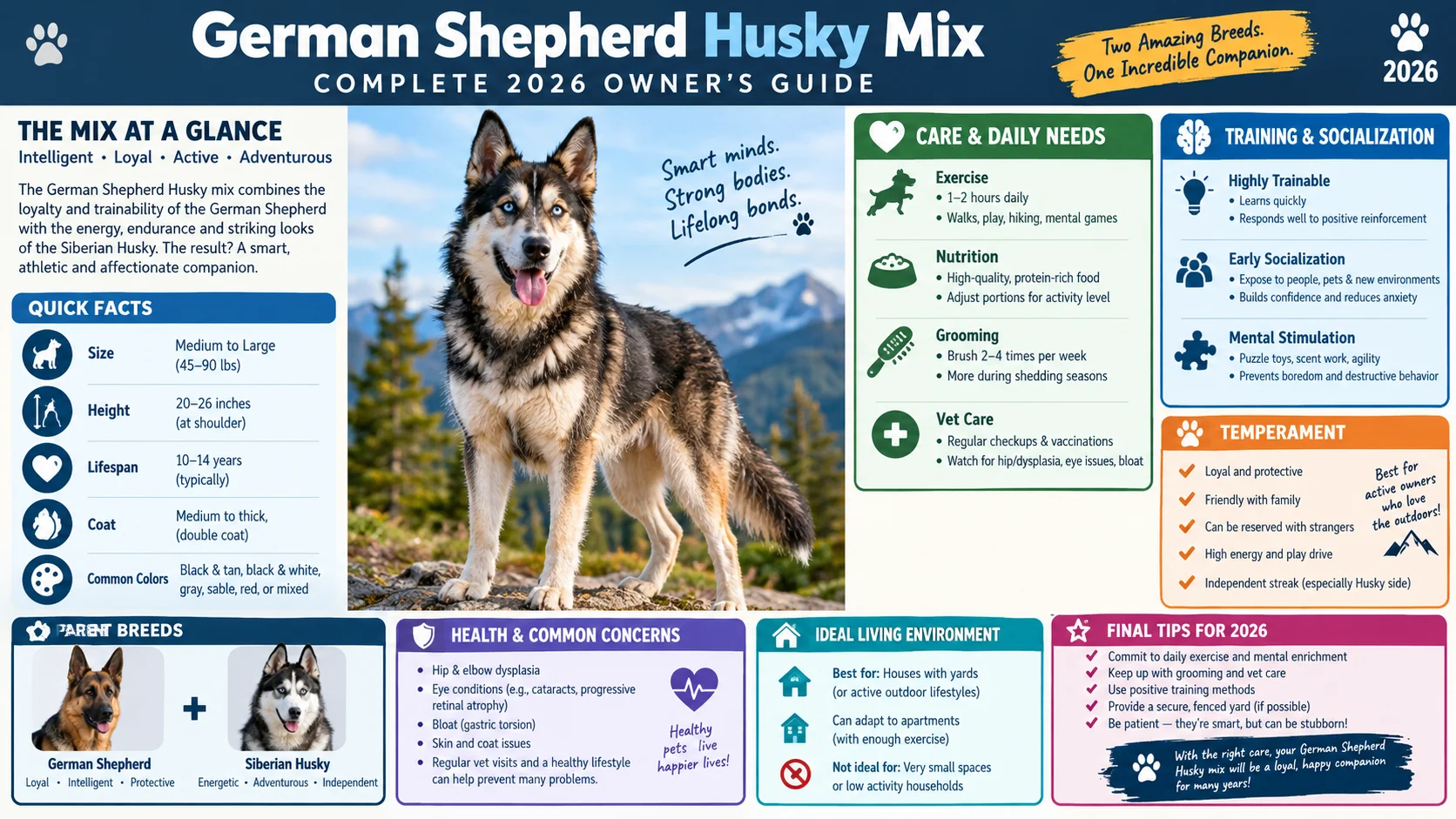
A German Shepherd Husky Mix is a cross between a German Shepherd and Siberian Husky, combining intelligence, loyalty, athleticism, and high energy. Most weigh about 45–90 pounds and need plenty of daily exercise, training, and mental stimulation.
Quick Snapshot
| Category | Details |
|---|---|
| Common Name | German Shepherd Husky Mix |
| Other Name | Gerberian Shepsky |
| Parent Breeds | German Shepherd Dog × Siberian Husky |
| Type | Mixed breed |
| Typical Weight | About 40 to 60+ lbs, with considerable variation |
| Height | Commonly medium to large |
| Lifespan | Variable; often around 10 to 14 years |
| Energy Level | Very high |
| Intelligence | Very high |
| Trainability | High but can be independent |
| Shedding | High |
| Grooming | Moderate to high |
| Temperament | Loyal, alert, playful, independent |
| Exercise | High daily requirement |
| Best Owner | Active, experienced dog owner |
| Apartment Suitability | Challenging without exceptional exercise and management |
Because the Shepsky is a mixed breed without a single breed standard, adult size, appearance, and temperament can vary considerably from one dog to another. PetMD describes the Gerberian Shepsky as a relatively rare crossbreed and notes that puppies can inherit different combinations of traits from their German Shepherd and Siberian Husky parents.
What Is a German Shepherd Husky Mix?
A German Shepherd Husky Mix is the offspring of a German Shepherd Dog and a Siberian Husky.
The mix combines two working breeds with very different histories.
The German Shepherd was developed as an intelligent, versatile working dog with strong trainability and protective instincts. The Siberian Husky was developed for endurance, speed, and pulling loads over long distances.
Put those traits together and you can get a dog that is:
- extremely active
- highly intelligent
- physically athletic
- people oriented
- alert
- independent
- occasionally stubborn
- difficult to tire mentally
That combination is what makes the Shepsky fascinating.
It is also what makes the breed mix a poor choice for someone looking for an easygoing, low maintenance dog.
Why the Shepsky Is So Popular
The appeal is obvious.
A German Shepherd Husky Mix can combine the German Shepherd’s powerful athletic appearance with the Husky’s striking eyes, thick coat, and expressive face.
Some puppies inherit:
- blue eyes
- brown eyes
- one blue and one brown eye
- gray coats
- black and tan markings
- sable coloring
- black and white patterns
- wolf like facial features
But appearance is highly unpredictable.
One puppy may look almost entirely like a German Shepherd while another may strongly resemble a Husky.
Here Is Where Most People Get It Wrong
People often choose a Shepsky because they want the appearance of both parent breeds.
Experienced owners look at something else.
They ask:
Can I handle the combined drive of two working breeds?
That is the more important question.
A beautiful Shepsky with poor impulse control can be much harder to live with than an ordinary looking puppy with stable nerves and a manageable temperament.
German Shepherd Husky Mix Temperament
The temperament of a Shepsky depends heavily on which traits it inherits from each parent.
German Shepherds tend to be intelligent, confident, loyal, and more reserved with unfamiliar people. Siberian Huskies are generally more outgoing and social, with a strong instinct to run and a history of endurance work.
A Shepsky can therefore be:
- affectionate with family
- alert around strangers
- playful
- energetic
- highly observant
- independent
- vocal
- persistent
The Personality Can Change Dramatically During Adolescence
This is one of the most important things potential owners should understand.
A Shepsky puppy may seem easy at 10 weeks old.
Then adolescence arrives.
Between roughly 6 and 18 months, owners may suddenly notice:
- stronger independence
- increased pulling
- selective listening
- greater prey drive
- boundary testing
- increased vocalization
- escape attempts
- frustration when mentally under-stimulated
This does not mean the dog has “turned bad.”
It means the adult instincts are becoming stronger.
The owner now has to provide structure rather than simply affection.
German Shepherd Husky Mix Intelligence
Both parent breeds are highly intelligent working dogs.
That sounds like an advantage.
It is, but there is a catch.
Smart dogs learn good habits quickly.
They also learn bad habits quickly.
A Shepsky that discovers how to open a gate, manipulate an owner, jump a fence, or demand attention can become extremely creative about repeating the behavior.
Training Intelligence vs Obedience
A Shepsky can understand a command without always wanting to perform it.
That distinction is especially important when the Husky side is strong.
The dog may essentially think:
“I know what you want. I am deciding whether it is worth doing.”
This is why reward based training, consistency, and engagement are more useful than endlessly repeating commands.
PetMD specifically recommends early and consistent positive training for Gerberian Shepskies because of their high intelligence and activity requirements.
Training a German Shepherd Husky Mix
Training should begin immediately after bringing the puppy home.
Start With These Skills
Focus first on:
- name recognition
- recall
- loose leash walking
- sit and down
- leave it
- drop it
- place
- impulse control
- calm greetings
- crate training
Use Mental Work, Not Just Physical Exercise
One of the biggest Shepsky mistakes is trying to solve every behavior problem with more running.
That can create an extremely fit dog without teaching the dog how to settle.
Instead, combine:
Exercise + obedience + problem solving + rest
Useful activities include:
- scent work
- food puzzles
- tracking
- obedience
- agility
- hiking
- swimming
- controlled retrieving
These activities are also consistent with the types of exercise and enrichment recommended for the mix by PetMD.
Puppy Development Timeline
A German Shepherd Husky Mix can develop at different rates depending on genetics, nutrition, environment, and parent size.
| Age | Development |
|---|---|
| 8 to 12 Weeks | Socialization, bite inhibition, basic training |
| 3 to 4 Months | Rapid learning and environmental exploration |
| 4 to 6 Months | Teething, coordination and confidence development |
| 6 to 9 Months | Adolescence begins, independence increases |
| 9 to 12 Months | Stronger physical ability and drive |
| 12 to 18 Months | Adult behavior gradually becomes clearer |
| 18 to 24 Months | Better emotional control and physical maturity |
| 2+ Years | Adult temperament becomes more established |
The First 16 Weeks Matter
The early puppy period is particularly important.
PetMD notes that puppies experience a critical development period from birth to around 16 weeks, making appropriate socialization and exposure especially important.
Good socialization does not mean forcing the puppy to meet everyone.
It means teaching the puppy that unfamiliar environments can be handled calmly.
Expose the puppy gradually to:
- different surfaces
- traffic sounds
- household noises
- friendly people
- stable dogs
- grooming
- car rides
- veterinary handling
The goal is confidence, not overstimulation.
Exercise Requirements
This is where prospective owners need to be realistic.
A Shepsky is not a dog that will usually be satisfied with a short bathroom walk.
Both parent breeds have strong working backgrounds, and the Husky in particular was bred for endurance and running. AKC describes Siberian Huskies as active athletic dogs requiring substantial physical and mental exercise, while German Shepherds also need significant daily physical and mental outlets.
A Balanced Adult Routine
A healthy adult Shepsky may benefit from a combination of:
- structured walks
- hiking
- obedience training
- scent games
- controlled running
- retrieving
- puzzle feeding
- supervised play
The exact amount depends on age, health, conditioning, and individual temperament.
Do Not Overexercise Puppies
Young Shepskies are still developing physically.
Do not turn a puppy into a distance runner simply because the adult dog will eventually be athletic.
Instead, use age appropriate play, short training sessions, controlled walks, and plenty of rest.
German Shepherd Husky Mix Size
There is no guaranteed adult size because this is a crossbreed.
PetMD gives a general weight range of approximately 40 to 60 pounds, while individual dogs can fall outside that range depending on their parents and genetics.
The German Shepherd parent itself is substantially larger on average than the Siberian Husky. AKC lists German Shepherd males at 65 to 90 pounds and females at 50 to 70 pounds, while Siberian Husky males are listed at 45 to 60 pounds and females at 35 to 50 pounds.
That explains why two Shepsky puppies from different pairings can mature into noticeably different dogs.
Coat, Shedding and Grooming
Prepare for hair.
Both parent breeds have double coats, and a Shepsky commonly inherits substantial shedding.
You may see:
- moderate daily shedding
- heavier seasonal shedding
- dense undercoat
- frequent loose hair around the house
Grooming Routine
A practical routine includes:
| Task | Frequency |
|---|---|
| Brushing | Several times weekly |
| Heavy shedding periods | More frequent brushing |
| Nail trimming | As needed |
| Ear checks | Weekly |
| Bathing | When necessary |
| Dental care | Regularly |
Do not shave a double coated Shepsky simply because the dog sheds.
The coat serves important protective and insulating functions.
Health and Genetic Considerations
A mixed breed is not automatically free from inherited health problems.
The puppy can inherit health risks associated with either parent breed.
German Shepherds can be affected by hip and elbow dysplasia, degenerative myelopathy, and bloat among other concerns. AKC recommends hip, elbow, and temperament evaluation for German Shepherd breeding stock.
Siberian Huskies have recommended screening that includes hip and ophthalmologist evaluations, along with breed specific genetic testing for certain inherited disorders.
What Buyers Should Ask For
Before purchasing a Shepsky puppy, ask to see health information for both parents.
Look for:
- hip evaluations
- elbow evaluations where appropriate
- eye examinations
- relevant genetic testing
- veterinary records
- vaccination history
- pedigree information
A breeder who talks for an hour about blue eyes but cannot clearly explain parent health testing is giving you the wrong information.
Common Mistakes Shepsky Owners Make
Choosing the Puppy Only for Its Eyes
Blue eyes are attractive, but they do not guarantee:
- good temperament
- health
- trainability
- stable nerves
Underestimating Escape Behavior
The Husky side can bring a powerful desire to explore and run.
Secure fencing is essential.
Never assume a backyard fence is automatically enough.
Exercising Without Teaching Calmness
More activity is not always the answer.
A balanced dog needs to learn:
Go → Work → Relax
Waiting Too Long to Start Training
A 60 pound adolescent Shepsky is much harder to manage than a 12 week old puppy who has already learned basic manners.
Start early.
What Experienced Owners Look For
When evaluating a German Shepherd Husky Mix puppy, appearance should not be the first priority.
Look for:
Stable Nerves
The puppy should be able to investigate unfamiliar things without extreme fear.
Recovery
A brief startle is normal.
The important observation is how quickly the puppy recovers.
Engagement
Does the puppy willingly interact with people?
Appropriate Confidence
You want curiosity without reckless, uncontrolled behavior.
Healthy Structure
Look at:
- movement
- feet
- joints
- topline
- body condition
A pretty face cannot compensate for poor structure or unstable temperament.
Buyer Warning Section
Be Careful With “Rare Shepsky” Marketing
Some sellers charge more for:
- blue eyes
- unusual colors
- fluffy coats
- wolf appearance
- “mini” Shepskies
These features do not automatically indicate a better dog.
There is also no standardized Shepsky breed standard guaranteeing adult appearance or temperament. PetMD specifically notes that this lack of a breed standard makes definitive predictions difficult.
Questions to Ask a Breeder
Before putting down a deposit, ask:
- Can I meet the mother?
- Can I see the father or verified health records?
- What health testing has been completed?
- How are puppies socialized?
- What are the parents like around strangers?
- How much exercise do the parents require?
- What happens if the puppy develops a serious inherited condition?
The breeder’s answers can tell you more than the puppy’s eye color.
Lifestyle Compatibility
| Lifestyle | Compatibility |
|---|---|
| Experienced active owner | Strong |
| Hiking and outdoor lifestyle | Strong |
| Working dog enthusiast | Strong |
| Active family | Often suitable |
| First time owner | Challenging |
| Sedentary household | Poor fit |
| Owner away all day | Challenging |
| Small unsecured yard | Poor fit |
| Apartment with serious exercise commitment | Possible but demanding |
Is a German Shepherd Husky Mix Good With Children?
A well socialized Shepsky can become a loving family companion.
But supervision still matters.
The issue is often not aggression.
It is intensity.
A powerful young dog can accidentally knock over a small child during play.
Teach:
- calm greetings
- no jumping
- controlled play
- leave it
- place
- appropriate boundaries
Children should also learn how to interact respectfully with the dog.
German Shepherd Husky Mix vs German Shepherd vs Husky
| Trait | Shepsky | German Shepherd | Siberian Husky |
|---|---|---|---|
| Intelligence | Very high | Very high | Very high |
| Energy | Very high | High | Very high |
| Independence | Moderate to high | Moderate | High |
| Protective instinct | Variable | Stronger | Generally lower |
| Stranger attitude | Variable | Often reserved | Usually more outgoing |
| Running instinct | High | High | Extremely strong |
| Trainability | High but variable | High | High but independent |
| Shedding | High | High | High |
| Predictability | Lower | Higher | Higher |
The Shepsky sits between two very different personalities, which is exactly why individual puppies can vary so much.
Preparation Checklist
Before bringing home a German Shepherd Husky Mix, make sure you have:
Training
- puppy classes
- crate or safe confinement area
- high value training rewards
- secure leash equipment
Exercise
- daily walking plan
- safe outdoor space
- enrichment toys
- mentally stimulating activities
Home
- secure fencing
- durable toys
- grooming tools
- vacuum cleaner
- safe resting area
Veterinary Care
- vaccination plan
- parasite prevention
- wellness examinations
- discussion of breed related health risks
Frequently Asked Questions
What is a German Shepherd Husky Mix called?
The mix is commonly called a Gerberian Shepsky or simply a Shepsky.
How big does a German Shepherd Husky Mix get?
Size varies considerably. PetMD gives a general range of about 40 to 60 pounds, but individual dogs can be larger or smaller depending on their parents.
Is a Shepsky a good family dog?
A well socialized Shepsky can be an affectionate family companion, particularly in an active household. However, its exercise, training, and management requirements are substantial.
Are German Shepherd Husky Mixes aggressive?
There is no basis for labeling the mix as inherently aggressive. Temperament varies according to genetics, early socialization, training, environment, and the individual dog.
Are Shepskies easy to train?
They are highly intelligent and capable of learning quickly, but Husky independence can make consistent obedience more challenging than owners expect.
Do Shepskies shed?
Yes. Both parent breeds have double coats, so significant shedding should be expected.
Can a Shepsky live in an apartment?
It can be possible with a highly committed owner, but the combination of size, energy, mental stimulation needs, and exercise requirements makes apartment living more demanding.
How much exercise does a Shepsky need?
Most healthy adults need substantial daily physical and mental activity. The exact requirement varies with age, health, conditioning, and individual drive.
Final Thoughts
The German Shepherd Husky Mix is not simply a beautiful combination of two popular dogs.
It is a combination of two working backgrounds, two strong personalities, and two very active genetic packages.
That can produce an exceptional companion for the right owner.
But the most successful Shepsky homes do not focus only on appearance. They focus on early socialization, consistent training, controlled exercise, secure management, health testing, and teaching the dog when it is time to work and when it is time to settle.
The most important question is therefore not “How good does a Shepsky look?”
It is “Can your lifestyle meet the dog’s physical and mental needs for the next 10 or more years?”
That answer should come before choosing the puppy.