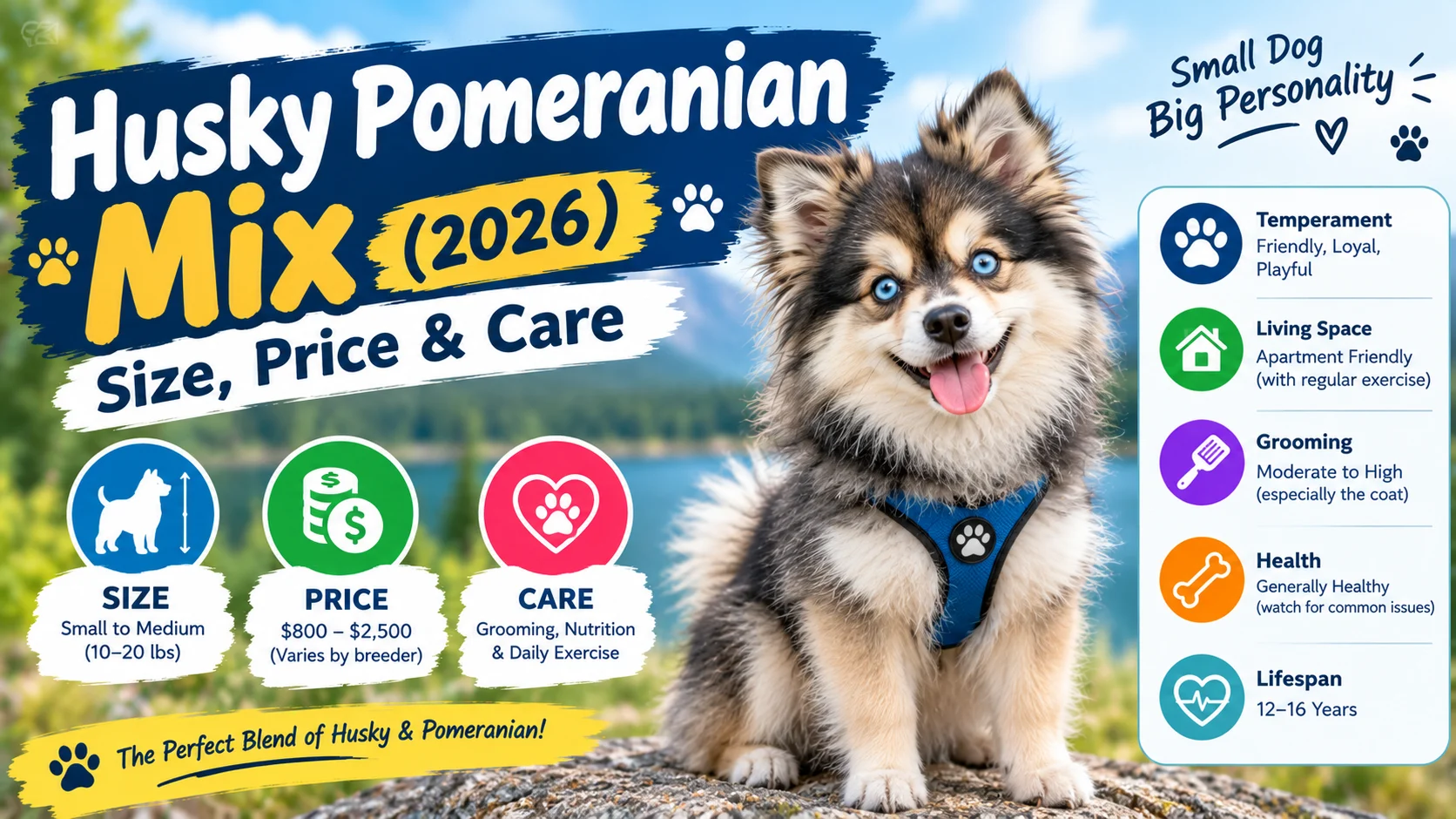
A Husky Pomeranian mix, also called a Pomsky, is a cross between a Siberian Husky and a Pomeranian. In 2026, Pomskies typically weigh around 10–30 pounds, although their adult size varies depending on genetics. They are intelligent, playful, energetic, and affectionate dogs that need regular exercise, consistent training, and frequent coat brushing. Prices vary by breeder, location, and lineage, so check health testing and adoption options before choosing a puppy.
Quick Snapshot Table
| Feature | Details |
|---|---|
| Common Name | Pomsky |
| Parent Breeds | Siberian Husky and Pomeranian |
| Breed Status | Designer crossbreed |
| Adult Weight | Often around 10–30 lbs |
| Adult Height | Approximately 10–15 inches |
| Lifespan | Commonly around 12–15 years |
| Temperament | Playful, intelligent, alert, affectionate |
| Energy Level | Moderate to high |
| Trainability | Intelligent but can be stubborn |
| Coat | Thick, fluffy double coat is common |
| Shedding | Moderate to heavy |
| Grooming | Frequent brushing required |
| Family Compatibility | Good with suitable training and supervision |
| Typical Price | Varies by breeder, location, and lineage |
These are general estimates, not guaranteed breed standards. Because the Pomsky is a crossbreed, adult size, appearance, and temperament can vary considerably.
What Is a Husky Pomeranian Mix?
The Husky Pomeranian mix, widely known as the Pomsky, is a designer dog created by crossing a Siberian Husky with a Pomeranian. It is popular for its fluffy coat, expressive eyes, pointed ears, and combination of playful energy and companion-dog affection.
However, a Pomsky is not simply a miniature Husky. Its adult size, coat, exercise needs, and personality depend on the traits inherited from both parent breeds.
Some Pomskies are compact and cuddly, while others are energetic, vocal, independent, and surprisingly demanding.
The important insight: Never choose a Pomsky based on blue eyes or a wolf-like appearance alone. Health testing, stable temperament, and responsible breeding matter much more.
Why the Pomsky Is So Popular
The Pomsky attracts attention because it can combine the Siberian Husky’s dramatic appearance with the Pomeranian’s smaller size and fluffy coat.
Appearance That Stands Out
Pomskies may have:
• Blue, brown, or differently colored eyes
• Gray and white, black and white, cream, red, or brown coats
• Erect ears and a fox-like facial expression
• A thick double coat and a curled or plume-like tail
Not every puppy inherits blue eyes, Husky markings, or a particularly small body. Even puppies from the same litter can look noticeably different.
A Small Dog With a Big Personality
Many Pomskies are curious, energetic, people-oriented, and alert. They may enjoy games, walks, training sessions, and spending time with their families.
The Husky influence can bring independence and a strong desire to explore. The Pomeranian influence can contribute alertness, vocal behavior, and close attachment to owners.
The result is often an entertaining companion, but not necessarily an easy one.
Husky Pomeranian Mix Size and Appearance
How Big Does a Pomsky Get?
A full grown Husky Pomeranian mix commonly weighs around 12 to 35 pounds, although some dogs fall outside that range. Height and body shape vary according to parental size, generation, and inherited genetics.
| Growth Stage | What to Expect |
|---|---|
| 8 weeks | Small puppy with fluffy fur and developing coordination |
| 3 to 4 months | Noticeable growth in legs, body, and ears |
| 6 months | Increasing height, stronger movement, and changing coat |
| 9 to 12 months | Many dogs approach adult height |
| 12 to 18 months | Body weight and muscle development continue to settle |
Individual development differs, so a puppy’s parents and growth history provide better clues than its appearance at eight weeks.
What Does a Full Grown Pomsky Look Like?


Common features include:
- A wedge-shaped or fox-like face
- Erect triangular ears
- A fluffy double coat
- A plumed tail that may curl over the back
- Blue, brown, amber, or differently colored eyes
- A compact but potentially athletic body
Some resemble miniature Huskies, while others look more like fluffy Pomeranians with longer legs or different facial markings.
Can You Predict Adult Size From the Parents?
Parents provide useful clues, but they cannot guarantee an exact adult size. Ask the breeder for the parents’ measured weights, previous litter records, and growth information for the puppy.
Be cautious when a seller promises a permanently tiny dog without credible evidence. Terms such as “teacup Pomsky” are marketing labels, not reliable guarantees of adult size or health.
Husky Pomeranian Mix Temperament and Personality
The Pomsky combines two intelligent spitz-type dogs, but their personalities can differ substantially.
Intelligence and Trainability
Pomskies can learn commands, routines, and tricks quickly. The challenge is maintaining their attention when something more interesting catches their eye.
A Pomsky may understand “come” perfectly and still choose to investigate a squirrel. This is why consistent reward-based training, recall practice, and secure outdoor management are important.
Barking, Howling, and Vocal Behavior
Some Pomskies inherit the Husky’s howling and vocal communication, while others display the Pomeranian’s tendency to bark at unfamiliar sounds.
Early training can help teach a dog to settle after an alert. Punishing every vocalization is less useful than identifying what triggers it and rewarding calm behavior.
Are Pomskies Affectionate?
Many enjoy close contact with their families and follow their favorite person around the home. However, affection does not mean a dog can comfortably spend every day alone.
Gradually teach your puppy to relax independently. This helps reduce the risk of separation-related distress and excessive barking.
Husky Pomeranian Mix Puppy Development Timeline
Pomsky puppies grow at different rates, particularly when their parents differ considerably in size. Use this timeline as a general guide rather than a strict breed standard.
| Age | Development | Owner’s Priority |
|---|---|---|
| 0 to 4 weeks | Rapid early growth and dependence on the mother | Breeder provides appropriate maternal care |
| 5 to 8 weeks | Play, exploration, and early social learning | Safe environment and positive handling |
| 8 to 12 weeks | Adjustment to a new home and learning household routines | Veterinary visit, gentle socialization, and name recognition |
| 3 to 4 months | Improved coordination, curiosity, and teething | Short training sessions and bite inhibition |
| 4 to 6 months | Growing confidence and changing physical proportions | Recall practice, leash skills, and consistent boundaries |
| 6 to 12 months | Adolescence, increased independence, and changing energy needs | Impulse control and age-appropriate exercise |
| 12 to 18 months | Many dogs approach physical maturity | Maintain training and monitor body condition |
The Most Important Puppy Development Stage
The first months at home are especially valuable for building confidence and healthy habits.
Focus on calm exposure to different surfaces, household noises, friendly people, car journeys, and suitable dogs. Keep experiences positive and manageable rather than forcing interactions.
Because Pomskies may be small, supervise interactions with larger dogs and young children carefully. Prevent jumping from high furniture and rough handling that could injure a small puppy.
Husky Pomeranian Mix Training Guide
Start With Short, Reward-Based Sessions
Pomskies generally benefit from consistent, positive reinforcement. Begin with sessions lasting a few minutes and gradually increase difficulty as the puppy succeeds.
Prioritize these skills:
- Responding to its name
- Coming when called indoors and in secure areas
- Walking on a loose leash
- Settling on a bed or mat
- Waiting calmly before meals
- Accepting grooming and veterinary handling
Manage the Husky’s Independent Side
If your Pomsky ignores a cue, avoid repeating it endlessly. Make the task easier, reduce distractions, and reward the response you want.
Practice recall with a long line in secure areas. A fenced yard is safer than relying on obedience alone, particularly if your dog inherits a strong chasing instinct.
Prevent Excessive Barking and Nipping
Pomeranians can be vocal, while puppies of either parent breed may mouth during play.
Provide appropriate chew toys, reward quiet moments, and redirect biting toward suitable objects. If the puppy becomes overly excited, allow a calm break rather than escalating the interaction.
Husky Pomeranian Mix Exercise Requirements
Pomskies are often energetic companion dogs that need a combination of physical activity and mental enrichment. Their exact exercise requirements depend on age, health, size, and individual temperament.
How Much Exercise Does a Pomsky Need?
Many healthy adults do well with daily walks, play, sniffing opportunities, and short training sessions. Some need considerably more activity than others.
| Activity | Main Benefit |
|---|---|
| Daily walks | Physical activity and environmental exploration |
| Scent games | Mental stimulation |
| Fetch on safe ground | Interactive play |
| Obedience practice | Focus and impulse control |
| Food puzzles | Problem-solving |
| Supervised play | Social learning and coordination |
Puppies need shorter, age-appropriate activity periods with plenty of rest. Avoid forced long-distance running or repetitive high-impact exercise while they are growing.
Can a Pomsky Live in an Apartment?
Yes, provided its needs are met. Apartment living requires particular attention to barking, toilet breaks, exercise, and noise sensitivity.
A home with a yard is convenient but does not replace walks, training, or companionship. Any outdoor area should be secure because some Pomskies are persistent explorers.
Grooming and Shedding
Do Husky Pomeranian Mixes Shed a Lot?
Yes. Many Pomskies inherit a dense double coat and shed regularly, with heavier shedding possible during seasonal coat changes. Coat density varies among individuals.

Recommended Grooming Routine
| Task | Suggested Frequency |
|---|---|
| Brushing | Several times weekly; daily during heavy shedding |
| Coat checks | Weekly |
| Nail trimming | As needed, often every few weeks |
| Ear checks | Weekly |
| Tooth brushing | Ideally daily |
| Bathing | When needed, using dog-safe shampoo |
Brush gently through the undercoat, paying attention to areas behind the ears, under the legs, and around the tail, where tangles can develop.
Do not shave a double-coated Pomsky simply to reduce shedding. Ask a veterinarian or qualified groomer about appropriate coat care if matting or skin problems occur.
Husky Pomeranian Mix Health Issues
A Pomsky can inherit health risks associated with either parent breed. Crossbreeding does not guarantee better health, and because the Pomsky is a relatively recent designer cross, reliable long-term data on its specific disease rates remain limited.
Health Conditions to Discuss With a Veterinarian
| Potential Concern | What Owners Should Know |
|---|---|
| Patellar luxation | The kneecap moves out of its normal position; this is a recognized concern in Pomeranians |
| Eye disorders | Ask about inherited eye conditions in both parent lines |
| Dental disease | Smaller mouths can make dental care particularly important |
| Hip and joint problems | Assess family history and appropriate orthopedic screening |
| Skin and coat disorders | Persistent itching, hair loss, or irritation requires evaluation |
| Obesity | Excess weight increases strain on joints and overall health |
These are potential risks, not a prediction that an individual Pomsky will develop them.
Health Tests to Ask About
A responsible breeder should explain the health screening performed on both parents and provide verifiable results where applicable.
Ask about:
- Patellar evaluations
- Eye examinations
- Hip evaluations when appropriate to the parent lines
- Relevant inherited disease testing
- Family history of significant health problems
A veterinarian can help determine which screening is appropriate for the specific dogs involved.
How Long Does a Husky Pomeranian Mix Live?
A lifespan of approximately 12 to 15 years is commonly cited for Pomskies, although individual dogs may live shorter or longer lives. Genetics, preventive veterinary care, nutrition, dental health, and body condition all influence long-term well-being.
Husky Pomeranian Mix Price in 2026
Pomsky prices vary by location, breeder reputation, parent health testing, lineage, and the demand for particular appearances.
Veterinary-reviewed breed information cites prices around $2,500 to $5,000 in some markets, but this should not be treated as a universal price or a guaranteed current quote.
What Affects the Price?
- Documented health testing of the parents
- Veterinary care and early puppy socialization
- Breeder experience and transparency
- Pedigree and generation
- Location and local demand
Blue eyes, unusual markings, or a very small projected size should not be treated as evidence of superior health or temperament.
Questions to Ask Before Buying
- Can I see health records for both parents?
- What are the parents’ actual adult sizes and temperaments?
- How are the puppies raised and socialized?
- What veterinary examinations and vaccinations have been completed?
- Will you take the dog back if I can no longer care for it?
A breeder who welcomes sensible questions is generally a better starting point than one who pressures buyers to pay a deposit immediately.
Common Mistakes Pomsky Owners Should Avoid
Choosing Appearance Over Temperament
A blue-eyed puppy with Husky markings may look appealing, but appearance cannot tell you whether the dog is confident, healthy, or suitable for your household.
Meet the puppy when possible and ask how it responds to handling, new sounds, and unfamiliar situations.
Assuming Every Pomsky Stays Small
The Husky and Pomeranian differ substantially in size. Their puppies do not all mature into the same compact body type.
Plan for the dog’s likely adult needs rather than purchasing based on a promise of a particular weight.
Underestimating Shedding
A fluffy puppy coat can become a dense adult double coat that requires regular maintenance. Consider your tolerance for loose fur before committing.
Leaving the Dog Alone for Long Periods
Some Pomskies become distressed when separated from their owners. Build independence gradually and seek professional help if persistent barking, destructive behavior, or panic occurs.
Insights Most Pomsky Articles Miss
A Pomsky Is Not a Guaranteed Miniature Husky
The cross can inherit a wide range of physical traits. Even puppies from the same litter can differ in size, coat, and behavior.
Intelligence Does Not Mean Easy Training
A clever dog can learn quickly while remaining independent and easily distracted. Training should focus on cooperation, consistency, and reliable behavior in real situations.
Small Dogs Still Need Serious Enrichment
A compact body does not eliminate the Husky’s potential need to explore, chase, and solve problems. Mental stimulation is essential, not an optional extra.
Crossbreeding Is Not a Health Guarantee
Inherited health conditions can occur in both purebred and mixed breed dogs. A responsible breeder evaluates the health of both parental lines rather than relying on the claim that mixed breeds are automatically healthier.
Is the Husky Pomeranian Mix Right for You?
| Owner Lifestyle | Suitability |
|---|---|
| Active individual or couple | Often a good match |
| Family with older children | Often suitable with supervision |
| First time dog owner | Possible with preparation and training |
| Apartment resident | Suitable if exercise and barking are managed |
| Frequently absent owner | May be challenging |
| Owner wanting a low shedding dog | Usually a poor match |
| Owner wanting a guaranteed tiny dog | Not a reliable choice |
Who Should Consider Another Dog?
Consider a different companion if you cannot provide regular activity, grooming, training, and daily interaction.
A Pomsky can be affectionate and entertaining, but its needs should fit your lifestyle rather than the other way around.
Preparation Checklist Before Bringing a Pomsky Home
Your Pomsky readiness checklist
0 of 9Research both parent breeds and their health risksReview the breeder’s health testing and veterinary recordsPrepare a secure sleeping and resting areaArrange an initial veterinary appointmentBuy a suitable harness, leash, and identification tagPrepare grooming tools and a dog toothbrushPlan daily walks, training, and enrichmentArrange gradual alone time and toilet trainingBudget for routine care and unexpected veterinary expenses
Reset checklist
Frequently Asked Questions
What is a Husky Pomeranian mix called?
It is commonly called a Pomsky, a designer cross between a Siberian Husky and a Pomeranian.
How big does a Husky Pomeranian mix get?
Many adult Pomskies weigh approximately 12 to 35 pounds, but size varies considerably depending on genetics and generation.
Are Pomskies good family dogs?
They can be excellent companions for suitable families. Early socialization, consistent training, supervision around young children, and appropriate exercise are important.
Do Pomskies have blue eyes?
Some do, but others have brown, amber, or differently colored eyes. Blue eyes are not guaranteed, and eye color alone does not establish health or breeding quality.
Are Husky Pomeranian mixes easy to train?
They are intelligent and capable learners, but some inherit independence, vocal behavior, and a strong chasing instinct. Positive reinforcement and consistent practice are important.
Do Pomskies shed heavily?
Many shed moderately to heavily because of their double coats. Regular brushing and additional grooming during seasonal shedding can help manage loose fur.
Are Pomskies recognized by the American Kennel Club?
The Pomsky is not recognized by the American Kennel Club as an established purebred breed. It is a designer crossbreed, so its size and appearance are not governed by a single AKC breed standard.
Can a Husky Pomeranian mix live in a hot climate?
Yes, but owners must manage heat carefully, especially when the dog has a dense double coat. Provide shade, fresh water, good ventilation, and cooler times for exercise. Never leave a dog in a parked vehicle, and contact a veterinarian immediately if heatstroke is suspected.
Is a Pomsky hypoallergenic?
No. Pomskies commonly shed and produce normal dog allergens. They are not a reliable choice for someone seeking a hypoallergenic dog.
Conclusion
The Husky Pomeranian mix combines the striking appearance of a Siberian Husky with the compact, lively character often associated with a Pomeranian. The result can be a loyal, clever, and entertaining companion, but size, temperament, grooming needs, and energy levels are not completely predictable.
Before choosing a Pomsky, prioritize health tested parents, a stable temperament, responsible breeding, and a realistic care plan. Those factors matter much more than blue eyes, fashionable markings, or promises of a permanently miniature dog.
For the right owner, a well cared for Pomsky can be a rewarding family companion for many years. For someone seeking a quiet, low shedding, low maintenance pet, another dog may be a better fit.