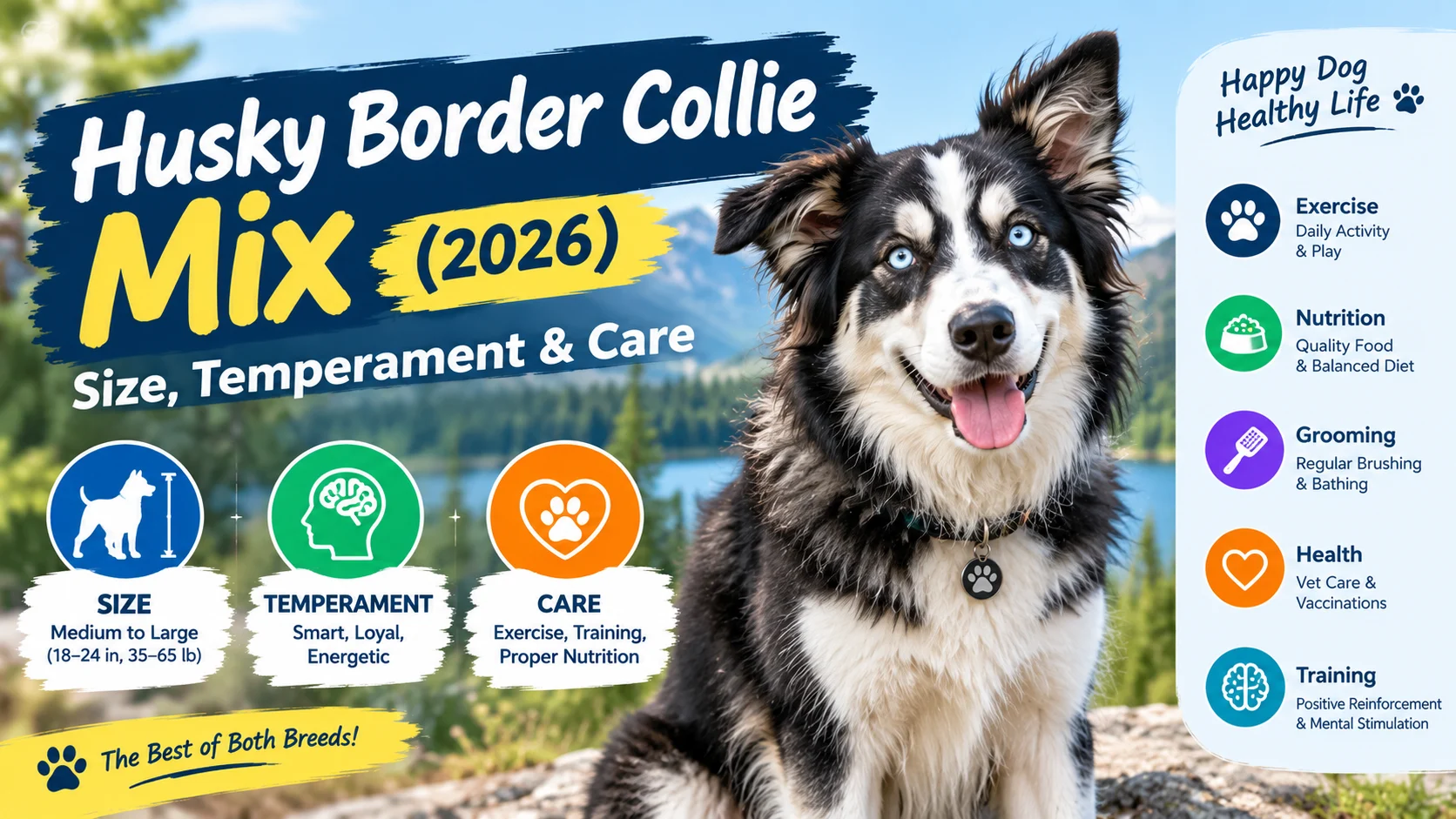
The Husky Border Collie mix is an energetic, intelligent cross between a Siberian Husky and a Border Collie. It typically weighs 30–60 pounds, lives around 12–15 years and needs daily exercise, mental stimulation, and consistent training.
Quick Snapshot Table
| Feature | Details |
|---|---|
| Common Names | Border Husky, Husky Collie mix |
| Parent Breeds | Siberian Husky and Border Collie |
| Type | Mixed breed |
| Adult Weight | Approximately 30 to 60 pounds |
| Adult Height | Approximately 18 to 24 inches |
| Lifespan | Often around 12 to 15 years |
| Energy Level | Very high |
| Intelligence | Very high |
| Coat | Usually medium length, often double coated |
| Shedding | Moderate to heavy, sometimes seasonal |
| Trainability | High, but can be challenging |
| Exercise Needs | Often 1.5 to 2.5 hours of combined daily activity |
| Best For | Active, committed owners |
| Main Challenge | Managing energy, independence, and mental stimulation |
These are general estimates, not guaranteed breed standards. A mixed-breed puppy can inherit very different traits from either parent.
What Makes the Husky Border Collie Mix Special?
The Husky Border Collie mix combines two highly intelligent working breeds, creating a dog that may be athletic, curious, independent, and exceptionally demanding of its owner’s time. Some inherit the Border Collie’s intense focus, while others display more of the Husky’s adventurous and independent nature.
Here is what prospective owners need to understand: intelligence does not automatically make a dog easy to manage. This mix may learn commands quickly yet still struggle with recall, chasing, boredom, or settling down when its daily needs are not met.
What Is a Husky Border Collie Mix?
The Husky Border Collie mix, often called a Border Husky, is a cross between a Siberian Husky and a Border Collie. It is not a separately recognized purebred dog, and its appearance and behavior can vary considerably depending on which parent it resembles.
The Siberian Husky was developed for endurance sled pulling, while the Border Collie was developed for livestock herding. Combining these backgrounds can produce a dog with remarkable stamina, strong instincts, and a constant desire for activity.
What Does This Mix Inherit From Each Parent?

Siberian Husky
Often contributes endurance, independence, vocal behavior, a dense double coat, and an adventurous personality.

Border Collie
Often contributes intense focus, herding instincts, responsiveness to training, athleticism, and sensitivity to movement.
Neither parent determines every trait. Even puppies from the same litter can differ in coat, eye color, confidence, energy, and willingness to follow commands.
Appearance, Size, and Weight
The Border Husky usually develops into a medium sized, athletic dog with a relatively lean body, alert expression, and a coat that may resemble either parent.
Size Chart
| Physical Feature | Typical Estimate |
|---|---|
| Height | 18 to 24 inches |
| Weight | 30 to 60 pounds |
| Build | Lean, muscular, athletic |
| Ears | Erect or semi erect |
| Eyes | Brown, blue, or occasionally different colors |
| Tail | Straight, curved, or bushy |
| Coat | Short to medium or longer, often dense |
| Growth | Usually approaches adult size within 12 to 18 months |
These are approximate mixed breed estimates rather than guaranteed measurements.
Coat Colors and Patterns

Black and white
A common-looking combination influenced by Border Collie coloring.

Gray and white
Often gives the dog a classic Husky-like appearance.

Brown and white
Possible when the parents carry the relevant coat-color genes.

Tri-color or mixed markings
Individual markings vary, even within one litter.
Do All Border Huskies Have Blue Eyes?
No. Blue eyes can come from the Husky parent, but brown eyes are also possible. Some dogs have one blue eye and one brown eye, a condition known as heterochromia.
Blue eyes do not prove that a dog is a purebred Husky or guarantee a particular temperament.
Temperament and Personality
The Husky Border Collie mix is often affectionate, alert, energetic, and quick to learn. However, its personality can be complicated by the combination of herding instincts and independent decision making.
Border Collies are known for intense focus, while Siberian Huskies are known for independence and endurance.
The Personality Traits Owners Should Expect
| Trait | What It Can Mean at Home |
|---|---|
| Intelligence | Learns routines and patterns quickly |
| Loyalty | May form a close bond with family |
| Independence | May ignore a familiar command when distracted |
| Herding instinct | May chase, circle, or nip at moving people |
| Prey drive | May pursue cats, wildlife, or running objects |
| Vocalization | May bark, howl, or make Husky-like sounds |
| Energy | Needs purposeful activity every day |
Are Border Huskies Aggressive?
Aggression is not an inevitable characteristic of this mix. Behavior depends on genetics, early experiences, health, socialization, and training.
However, a dog that is highly aroused, fearful, frustrated, or poorly managed may develop behaviors that owners find difficult to control.
Focus on calm introductions, reward-based training, and safe management rather than assuming that intelligence will automatically produce good behavior.
Are They Good With Children?
They can be good family companions, especially in households where children understand how to interact respectfully with dogs.
The main concern is herding and chasing behavior. A Border Husky may follow running children, circle them, or nip at their heels during excited play.
Always supervise interactions with young children and give the dog a quiet place to rest. A child should never be expected to manage a powerful, overstimulated dog alone.
Training a Husky Border Collie Mix
Training can be rewarding because this mix may learn quickly, but consistency is essential. The Border Collie side may be highly responsive, while the Husky side can introduce independent behavior.
Essential Training Priorities
- Recall training: Teach the dog to return when called, starting in quiet, enclosed spaces. Keep it on a lead or in a secure fenced area when wildlife or other distractions could trigger chasing.
- Loose lead walking: Reward calm walking before pulling becomes an established habit.
- Impulse control: Practice waiting at doors, settling on a mat, and disengaging from moving objects.
- Socialization: Introduce different people, sounds, surfaces, and environments gradually, using positive experiences rather than forced encounters.
- Alone-time training: Build independence gradually to help the dog cope with normal periods without company.
Why Recall Can Be Difficult
A Border Husky may understand the recall command perfectly but choose to pursue a squirrel or investigate an interesting scent instead.
This is not necessarily a lack of intelligence. It can reflect strong motivation and competing instincts.
Use a long training line in suitable open areas, reward voluntary check-ins, and do not rely on off-leash obedience near roads or unsecured wildlife.
Exercise and Mental Stimulation
A Husky Border Collie mix usually needs more than a few short walks. Both parent breeds were developed for demanding physical work, and their offspring may inherit substantial stamina.
How Much Exercise Does It Need?
Many healthy adults may need around 1.5 to 2.5 hours of combined daily activity, adjusted for age, fitness, weather, and individual health. This is a planning estimate, not a fixed prescription for every dog.
| Activity | Why It Helps |
|---|---|
| Brisk walks and hikes | Supports fitness and exploration |
| Scent games | Encourages focused problem solving |
| Obedience sessions | Builds communication and self-control |
| Fetch with rules | Provides structured movement |
| Agility foundations | Develops coordination and teamwork |
| Food puzzles | Adds mental enrichment indoors |
Can Exercise Become Too Much?
Yes. More exercise is not always the answer to every behavioral problem.
Repeated high-intensity activity without teaching calmness may leave a dog physically fit but still unable to settle. Puppies also need age-appropriate movement and adequate rest while their joints develop.
Build a routine that includes both active periods and quiet recovery.
Health and Genetic Considerations
A mixed breed can inherit health risks from either parent. Crossing two breeds does not automatically eliminate inherited conditions.
Health Issues to Discuss With a Veterinarian
| Concern | What Owners Should Know |
|---|---|
| Hip dysplasia | Abnormal hip development can affect mobility |
| Eye disorders | Some inherited eye conditions occur in Border Collies and related lines |
| Epilepsy | Seizure disorders can occur in dogs |
| Joint injuries | High activity can expose existing problems or cause injury |
| Skin and coat issues | Irritation, parasites, or allergies may affect the skin |
| Weight problems | Excess weight places additional stress on joints |
The American Kennel Club identifies hip, eye, and other inherited health screenings as important considerations for Border Collie breeding programs.
What Health Tests Should Breeders Provide?
Ask for relevant veterinary records and documented health testing for both parents. Depending on their pedigrees, this may include:
• Hip evaluations and appropriate joint screening.
• Eye examinations by a qualified veterinary eye specialist.
• Genetic tests recommended for the parent breeds and family lines.
• Veterinary records documenting overall health and vaccination history.
A responsible breeder should explain the results and their significance rather than simply claiming that the puppies are healthy.
Puppy Development Timeline
A Border Husky puppy changes considerably during its first year. Training, socialization, and appropriate rest should progress alongside physical growth.
| Age | Development and Care Priorities |
|---|---|
| 0 to 8 weeks | Early growth, maternal care, and littermate learning |
| 8 to 12 weeks | Gentle socialization, toilet training, and positive introductions |
| 3 to 6 months | Basic cues, bite inhibition, confidence building, and short training sessions |
| 6 to 12 months | Adolescence, increasing strength, impulse control, and consistent boundaries |
| 12 to 18 months | Continued maturity, gradually developed fitness, and advanced training |
| 18 to 24 months | Adult habits become more established, although individual maturity varies |
Grooming and Shedding
Most Border Huskies need regular brushing, and dogs that inherit a dense double coat may shed heavily during seasonal coat changes.
Recommended Grooming Routine
| Task | Suggested Frequency |
|---|---|
| Brushing | Several times a week, more during heavy shedding |
| Nail trimming | As needed to maintain comfortable movement |
| Ear checks | Weekly and after outdoor activities |
| Tooth brushing | Ideally daily |
| Bathing | When dirty or as recommended for the individual coat |
Do not shave a double coat simply to reduce shedding unless a veterinarian recommends clipping for a medical reason. Regular brushing and good skin care are generally better approaches.
Feeding and Nutrition
The right diet depends on age, body condition, activity level, and health. A growing puppy has different nutritional needs from a mature working or companion dog.
Feeding Guidelines
• Choose a complete and balanced food appropriate for the dog’s life stage.
• Measure portions and adjust according to body condition rather than appetite alone.
• Keep fresh water available throughout the day.
• Use training treats strategically and include them in daily calorie intake.
• Discuss growth, weight, and joint health with your veterinarian, especially if the puppy is growing rapidly or participating in strenuous activities.
Common Mistakes Border Husky Owners Make
Assuming Intelligence Means Easy Training
A clever dog can learn undesirable habits just as quickly as desirable ones. Consistent boundaries and reinforcement matter.
Leaving the Dog Unsupervised in an Insecure Yard
Some Huskies are persistent escape artists, while Border Collies may chase moving animals. Use secure fencing, supervise outdoor time, and provide identification.
Ignoring Herding and Chasing
Do not allow repeated chasing of bicycles, cars, children, or other pets. Interrupt safely and redirect the dog toward controlled training activities.
Relying Only on Physical Exercise
Include sniffing, problem solving, calmness training, and rest instead of trying to exhaust the dog every day.
Is the Husky Border Collie Mix Right for You?
This mix may be a wonderful match for people who genuinely enjoy training and outdoor activities. It is less suitable for owners who want a quiet, low-maintenance companion.
| Owner Lifestyle | Suitability |
|---|---|
| Active owner who enjoys daily training | Excellent potential match |
| Experienced dog owner | Often a strong match |
| Family with older, dog-aware children | Potentially suitable with supervision |
| First-time owner willing to learn | Possible, but demanding |
| Sedentary household | Usually a poor match |
| Owner away for long hours every day | Challenging without reliable care |
| Home with small animals | Requires careful assessment and management |
Apartment living is not automatically impossible, but it requires a realistic exercise plan, appropriate enrichment, and management of barking and noise.
Buyer Warning: Choosing a Healthy Puppy
The name “Border Husky” does not guarantee a particular appearance, temperament, or level of health. Be cautious of sellers who promise perfectly blue eyes, exceptional intelligence, a specific adult size, or a guaranteed low-shedding coat.
Questions to Ask a Breeder
• Can I meet the puppy’s mother and see where the puppies are raised?
• What health screening has been completed for both parents?
• How do the parents behave around people, dogs, and unfamiliar situations?
• What early socialization have the puppies experienced?
• What veterinary records, vaccination information, and written contract are provided?
• What support is available if a health or behavior concern develops after adoption?
Consider rescue organizations as well. An adult dog may offer a clearer picture of its size, energy level, and temperament than a young puppy.
Preparation Checklist
Before bringing home a Husky Border Collie mix, make sure you can provide:
Your readiness checklist
0 of 7A secure outdoor area or safe exercise planTime for daily walks and trainingPuzzle toys and scent-based enrichmentA consistent reward-based training routineRegular grooming and veterinary careA plan for alone time and backup careA budget for food, preventive care, and emergencies
Frequently Asked Questions
How big does a Husky Border Collie mix get?
Many adults weigh around 30 to 60 pounds and stand approximately 18 to 24 inches tall. Genetics, sex, and individual development can produce dogs outside these estimates.
Is a Border Husky a good family dog?
It can be, particularly in an active household that provides training, supervision, and appropriate mental stimulation. Herding behavior around children needs to be managed.
Do Husky Border Collie mixes shed a lot?
Many shed moderately to heavily, especially if they inherit the dense double coat of the Husky. Brushing needs vary with coat type and season.
Are they easy to train?
They are often quick learners, but their independence, prey drive, and high energy can make reliable behavior challenging. Reward-based training and consistency are essential.
Can a Husky Border Collie mix live in an apartment?
Potentially, if the owner can meet its activity and enrichment needs and manage barking or howling. Living space alone does not determine success, but a demanding exercise routine is essential.
How long does a Husky Border Collie mix live?
A lifespan of approximately 12 to 15 years is a reasonable estimate often given for this mix, but individual longevity depends on genetics, health, weight, and care.
Are Border Huskies good off leash?
Some can develop strong recall, but reliable off-leash behavior should never be assumed. Prey drive, distractions, and Husky independence make secure areas and lead management important.
Do all Husky Border Collie mixes have blue eyes?
No. Eye color may be brown, blue, or different in each eye. It depends on inherited genetics and cannot be guaranteed by the mix name.
Conclusion
The Husky Border Collie mix can combine impressive intelligence, athletic ability, and a deeply engaging personality. But those same qualities can become difficult to manage without consistent training, daily activity, and thoughtful boundaries.
Before choosing a Border Husky, look beyond blue eyes and striking markings. Evaluate the individual dog’s temperament, the parents’ health, and whether your lifestyle can meet its needs for years to come.
The best match is not necessarily the smartest or most beautiful puppy. It is the dog whose needs and temperament fit the life you can realistically provide.