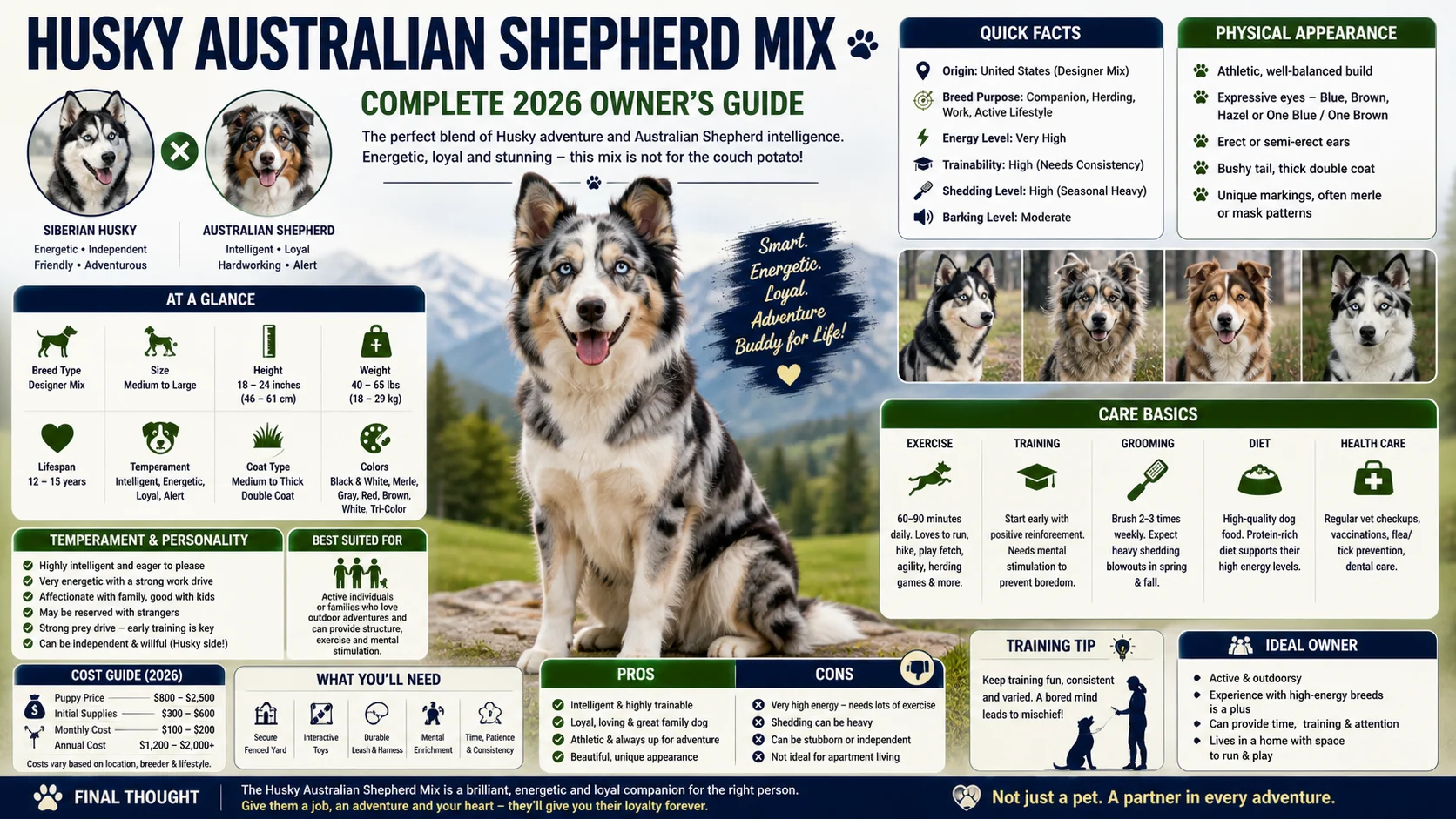
A Husky Australian Shepherd Mix is a high-energy, intelligent hybrid that combines the athletic nature of the Siberian Husky with the herding instincts of the Australian Shepherd. These dogs are usually affectionate, active, and highly trainable but need plenty of daily exercise, mental stimulation, consistent training, and regular grooming. They can make excellent companions for active owners who have enough time for exercise, training, and attention.
Quick Snapshot
| Trait | Husky Australian Shepherd Mix |
|---|---|
| Other Names | Aussie Husky, Australian Shepherd Husky Mix |
| Parent Breeds | Australian Shepherd × Siberian Husky |
| Type | Mixed breed |
| Adult Size | Usually medium to large |
| Approx. Weight | About 40–65+ lbs |
| Height | Roughly 18–24 inches |
| Lifespan | Often around 10–15 years |
| Energy Level | Very high |
| Intelligence | Very high |
| Trainability | High, but can be independent |
| Shedding | High |
| Coat | Medium to long, double coat |
| Exercise | 1.5–2+ hours daily for many adults |
| Social Needs | High |
| Best For | Active, involved owners |
The parent breeds provide a useful starting point: AKC lists Australian Shepherds at 18–23 inches and 40–65 pounds, with a typical lifespan of 12–15 years, while Siberian Huskies are 20–23.5 inches and 35–60 pounds, with a typical lifespan of 12–14 years. A mix can fall outside those ranges, so these numbers should be treated as estimates rather than a breed standard.
What Is a Husky Australian Shepherd Mix?
A Husky Australian Shepherd Mix is a cross between a Siberian Husky and an Australian Shepherd.
It combines two highly active working breeds with very different original jobs.
The Australian Shepherd was developed as an intelligent ranch and herding dog, while the Siberian Husky was developed for endurance and sled work. Both parent breeds are athletic and mentally demanding, which is why this mix can be considerably more challenging than its attractive appearance suggests.
The result can be a dog that is:
- exceptionally energetic
- intelligent and curious
- athletic
- playful
- strongly bonded with its family
- independent at times
- highly alert
- prone to boredom without enough activity
There is no single guaranteed personality for a mixed breed. Genetics can lean strongly toward either parent.
Why This Mix Looks So Different From Dog to Dog
One Husky Australian Shepherd Mix may look predominantly like an Aussie, while another may resemble a Siberian Husky.
Coat and appearance can vary considerably.
Common Physical Features
You may see:
- upright or semi upright ears
- blue, brown, amber, or mixed eye coloration
- a thick double coat
- a bushy tail
- athletic legs
- medium to substantial bone
- facial markings inherited from either parent
Some inherit merle coloring from the Australian Shepherd side, while others may have Husky style facial markings.
Appearance alone cannot tell you which parent’s temperament will dominate.
Husky Australian Shepherd Mix Size
There is no official size standard because this is a mixed breed.
A practical adult estimate is around 40–65 pounds, although some individuals can be smaller or considerably larger depending on their parents.
Size Comparison
| Dog | Typical Male Weight | Typical Female Weight |
|---|---|---|
| Australian Shepherd | 50–65 lbs | 40–55 lbs |
| Siberian Husky | 45–60 lbs | 35–50 lbs |
| Husky Aussie Mix | ~40–65+ lbs | ~35–60+ lbs |
The mix may inherit the Australian Shepherd’s slightly heavier working build or the Siberian Husky’s lighter endurance-oriented structure. The parent breeds themselves have overlapping but different size ranges.
Temperament and Personality
This is where the mix becomes especially interesting.
The Australian Shepherd tends to bring intense herding intelligence and close engagement with its handler. The Siberian Husky contributes endurance, sociability, curiosity, and an independent streak.
Put those traits together and you can get a dog that learns extremely quickly but does not always feel obligated to cooperate.
Typical Personality Traits
| Trait | Likely Expression |
|---|---|
| Intelligence | Very high |
| Energy | Very high |
| Affection | High |
| Independence | Moderate to high |
| Playfulness | High |
| Herding instinct | Moderate to high |
| Prey drive | Moderate to high |
| Stranger friendliness | Variable |
| Trainability | High |
| Escape tendency | Can be significant |
Here is where most people get it wrong: a smart dog is not automatically an easy dog.
This mix may learn a command rapidly and then decide that chasing something across the yard is more interesting.
Are Husky Australian Shepherd Mixes Good Family Dogs?
They can be excellent family companions when their exercise, training, and social needs are properly managed.
However, the household needs to understand what it is taking on.
Australian Shepherds can be highly work-oriented and may attempt to herd moving children, while Siberian Huskies are energetic, social, and strongly motivated to run.
With Children
A well socialized individual can live successfully with children.
However:
- supervise young children
- teach children appropriate dog interaction
- prevent chasing games from becoming a daily habit
- redirect herding behavior
- provide the dog with a quiet resting area
The goal is not simply making the dog “tolerate” children. It is teaching calm behavior around movement and excitement.
Intelligence and Training
The Husky Australian Shepherd Mix can be exceptionally intelligent.
That sounds like an advantage — and it is.
But intelligence also means the dog notices inconsistency.
If one person allows jumping while another forbids it, the dog learns very quickly that household rules are negotiable.
Best Training Strategy
Use:
- short training sessions
- positive reinforcement
- consistent boundaries
- impulse-control exercises
- recall training
- leash skills
- environmental socialization
- puzzle-based learning
Avoid relying on physical punishment or repetitive drilling.
The Husky side can bring independence, while the Australian Shepherd side can bring intense engagement and herding behavior. Training needs to work with both rather than expecting robotic obedience.
Exercise Requirements
This is not a couch dog.
Both parent breeds were developed for physically demanding work. Australian Shepherds are described by AKC as high-energy working dogs requiring substantial daily exercise, while Siberian Huskies were bred for endurance and are also highly active.
A Practical Adult Routine
Many healthy adults will benefit from approximately:
1.5–2+ hours of combined physical and mental activity per day
That does not mean two hours of nonstop running.
A balanced day might include:
| Activity | Purpose |
|---|---|
| Brisk walk | Basic conditioning |
| Hiking | Endurance |
| Obedience | Mental control |
| Fetch | Physical outlet |
| Scent games | Mental fatigue |
| Agility | Coordination |
| Puzzle feeding | Problem solving |
The Exercise Mistake to Avoid
Owners sometimes respond to high energy by simply increasing physical exercise.
That can create an extremely fit dog that still does not know how to relax.
Teach both:
activity + calmness
A good working dog should know when the job starts and when it ends.
Puppy Development Timeline
8–12 Weeks
The puppy begins forming its relationship with people, surroundings, and training.
Focus on:
- gentle socialization
- handling
- name recognition
- crate training
- calm exposure to sounds
- basic recall
3–6 Months
Energy and curiosity increase rapidly.
You may notice:
- chasing behavior
- increased chewing
- stronger play drive
- early herding attempts
- selective listening
Keep training structured but age appropriate.
6–12 Months
This is often the challenging adolescent period.
The puppy may suddenly appear to “forget” training.
That does not necessarily mean the training failed.
Hormonal and behavioral maturity are still developing.
12–24 Months
Adult athletic ability becomes more obvious.
Continue working on:
- recall
- impulse control
- leash manners
- neutrality around distractions
- settling indoors
Mental maturity can take longer than physical maturity.
Coat and Grooming
Expect significant shedding.
Both parent breeds have substantial coats, and the Australian Shepherd has a medium length double coat while the Siberian Husky has a thick double coat with major seasonal shedding.
Grooming Routine
A practical routine includes:
- brushing several times weekly
- more frequent brushing during coat blow
- checking ears
- trimming nails
- checking paws
- occasional bathing when necessary
Do not shave the double coat simply because the dog sheds.
Regular brushing is generally the better approach.
Common Coat Colors
Depending on inheritance, puppies may appear:
- black and white
- red
- red merle
- blue merle
- gray
- sable
- brown
- cream
- mixed markings
Important Merle Genetics Warning
If an Australian Shepherd parent carries the merle gene, breeders need to understand merle inheritance before planning a litter.
Breeding two merle dogs can produce double merle puppies, which are at increased risk of serious eye and hearing abnormalities.
This is one area where responsible genetic planning matters much more than producing an unusual coat pattern.
Health and Genetic Considerations
A mixed breed is not automatically free from inherited disease.
The parent breeds have their own health considerations.
Australian Shepherd Health Testing
The Australian Shepherd Club of America and responsible breeders commonly consider screening for issues involving:
- hips
- elbows
- eyes
- hereditary diseases
Siberian Husky Health Testing
AKC lists recommended health evaluations for Siberian Huskies including hip evaluation, ophthalmologist evaluation, and specific genetic tests for recognized hereditary conditions.
What Buyers Should Ask
Ask the breeder:
- What health testing was performed on both parents?
- Can I see the actual results?
- What are the parents’ temperaments like?
- Are there known hereditary conditions in the pedigree?
- How were the puppies socialized?
- Why were these two dogs bred together?
A breeder who can discuss health and temperament in detail is giving you far more useful information than one who focuses only on eye color or coat pattern.
Common Mistakes Owners Make
Choosing the Puppy Only for Its Eyes
Blue eyes can be striking, but eye color does not determine:
- intelligence
- temperament
- trainability
- health
- working ability
Underestimating the Husky Side
Some owners prepare for an active Australian Shepherd but underestimate the Husky’s independent nature and instinct to run.
Secure fencing and reliable leash habits are important.
AKC specifically notes that Siberian Huskies have a strong desire to run and should be kept on leash, in harness, or in securely fenced areas.
Treating Mental Stimulation as Optional
A long walk may tire the body without satisfying the brain.
Use:
- scent work
- obedience
- trick training
- food puzzles
- controlled problem solving
Insights Most Articles Miss
The Mix Can Be More Complicated Than Either Parent Appears
You are combining two breeds selected for work.
The Australian Shepherd was developed around herding and ranch work, while the Siberian Husky was selected for endurance and sled work.
That combination can create exceptional athleticism but also a demanding ownership experience.
Recall Deserves Special Attention
Huskies have a strong running instinct.
If your puppy inherits that tendency, an unreliable recall can become a genuine safety problem.
Build recall gradually in controlled environments rather than assuming your dog will naturally return when called.
Herding and Chasing Are Different Behaviors
An Aussie influenced puppy may attempt to control movement.
A Husky influenced puppy may chase movement.
Those behaviors can overlap but should be addressed differently during training.
Lifestyle Compatibility
| Lifestyle | What to Expect |
|---|---|
| Active outdoor owner | Strong match |
| Hiking household | Potentially excellent |
| Dog sport enthusiast | Strong potential |
| Large secure yard | Helpful |
| Apartment with committed exercise routine | Possible but demanding |
| Sedentary household | Poor fit |
| Owner away all day | Challenging |
| First time owner | Possible but demanding |
A yard helps, but it is not a substitute for interaction and training.
Australian Shepherds can become destructive when their energy and need for companionship are not properly channeled, while Siberian Huskies are also highly social and are not well suited to being isolated all day.
Buyer Warning Section
Be Careful With “Rare Husky Aussie” Marketing
A breeder may advertise:
- rare blue eyes
- exotic merle
- miniature size
- wolf appearance
- unusual colors
None of those automatically indicates a healthy puppy.
Look Beyond Appearance
Prioritize:
- parent health testing
- stable temperament
- appropriate structure
- transparent pedigree information
- responsible puppy raising
- veterinary records
The best-looking puppy in a litter is not necessarily the best fit for your household.
Preparation Checklist
Before Bringing the Puppy Home
Prepare:
- secure crate
- puppy-safe room
- durable chew toys
- grooming tools
- quality food
- identification
- veterinarian appointment
- secure outdoor area
- training plan
Training Priorities
Start with:
- name recognition
- recall
- loose-leash walking
- crate training
- bite inhibition
- calm settling
- impulse control
- appropriate socialization
Frequently Asked Questions
What is a Husky Australian Shepherd Mix?
It is a mixed breed produced by crossing a Siberian Husky with an Australian Shepherd. It can inherit athleticism, intelligence, endurance, herding instincts, and independence from its parent breeds.
How big does a Husky Australian Shepherd Mix get?
Many fall around 40–65 pounds, but adult size can vary because this is not a standardized breed.
How long do Husky Australian Shepherd Mixes live?
A reasonable expectation is often around 10–15 years, but individual lifespan depends on genetics, health, nutrition, preventive care, and overall lifestyle.
Are Husky Australian Shepherd Mixes aggressive?
Coat type or being a mix does not determine aggression. Temperament varies between individuals and is influenced by genetics, early development, socialization, training, and environment.
Are they good family dogs?
They can be, particularly in active households that can provide exercise, training, companionship, and supervision around children.
Do Husky Australian Shepherd Mixes shed?
Yes. Expect substantial shedding because both parent breeds have double coats.
Are they easy to train?
They can learn extremely quickly, but the Husky side may contribute independence while the Australian Shepherd side can contribute intense work drive. Consistency and engagement are important.
Can they live in an apartment?
Potentially, but apartment living requires significantly more intentional exercise, mental stimulation, training, and management than simply providing access to a yard.
Conclusion
The Husky Australian Shepherd Mix combines two highly capable working backgrounds into one energetic, intelligent, and often visually striking companion.
The attraction is easy to understand.
The commitment is what prospective owners need to understand.
This mix can bring:
- remarkable intelligence
- athletic ability
- strong family attachment
- impressive trainability
- plenty of personality
But it can also bring:
- heavy shedding
- high exercise requirements
- herding behavior
- independence
- escape tendencies
- a serious need for mental stimulation
Experienced owners look beyond the blue eyes, merle coat, or wolf-like appearance. They evaluate the individual dog’s temperament, health, structure, genetics, and ability to fit realistically into the household.
That is ultimately what determines whether this fascinating mix becomes a rewarding companion or an overwhelming responsibility.