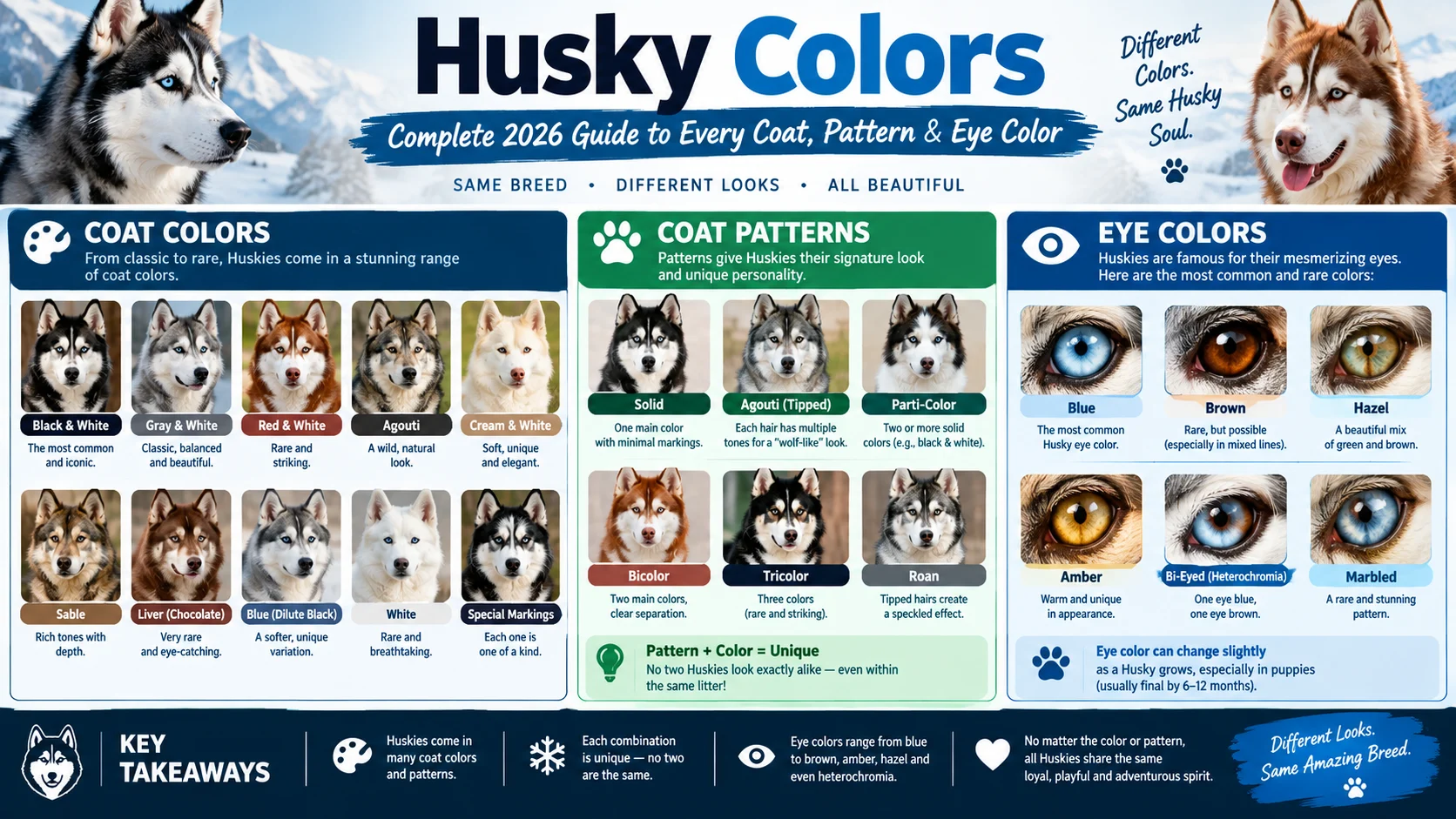
Huskies come in black, gray, agouti, sable, red, and white, with striking variations in markings and eye color.
Quick Snapshot
| Feature | Husky Color Facts |
|---|---|
| Breed | Siberian Husky |
| Coat Type | Medium length double coat |
| Main Recognized Colors | Black, gray, agouti, sable, red, white |
| Coat Pattern | Solid, mixed, facial markings, piebald and other combinations |
| Eye Colors | Blue, brown, amber and combinations |
| Blue Eyes | Common in Siberian Huskies |
| Pure White | Naturally occurring |
| Agouti | Wolf like banded appearance |
| Sable | Layered darker guard hairs with warmer or lighter base tones |
| Merle | Not an allowable Siberian Husky pattern |
| Brindle | Not an allowable Siberian Husky pattern |
| Color & Temperament | Coat color does not determine personality |
| Major Shedding | Yes, especially during seasonal coat blowouts |
The Siberian Husky breed standard recognizes a broad range of colors including black, gray, agouti, sable, red, and white, with solid colors, multiple shades, white markings, and varied symmetrical or asymmetrical patterns possible. The standard specifically states that no allowable color or marking should be preferred over another.
Why Husky Colors Are So Fascinating
Few dog breeds create as much visual variation as the Siberian Husky.
One Husky may be almost completely white. Another may have a dark wolf like agouti coat. Others combine black, gray, copper, red, cream and white into patterns that look completely different from one another.
But there is an important distinction between what a Husky looks like and what its color actually means.
Experienced breeders do not evaluate a Siberian Husky primarily by coat color. Structure, movement, temperament, health and working ability matter considerably more.
The Siberian Husky was developed as an endurance sled dog, and its breed standard emphasizes balance, efficient movement, moderate bone and the ability to work over distance.
What Colors Can Siberian Huskies Be?
Black Husky
Black Huskies can range from strong black areas to coats where black guard hairs are combined with substantial white markings.
The amount of black can vary dramatically between individuals.
A black and white Husky may have:
• Dark facial markings
• Black back and shoulders
• White chest
• White legs
• White underside
• Dark tail
• Distinctive facial mask
This is one of the most recognizable Husky appearances.
Gray Husky
Gray is one of the most visually distinctive Husky colors.
The coat can contain different shades of:
• Light silver gray
• Medium gray
• Dark charcoal gray
• Gray mixed with white
Because individual guard hairs can contain different pigmentation, gray Huskies may look noticeably different under sunlight compared with indoor lighting.
Agouti Husky
Agouti Huskies often have the strongest wolf like appearance.
The coat contains banded hairs with darker pigmentation, particularly across the back and body.
An agouti Husky may appear:
• Charcoal
• Wolf gray
• Brownish gray
• Dark gray
• Almost black from a distance
This appearance can be confused with sable, but the underlying hair pattern and pigment distribution are different.
Red Husky
Red Huskies can range from relatively pale copper to deeper reddish shades.
You may hear owners use terms such as:
• Red
• Copper
• Chocolate red
• Dark copper
These descriptions are often used informally, while official breed standards group the recognized color range under red. The breed standard also specifies liver pigmentation for red dogs.
Sable Husky
Sable Huskies have a layered appearance created by darker pigmentation in the guard hairs over a lighter or warmer base.
Depending on the individual dog, sable may appear:
• Red sable
• Copper sable
• Brownish sable
• Dark sable
This is one of the colors where photographs can be misleading because lighting dramatically changes how the coat appears.
White Husky
Pure white Siberian Huskies are naturally occurring.
A white Husky can have a predominantly white or completely white coat while still retaining normal breed characteristics.
It is important not to automatically confuse a white Husky with an albino dog.
A white Siberian Husky can have normal pigmentation around the nose and eyes. AKC also notes that “Isabella” terminology refers to dilute fawn coloration in some breeds and should not simply be used as another name for every white Husky.
Husky Color Comparison
| Husky Color | Typical Appearance | Common Impression |
|---|---|---|
| Black | Black with possible white areas | Bold, dramatic |
| Gray | Silver to charcoal | Wolf like |
| Agouti | Banded dark hairs | Wild, natural |
| Sable | Layered darker guard hairs | Warm, dimensional |
| Red | Copper to deep red | Striking |
| White | Predominantly white | Clean, bright |
Husky Colors and Patterns
Color and pattern are not exactly the same thing.
A Husky’s base color describes its primary pigmentation, while markings describe how different colors are distributed across the body.
The Siberian Husky standard allows multiple shades and a wide range of symmetrical and asymmetrical markings, including piebald.
Black and White Husky
This is perhaps the classic Husky image people recognize.
The dog may have:
• Black dorsal coat
• White face
• White chest
• White legs
• White belly
Facial markings can vary enormously even among puppies from the same breeding.
Gray and White Husky
Gray and white Huskies often have a softer appearance than black and white dogs.
The gray may range from nearly silver to deep charcoal.
Red and White Husky
Red and white Huskies combine warm red or copper pigmentation with white areas.
Their nose and other pigment points can differ from black based on their underlying pigmentation.
Piebald Husky
Piebald refers to irregular areas of white spotting.
This can create highly individual patterns around:
• Head
• Neck
• Back
• Chest
• Legs
• Tail
Piebald is specifically recognized as one of the varied patterns that can occur in Siberian Huskies.
Husky Color Genetics Explained
Where Does Coat Color Come From?
Dog coat color is controlled by multiple interacting genes rather than a single “Husky color gene.”
Two major pigment systems are involved:
• Eumelanin, responsible for black and brown pigment
• Pheomelanin, responsible for red, yellow and related tones
Different genes influence how these pigments are produced, distributed, diluted or restricted.
The genetics become particularly interesting in Siberian Huskies because their coat patterns can be extremely variable.
Why Two Puppies Can Look Completely Different
Two puppies can have the same parents yet develop noticeably different coats.
Genetic combinations can influence:
• Base pigmentation
• Banding
• White spotting
• Facial markings
• Pigment intensity
• Eye color
That is why predicting the exact adult appearance of a Husky puppy can sometimes be difficult.
Does Color Determine Temperament?
No.
There is no reliable reason to assume a black Husky is calmer than a red Husky or that a white Husky is friendlier than an agouti Husky.
Experienced breeders evaluate temperament independently from appearance.
This matters because buyers sometimes choose puppies based almost entirely on photographs.
That is the wrong priority.
Coat Color Can Change as a Husky Matures
Puppy Coat vs Adult Coat
Husky puppies can change considerably during development.
A puppy may appear:
• Darker than its adult coat
• More gray than expected
• Less red than it eventually becomes
• More heavily masked
• More heavily marked with age
Seasonal shedding can also temporarily change the visual balance of the coat.
Why Photographs Can Be Misleading
Lighting can dramatically affect Husky colors.
Outdoor sunlight may make:
- red look brighter
- gray look lighter
- black look deeper
- white look warmer
Indoor lighting can produce completely different results.
This is one reason experienced breeders prefer evaluating puppies in person or through multiple natural-light photographs.
Husky Eye Colors
Husky eye color is another reason the breed attracts so much attention.
Blue Eyes
Blue eyes are common in Siberian Huskies.
They can range from:
• Pale icy blue
• Medium blue
• Deep blue
Interestingly, the genetic mechanism behind blue eyes in Siberian Huskies is distinct from several mechanisms associated with blue eyes in other breeds. Research discussed by the AKC links the trait to a duplication near the ALX4 gene region.
Brown Eyes
Brown eyes are also normal in Siberian Huskies.
They can appear:
• Light brown
• Amber brown
• Medium brown
• Dark brown
Bi Eyes
Some Huskies have one blue eye and one brown eye.
This is called heterochromia.
It is a well known and naturally occurring feature of the breed.
Parti Colored Eyes
A Husky may also have an eye containing more than one visible color.
This can create a marbled or partially colored appearance.
Importantly, eye color and coat color should not be treated as the same genetic trait.
Rare Husky Colors: What Buyers Should Know
The word rare is heavily used in online Husky advertising.
That does not automatically mean better.
A breeder may describe a puppy as:
• Rare
• Exotic
• Unique
• Special color
• Exclusive
But these marketing terms do not tell you whether the dog has good structure, health or temperament.
The Siberian Husky breed standard itself states that no preference should be given to any allowable color, marking or pattern.
The Real Buyer Question
Instead of asking:
“Is this Husky color rare?”
Ask:
“Is this puppy healthy, structurally sound and temperamentally stable?”
That question tells you much more.
Colors That Should Raise Questions
Merle Husky
Merle is sometimes advertised online as an exotic Husky color.
However, merle is not an allowable Siberian Husky pattern under the AKC breed standard and is listed as a disqualification.
This deserves careful attention when buying a puppy advertised as a “rare merle Husky.”
Brindle Husky
Brindle is also not an allowable Siberian Husky pattern under the AKC standard and is listed as a disqualification.
If someone markets a supposed purebred Siberian Husky primarily around an unusual brindle pattern, ask for pedigree documentation and consider whether another breed may be involved.
Husky Coat Care
Regardless of color, Siberian Huskies have a dense double coat.
The breed standard describes a medium length outer coat supported by a soft, dense undercoat.
Grooming Needs
Expect:
• Regular brushing
• Heavy seasonal shedding
• Undercoat blowouts
• Occasional bathing
• Nail maintenance
• Ear checks
Do not shave a Husky simply because the dog sheds.
Their double coat serves an important protective function.
The breed standard specifically discourages trimming the coat beyond limited areas such as the feet and whiskers.
Puppy Development and Color Changes
8 to 12 Weeks
The puppy coat is still developing.
Facial markings may be strong or soft.
3 to 6 Months
Color transitions can become more obvious.
Dark guard hairs may change the overall appearance.
6 to 12 Months
The adult coat gradually becomes more established.
Some Huskies appear significantly different from their puppy photographs.
12 to 24 Months
The mature coat and adult pigmentation become easier to evaluate.
This is one reason buyers should not assume that an eight week old puppy will retain exactly the same color balance throughout adulthood.
Common Mistakes When Choosing a Husky
Choosing Color Before Temperament
A beautiful coat does not guarantee an easy dog.
Paying Extra Simply for “Rare” Color
Rare does not automatically mean higher quality.
Assuming Blue Eyes Mean Better Genetics
Blue eyes are a normal and recognizable Husky feature, but they do not determine overall health or temperament.
Confusing Color Names With Official Terminology
Terms such as:
- silver
- charcoal
- chocolate
- Isabella
- wolf gray
may be used differently by breeders and sellers.
Always look at the actual dog, pedigree and breed standard rather than relying only on marketing terminology.
Insights Most Husky Color Articles Miss
Color Is Only One Part of the Dog
The Siberian Husky was developed for endurance, efficient movement and moderate loads over long distances.
That original purpose explains why experienced breeders pay close attention to balance and movement rather than simply selecting the most visually dramatic coat.
Facial Markings Are Highly Individual
Even two black and white Huskies can have completely different masks.
Some have:
- broad white faces
- narrow facial stripes
- dramatic spectacles
- asymmetrical markings
This individual variation is part of what makes the breed visually distinctive.
“Rare” Is Not a Health Category
A rare color does not automatically indicate:
- better health
- better temperament
- better pedigree
- higher working ability
The color should be considered separately from those characteristics.
Lifestyle Compatibility
| Owner Preference | Husky Color Should Matter? | What Matters More |
|---|---|---|
| Family companion | No | Temperament |
| Working dog | No | Structure and drive |
| Running partner | No | Fitness and endurance |
| Show prospect | Yes, within standard | Structure and movement |
| First time owner | No | Breed suitability |
| Breeding prospect | Secondary | Health and pedigree |
Preparation Checklist for a Husky Puppy
Before Buying
Check:
☐ Health records
☐ Parent information
☐ Genetic testing where appropriate
☐ Vaccination and parasite records
☐ Pedigree documentation
☐ Temperament of parents
☐ Puppy socialization history
Do Not Buy Solely Because
☐ The color looks rare
☐ The eyes are unusually blue
☐ The puppy looks “wolf like”
☐ The breeder claims the color is exclusive
☐ The price is higher because of appearance
Frequently Asked Questions
What are the main Siberian Husky colors?
The breed standard recognizes black, gray, agouti, sable, red and white, with multiple shades and markings possible.
What is the rarest Husky color?
There is no simple official ranking of the “rarest” acceptable Husky color. Frequency varies among bloodlines and regions, and rarity should not be confused with quality.
What is the most common Husky color?
Black and white and gray and white are among the most familiar Husky appearances, but the breed has substantial variation.
Can Huskies be pure white?
Yes. Pure white Siberian Huskies can occur naturally.
Can Huskies have blue eyes?
Yes. Blue eyes are a well known Siberian Husky trait, and some dogs have one blue eye and one brown eye.
Are red Huskies real?
Yes. Red is an accepted Siberian Husky color under the breed standard.
Are agouti Huskies rare?
Agouti Huskies are less commonly seen than some traditional black and white or gray and white Huskies, but they are a recognized color pattern.
Are merle Huskies purebred?
Merle is not an allowable pattern under the AKC Siberian Husky standard and is listed as a disqualification. A dog marketed as a purebred “merle Husky” therefore deserves careful pedigree and breeding scrutiny.
Does Husky color affect personality?
No reliable evidence supports choosing a Husky’s temperament based simply on coat color. Breeding, genetics, early development, socialization and individual personality are much more relevant.
Do Husky colors change with age?
Yes. Puppy coats can change as the adult coat develops, and seasonal shedding can temporarily alter the dog’s overall appearance.
Conclusion
Siberian Huskies come in an impressive range of colors, from black, gray and agouti to sable, red and pure white. Their facial markings can be equally diverse, while blue eyes, brown eyes and heterochromia add another layer of variation.
But the most important lesson for buyers is simple: choose the dog, not just the color.
A striking coat may catch your attention, but responsible Husky selection should ultimately focus on health, temperament, structure, pedigree and the dog’s ability to fit your lifestyle. The breed standard itself places no preference on one allowable color over another.
That is the difference between buying a beautiful Husky and choosing a well bred, healthy and genuinely suitable companion.










2 thoughts on “Husky Colors | Complete 2026 Guide to Every Coat, Pattern & Eye Color”