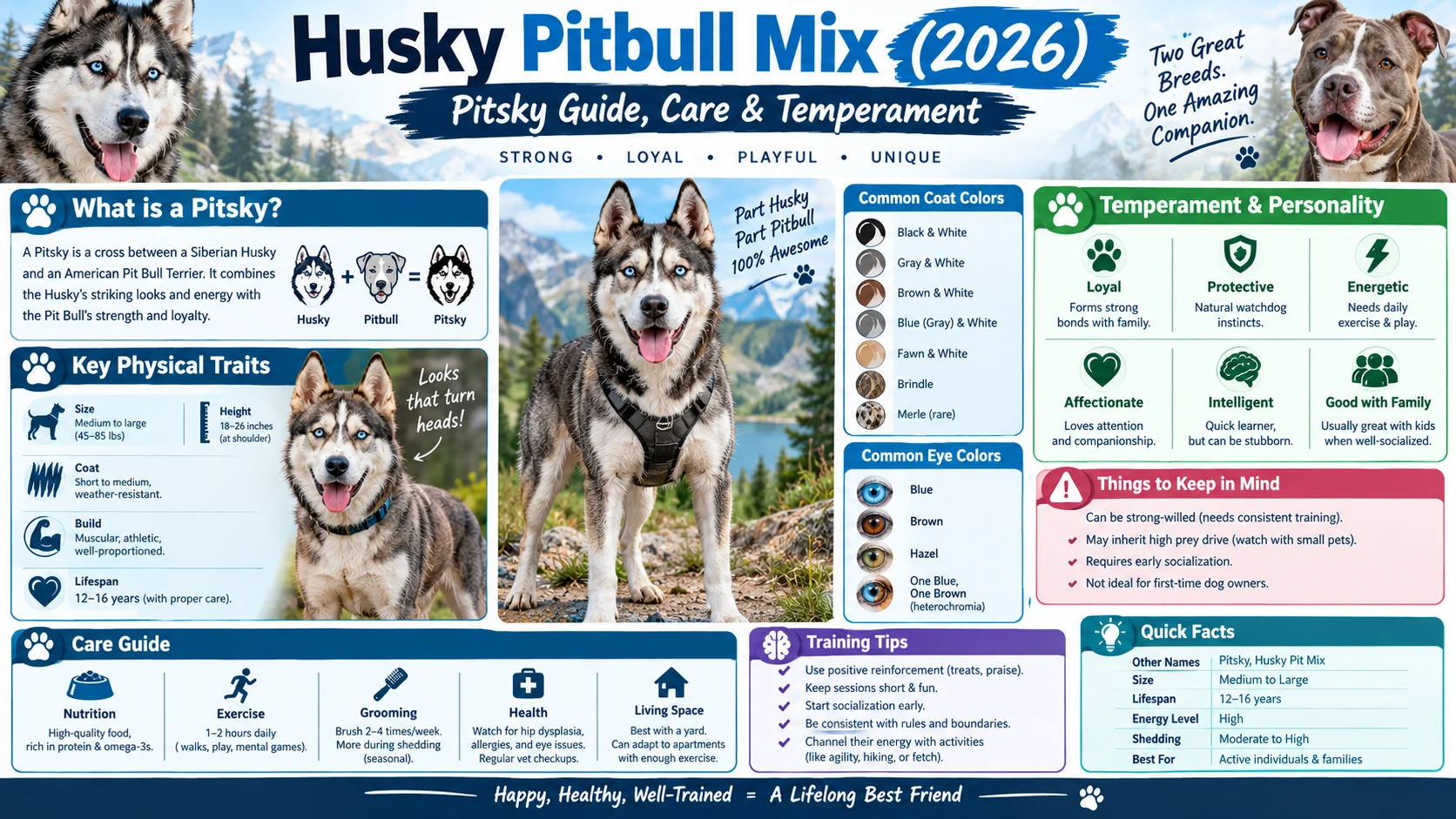
A Husky Pitbull Mix (Pitsky) is an energetic, intelligent, athletic dog that combines Husky endurance with Pit Bull strength and affection.
Quick Snapshot
| Category | Husky Pitbull Mix Details |
|---|---|
| Common Name | Husky Pitbull Mix |
| Nickname | Pitsky |
| Parent Breeds | Siberian Husky × Pit Bull type |
| Breed Type | Mixed breed |
| Height | Approximately 16–25 inches |
| Weight | Approximately 30–80 lbs |
| Lifespan | Around 12–16 years |
| Energy Level | High to very high |
| Intelligence | High |
| Trainability | Moderate to high |
| Coat | Short to dense double coat |
| Shedding | Moderate to heavy |
| Temperament | Playful, energetic, affectionate, independent |
| Exercise Needs | High |
| First Time Owner | Can be challenging |
| Apartment Living | Possible only with substantial exercise |
| Best For | Active, experienced owners |
Because this is a mixed breed without a single universally enforced breed standard, size, coat, appearance, and temperament can vary substantially from one Pitsky to another. Current breed guides commonly place the mix in the medium to large range.
What Is a Husky Pitbull Mix?
The Husky Pitbull Mix is a cross between a Siberian Husky and a Pit Bull type dog, most commonly described as an American Pit Bull Terrier. The mix is also widely called a Pitsky.
It is not a separate standardized breed like the Siberian Husky. Instead, it is a mixed breed whose characteristics can fall anywhere between the two parent breeds.
That distinction matters.
A puppy can inherit:
- the Husky’s endurance
- the Husky’s independence
- the Pit Bull’s muscular build
- the Pit Bull’s strong human attachment
- either parent’s prey drive
- either parent’s coat characteristics
You cannot reliably predict every trait simply by looking at the parents.
The Siberian Husky was developed as an endurance sled dog, while the American Pit Bull Terrier is a strong, athletic, people-oriented breed type. Combining those backgrounds can produce a remarkably energetic companion.
Why the Pitsky Gets So Much Attention
Some Pitskies have the muscular body of a Pit Bull with the facial mask and eyes associated with a Siberian Husky.
Others look almost entirely like one parent.
You may see:
- blue eyes
- brown eyes
- amber eyes
- heterochromia
- Husky facial masks
- broad Pit Bull type heads
- upright ears
- semi-pricked ears
- short coats
- dense double coats
That unpredictability is part of the appeal.
It is also the reason buyers should not choose a puppy based entirely on appearance.
Here Is Where Most People Get It Wrong
A blue-eyed Pitsky is not automatically more valuable.
A muscular Pitsky is not automatically healthier.
And a puppy that looks strongly like a Husky does not necessarily have a Husky temperament.
Genetics influence appearance and behavior separately, and individual puppies can inherit very different combinations of traits.
Husky vs Pitbull: What Each Parent Can Contribute
| Trait | Siberian Husky | Pit Bull Type |
|---|---|---|
| Energy | Very high | High |
| Endurance | Exceptional | High |
| Human Bond | Strong | Often very strong |
| Independence | High | Moderate |
| Trainability | Intelligent but independent | Often eager and responsive |
| Prey Drive | Often high | Can be moderate to high |
| Vocalization | Often high | Variable |
| Body Type | Athletic, lighter framed | Muscular |
| Coat | Dense double coat | Usually short coat |
| Social Behavior | Generally outgoing | Often strongly people oriented |
The Siberian Husky standard emphasizes endurance, balance, and a friendly, outgoing temperament, while Husky owners must also account for the breed’s instinct to run and its need for regular activity.
Appearance and Size
There is no single “correct” Pitsky appearance.
Most are medium to large athletic dogs.
Typical Size
Many sources place adult Pitskies around:
Height: 16–25 inches
Weight: 30–80 pounds
However, these figures are ranges rather than guarantees. A puppy’s eventual size depends heavily on the actual parent dogs and inherited genetics.
Common Physical Features
A Husky Pitbull Mix may have:
- muscular shoulders
- athletic legs
- deep chest
- wedge shaped or broad head
- almond shaped eyes
- upright or semi upright ears
- long or medium muzzle
- thick or narrow tail
- short or medium coat
Some inherit the Husky’s curled or brush-like tail, while others have a more Pit Bull type tail.
Coat Colors and Eye Color
Pitskies can appear in a wide variety of colors.
Common possibilities include:
- black
- white
- gray
- brown
- red
- brindle
- black and white
- brown and white
- red and white
Blue eyes are particularly associated with Husky genetics, but they are not guaranteed.
Some Pitskies have:
- two blue eyes
- one blue and one brown eye
- two brown eyes
- amber eyes
Important Buyer Insight
Eye color should never be used as a substitute for evaluating health, temperament, or structure.
A responsible breeder should be able to discuss the parents’ health and temperament rather than simply advertising unusual eyes or markings.
Temperament and Personality
The Husky Pitbull Mix can be affectionate, athletic, playful, intelligent, stubborn, vocal, and extremely energetic.
That is a lot of dog in one package.
The biggest mistake is assuming that every Pitsky will have the same personality.
Mixed breed genetics do not work that neatly.
Common Temperament Traits
| Trait | What You May See |
|---|---|
| Affection | Strong attachment to family |
| Energy | Very high |
| Playfulness | Very high |
| Intelligence | High |
| Independence | Moderate to high |
| Vocalization | Moderate to high |
| Prey Drive | Can be high |
| Stranger Behavior | Often social, but variable |
| Dog Compatibility | Individual and management dependent |
| Trainability | Good with consistency |
Current breed guides consistently describe Pitskies as energetic and affectionate while emphasizing substantial variation between individual dogs.
The Pitsky’s Most Challenging Trait
It is usually not intelligence.
It is impulse control combined with energy.
A Pitsky may understand what you want and still decide that chasing a squirrel, digging beneath the fence, or wrestling with a toy is more interesting.
That is particularly relevant when Husky independence is combined with the physical strength and determination associated with the Pit Bull side.
The Real Issue Is Management
A well trained Pitsky needs more than basic commands.
Owners should teach:
- reliable leash manners
- impulse control
- recall foundations
- calm settling
- door manners
- polite greetings
- disengagement from distractions
Are Husky Pitbull Mixes Aggressive?
A Pitsky should not be labeled aggressive simply because of its parentage.
Individual temperament depends on genetics, early development, socialization, training, environment, and previous experiences.
However, owners should take prey drive and dog-to-dog behavior seriously.
Some individuals may be:
- highly interested in chasing small animals
- selective around unfamiliar dogs
- reactive when overstimulated
- difficult to control once highly aroused
Responsible ownership means evaluating the individual dog rather than assuming either “all Pitskies are dangerous” or “all Pitskies are automatically friendly.”
Training a Husky Pitbull Mix
Training can be highly rewarding because these dogs are intelligent and physically capable.
But expect negotiation.
The Husky side may contribute independence, while the Pit Bull side may contribute determination and strong physical engagement.
Best Training Strategy
Start with:
- Short training sessions
- High value rewards
- Clear household rules
- Loose leash training
- Recall foundations
- Impulse control
- Calmness exercises
- Gradual distraction exposure
Avoid Endless Repetition
A bored Pitsky can become less cooperative.
Training should be:
- varied
- rewarding
- structured
- mentally challenging
The Siberian Husky responds well to patient, consistent positive training and benefits from activities that keep both body and mind engaged.
Puppy Development Timeline
Pitsky puppies can develop at different rates because they inherit traits from two distinct parent breeds.
Pitsky Puppy Growth Stages
| Age | Development |
|---|---|
| 8–12 Weeks | Bonding, socialization, basic house training |
| 3–4 Months | Rapid learning and environmental exploration |
| 4–6 Months | Teething, confidence changes, increasing energy |
| 6–9 Months | Adolescence begins; independence may increase |
| 9–12 Months | Strength and endurance continue developing |
| 12–18 Months | Adult size becomes clearer |
| 18–24 Months | Physical and behavioral maturity continues |
The Critical Socialization Window
The first months matter enormously.
Puppies should gradually experience:
- different surfaces
- household sounds
- vehicles
- visitors
- grooming
- veterinary handling
- calm dogs
- controlled outdoor environments
Socialization does not mean taking a puppy everywhere and exposing it to chaos.
The goal is controlled confidence.
Exercise Requirements
This is not a breed mix for a sedentary household.
Both parent breeds can bring substantial physical drive.
A mature Pitsky may enjoy:
- hiking
- running
- long walks
- structured fetch
- scent games
- obedience
- agility
- swimming
- supervised pulling activities
Mental Exercise Matters Too
Physical exercise alone is not enough.
A dog can be physically tired and still mentally frustrated.
Include:
- puzzle feeders
- scent searches
- obedience challenges
- controlled tug
- food scatter games
- trick training
One Important Warning
Do not turn every exercise session into maximum intensity.
The goal is a dog that can work hard and settle afterward.
That calm recovery is an important part of a well balanced companion.
Grooming and Shedding
Coat care depends heavily on which parent the Pitsky resembles genetically.
A short coated dog may be relatively easy to maintain.
A dense Husky influenced coat can produce much more shedding.
Grooming Requirements
| Coat Type | Maintenance |
|---|---|
| Short coat | Low to moderate |
| Medium coat | Moderate |
| Dense double coat | Moderate to high |
| Seasonal shedding | Potentially heavy |
Regular brushing helps remove loose hair and keeps the skin and coat in good condition.
Do not shave a double coated Pitsky simply because it sheds.
Health and Genetics
Mixed breeding does not eliminate inherited health problems.
A Pitsky can inherit health risks associated with either parent.
Potential concerns include:
- hip dysplasia
- eye disorders
- allergies
- orthopedic problems
- skin issues
- thyroid disorders
- certain inherited conditions
The exact risk depends on the individual dog’s genetic background.
Health Testing Matters
When buying from a breeder, ask for documentation concerning the parents’ health screening.
Do not accept:
“Mixed breeds are automatically healthier.”
That is too simplistic.
Crossbreeding can change the probability of particular inherited disorders, but it does not make a dog genetically risk free.
Buyer Warning: What Breeders Should Tell You
A responsible breeder should be comfortable discussing:
- parent breed
- parent health history
- genetic testing
- orthopedic screening
- temperament
- puppy socialization
- veterinary records
- vaccination history
- return policy
Red Flags
Be cautious when a seller focuses almost entirely on:
- blue eyes
- rare colors
- giant size
- “wolf look”
- muscular appearance
- designer branding
The real question is:
What kind of dog are the parents when nobody is looking at their appearance?
Temperament and health history tell you considerably more.
Is a Husky Pitbull Mix Good With Children?
Some can be excellent family companions.
But the answer depends on the individual dog.
A Pitsky’s size, strength, excitement level, and play style mean supervision is important around young children.
Children should learn:
- not to disturb the dog while eating
- not to climb on the dog
- not to pull ears or tails
- how to recognize stress signals
- when to give the dog space
Even a friendly dog needs boundaries.
Is a Pitsky Good With Other Dogs?
It varies considerably.
Some Pitskies enjoy canine companionship.
Others may become selective as they mature.
This is particularly important because puppy friendliness does not guarantee adult compatibility.
Owners should monitor:
- play intensity
- body language
- resource guarding
- arousal
- leash reactivity
- same sex interactions
A calm, controlled introduction is more useful than assuming two dogs will automatically become friends.
Can a Husky Pitbull Mix Live in an Apartment?
Possibly, but the home itself is not the deciding factor.
A Pitsky living in a small apartment but receiving appropriate exercise and mental stimulation may cope better than one living in a large house with nothing to do.
The challenges include:
- vocalization
- high activity needs
- boredom
- jumping
- destructive behavior
Secure outdoor access is particularly important because Husky genetics can contribute to strong running and escape tendencies.
Common Mistakes Owners Make
Treating It Like a Couch Dog
A tired Pitsky is generally easier to live with than an under-stimulated one.
Relying Only on Physical Exercise
Mental work is equally important.
Assuming Blue Eyes Mean Husky Temperament
Eye color does not predict personality.
Allowing Uncontrolled Dog Park Play
Socialization should teach appropriate behavior, not simply maximize dog-to-dog exposure.
Ignoring Recall
A Husky influenced dog may be exceptionally interested in running.
Reliable recall takes serious training and should not be assumed.
Insights Most Articles Miss
The Same Litter Can Produce Very Different Dogs
One puppy may look Pit Bull dominant.
Another may look strongly Husky influenced.
A third may sit somewhere between the two.
This variation is normal for a mixed breed.
“Easy to Train” Does Not Mean “Easy to Own”
A clever Pitsky can learn commands quickly while still being difficult to manage.
Intelligence can actually make an independent dog more creative.
Calmness Is a Skill
Many owners concentrate on tiring their dog out.
Experienced handlers also teach the dog how to relax.
That distinction can dramatically change life with a high energy Pitsky.
Step by Step Daily Care Guide
Morning
Start with:
- toilet break
- structured walk
- short obedience session
- breakfast through a puzzle or enrichment feeder
Afternoon
Provide:
- mental stimulation
- supervised play
- training
- controlled social exposure
Evening
Focus on:
- exercise appropriate to age
- calm walking
- grooming
- settling exercises
The exact amount should be adjusted for age, health, weather, and individual temperament.
Feeding and Nutrition
A Pitsky’s nutritional needs depend on:
- age
- body condition
- activity level
- growth stage
- health status
Puppies should receive a complete diet appropriate for growth.
Adults should maintain a lean body condition rather than carrying unnecessary weight.
For athletic dogs, muscle definition can be misleading. A healthy dog should not simply look muscular; its weight should be appropriate for its frame.
Lifestyle Compatibility
| Lifestyle | Pitsky Compatibility |
|---|---|
| Active owner | Excellent |
| Hiking household | Excellent |
| Experienced dog owner | Excellent |
| Family with older children | Often suitable |
| First time owner | Challenging |
| Sedentary household | Poor fit |
| Long workdays away from home | Difficult |
| Small apartment | Possible but demanding |
| Rural property | Good with secure fencing |
| Multiple pets | Individual assessment needed |
Preparation Checklist
Before bringing home a Husky Pitbull Mix, prepare:
Training
☐ Puppy socialization plan
☐ Basic obedience program
☐ Leash training
☐ Recall foundations
☐ Impulse control exercises
Home
☐ Secure fencing
☐ Durable toys
☐ Crate or safe resting area
☐ Food enrichment toys
☐ Grooming equipment
Health
☐ Veterinary appointment
☐ Vaccination records
☐ Parasite prevention
☐ Parent health information if buying from breeder
☐ Emergency veterinary plan
Lifestyle
☐ Daily exercise schedule
☐ Mental stimulation plan
☐ Time for training
☐ Plan for alone time
☐ Long term financial commitment
Frequently Asked Questions
What is a Husky Pitbull Mix called?
The Husky Pitbull Mix is commonly called a Pitsky. It is a mixed breed rather than a standardized purebred.
How big does a Husky Pitbull Mix get?
Many adult Pitskies fall roughly within 30–80 pounds and 16–25 inches, although individual size can vary significantly.
Is a Pitsky a good family dog?
Some Pitskies can be affectionate and excellent family companions, but their energy, strength, and individual temperament require appropriate training, supervision, and exercise.
Are Husky Pitbull Mixes easy to train?
They can learn quickly, but Husky independence can make consistency and impulse control challenging. Positive, structured training usually works better than repetitive or harsh methods.
Do Pitskies shed a lot?
It depends on the coat they inherit. A short Pit Bull type coat may shed moderately, while a dense Husky influenced double coat can shed heavily, particularly during seasonal coat changes.
Are Pitskies aggressive?
There is no responsible basis for labeling the entire mix aggressive. Individual behavior varies. Owners should nevertheless take prey drive, dog compatibility, socialization, and training seriously.
Can a Husky Pitbull Mix have blue eyes?
Yes. Blue eyes can be inherited from the Husky side, although brown, amber, and other eye colors are also possible.
How long does a Husky Pitbull Mix live?
Published breed guides commonly estimate approximately 12–16 years, but actual lifespan depends on genetics, health, nutrition, weight, veterinary care, and lifestyle.
Final Thoughts
The Husky Pitbull Mix is not simply a combination of two attractive breeds. It is a high energy, athletic cross whose personality can vary considerably from one dog to another.
The best Pitsky ownership starts with realistic expectations.
You should be prepared for:
- significant exercise needs
- intelligent problem solving
- possible vocalization
- strong physical ability
- variable dog compatibility
- consistent training
- substantial companionship needs
The most important thing to remember is simple:
Do not buy a Pitsky for the eyes, markings, or muscular appearance alone.
Look at the parents, health history, temperament, early socialization, and the lifestyle the puppy will actually live.
That is where the difference between an attractive dog and a genuinely good long term match begins.