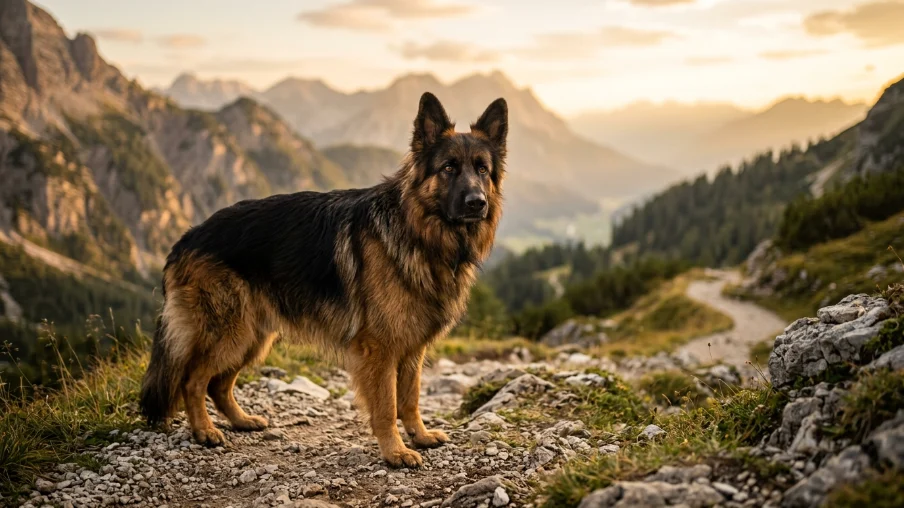
A Long Coat German Shepherd is a purebred German Shepherd that inherits a recessive long-hair gene, resulting in a fuller and more flowing coat. The breed retains the intelligence, trainability, loyalty, and working ability that German Shepherds are known for while requiring additional grooming. Experienced breeders prioritize health, temperament, structure, and working ability far above coat length or appearance.
Quick Snapshot Table
| Category | Details |
|---|---|
| Breed | German Shepherd Dog |
| Coat Type | Long Coat |
| Coat Gene | Recessive Long-Hair Gene |
| AKC Recognition | Purebred German Shepherd |
| FCI Recognition | Recognized as a Long-Haired Variety |
| Size | Large |
| Height | 22–26 Inches |
| Weight | 50–90 Pounds |
| Lifespan | 9–13 Years |
| Intelligence | Extremely High |
| Trainability | Excellent |
| Energy Level | High |
| Family Friendly | Yes |
| Good With Children | Usually |
| Good With Other Dogs | Generally Good When Socialized |
| Stranger Friendly | Moderate |
| Loyalty Level | Exceptional |
| Affection Level | High |
| Protective Instinct | Strong |
| Watchdog Ability | Excellent |
| Guard Dog Ability | Excellent |
| Grooming Needs | Moderate to High |
| Shedding | Heavy |
| Seasonal Shedding | Very Heavy During Coat Blowing Seasons |
| Coat Length | Medium-Long to Long |
| Undercoat | Present in Most Long-Coated Lines |
| Coat Texture | Soft, Dense, and Flowing |
| Drooling | Low |
| Barking Level | Moderate |
| Apartment Friendly | Usually No |
| Exercise Needs | High |
| Daily Exercise Requirement | 60–120 Minutes |
| Mental Stimulation Needs | Very High |
| Prey Drive | Moderate to High |
| Working Ability | Excellent |
| Service Dog Potential | High |
| Search & Rescue Potential | High |
| Police K9 Potential | Moderate to High |
| Therapy Dog Potential | High |
| First-Time Owner Friendly | Sometimes |
| Experience Level | Beginner to Intermediate |
| Socialization Importance | Critical |
| Training Difficulty | Moderate |
| Adaptability | High |
| Climate Preference | Cool to Cold Climates |
| Heat Tolerance | Moderate |
| Cold Tolerance | Excellent |
| Food Consumption | 2.5–5 Cups Daily |
| Common Colors | Black & Tan, Sable, Black, Bi-Color |
| Rare Colors | White, Blue, Liver, Panda, Isabella |
| Eye Color | Brown, Dark Brown, Amber |
| Puppy Price Range | $800–$3,500+ |
| AKC Breed Group | Herding Group |
| Original Purpose | Herding and Livestock Management |
| Modern Roles | Family Companion, Service Dog, Protection Dog, Search & Rescue |
| Common Health Concerns | Hip Dysplasia, Elbow Dysplasia, Degenerative Myelopathy, Bloat, Allergies |
| Health Screening Importance | Extremely High |
| Lifelong Training Need | Moderate to High |
| Escape Artist Potential | Moderate |
| Overall Maintenance Level | High |
| Companion Dog Rating | Excellent |
| Family Protection Rating | Excellent |
| Working Dog Rating | Excellent |
| Best For | Active Families, Working Homes, Experienced Owners |
| Not Ideal For | Sedentary Owners or Low-Activity Households |
| Distinguishing Feature | Long, Feathered Coat Around Ears, Tail, Chest, and Legs |
| Puppy Coat Development | Adult Coat Usually Fully Develops by 18–24 Months |
| Temperament Difference from Standard Coat | No Proven Difference |
| Working Ability Difference | No Proven Difference |
| Overall Suitability | An Intelligent, Loyal, and Beautiful German Shepherd Variant Best Suited for Active Homes |
Why So Many People Are Interested in Long Coat German Shepherds
Few dogs attract attention quite like a Long Coat German Shepherd.
Their flowing fur, wolf-like appearance, and confident posture often make them stand out immediately. Many people discover the variety through photos online and assume the longer coat creates a different breed.
In reality, the Long Coat German Shepherd remains a German Shepherd first and foremost.
The coat changes the appearance.
It does not fundamentally change the dog’s intelligence, drives, trainability, or temperament.
This distinction is important because many first-time buyers focus heavily on appearance while overlooking health, structure, and temperament.
Here is where most people get it wrong.
The coat is one of the least important characteristics when evaluating a German Shepherd puppy.
Experienced breeders focus on health testing, working ability, stable temperament, and sound structure long before considering coat length.
What Is a Long Coat German Shepherd?
Breed Definition
A Long Coat German Shepherd is a purebred German Shepherd Dog that inherits two copies of a recessive gene responsible for producing longer hair.
The longer coat creates feathering around the ears, chest, legs, tail, and neck while maintaining the overall structure and characteristics of the breed.
These dogs remain members of the same breed and share the same ancestry as standard-coated German Shepherds.
Is It a Separate Breed?
No.
A Long Coat German Shepherd is not a separate breed.
The dog remains a German Shepherd Dog regardless of coat length.
Many prospective owners mistakenly assume that long-coated dogs represent a rare variation with different behavioral traits. Scientific evidence and breeder experience do not support this belief.
Temperament is influenced by genetics, socialization, environment, and breeding selection not coat length.
Long Coat vs Standard Coat
| Feature | Long Coat | Standard Coat |
|---|---|---|
| Hair Length | Longer | Medium |
| Feathering | Pronounced | Moderate |
| Grooming Needs | Higher | Moderate |
| Weather Protection | Slightly Reduced in Some Dogs | Excellent |
| Shedding | Heavy | Heavy |
| Temperament | Similar | Similar |
| Intelligence | Similar | Similar |
| Working Ability | Similar | Similar |
Physical Characteristics
Long Coat German Shepherds typically display:
- Feathering behind the ears
- Longer fur on the chest
- Bushier tail
- Fuller neck ruff
- Longer leg furnishings
- Softer coat texture
The overall body structure should still reflect proper German Shepherd conformation.
Appearance alone tells you very little about quality.
A beautiful coat cannot compensate for poor health, weak temperament, or structural faults.
Breed History and Origin
The Development of the German Shepherd
The German Shepherd breed originated in Germany during the late nineteenth century.
The goal was to create a highly versatile working dog capable of herding livestock while remaining intelligent, athletic, trainable, and reliable.
The breed quickly gained recognition for its adaptability and exceptional working ability.
Max von Stephanitz and Breed Standardization
Captain Max von Stephanitz is widely credited as the founder of the modern German Shepherd Dog.
His philosophy remains highly relevant today:
“Utility is the true criterion of beauty.”
This principle emphasized functionality over appearance.
Modern responsible breeders still prioritize health, temperament, nerve strength, and working ability before cosmetic traits.
The Long Coat Gene Through History
Long-coated puppies have existed since the earliest days of the breed.
The trait was never a recent mutation or designer variation.
Instead, it has remained hidden within breeding populations for generations because of recessive inheritance.
As a result, even two standard-coated parents can occasionally produce long-coated puppies if both carry the gene.
Why Long Coat German Shepherds Became Popular
Several factors contributed to their popularity:
- Striking appearance
- Social media exposure
- Increased demand for companion dogs
- Interest in unique coat types
- Growing awareness among breed enthusiasts
Despite their popularity, responsible breeders continue to evaluate puppies based on health and temperament rather than coat length.
Appearance
Overall Structure
A well-bred Long Coat German Shepherd should possess the same structural qualities expected of the breed.
The dog should appear:
- Athletic
- Balanced
- Powerful
- Agile
- Confident
The body should never appear overly heavy, exaggerated, or cumbersome.
Size
Males
| Measurement | Range |
|---|---|
| Height | 24–26 Inches |
| Weight | 65–90 Pounds |
Females
| Measurement | Range |
|---|---|
| Height | 22–24 Inches |
| Weight | 50–70 Pounds |
Individual dogs may vary depending on bloodline and breeding goals.
Head and Expression
The ideal German Shepherd head is strong without appearing coarse.
Key features include:
- Intelligent expression
- Dark almond-shaped eyes
- Moderately broad skull
- Strong muzzle
- Alert ears
Experienced breeders often evaluate expression carefully because it can reveal confidence, attentiveness, and overall breed character.
Coat Characteristics
The defining feature is the coat.
Long Coat German Shepherds typically possess:
- Longer outer hair
- Pronounced neck ruff
- Tail feathering
- Leg furnishings
- Chest feathering
Some individuals have a dense undercoat while others possess a softer coat with reduced undercoat density.
Tail
The tail is often one of the most striking features.
Long Coat German Shepherds frequently develop:
- Fuller feathering
- Longer hair length
- More dramatic appearance during movement
Common Colors
Long Coat German Shepherds can occur in nearly every accepted German Shepherd color pattern.
Common colors include:
- Black and Tan
- Black and Red
- Sable
- Solid Black
- Bi-Color
Less common colors may appear depending on bloodlines.
Responsible breeders evaluate far more than color.
Color alone does not determine quality, temperament, health, or working potential.
Genetics and Color Explanation
Understanding the Long Coat Gene
The long coat trait is inherited through recessive genetics.
For a puppy to develop a long coat, both parents must contribute the long-hair gene.
This inheritance pattern explains why long-coated puppies occasionally appear in litters from standard-coated parents.
Simplified Inheritance Example
| Parent 1 | Parent 2 | Possible Result |
|---|---|---|
| Carrier | Carrier | Long Coat Puppies Possible |
| Long Coat | Long Coat | All Long Coat Puppies |
| Long Coat | Carrier | Mixed Results Possible |
| Standard Non-Carrier | Standard Non-Carrier | No Long Coat Puppies |
Coat Length and Temperament
One of the most persistent myths involves temperament.
Many owners assume long-coated dogs are calmer or friendlier.
Evidence does not support this claim.
Temperament is influenced by:
- Breeding selection
- Genetics
- Socialization
- Environment
- Training
The coat itself does not alter personality.
Coat Length and Health
The long coat gene primarily affects hair growth.
It does not automatically improve or worsen overall health.
The real issue is the quality of the breeding program.
Responsible breeders evaluate:
- Hip health
- Elbow health
- Temperament
- Structural soundness
- Genetic diversity
- Working ability
These factors have a far greater impact on the dog’s future than coat length alone.
Why Responsible Breeders Evaluate More Than Appearance
Experienced breeders focus on something else.
They assess:
- Nerve strength
- Working drives
- Stability
- Health testing
- Conformation
- Longevity within bloodlines
A puppy with excellent health and temperament is far more valuable than one selected solely for a beautiful coat.
The best Long Coat German Shepherds combine appearance with sound genetics, stable temperament, and strong overall health.
Temperament and Personality
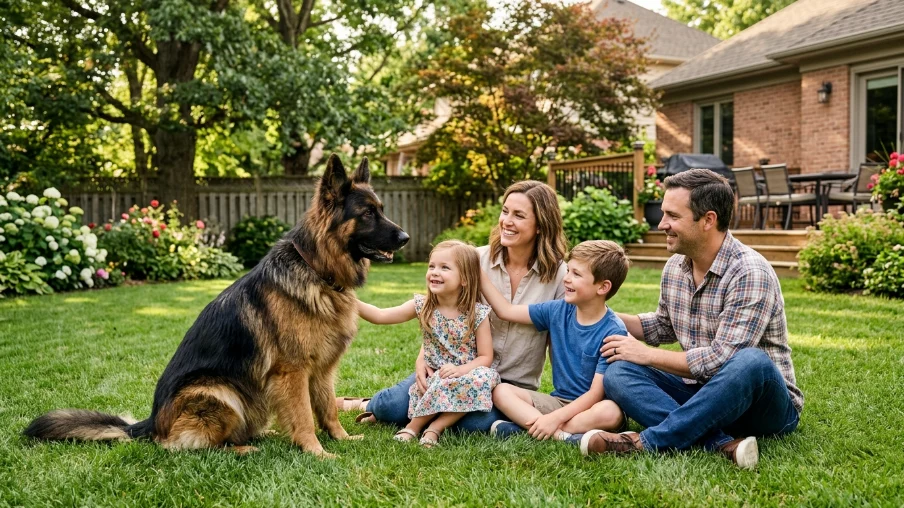
The Long Coat German Shepherd is typically loyal, intelligent, protective, confident, and highly people-oriented. Temperament depends far more on genetics, socialization, and breeding practices than coat length.
Loyalty and Family Bond
German Shepherds are known for forming exceptionally strong bonds with their families.
Many owners describe them as:
- Loyal
- Devoted
- Attentive
- Protective
- Eager to participate in daily activities
Unlike some independent breeds, German Shepherds generally prefer being involved with their people.
This strong attachment often makes them excellent family companions.
Protective Instincts
One of the breed’s defining characteristics is its natural protective tendency.
A properly bred German Shepherd should:
- Observe before reacting
- Remain confident in new situations
- Display controlled protective behavior
- Show stability around neutral strangers
A stable dog should not be excessively fearful or aggressive.
Here is where many people get it wrong.
Protectiveness is not the same thing as aggression.
The ideal German Shepherd is confident, thoughtful, and controlled.
Confidence and Nerve Strength
Experienced breeders often prioritize nerve strength above appearance.
Nerve strength refers to a dog’s ability to remain composed under stress.
A dog with strong nerves typically:
- Handles new environments well
- Recovers quickly from startling events
- Shows resilience during training
- Maintains confidence in unfamiliar situations
Appearance alone tells you very little.
A beautiful dog with weak nerves may struggle as a family companion or working dog.
Social Behavior
Most Long Coat German Shepherds are social with their families but somewhat reserved with strangers.
This reserved nature should not be confused with fearfulness.
A well-socialized German Shepherd generally:
- Accepts visitors calmly
- Observes before engaging
- Remains confident in public
- Displays appropriate manners
Temperament Traits Table
| Trait | Typical Rating |
|---|---|
| Loyalty | Excellent |
| Intelligence | Excellent |
| Trainability | Excellent |
| Protectiveness | High |
| Confidence | High |
| Affection | High |
| Stranger Friendliness | Moderate |
| Energy Level | High |
| Working Drive | High |
Long Coat Temperament Myth
Many online sources claim Long Coat German Shepherds are calmer than standard-coated dogs.
There is little evidence supporting this belief.
Temperament is influenced by:
- Bloodline selection
- Breeding practices
- Socialization
- Training
- Environment
The coat itself does not determine personality.
Intelligence and Trainability
Quick Answer
The Long Coat German Shepherd is one of the most intelligent and trainable dog varieties in the world. Properly motivated individuals can excel in obedience, protection work, scent detection, tracking, service work, and advanced canine sports.
Why German Shepherds Are So Intelligent
German Shepherds consistently rank among the world’s most intelligent working breeds.
Their success stems from a combination of:
- Problem-solving ability
- Learning speed
- Memory retention
- Human cooperation
- Work ethic
These traits explain why the breed remains widely used in professional working roles.
Trainability
Few breeds match the German Shepherd’s ability to learn complex tasks.
They often excel in:
- Obedience training
- Tracking
- Scent work
- Search and rescue
- Protection sports
- Service dog work
Importance of Early Training
Training should begin immediately after bringing a puppy home.
Focus on:
- Basic obedience
- Socialization
- Confidence building
- Environmental exposure
Waiting until adolescence often creates avoidable challenges.
Common Training Mistakes
Many first-time owners make these mistakes:
- Delaying training
- Inconsistent rules
- Overusing punishment
- Insufficient mental stimulation
- Poor socialization
The real issue is consistency.
German Shepherds thrive when expectations remain clear and predictable.
Mental Stimulation Needs
A bored German Shepherd often creates its own entertainment.
This can result in:
- Excessive barking
- Destructive chewing
- Digging
- Fence running
Mental exercise is just as important as physical exercise.
Exercise Requirements
Quick Answer
Long Coat German Shepherds require significant daily exercise and mental stimulation. Most healthy adults need at least 1–2 hours of combined physical activity and structured engagement every day.
Why Exercise Matters
German Shepherds were developed as working dogs.
Their bodies and minds were designed for activity.
Insufficient exercise commonly contributes to behavioral problems.
Daily Exercise Recommendations
| Age Group | Recommended Activity |
|---|---|
| Puppy | Short structured sessions |
| Adolescent | 60–90 Minutes Daily |
| Adult | 1–2 Hours Daily |
| Senior | Moderate activity based on health |
Physical Activities
Excellent exercise options include:
- Hiking
- Running
- Structured walks
- Fetch
- Swimming
- Agility
Mental Activities
Important mental outlets include:
- Puzzle toys
- Scent games
- Obedience sessions
- Tracking exercises
- Advanced training
Apartment Living Considerations
Can a Long Coat German Shepherd live in an apartment?
Sometimes.
The answer depends far more on exercise and management than square footage.
A well-exercised German Shepherd in an apartment may be happier than an under-stimulated dog living on acreage.
Health Problems and Genetic Risks
Long Coat German Shepherds face the same health concerns seen throughout the breed. Responsible breeding, health screening, and proper management significantly influence long-term health outcomes.
Featured Health Testing Table
| Health Screening | Recommended |
|---|---|
| OFA Hips | Yes |
| OFA Elbows | Yes |
| DM Testing | Yes |
| Cardiac Evaluation | Recommended |
| Temperament Assessment | Essential |
| Veterinary Examination | Essential |
Hip Dysplasia
Hip dysplasia remains one of the most recognized orthopedic concerns in German Shepherds.
This condition involves abnormal hip joint development that may contribute to:
- Pain
- Reduced mobility
- Arthritis
Responsible breeders perform hip evaluations before breeding.
Elbow Dysplasia
Elbow dysplasia can affect mobility and athletic performance.
Symptoms may include:
- Front-leg lameness
- Stiffness
- Exercise intolerance
Early diagnosis improves management options.
Degenerative Myelopathy
Degenerative myelopathy is a progressive neurological disease affecting the spinal cord.
Genetic testing can help breeders make informed breeding decisions.
Gastric Dilatation Volvulus (Bloat)
Bloat represents a potentially life-threatening emergency.
Risk factors may include:
- Large meal size
- Rapid eating
- Genetic predisposition
Owners should familiarize themselves with warning signs.
Allergies
Some German Shepherds experience:
- Food sensitivities
- Environmental allergies
- Skin irritation
Management varies by individual case.
The Importance of Health Testing
Responsible breeders typically perform:
- Hip evaluations
- Elbow evaluations
- Genetic testing
- Temperament assessments
Responsible breeders evaluate far more than color.
Health testing remains one of the strongest indicators of breeding quality.
Puppy Development Timeline
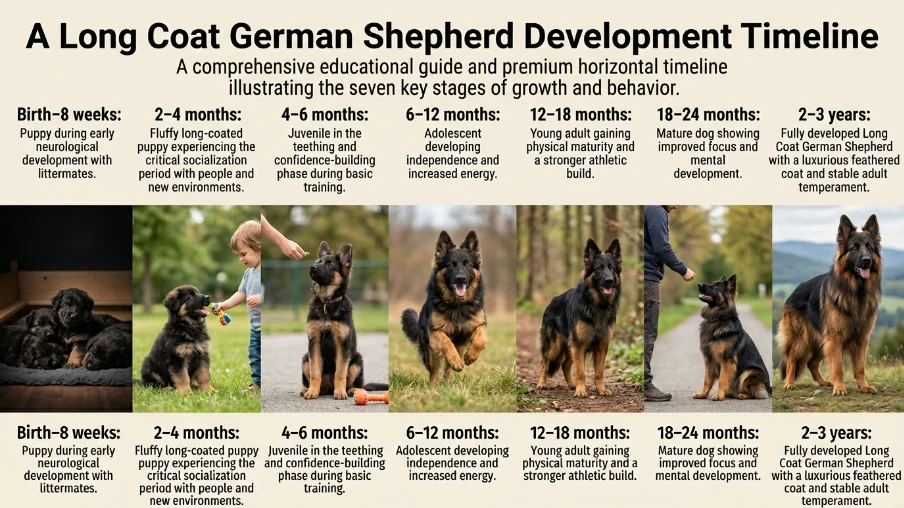
Most Long Coat German Shepherds continue developing physically and mentally until approximately two to three years of age. Understanding developmental stages helps owners set realistic expectations.
Development Timeline Table
| Age | Development Stage |
|---|---|
| Birth–8 Weeks | Early neurological development |
| 2–4 Months | Critical socialization period |
| 4–6 Months | Teething and confidence building |
| 6–12 Months | Adolescence develops |
| 12–18 Months | Physical maturity increases |
| 18–24 Months | Mental maturity improves |
| 2–3 Years | Full adult temperament develops |
Birth–8 Weeks
Key developments include:
- Sensory growth
- Early learning
- Littermate interaction
Breeder management during this period is critical.
2–4 Months
This represents one of the most important developmental windows.
Owners should prioritize:
- Socialization
- Positive experiences
- Basic training
4–6 Months
Common observations include:
- Teething
- Increased curiosity
- Rapid learning
6–12 Months
Adolescence begins.
Many owners experience:
- Selective listening
- Increased independence
- Rising confidence
Consistency becomes extremely important.
12–18 Months
Physical maturity progresses rapidly.
However, mental maturity often lags behind physical development.
18–24 Months
Many German Shepherds become more emotionally stable during this period.
2–3 Years
Most dogs reach full adult temperament.
This is often when owners see the complete picture of the dog’s personality.
Feeding and Nutrition
Quick Answer
A Long Coat German Shepherd requires balanced nutrition that supports growth, muscle maintenance, joint health, and overall condition. Nutritional needs vary based on age, activity level, and health status.
Puppy Nutrition
Growing puppies require:
- High-quality protein
- Balanced calcium and phosphorus
- Controlled growth rates
Rapid growth should not be encouraged.
Adult Nutrition
Adult dogs generally benefit from:
- High-quality protein sources
- Appropriate fat levels
- Weight management
Senior Nutrition
Older dogs may require:
- Joint-support supplements
- Calorie adjustments
- Veterinary guidance
Weight Management
Maintaining a healthy body condition is one of the most important health decisions owners make.
Excess weight increases stress on joints and may worsen orthopedic conditions.
Grooming Guide
Quick Answer
Long Coat German Shepherds require more grooming than standard-coated German Shepherds, though maintenance remains manageable with a consistent routine.
Brushing Schedule
Recommended brushing:
| Coat Condition | Frequency |
|---|---|
| Normal Maintenance | 2–3 Times Weekly |
| Seasonal Shedding | Daily |
| Heavy Coat | Several Times Weekly |
Shedding Expectations
These dogs shed heavily.
Owners should expect:
- Year-round shedding
- Seasonal coat blowouts
- Increased grooming demands
Bathing
Most dogs only require occasional bathing.
Over-bathing may remove natural skin oils.
Nail Care
Nails should be trimmed regularly to prevent:
- Discomfort
- Altered movement
- Structural stress
Ear Care
Routine ear checks help identify:
- Debris
- Irritation
- Early infection
Grooming Tools Checklist
- Slicker brush
- Undercoat rake
- Nail trimmer
- Dog shampoo
- Ear cleaning supplies
- Grooming comb
Consistent maintenance keeps the coat healthy while reducing loose hair throughout the home.
Step-by-Step Care Guide
Quick Answer
Successfully raising a Long Coat German Shepherd requires a combination of structured training, proper socialization, regular grooming, quality nutrition, preventative healthcare, and daily physical and mental exercise.
Many ownership challenges arise not from the breed itself but from inconsistent management.
Step 1: Prioritize Early Socialization
The socialization period between 8 and 16 weeks is one of the most important stages of development.
Expose your puppy to:
- Different people
- Safe dogs
- Various surfaces
- Everyday sounds
- New environments
The goal is not overwhelming exposure.
The goal is positive exposure.
Socialization Checklist
| Experience | Importance |
|---|---|
| Meeting New People | High |
| Car Rides | High |
| Veterinary Visits | High |
| Different Surfaces | High |
| Public Environments | High |
| Other Animals | Moderate to High |
Step 2: Establish Consistent Training
German Shepherds thrive when expectations remain clear.
Focus on:
- Sit
- Down
- Recall
- Leash walking
- Impulse control
Short, consistent sessions typically produce better results than occasional long sessions.
Step 3: Meet Exercise Requirements
Daily activity should include:
- Physical exercise
- Mental stimulation
- Structured engagement
Simply allowing a dog into a backyard rarely satisfies its needs.
Step 4: Maintain Grooming Routine
A regular grooming schedule helps reduce:
- Mats
- Loose hair
- Skin issues
Consistency is far easier than allowing the coat to become neglected.
Step 5: Schedule Preventative Veterinary Care
Preventative care should include:
- Vaccinations
- Parasite prevention
- Routine examinations
- Dental care
Step 6: Monitor Weight and Nutrition
Maintaining proper body condition helps support:
- Joint health
- Mobility
- Longevity
Many owners underestimate how quickly excess weight can accumulate.
Step 7: Continue Training Throughout Life
German Shepherds remain highly trainable well into adulthood.
Ongoing training helps maintain:
- Obedience
- Confidence
- Mental engagement
Common Owner Mistakes
Quick Answer
Most ownership problems develop because people underestimate the breed’s needs. Long Coat German Shepherds are intelligent working dogs, not simply attractive companions.
Mistake #1: Choosing Appearance Over Temperament
This remains one of the most common buyer mistakes.
A beautiful coat cannot compensate for:
- Poor nerves
- Weak temperament
- Aggression
- Anxiety
Experienced breeders focus on something else.
They prioritize health, temperament, and structure.
Mistake #2: Delaying Socialization
Poor socialization can contribute to:
- Fearfulness
- Reactivity
- Confidence issues
The first few months matter tremendously.
Mistake #3: Underestimating Exercise Needs
Many first-time owners assume a daily walk is enough.
For most German Shepherds, it is not.
Mental and physical exercise are both essential.
Mistake #4: Inconsistent Rules
German Shepherds learn quickly.
Unfortunately, they also learn inconsistency quickly.
Mixed expectations often create confusion.
Mistake #5: Purchasing From Unethical Breeders
Warning signs include:
- No health testing
- No pedigree transparency
- Focus on rarity marketing
- Multiple litters available at all times
The real issue is breeding quality, not coat length.
Mistake #6: Ignoring Mental Stimulation
A bored German Shepherd often becomes a creative problem solver.
Unfortunately, owners may not appreciate the solutions.
Insights Most Articles Miss
Quick Answer
Many articles focus heavily on appearance while ignoring the factors that truly influence ownership success: temperament, nerve strength, health testing, bloodlines, and realistic lifestyle compatibility.
Temperament Matters More Than Coat Length
One of the biggest misconceptions is that coat length predicts behavior.
It does not.
Two long-coated puppies from different breeding programs may display dramatically different personalities.
Bloodlines Influence Behavior
Working-line and show-line dogs often differ significantly in:
- Energy level
- Drive
- Training intensity
- Working instincts
The coat tells you very little about these characteristics.
Puppy Temperament Evaluation Matters
Responsible breeders often evaluate:
- Confidence
- Recovery from stress
- Human engagement
- Curiosity
- Environmental stability
These assessments provide valuable insight into future behavior.
Nerve Strength Is Often Overlooked
Many first-time buyers have never heard the term.
Strong nerves help a dog remain:
- Stable
- Confident
- Resilient
Weak nerves can create lifelong challenges.
Social Media Can Create Unrealistic Expectations
Photos often highlight appearance.
They rarely show:
- Grooming requirements
- Training effort
- Exercise demands
- Behavioral management
Ownership involves far more than appearance.
Working Line vs Show Line Long Coat German Shepherd
Quick Answer
Long Coat German Shepherds can come from working lines or show lines. Understanding the difference is essential because bloodline influences behavior, energy level, trainability, and lifestyle compatibility.
Working Line German Shepherds
Working-line dogs are bred primarily for performance.
Common priorities include:
- Drive
- Endurance
- Trainability
- Working ability
These dogs often excel in:
- IGP
- Schutzhund
- Tracking
- Detection work
- Protection sports
Typical Characteristics
| Trait | Working Line |
|---|---|
| Energy Level | Very High |
| Drive | Very High |
| Trainability | Excellent |
| Exercise Needs | High |
| Working Ability | Exceptional |
Show Line German Shepherds
Show lines are generally bred with greater emphasis on conformation and breed standard appearance.
Good breeders still prioritize:
- Temperament
- Health
- Stability
Typical Characteristics
| Trait | Show Line |
|---|---|
| Energy Level | Moderate to High |
| Drive | Moderate |
| Family Compatibility | Excellent |
| Training Ability | Excellent |
| Working Potential | Good |
Which Is Better?
Neither is inherently better.
The better choice depends on your goals.
Active sport enthusiasts may prefer working lines.
Many family owners prefer show lines.
Male vs Female Long Coat German Shepherd
Quick Answer
Male and female Long Coat German Shepherds share many characteristics, but there are often differences in size, maturity, confidence, and social behavior.
Male Long Coat German Shepherd
Common characteristics include:
- Larger size
- Greater muscle mass
- Stronger physical presence
- Slower maturity
Potential Advantages
- Impressive appearance
- Strong working presence
- Often highly affectionate
Potential Challenges
- Larger management requirements
- Increased strength
Female Long Coat German Shepherd
Common characteristics include:
- Smaller size
- Faster maturity
- Slightly easier physical management
Potential Advantages
- More manageable size
- Earlier maturity
- Often easier handling
Potential Challenges
- Heat cycles if not spayed
Male vs Female Comparison
| Feature | Male | Female |
|---|---|---|
| Size | Larger | Smaller |
| Weight | Heavier | Lighter |
| Maturity | Slower | Faster |
| Strength | Greater | Moderate |
| Trainability | Excellent | Excellent |
| Family Suitability | Excellent | Excellent |
Long Coat German Shepherd Living With Other Pets
Quick Answer
Many Long Coat German Shepherds can live successfully with other pets when properly socialized and introduced.
Living With Other Dogs
Most well-socialized individuals coexist well with:
- Family dogs
- Household companions
- Training partners
Early exposure often improves outcomes.
Living With Cats
Success varies.
Factors include:
- Individual temperament
- Prey drive
- Early exposure
Many German Shepherds learn to coexist peacefully with cats.
Small Animals
Owners should exercise caution around:
- Rabbits
- Guinea pigs
- Birds
Some dogs possess stronger prey drive than others.
Multi-Pet Household Tips
- Introduce gradually
- Supervise interactions
- Reward calm behavior
- Avoid forcing interactions
Long Coat German Shepherd Pros and Cons
Quick Answer
Long Coat German Shepherds offer intelligence, loyalty, and versatility, but they also require significant time, training, grooming, and commitment.
Pros
Exceptional Intelligence
Among the most trainable dog breeds in the world.
Strong Family Loyalty
Deep bonds with family members.
Excellent Working Ability
Capable of performing complex tasks.
Versatility
Can excel as:
- Family companion
- Sport dog
- Service dog
- Working dog
Striking Appearance
Their flowing coat creates a beautiful and memorable appearance.
Cons
Heavy Shedding
Owners should expect regular hair throughout the home.
High Exercise Needs
Not suitable for sedentary lifestyles.
Training Commitment
They require consistent guidance.
Potential Health Concerns
Responsible breeding remains critical.
Grooming Requirements
Long coats require more maintenance than standard coats.
Pros and Cons Table
| Pros | Cons |
|---|---|
| Highly Intelligent | Heavy Shedding |
| Loyal Family Companion | High Exercise Needs |
| Excellent Trainability | Grooming Commitment |
| Strong Working Ability | Can Be Demanding |
| Versatile | Requires Consistent Training |
| Protective Instincts | Not Ideal for Every Household |
Final Thought on Ownership
A Long Coat German Shepherd can be an exceptional companion when placed in the right home.
The people who succeed with the breed typically focus on:
- Training
- Structure
- Health
- Socialization
- Consistency
The people who struggle often focus primarily on appearance.
That distinction frequently determines whether ownership becomes rewarding or frustrating.
Price Guide and Ownership Costs
Quick Answer
A Long Coat German Shepherd puppy typically costs between $1,000 and $4,000 from a reputable breeder. However, the purchase price is only a small portion of total ownership expenses.
Many first-time buyers focus entirely on puppy price while overlooking long-term costs.
The real issue is lifetime ownership expense, not initial purchase price.
Long Coat German Shepherd Puppy Price
Several factors influence pricing:
- Health testing
- Pedigree quality
- Bloodlines
- Geographic location
- Breeder reputation
- Working or show lineage
Typical Puppy Price Range
| Source | Typical Price |
|---|---|
| Backyard Breeder | $300–$1,000 |
| Reputable Breeder | $1,000–$4,000 |
| Elite Working Lines | $3,000–$6,000+ |
| Imported Bloodlines | $4,000–$10,000+ |
A higher price does not automatically indicate quality.
Responsible breeders provide documentation supporting their breeding decisions.
First-Year Ownership Costs
Initial Setup Expenses
| Item | Estimated Cost |
|---|---|
| Puppy Purchase | $1,000–$4,000 |
| Crate | $75–$250 |
| Bed | $50–$200 |
| Collar and Leash | $25–$100 |
| Food Supplies | $100–$300 |
| Toys | $50–$200 |
| Veterinary Exams | $200–$800 |
| Vaccinations | $100–$400 |
Estimated First-Year Total
Most owners spend:
$2,500–$8,000+
during the first year.
Monthly Cost Breakdown
Typical Monthly Expenses
| Expense | Monthly Estimate |
|---|---|
| Food | $50–$150 |
| Preventatives | $20–$60 |
| Insurance | $30–$100 |
| Grooming Supplies | $10–$40 |
| Training | Variable |
| Toys and Enrichment | $10–$50 |
Annual Ownership Costs
| Expense Category | Annual Estimate |
|---|---|
| Food | $600–$1,800 |
| Veterinary Care | $300–$1,500 |
| Insurance | $360–$1,200 |
| Training | $200–$2,000+ |
| Grooming Supplies | $100–$500 |
Lifetime Cost Estimate
Over a lifespan of 9–13 years, ownership costs can easily exceed:
$15,000–$40,000+
depending on healthcare, training, and lifestyle choices.
How to Find a Reputable Breeder
Quick Answer
A reputable breeder prioritizes health, temperament, structure, and breed preservation. They do not rely on rarity marketing, color marketing, or emotional sales tactics.
What Responsible Breeders Prioritize
Experienced breeders focus on:
- Health testing
- Stable temperament
- Sound structure
- Breed standard preservation
- Genetic diversity
- Working ability
Appearance alone tells you very little.
Health Testing Expectations
At minimum, responsible breeders often evaluate:
| Test | Importance |
|---|---|
| Hip Evaluation | Essential |
| Elbow Evaluation | Essential |
| DM Testing | Recommended |
| Veterinary Screening | Essential |
| Temperament Assessment | Essential |
Signs of a Quality Breeder
Look for breeders who:
- Answer questions openly
- Discuss weaknesses honestly
- Provide health documentation
- Explain pedigree choices
- Screen potential buyers
- Offer lifetime support
Good Breeders Ask Questions
A breeder who asks many questions is often a positive sign.
They may ask about:
- Lifestyle
- Experience level
- Training plans
- Living arrangements
Responsible placement matters.
Questions a Breeder Should Be Able to Answer
- Why was this breeding performed?
- What health testing was completed?
- What temperament traits are expected?
- What weaknesses exist in the bloodline?
- How are puppies socialized?
Questions to Ask Before Buying
Quick Answer
The quality of your questions often determines the quality of your purchase decision.
Essential Questions
Health Questions
- Are both parents health tested?
- Can I see the results?
- Have previous offspring experienced health issues?
Temperament Questions
- How would you describe the parents?
- Have temperament evaluations been performed?
- What drives are common in this bloodline?
Puppy Development Questions
- How are puppies socialized?
- What environments are they exposed to?
- How do you evaluate temperament?
Breeder Support Questions
- Do you offer ongoing guidance?
- What happens if I cannot keep the dog?
- Is there a health guarantee?
Lifestyle Questions
Ask yourself:
- Can I provide daily exercise?
- Can I commit to training?
- Am I prepared for shedding?
- Can I afford veterinary care?
Buyer Warning Section
Quick Answer
Some sellers market Long Coat German Shepherds as rare luxury dogs while ignoring health and temperament. Buyers should approach such claims cautiously.
Red Flags to Avoid
No Health Testing
This is one of the most significant warning signs.
Rare Color Marketing
Some advertisements focus heavily on:
- Rare coats
- Rare colors
- Unique appearance
Responsible breeders focus on health first.
Multiple Litters Available Constantly
High-volume production may indicate profit-driven breeding.
No Questions for Buyers
Ethical breeders care where their puppies go.
Extremely Low Prices
While bargains exist, unusually low prices may indicate:
- Lack of testing
- Poor socialization
- Poor breeding practices
Guarantees That Sound Too Good
No breeder can guarantee:
- Perfect health
- Perfect temperament
- Show quality outcomes
Be cautious of unrealistic promises.
Rescue and Adoption Guide
Quick Answer
Adoption can be an excellent option for people interested in Long Coat German Shepherds. Many wonderful dogs enter rescue systems through no fault of their own.
Benefits of Adoption
Potential advantages include:
- Lower initial cost
- Adult temperament visibility
- Helping a dog in need
Things to Consider
Rescue dogs may come with unknown histories.
Potential challenges include:
- Training gaps
- Behavioral concerns
- Limited pedigree information
Adoption Evaluation Checklist
Before adopting:
- Meet the dog multiple times
- Observe temperament
- Evaluate energy level
- Discuss known history
- Review veterinary records
Who Should Consider Rescue?
Rescue may be ideal for:
- Experienced owners
- Families seeking adults
- People willing to invest in training
Lifestyle Compatibility

Quick Answer
Long Coat German Shepherds thrive in active homes that provide structure, training, and engagement. They are not ideal for every lifestyle.
Compatibility Table
| Lifestyle Factor | Suitable? | Notes |
|---|---|---|
| Families | Yes | Excellent when trained |
| Children | Usually | Supervision recommended |
| Apartments | Sometimes | Requires significant exercise |
| Active Owners | Excellent | Strong match |
| Working Homes | Excellent | Ideal environment |
| First-Time Owners | Moderate | Commitment required |
| Seniors | Variable | Depends on activity level |
| Multi-Pet Homes | Usually | Early socialization helps |
Best Owner Profile
The ideal owner:
- Enjoys training
- Values structure
- Has time for exercise
- Understands working breeds
Less Suitable Homes
Potential challenges occur when owners:
- Prefer low-energy dogs
- Travel frequently
- Dislike shedding
- Avoid training
Long Coat German Shepherd vs Standard German Shepherd
Quick Answer
The primary difference is coat length. Temperament, intelligence, trainability, and working ability remain largely the same.
Comparison Table
| Feature | Long Coat | Standard Coat |
|---|---|---|
| Coat Length | Long | Medium |
| Grooming | Higher | Moderate |
| Shedding | Heavy | Heavy |
| Intelligence | Excellent | Excellent |
| Working Ability | Excellent | Excellent |
| Temperament | Similar | Similar |
| Health Risks | Similar | Similar |
Which Is Better?
Neither.
The better choice depends on owner preference and grooming commitment.
Long Coat German Shepherd vs King Shepherd
Quick Answer
King Shepherds are a separate breed type developed using German Shepherd ancestry and other breeds. They are generally larger than Long Coat German Shepherds.
Comparison Table
| Feature | Long Coat German Shepherd | King Shepherd |
|---|---|---|
| Breed Status | German Shepherd | Separate Development |
| Size | Large | Very Large |
| Working Ability | Excellent | Moderate to High |
| Grooming Needs | Moderate to High | High |
| Recognition | Widely Recognized | Limited Recognition |
Key Difference
King Shepherds were developed with different breeding goals and should not be viewed as simply oversized German Shepherds.
Long Coat German Shepherd vs Shiloh Shepherd
Quick Answer
The Shiloh Shepherd is a separate breed developed from German Shepherd stock with emphasis on size, temperament, and companion qualities.
Comparison Table
| Feature | Long Coat German Shepherd | Shiloh Shepherd |
|---|---|---|
| Breed Type | German Shepherd | Separate Breed |
| Size | Large | Very Large |
| Coat Types | Various | Various |
| Working Ability | High | Moderate |
| Protective Instinct | Strong | Moderate |
| Trainability | Excellent | Excellent |
Which Breed Fits Better?
Choose a Long Coat German Shepherd if you want:
- Traditional German Shepherd characteristics
- Strong working ability
- High trainability
Choose a Shiloh Shepherd if you prefer:
- Larger size
- Companion-oriented temperament
- Reduced intensity in some cases
Comparison Summary Table
| Comparison | Better Choice For Working Ability | Better Choice For Size |
|---|---|---|
| Standard vs Long Coat | Tie | Tie |
| Long Coat vs King Shepherd | Long Coat | King Shepherd |
| Long Coat vs Shiloh Shepherd | Long Coat | Shiloh Shepherd |
Final Buying Advice
Responsible breeders evaluate far more than color.
Experienced breeders focus on something else:
- Health
- Temperament
- Structure
- Nerve strength
- Working ability
Those factors have a far greater impact on ownership success than coat length alone.
A well-bred Long Coat German Shepherd should be evaluated as a German Shepherd first and a long-coated dog second.
Common Myths About Long Coat German Shepherds
Quick Answer
Long Coat German Shepherds are surrounded by myths regarding rarity, temperament, health, and value. Most of these claims are based on marketing rather than genetics or breeder experience.
Myth #1: Long Coat German Shepherds Are a Separate Breed
False.
A Long Coat German Shepherd remains a purebred German Shepherd Dog.
The coat length does not create a separate breed.
Myth #2: Long Coat German Shepherds Are Always Calmer
False.
Temperament is influenced by:
- Genetics
- Socialization
- Bloodlines
- Training
Coat length does not determine personality.
Myth #3: Long Coat German Shepherds Are Extremely Rare
False.
They are less common than standard-coated dogs but are not truly rare.
The long coat results from a recessive genetic trait that has existed within the breed for generations.
Myth #4: Long Coats Are Healthier
False.
The coat gene does not automatically improve health.
Responsible breeding practices have a much greater impact on long-term health outcomes.
Myth #5: Expensive Means Better
False.
A higher price does not guarantee:
- Better temperament
- Better health
- Better genetics
Documentation and health testing matter more than price alone.
Preparation Checklist
Quick Answer
Preparing before bringing a puppy home helps create a smoother transition and reduces common ownership mistakes.
Home Preparation Checklist
Essential Supplies
- Crate
- Bed
- Food and water bowls
- Quality puppy food
- Collar
- Leash
- Identification tags
- Training treats
- Grooming tools
- Toys
Veterinary Preparation
- Select a veterinarian
- Schedule initial examination
- Discuss vaccination schedule
- Establish parasite prevention plan
Training Preparation
- Research training methods
- Create household rules
- Plan socialization opportunities
- Identify local training classes
Safety Preparation
- Secure fencing
- Remove hazards
- Protect electrical cords
- Store toxic substances safely
New Puppy Checklist Table
| Task | Completed |
|---|---|
| Crate Purchased | □ |
| Veterinarian Selected | □ |
| Food Purchased | □ |
| Grooming Tools Ready | □ |
| Training Plan Created | □ |
| Socialization Plan Created | □ |
| Puppy-Proofing Completed | □ |
Frequently Asked Questions
How Big Does a Long Coat German Shepherd Get?
Most adults stand between 22 and 26 inches tall and weigh between 50 and 90 pounds.
What Colors Can Long Coat German Shepherds Be?
Common colors include:
- Black and Tan
- Black and Red
- Sable
- Bi-Color
- Solid Black
Do Long Coat German Shepherds Bark a Lot?
They can be vocal, especially if under-stimulated or lacking adequate training.
Are Long Coat German Shepherds Aggressive?
A properly bred and socialized German Shepherd should display confidence and stability rather than unnecessary aggression.
How Often Should I Brush a Long Coat German Shepherd?
Most owners benefit from brushing two to three times weekly, with more frequent grooming during shedding seasons.
Can First-Time Owners Handle a Long Coat German Shepherd?
Some can, provided they are willing to invest significant time into training and exercise.
Are Long Coat German Shepherds Better Than Standard German Shepherds?
Neither is objectively better.
The primary difference involves coat length and grooming requirements.
What Health Testing Should Parents Have?
Responsible breeders commonly evaluate hips, elbows, temperament, and relevant genetic conditions.
How Much Exercise Do They Need?
Most adults require at least one to two hours of combined physical and mental activity daily.
What Is the Biggest Ownership Challenge?
Many owners underestimate the breed’s need for structure, training, and mental stimulation.
Final Conclusion
The Long Coat German Shepherd combines everything people admire about the German Shepherd breed with a striking, elegant coat that immediately attracts attention.
However, successful ownership has very little to do with coat length.
The most important factors remain:
- Temperament
- Health
- Structure
- Socialization
- Training
- Responsible breeding
Here is where many prospective owners get it wrong.
They spend enormous amounts of time comparing coat types while paying little attention to health testing, temperament evaluations, and breeding quality.
Experienced breeders focus on something else.
They evaluate nerve strength, working ability, genetic health, and long-term stability because those qualities determine how a dog will live, learn, and interact with its family.
A well-bred Long Coat German Shepherd can become an exceptional companion, working partner, sport dog, or family protector.
For active owners willing to invest in training, exercise, and responsible care, this remarkable breed remains one of the most versatile and rewarding dogs in the world.