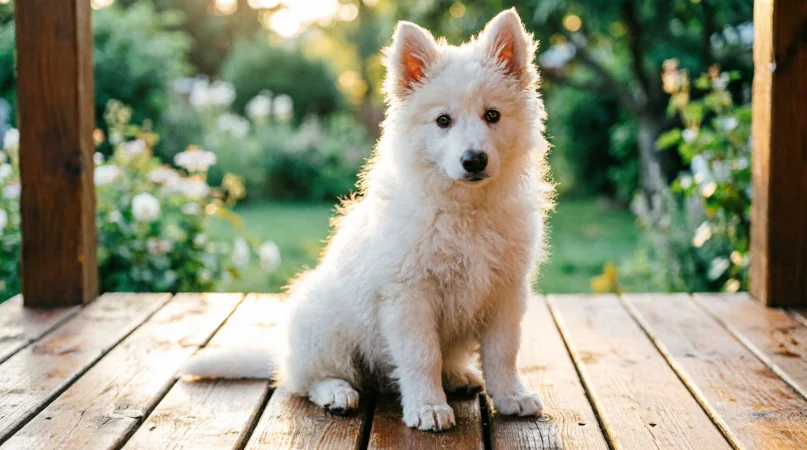
White German Shepherds are purebred German Shepherds carrying a recessive white coat gene not albinos, not a separate breed. They share the same intelligence, drive, and structural needs as standard-colored GSDs, which most casual guides overlook entirely. Experienced breeders caution: coat color tells you almost nothing about temperament or health always evaluate the full dog, not the shade.
Quick Snapshot
| Feature | Details |
|---|---|
| Breed | German Shepherd Dog (GSD) |
| Coat Color | White (Recessive Gene) |
| Color Classification | Naturally Occurring Purebred Color Variant |
| AKC Recognition | Yes Registered as German Shepherd; White Disqualifies in Conformation Shows Only |
| UKC Recognition | Yes White Shepherd Recognized Separately |
| FCI Recognition | White Color Not Accepted in Standard German Shepherd Conformation |
| Breed Group | Herding Group |
| Size | Males: 65–90 lbs / Females: 50–70 lbs |
| Height | Males: 24–26 in / Females: 22–24 in |
| Lifespan | 9–13 Years |
| Temperament | Loyal, Intelligent, Alert, Trainable, Sensitive |
| Intelligence Level | Extremely High |
| Trainability | Excellent |
| Energy Level | High |
| Exercise Needs | High 1.5–2 Hours Daily Minimum |
| Mental Stimulation Needs | Very High |
| Working Drive | High |
| Protective Instinct | Strong |
| Watchdog Ability | Excellent |
| Guard Dog Ability | Excellent |
| Family Compatibility | Excellent |
| Good for Families | Yes, with Proper Socialization |
| Good With Children | Usually Excellent |
| Good With Other Dogs | Good When Socialized Early |
| Stranger Friendly | Moderate |
| Loyalty Level | Exceptional |
| Affection Level | High |
| Shedding | Heavy Seasonal Blowouts, Year-Round Moderate |
| Coat Type | Double Coat |
| Coat Length | Short, Medium, or Long |
| Grooming Requirements | Moderate to High |
| Brushing Frequency | 3–5 Times Per Week |
| Bathing Frequency | Every 6–10 Weeks |
| Drooling | Low |
| Barking Level | Moderate |
| Apartment Friendly | Possible but Not Ideal |
| Yard Requirement | Preferred |
| First-Time Owner Friendly | Sometimes |
| Experience Level | Beginner to Intermediate |
| Socialization Importance | Critical |
| Training Difficulty | Moderate |
| Off-Leash Reliability | High with Proper Training |
| Prey Drive | Moderate to High |
| Adaptability | High |
| Escape Artist Potential | Moderate |
| Heat Tolerance | Moderate |
| Cold Tolerance | Excellent |
| Climate Preference | Cool to Moderate Climates |
| Eye Color | Brown, Dark Brown, Amber |
| Nose Color | Black |
| Skin Pigmentation | Normal Dark Pigmentation |
| Puppy Price Range | $800–$2,500 from Reputable Breeders |
| Adult Price Range | Varies by Pedigree and Training |
| Popularity | Increasing Worldwide |
| Rarity | Less Common Than Traditional Colors |
| Original Purpose | Herding and Livestock Management |
| Modern Roles | Family Companion, Service Dog, Therapy Dog, Search & Rescue, Protection Work |
| Service Dog Potential | Excellent |
| Therapy Dog Potential | Excellent |
| Search & Rescue Potential | Excellent |
| Protection Sport Potential | High |
| Herding Ability | Excellent |
| Common Health Concerns | Hip Dysplasia, Elbow Dysplasia, Degenerative Myelopathy, Bloat, Allergies |
| Health Difference From Standard Colors | None Proven |
| Temperament Difference From Standard Colors | None Proven |
| Intelligence Difference From Standard Colors | None Proven |
| Working Ability Difference From Standard Colors | None Proven |
| Genetic Cause | Recessive Color Gene Affecting Coat Color Only |
| Common Myth | White German Shepherds Are Not Albino |
| Health Testing Importance | Extremely High |
| Lifelong Training Need | Moderate to High |
| Maintenance Level | Moderate to High |
| Companion Dog Rating | Excellent |
| Family Protection Rating | Excellent |
| Working Dog Rating | Excellent |
| Best For | Active Families, Working Homes, Service Work, Dog Sports |
| Not Ideal For | Low-Activity Households |
| Distinguishing Feature | Pure White Coat with Classic German Shepherd Structure and Temperament |
| Overall Suitability | A Highly Intelligent, Loyal, and Versatile German Shepherd That Differs Only in Coat Color, Not Ability |
What Is a White German Shepherd?
A white German Shepherd is a purebred German Shepherd Dog with a white coat caused by a naturally occurring recessive gene. This is not a separate breed, not a designer variation, and not a health defect. The white coat simply masks the underlying pigment expression it does not alter the dog’s structure, drive, intelligence, or working ability.
Here is where most people get it wrong: many buyers assume white GSDs are either rare exotics or inferior rejects. Neither is true. White-coated GSDs have existed within the breed since its earliest documented history. Max von Stephanitz, the founder of the German Shepherd breed, recorded white-coated dogs in original breed registrations.
The confusion arises because the AKC conformation standard disqualifies the white coat in the show ring. This is purely a cosmetic judging rule. It says nothing about the dog’s health, temperament, or suitability as a working or companion animal.
What Is a White German Shepherd?
A white German Shepherd is a purebred GSD with a recessive white coat gene. It is not albino, not a separate breed, and not a health defect. White-coated GSDs carry the same structural, behavioral, and genetic traits as standard-colored German Shepherds, differing only in coat pigmentation.
Breed History and Origin
The German Shepherd breed was formally established in 1899 by Captain Max von Stephanitz in Germany. His founding stud, Horand von Grafrath, set the breed standard for intelligence, herding instinct, and structural soundness. White-coated dogs appeared in those earliest breeding lines.
As the breed evolved toward military and police work in the early 20th century, white coats became controversial among German breeders not because of any health concern, but because white dogs were considered poor camouflage in working environments. German breed clubs began excluding white coats from the SV (Schäferhund-Verein) registry in the 1930s, and the AKC followed suit.
North American breeders, however, continued preserving the white-coated German Shepherd throughout the mid-20th century. By the 1970s, a movement to formally recognize the White Shepherd as its own breed gained momentum. Today, the United Kennel Club (UKC) recognizes the White Shepherd as a distinct breed under its own standard, while the AKC still registers white-coated GSDs as German Shepherds disqualified from conformation, but fully eligible for all performance events.
Understanding this history matters because it explains why white GSDs are not rare due to genetics. They are rare in certain show breeding programs simply because those programs select against white. In broader GSD populations, white is a naturally occurring variant that surfaces whenever two carriers mate.
Appearance
White German Shepherds look almost identical to standard-colored GSDs in structure and that is precisely how it should be. Coat color is a single trait. Everything else bone density, back angulation, chest depth, ear set, gait should match the breed standard exactly.
Coat: Double coat with a dense undercoat and medium-length outer guard hairs. Coat color ranges from pure bright white to cream-white. Puppies may appear slightly off-white at birth, deepening or staying white as they mature. Coat length varies: stock coat (standard) and long coat varieties both exist.
Eyes: Dark brown preferred. Pale yellow or light eyes occasionally appear and are considered a fault in the UKC White Shepherd standard. Eye color is not linked to coat color in this breed.
Ears: Erect, forward-facing triangular ears. Puppies typically have floppy ears until 8–20 weeks, with some delayed setters going to 5–6 months.
Size: Males typically reach 24–26 inches at the shoulder and 65–90 lbs. Females measure 22–24 inches and 50–70 lbs. Size variation exists between working lines (leaner, athletic) and show lines (heavier, more angulated).
Build: Well-muscled, balanced, athletic. Responsible breeders avoid extreme rear angulation an issue more common in show-line American breeding programs that affects movement and long-term joint health.
Genetics and Color Explanation
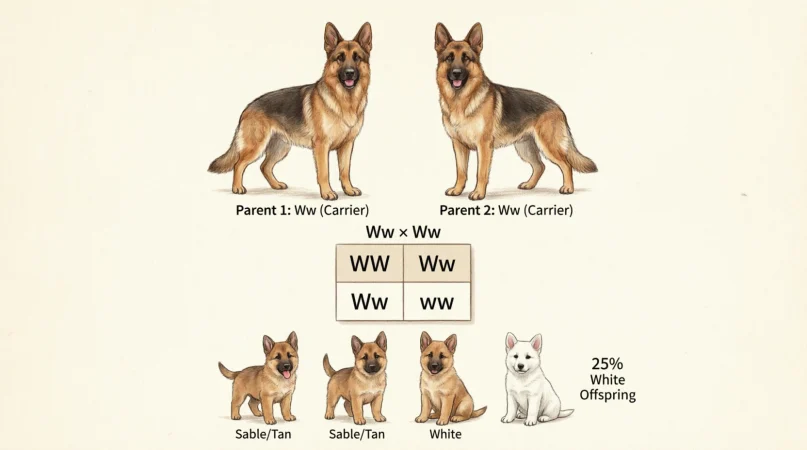
The white coat in German Shepherds is produced by a recessive allele at the E (extension) locus or, less commonly, interactions at the A (agouti) locus. The most straightforward explanation: a dog carrying two copies of the recessive white allele (ee genotype) will express a white coat, regardless of the underlying color genetics.
Key Genetics Facts
- White is recessive. Two white-producing alleles are needed for expression.
- Both parents can be People of Color (POC) and produce white puppies if both carry one hidden allele.
- White coat does not cause albinism. Albinism is a separate genetic condition involving melanin production in all tissues. White GSDs have normal pigmentation in their nose, lips, eye rims, and paw pads typically black.
- Coat color has no documented genetic link to temperament instability, increased disease risk, or deafness (unlike the merle gene in other breeds). The deafness-white coat link found in breeds like Dalmatians or Bull Terriers is tied to the merle or piebald gene systems, not the ee white locus in German Shepherds.
Appearance alone tells you very little about genetic health. Responsible breeders DNA test and health screen breeding pairs color is simply the last thing on their evaluation list.
Is a White German Shepherd Rare?
White German Shepherds are not genetically rare. The white coat is a recessive trait that appears whenever two carriers are bred together. They are less common in AKC show programs because white disqualifies in conformation rings, but white GSD puppies appear regularly in working and pet breeding lines globally.
Temperament and Personality
This is the section most buyer guides handle poorly glossing over it with phrases like “loyal family dog” without explaining what that actually looks like day to day.
German Shepherds, white-coated or otherwise, are working dogs. They were purpose-built for herding, guarding, tracking, and obedience. That origin shapes everything about how they behave in a home.
Core Temperament Traits
Loyalty and bonding: GSDs typically bond deeply to one primary person or family unit. This is a strength, but it also means they do not adapt easily to re-homing as adults.
Alertness and protective instinct: White GSDs have the same guarding instinct as their colored counterparts. This is not aggression it is a breed-appropriate wariness toward strangers that, when channeled through socialization and training, produces a calm, confident watchdog. Without that work, it can tip into reactivity or fearfulness.
Sensitivity: Here is what experienced breeders emphasize that most articles miss. German Shepherds particularly white-coated ones, in the observations of many long-term breeders tend to be highly emotionally sensitive. Harsh corrections, unstable environments, or inconsistent handling affect them more acutely than it might affect a Lab or a Rottweiler. This is not weakness. It is a breed characteristic that rewards handlers who use reward-based, clear, consistent training.
Drive: Most GSDs carry meaningful prey, play, and food drive. This is an asset for training. It is also why an under-exercised, under-stimulated GSD becomes destructive, noisy, or anxious.
With children: Well-socialized white GSDs are gentle and patient with children in their family unit. Supervision with young children is always recommended not because GSDs are aggressive, but because their size and exuberance can accidentally knock over small kids.
Is a White German Shepherd a Good Family Dog?
Yes, with the right preparation. White German Shepherds are loyal, protective, and affectionate with their families. They require early socialization, consistent training, and significant daily exercise. Families with active lifestyles who can commit to training will find them excellent companions. They are less suited to sedentary households or first-time owners without dedicated training plans.
Intelligence and Trainability
German Shepherds consistently rank among the most intelligent dog breeds in working obedience assessments. Dr. Stanley Coren’s research placed them third in working/obedience intelligence behind only Border Collies and Poodles.
What this means practically: they learn commands quickly, retain training reliably, and generalize skills across environments better than most breeds. It also means they pick up bad habits just as fast as good ones.
Experienced breeders focus on something beyond raw intelligence: handler suitability. A high-drive, intelligent dog in the hands of an inconsistent, permissive owner becomes a management problem. The same dog with a clear, calm, motivated handler becomes something extraordinary.
Training Essentials
- Begin training from the first day home puppies as young as 7–8 weeks can start basic shaping exercises.
- Use positive reinforcement as the primary method. Marker training (clicker or verbal marker) works exceptionally well with GSDs.
- Enroll in structured puppy classes. Socialization with other dogs, people, and environments before 16 weeks is critical.
- Never use punishment-based methods that create fear or conflict. With a sensitive, bonded GSD, this damages trust and often creates the reactive behaviors owners were trying to prevent.
- White GSDs excel at obedience, agility, nose work, tracking, herding trials, and Schutzhund/IPO the full range of working dog sports.
Exercise Requirements
Two hours of purposeful daily exercise is a realistic minimum for an adult white German Shepherd. This is not negotiable for behavioral health.
“Exercise” is not just physical. Mental stimulation training sessions, puzzle feeders, tracking games, nose work matters as much as physical movement. A dog that runs five miles and then sits idle in a quiet house is not a well-exercised dog.
Daily Exercise Framework
| Exercise Type | Duration | Frequency |
|---|---|---|
| Off-leash play or running | 30–45 min | Daily |
| Structured leash walk | 30–45 min | Daily |
| Training session | 10–20 min | Daily |
| Mental enrichment (puzzle, nose work) | 15–20 min | Daily |
Puppies: Follow the general guideline of 5 minutes of formal exercise per month of age, twice daily, until growth plates close (typically 12–18 months). Overworking joints before closure increases long-term orthopedic risk.
Health Problems and Genetic Risks
This is where responsible ownership begins understanding what the breed is actually predisposed to, before you buy.
What Health Problems Affect White German Shepherds?
White German Shepherds share the same health risks as standard GSDs: hip dysplasia, elbow dysplasia, degenerative myelopathy (DM), and bloat (GDV). Reputable breeders perform OFA hip and elbow evaluations and DNA test for the DM gene mutation before breeding. Coat color does not introduce additional health risks.
Key Health Conditions
Hip Dysplasia
The most prevalent orthopedic issue in the breed. Abnormal hip joint development leads to arthritis, pain, and mobility loss. OFA (Orthopedic Foundation for Animals) hip radiograph clearance of both parents is the minimum standard. The Pennhip method offers an alternative evaluation with different diagnostic criteria.
Elbow Dysplasia
Less discussed than hip dysplasia but equally significant. Elbow OFA clearances should be standard in any reputable breeding program.
Degenerative Myelopathy (DM)
A progressive neurological disease affecting the spinal cord, leading to hind limb weakness and paralysis. DM is caused by a mutation in the SOD1 gene. DNA testing identifies Clear, Carrier, and At-Risk dogs. An at-risk genotype does not guarantee DM will develop environmental factors are involved but responsible breeders do not breed two at-risk dogs together.
Bloat (Gastric Dilatation-Volvulus)
A life-threatening emergency where the stomach fills with gas and twists. Deep-chested breeds like GSDs are at elevated risk. Preventative measures include avoiding vigorous exercise immediately before and after meals, feeding from floor level (not elevated bowls, which some evidence suggests may increase risk), and awareness of early symptoms.
Exocrine Pancreatic Insufficiency (EPI)
A condition where the pancreas fails to produce sufficient digestive enzymes. More prevalent in GSDs than in most breeds. Symptoms include dramatic weight loss despite increased appetite, pale/greasy stools, and gas.
Perianal Fistulas
Painful chronic lesions around the anus. Strongly associated with the German Shepherd breed. Management typically requires long-term immunosuppressive therapy.
Health Testing Minimum Standards (Reputable Breeders)
| Test | Purpose |
|---|---|
| OFA Hip Evaluation | Dysplasia screening |
| OFA Elbow Evaluation | Dysplasia screening |
| DM DNA Test (SOD1) | Degenerative myelopathy risk |
| Eye Exam (CAER) | Hereditary eye conditions |
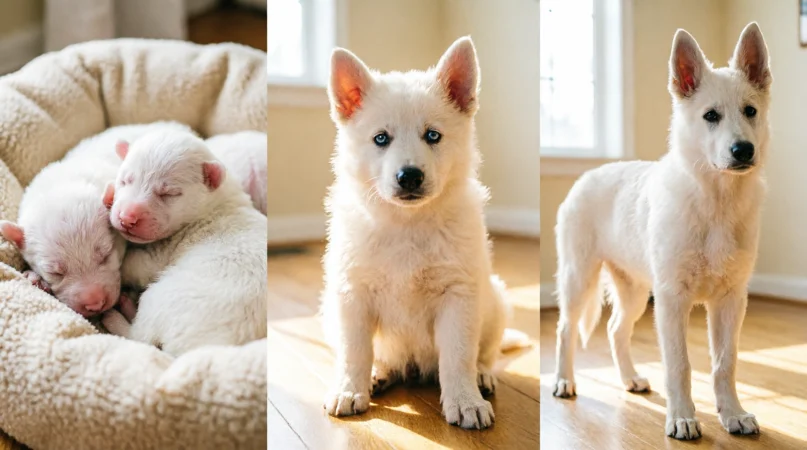
Puppy Development Timeline
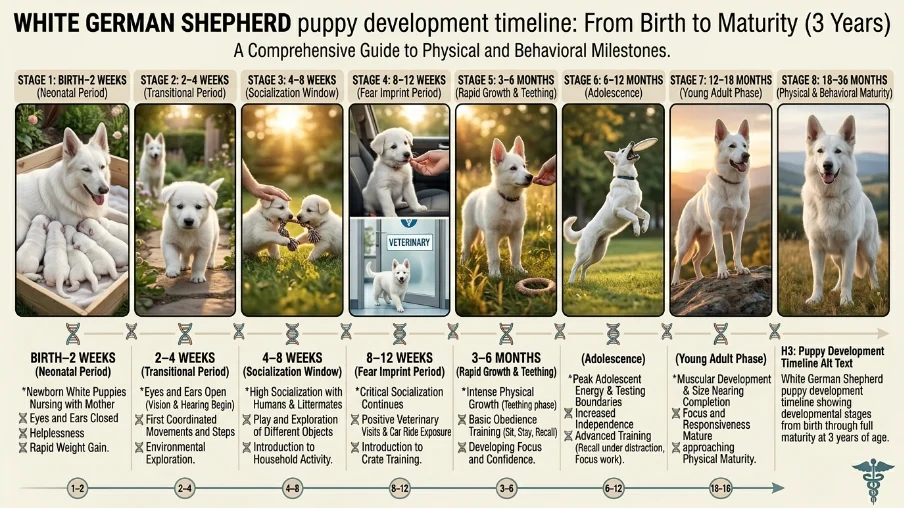
| Age | Development Stage |
|---|---|
| Birth–2 Weeks | Neonatal period. Eyes and ears closed. Fully dependent on mother. Sensory stimulation by breeder (ENS Early Neurological Stimulation) builds stress resilience. |
| 2–4 Weeks | Transitional period. Eyes open, ears begin to function. Starts to stand and walk. Social awareness begins. |
| 4–8 Weeks | Socialization window opens. Critical exposure to humans, sounds, surfaces, other animals. Do NOT place puppy before 7–8 weeks minimum. |
| 8–12 Weeks | Fear imprint period begins. Positive exposure to new experiences is essential. First veterinary visits, nail handling, car rides. |
| 3–6 Months | Rapid growth. Teething. Adolescent energy spikes. Consistent training reinforcement critical. Ears may fluctuate as calcium shifts to bone development. |
| 6–12 Months | Adolescent period. Second fear imprint often occurs around 6–9 months. Dogs may seem to “forget” prior training maintain structure. |
| 12–18 Months | Continued maturation. Most reach adult height, still filling out muscle. |
| 18–24 Months | Physical maturity approaching. Character and drives stabilize. |
| 2–3 Years | Full emotional and physical maturity. Working ability fully assessable. |
Feeding and Nutrition
Adult white German Shepherds do well on high-quality commercial diets formulated for large breeds, or on veterinarian-supervised raw/home-cooked diets. The real issue is not which brand you choose it is matching caloric intake to actual activity level.
General Feeding Guidelines
| Life Stage | Daily Amount (dry kibble baseline) |
|---|---|
| Puppy (8–16 weeks) | 3–4 cups, divided into 3–4 meals |
| Puppy (4–6 months) | 3–4 cups, divided into 3 meals |
| Adolescent (6–12 months) | 3–4.5 cups, divided into 2–3 meals |
| Adult (maintenance) | 3–4 cups, divided into 2 meals |
| Active adult / working dog | Adjust upward based on output |
Note: These are baseline estimates. Individual dogs vary significantly. Monitor body condition score you should be able to feel ribs with light pressure, not see them.
EPI consideration: If your GSD seems perpetually hungry, loses weight despite eating well, or produces unusually high-volume pale stools, discuss EPI screening with your vet promptly. Early diagnosis and enzyme supplementation dramatically improves outcomes.
Grooming Guide
The white coat looks striking but it is not maintenance-free. White dogs also show dirt more visibly than darker coats, which surprises many first-time owners.
Grooming Schedule
| Task | Frequency |
|---|---|
| Brushing (undercoat rake + slicker brush) | 3–4x per week; daily during seasonal shedding |
| Bathing | Every 4–8 weeks, or as needed |
| Nail trimming | Every 3–4 weeks |
| Ear cleaning | Monthly, or when debris visible |
| Dental brushing | Daily ideally; minimum 3x per week |
| Coat blowout | During spring and fall shedding seasons |
Staining: The white coat is prone to saliva staining around the mouth and tear staining below the eyes. These are cosmetic issues. Regular face wiping with a damp cloth helps reduce buildup. Persistent tear staining should be evaluated by a vet to rule out eye anatomy issues.
Tools: A quality undercoat rake (not a Furminator these can damage guard hairs with overuse), a slicker brush, and a high-velocity dryer for blowout seasons are your core kit.
Step-by-Step Care Guide
Week 1 With a New White GSD Puppy
- Set up a confined safe space (crate or x-pen) before the puppy arrives. Begin crate conditioning the first night not optional.
- Vet visit within 72 hours of bringing puppy home. Review vaccination schedule, discuss deworming, confirm microchip registration.
- Start name recognition and basic marker training on day one. Name → treat. Simple. Consistent.
- Begin handling desensitization immediately: touch ears, open mouth, hold paws, press on gums. Every day. This prevents examination aversion as adults.
- Establish a feeding, elimination, and nap routine. Puppies thrive on predictability.
- No forced socialization with adult dogs outside the household until the vaccine series is at least partially complete. Discuss appropriate exposure timing with your vet.
- Enroll in a puppy class. The best ones start at 7–8 weeks. Socialization in a controlled environment matters more during this window than any other training activity.
Common Owner Mistakes
These are the patterns experienced breeders and trainers see repeatedly things most online guides never mention.
1. Treating the white coat as the priority.
Buyers fixate on color, then are surprised when their puppy has high drive, separation anxiety, or reactivity. Color predicts none of this. Structure, lineage, parent temperament, and early socialization predict far more.
2. Under-socializing during the critical window.
The period between 3–12 weeks is neurologically irreplaceable. Puppies kept isolated “for safety” during this window often develop fear-based reactivity that takes years of remediation work.
3. Relying on dog parks as socialization.
Dog parks expose young puppies to unvaccinated, unsupervised dogs and unpredictable interactions. A single negative incident during a fear imprint period can create lasting reactivity. Structured puppy classes are superior.
4. Inconsistent rules in the house.
GSDs are very aware of inconsistency. A dog that is allowed on furniture sometimes and not others by different family members will push boundaries constantly. Decide your rules before the puppy arrives and enforce them uniformly.
5. Assuming the dog will self-regulate exercise.
Young GSDs often will not stop playing even when physically fatigued. Owners must manage exercise duration to protect developing joints the puppy’s enthusiasm is not a reliable indicator of what is appropriate.
6. Correcting fear-based behavior with punishment.
A puppy that lunges or barks from fear is not being “dominant.” Punishing fear responses increases anxiety and often accelerates the very behavior owners are trying to stop. This is especially damaging in the sensitive GSD temperament.
Insights Most Articles Miss
The working line vs. show line distinction matters far more than color.
White GSDs appear in both working lines and show/pet lines. A white puppy from high-drive working lines will have significantly more intensity, energy, and demand than a white puppy from a lower-drive show or companion breeding program. Many buyers who think they want a “GSD” are better suited to a show-line or mixed-lineage dog. This is not about inferiority it is about realistic compatibility.
White GSDs and UKC vs. AKC registration differences.
If you want to compete in conformation events with a white GSD, the AKC is not your venue. The UKC recognizes the White Shepherd as a distinct breed under its own standard. Some breeders register their dogs with both organizations; others register exclusively with one. Ask breeders which registration applies and why.
The “Blue” GSD and the “White” GSD are completely different genetic events.
Blue (dilute) German Shepherds carry a different recessive dilution gene (the d locus) that has documented associations with Color Dilution Alopecia in some breeds. White does not operate through this mechanism. They are different traits entirely.
Ear set takes longer than many guides say.
White GSD puppy ears can remain floppy or fluctuate through teething (4–6 months) and even past 7 months in some individuals. Calcium redistribution during bone growth affects cartilage. Most ears will stand fully by 5–6 months. Taping, gluing, or any structural intervention before 6 months is premature and unnecessary in the vast majority of cases.
Price Guide and Ownership Costs
Featured Snippet Answer How Much Does a White German Shepherd Cost?
White German Shepherd puppies from health-tested, reputable breeders typically cost between $800 and $2,500 in 2026. Price varies by region, lineage, health testing level, and breeder reputation. Very cheap puppies ($300–$500) almost always indicate absent health testing, puppy mills, or backyard breeding. Extraordinarily high prices ($3,000–$5,000+) are not always justified evaluate the breeder, not just the price.
Puppy Cost Breakdown
| Source | Typical Range | Health Testing? |
|---|---|---|
| Reputable hobby breeder | $1,000–$2,000 | Yes OFA, DM, eye clearances |
| Show/UKC registered breeder | $1,200–$2,500 | Yes extensive |
| Working line breeder | $1,500–$3,000 | Usually yes |
| Pet/backyard breeder | $400–$900 | Rarely |
| Puppy mill / broker | $500–$1,500 | No |
| Rescue / adoption | $50–$500 | Variable |
Ongoing Annual Ownership Costs
| Expense | Estimated Annual Cost (USD) |
|---|---|
| Quality dog food | $700–$1,400 |
| Routine veterinary care | $300–$600 |
| Heartworm/flea/tick prevention | $150–$350 |
| Grooming (professional blowouts) | $200–$600 |
| Training classes | $200–$600 (first year higher) |
| Toys, enrichment, accessories | $150–$400 |
| Pet insurance (recommended) | $400–$1,000 |
| Total estimated annual | $2,100–$4,950 |
First-year costs are significantly higher due to puppy vaccinations, spay/neuter, initial supplies, and starter training.
How to Find a Reputable Breeder
The real issue is not finding a breeder it is distinguishing responsible breeders from those who prioritize profit over dogs. This is harder than it sounds because most problematic breeders use the same language as good ones.
What Reputable Breeders Do
- Health test both parents: OFA hips, OFA elbows, DM gene test, CAER eye exam minimum.
- Raise puppies in the home, not outside kennels.
- Begin socialization and Early Neurological Stimulation (ENS) from birth.
- Interview buyers they want to know the puppy is going to a suitable home.
- Provide a written health contract with return policy if circumstances change.
- Are reachable after the sale and expect to stay in contact.
- Are involved with breed clubs (GSDCA, White Shepherd clubs, UKC) or working sports.
- Do not breed every heat cycle responsible frequency is typically once per year maximum per female.
Where to Search
- German Shepherd Dog Club of America (GSDCA.org) breeder referral listings
- United Kennel Club (UKC) White Shepherd breed club listings
- White Shepherd Club of America (WSCA) breed-specific network
- Working dog sport clubs (Schutzhund/IPO USA) access to working line breeders
Questions to Ask Before Buying
- Can I see the health clearances for both parents? (OFA certificates, DM results)
- Where are the puppies being raised? Can I visit and see the environment?
- What socialization protocol have you used since birth?
- What is the temperament of both parents? Can I meet the dam?
- What lineage are these puppies working, show, or pet lines?
- What does your health guarantee cover and for how long?
- What is your policy if I am unable to keep the dog at some point in its life?
- How many litters do you breed per year?
- Are you involved in any breed clubs or performance events?
- What do you recommend for feeding, training, and veterinary care?
Buyer Warning Section
Avoid these red flags they are consistent across bad breeding operations:
- No health clearances, or clearances only for the puppy (not the parents)
- Multiple breeds or litters always available
- Puppies available immediately with no waiting period
- Reluctance or refusal to let you visit the property
- Excessive pressure to close the sale quickly
- Price drops when you hesitate reputable breeders do not need to bargain
- No questions asked about your lifestyle, home, or experience
- Puppies placed before 7–8 weeks of age
- Registration paperwork that does not match the stated breed or parents
- Online-only transactions with no in-person meeting possible
Backyard breeders and puppy mills producing white GSDs are common because the color attracts buyers willing to pay a premium for novelty. The dogs they produce may look identical at 8 weeks to a well-bred puppy. The differences in health and temperament become apparent at 12–24 months.
Lifestyle Compatibility
| Lifestyle Factor | Suitable? | Notes |
|---|---|---|
| Families with children | Yes, with work | Socialize early; supervise with toddlers |
| Apartment living | Possible but challenging | Must meet full exercise requirements daily; high energy |
| Active outdoor owners | Excellent fit | Ideal for hiking, running, active sports |
| First-time dog owners | Possible with commitment | Requires training plan and structure; not a passive dog |
| Working / sporting homes | Excellent | Thrives with job or sport to perform |
| Seniors / low-activity owners | Not recommended | Drive and exercise needs are not negotiable |
| Multi-pet households | Usually fine | Early socialization with resident pets essential |
| Hot climates | Manageable | Double coat provides some insulation; limit midday exercise |
| Cold climates | Very well suited | Double coat handles cold well |
Breed and Color Comparisons
| Feature | White GSD | Standard GSD (Sable/Black-Tan) | Swiss White Shepherd |
|---|---|---|---|
| AKC Recognition | Yes (disqualified in conformation) | Yes | No |
| UKC Recognition | White Shepherd separate breed | Yes | No |
| Temperament | Identical | Identical | Very similar; often described as slightly softer |
| Health Risks | Same | Same | Same independent breed with own OFA data |
| Exercise Needs | High | High | High |
| Trainability | Excellent | Excellent | Excellent |
| Coat Care | Heavy shedding | Heavy shedding | Heavy shedding |
| Show eligibility | UKC, not AKC conformation | AKC + UKC | Separate FCI breed SBCS registries |
Note: The Berger Blanc Suisse (Swiss White Shepherd) is FCI-recognized as a distinct breed and has its own breed clubs in Europe. Some North American breeders use this name, though the UKC White Shepherd and the Berger Blanc Suisse have different registration systems.
Preparation Checklist
Before your white German Shepherd puppy comes home:
- [ ] Crate and crate pad (appropriately sized large breed)
- [ ] X-pen or puppy containment zone
- [ ] Food and water bowls (stainless steel or ceramic avoid plastic)
- [ ] High-quality large-breed puppy food (ask your breeder what the puppy is eating)
- [ ] Collar, ID tag, and 6-foot leash
- [ ] Flat martingale for training walks (not a choke chain or prong on a puppy)
- [ ] Undercoat rake and slicker brush
- [ ] Enzymatic cleaner (for accidents)
- [ ] Puppy-safe chews and durable toys
- [ ] Puppy class booked
- [ ] Veterinarian appointment within 72 hours of pickup scheduled
- [ ] Pet insurance research completed or enrolled
- [ ] Family rules discussed and agreed upon before puppy arrives
FAQs
Q1. Are white German Shepherds albino?
No. Albinism involves a complete absence of melanin production, including in the skin, eye tissue, and nose leather. White GSDs have a recessive white coat gene but retain normal pigmentation in their nose, lips, and eye rims typically black. Their eyes are dark brown, not pink or pale blue.
Q2. Do white German Shepherds have more health problems than other colors?
No documented evidence supports this claim. The white coat gene itself does not appear to carry health associations the way some color genetics do in other breeds (merle deafness, dilute alopecia). White GSDs are susceptible to the same breed-typical conditions as all German Shepherds: hip dysplasia, elbow dysplasia, DM, and bloat.
Q3. Will a white GSD puppy’s ears stand up?
In most cases, yes. Ear set typically completes between 4–7 months, though some individuals take longer especially during the teething period when calcium is redirected to bone development. If ears have not fully erected by 7–8 months, discuss with your breeder and vet. Premature intervention is rarely appropriate.
Q4. Can I register a white German Shepherd with the AKC?
Yes. White-coated dogs are registrable with the AKC as German Shepherds. However, they are disqualified from AKC conformation (breed) shows. They remain fully eligible for all AKC performance events: obedience, agility, tracking, herding trials, nose work, and rally.
Q5. Are white German Shepherds good with other dogs?
Generally yes, with proper socialization. German Shepherds can be dog-selective or reactive without adequate early exposure. Structured socialization controlled, positive meetings with other dogs during puppyhood builds appropriate social skills. Dog-park socialization is not an ideal substitute.
Q6. How much shedding should I expect?
Significant. White GSDs shed year-round with heavy seasonal blowouts in spring and fall. White hair is more visible on dark furniture and clothing. Budget for regular grooming sessions, a quality vacuum, and furniture covers if needed. Grooming 3–4 times per week dramatically reduces indoor hair accumulation.
Q7. Can white German Shepherds be left alone during the workday?
Adult GSDs can manage 4–6 hours alone with appropriate exercise before and after. More than 8 hours regularly is not suitable for most GSDs and often leads to destructive behavior or separation anxiety. Puzzle feeders, durable chews, and structured exercise before departure help. Puppies under 6 months should not be alone for extended periods without midday care.
Q8. Is a white German Shepherd suitable for a first-time dog owner?
With conditions. First-time owners who commit to structured training, read extensively about the breed, enroll in classes, and maintain consistent routine can absolutely raise a well-adjusted GSD. First-time owners who expect a passive, low-demand companion and underestimate the exercise and training requirements will struggle. The dog’s success is directly related to the owner’s preparation.
Q9. Do white GSDs have different personality traits than standard-colored GSDs?
Coat color and personality are genetically independent. However, individual breeders and trainers have anecdotally noted that some white-line GSDs trend toward a slightly softer temperament possibly due to selective breeding pressures over decades in programs that prioritized companionship over working drive. This is a population-level observation, not a rule. Temperament evaluation of parents remains the most reliable predictor.
Q10. What is the difference between a White Shepherd and a German Shepherd?
In the AKC system, there is no breed difference a white-coated GSD is still registered as a German Shepherd. In the UKC system, the White Shepherd is recognized as a distinct breed with its own standard. The FCI-recognized Berger Blanc Suisse is a separate breed with Swiss and European origins. The distinctions are primarily administrative and show-ring related structurally, the dogs are nearly identical.
Conclusion
White German Shepherd puppies are not novelties, fascinating variants, or rare gems they are German Shepherds with a recessive coat gene and every trait, demand, and potential that comes with that breed.
The buyers who thrive with them are the ones who came prepared. They understood the exercise requirements before the puppy arrived. They had a training plan in place. They chose a breeder based on health clearances and puppy socialization protocol rather than on availability or price. And they evaluated parent temperament at least as seriously as they evaluated coat color.
Appearance alone tells you very little. Experienced breeders focus on structure, health, drive stability, and early development. That is where a puppy’s long-term quality of life and yours is actually determined.
If you are ready for the commitment, a white German Shepherd raised well is one of the most rewarding dogs a person can own: fiercely loyal, intellectually engaged, and structurally magnificent. Just do not let the coat be the reason you bought one.