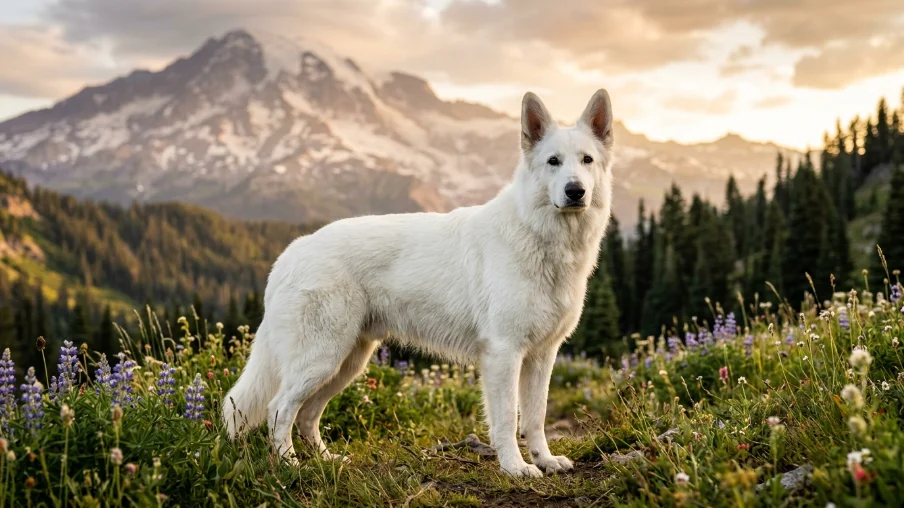
The All White German Shepherd is a purebred German Shepherd that inherits a recessive white coat gene. Despite common myths, white coloration does not affect intelligence, trainability, temperament, or working ability. The biggest challenge is finding a breeder who prioritizes health, structure, and temperament over coat color alone.
Quick Snapshot Table
| Trait | Details |
|---|---|
| Breed | German Shepherd Dog |
| Color | Solid White |
| Breed Type | Purebred German Shepherd |
| Color Classification | Naturally Occurring Recessive Color Variant |
| Size | Large |
| Height | 22–26 Inches |
| Weight | 50–90 Pounds |
| Lifespan | 9–13 Years |
| Temperament | Loyal, Intelligent, Alert |
| Intelligence | Extremely High |
| Trainability | Very High |
| Energy Level | High |
| Exercise Needs | High |
| Daily Exercise Requirement | 60–120+ Minutes |
| Mental Stimulation Needs | Very High |
| Grooming | Moderate to High |
| Shedding Level | Heavy |
| Seasonal Shedding | Very Heavy |
| Coat Type | Double Coat |
| Coat Length | Short, Medium, or Long |
| Family Friendly | Yes |
| Good With Children | Usually, with Socialization |
| Good With Other Dogs | Generally Good When Socialized |
| Stranger Friendly | Moderate |
| Loyalty Level | Exceptional |
| Affection Level | High |
| Protective Instinct | Strong |
| Watchdog Ability | Excellent |
| Guard Dog Ability | Excellent |
| Apartment Friendly | Sometimes |
| First-Time Owner Friendly | Sometimes |
| Experience Level | Beginner to Intermediate |
| Socialization Importance | Critical |
| Training Difficulty | Moderate |
| Working Ability | Excellent |
| Service Dog Potential | Excellent |
| Therapy Dog Potential | Excellent |
| Search & Rescue Potential | Excellent |
| Protection Sport Potential | High |
| Herding Ability | Excellent |
| Prey Drive | Moderate to High |
| Off-Leash Reliability | High with Proper Training |
| Adaptability | High |
| Drooling | Low |
| Barking Level | Moderate |
| Escape Artist Potential | Moderate |
| Heat Tolerance | Moderate |
| Cold Tolerance | Excellent |
| Climate Preference | Cool to Moderate Climates |
| Eye Color | Brown, Dark Brown, Amber |
| Nose Color | Usually Black |
| Skin Pigmentation | Normal Dark Pigmentation |
| AKC Recognition | Color Fault in Conformation Shows but Still a Purebred GSD |
| UKC Recognition | Yes |
| White Shepherd Recognition | Recognized Separately by Some Registries |
| Rarity | Less Common Than Traditional Colors |
| Popularity | Increasing Worldwide |
| Original Purpose | Herding and Livestock Management |
| Modern Roles | Family Companion, Service Dog, Therapy Dog, Working Dog |
| Common Health Concerns | Hip Dysplasia, Elbow Dysplasia, Degenerative Myelopathy, Bloat, Allergies |
| Health Difference from Standard Colors | None Proven |
| Temperament Difference from Standard Colors | None Proven |
| Intelligence Difference from Standard Colors | None Proven |
| Working Ability Difference from Standard Colors | None Proven |
| Health Testing Importance | Extremely High |
| Puppy Price Range | $1,000–$4,000+ |
| Lifelong Training Need | Moderate to High |
| Maintenance Level | Moderate to High |
| Distinguishing Feature | Solid White Coat with Classic German Shepherd Structure |
| Companion Dog Rating | Excellent |
| Family Protection Rating | Excellent |
| Working Dog Rating | Excellent |
| Best For | Active Families, Service Work, Dog Sports, Experienced Owners |
| Not Ideal For | Low-Activity Households |
| Common Misconception | White Color Is Not Albinism |
| Genetic Cause | Recessive Masking Gene Affecting Coat Color Only |
| Overall Suitability | A Loyal, Intelligent, and Fully Capable German Shepherd That Differs Only in Coat Color |
What Is an All White German Shepherd?
An All White German Shepherd is a purebred German Shepherd Dog with a solid white coat caused by a recessive genetic trait. The color changes appearance only and does not make the dog a separate breed.
Here is where most people get it wrong: they assume the white coat determines quality. Experienced breeders evaluate temperament, structure, health, and working ability long before considering color.
Breed History and Origin
White-coated German Shepherds have existed since the breed’s earliest development. The white gene naturally appeared within original German Shepherd bloodlines and has remained part of the breed’s genetic history for generations.
Although some kennel clubs discourage white coloration in conformation competition, White German Shepherds remain genetically German Shepherds.
Appearance
The All White German Shepherd has the same overall structure as any well-bred German Shepherd.
Common characteristics include:
- Dense double coat
- Erect ears
- Athletic build
- Dark eyes
- Black nose pigmentation
- Long, bushy tail
Appearance alone tells you very little about a dog’s health, temperament, or working potential.
Genetics and Color Explanation
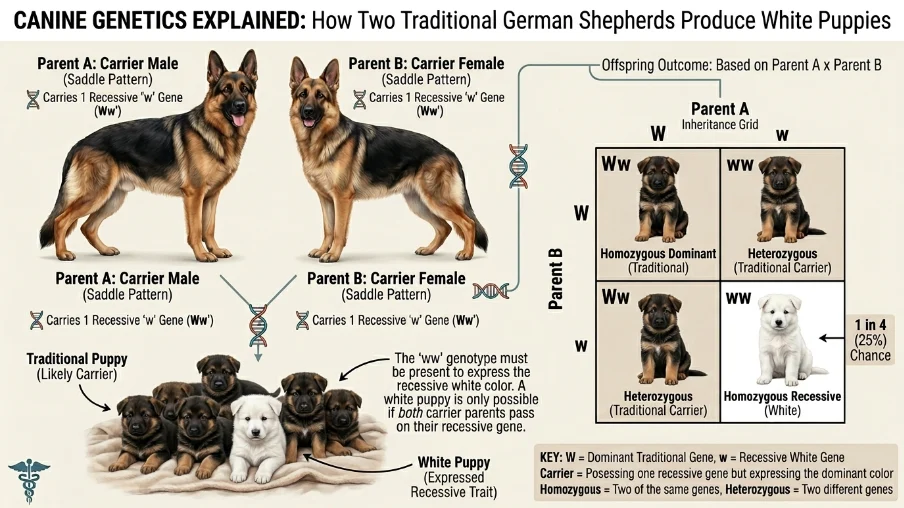
White coloration is produced by a recessive gene.
For a white puppy to be born:
- Both parents must carry the white gene.
- The puppy must inherit the gene from both parents.
Can Two Traditional German Shepherds Produce White Puppies?
Yes.
Two normally colored German Shepherds can produce white puppies if both carry the recessive white gene. This is why white puppies occasionally appear in otherwise traditional-colored litters.
White German Shepherd vs Albino
- White German Shepherds are not albino.
| White German Shepherd | Albino Dog |
|---|---|
| Dark eyes | Pink or very light eyes |
| Black nose | Little pigmentation |
| Normal pigment | Pigment deficiency |
White German Shepherd Myths vs Facts
| Myth | Fact |
|---|---|
| White German Shepherds are albino | False |
| White color affects intelligence | False |
| White dogs are more aggressive | False |
| White German Shepherds are mixed breeds | False |
| White dogs cannot work | False |
Temperament and Personality
Most White German Shepherds display classic German Shepherd traits:
- Loyal
- Intelligent
- Protective
- Trainable
- Alert
- Family-oriented
Many owners describe them as highly devoted companions who closely monitor their surroundings.
What Owners Often Notice
One behavior frequently overlooked is prolonged mental adolescence. Many White German Shepherds continue maturing emotionally well into their second or third year.
Consistency and patience are essential.
Intelligence and Trainability
German Shepherds consistently rank among the most trainable dog breeds.
They excel in:
- Obedience
- Service work
- Search and rescue
- Scent detection
- Therapy work
- Protection sports
Early socialization and reward-based training produce the best results.
Working Line vs Show Line White German Shepherds
| Trait | Working Line | Show Line |
|---|---|---|
| Energy | Higher | Moderate |
| Drive | Higher | Moderate |
| Training Intensity | Greater | Easier |
| Working Ability | Stronger | Variable |
| Family Lifestyle | Active homes | More flexible |
The real issue is matching the dog’s energy level to your lifestyle.
Exercise Requirements
This is a high-energy breed.
Adult White German Shepherds typically need:
- 90–120 minutes of activity daily
- Mental enrichment
- Structured training
Good activities include hiking, tracking, obedience training, scent work, and long walks.
Health Problems and Genetic Risks
White coloration itself is not associated with major health problems.
However, White German Shepherds can develop the same conditions seen throughout the breed.
Common concerns include:
- Hip dysplasia
- Elbow dysplasia
- Degenerative myelopathy
- Bloat
- Allergies
- Exocrine pancreatic insufficiency
Recommended Health Testing
- OFA hip evaluation
- OFA elbow evaluation
- Degenerative myelopathy testing
- Cardiac screening
- Eye examinations
Responsible breeders evaluate far more than color.
Puppy Development Timeline
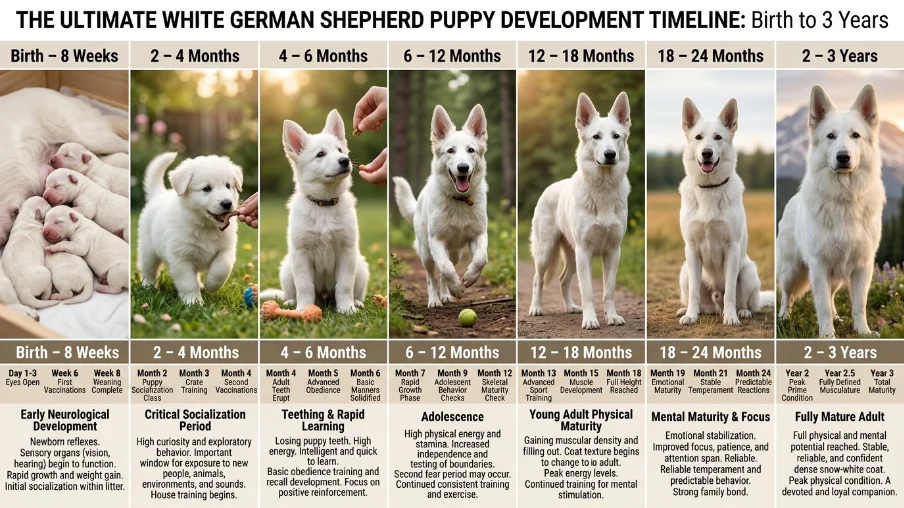
| Age | Development Stage |
|---|---|
| Birth–8 Weeks | Early neurological development |
| 2–4 Months | Critical socialization period |
| 4–6 Months | Teething begins |
| 6–12 Months | Adolescence develops |
| 12–18 Months | Physical maturity increases |
| 18–24 Months | Mental maturity improves |
| 2–3 Years | Full adult temperament develops |
Behavioral Milestones
| Age | Common Changes |
|---|---|
| 8–12 Weeks | Socialization window |
| 3–4 Months | Confidence building |
| 5–6 Months | Teething phase |
| 6–12 Months | Boundary testing |
| 12–18 Months | Protective instincts emerge |
| 18–36 Months | Emotional maturity develops |
Feeding and Nutrition
Choose a high-quality diet appropriate for large-breed dogs.
Focus on:
- Lean body condition
- Controlled growth
- Joint support
- Appropriate protein levels
Avoid overfeeding growing puppies.
Grooming Guide
White German Shepherds shed heavily, especially during seasonal coat changes.
Typical grooming routine:
- Brush 2–4 times weekly
- Check ears weekly
- Trim nails monthly
- Brush teeth regularly
The white coat does not require special maintenance beyond normal German Shepherd grooming.
Common Owner Mistakes
The most common mistakes include:
- Choosing color over temperament.
- Ignoring health testing.
- Underestimating exercise needs.
- Poor socialization.
- Inconsistent training.
- Purchasing from backyard breeders.
Insights Most Articles Miss
Many articles focus almost entirely on the white coat.
Experienced breeders focus on something else:
- Nerve strength
- Structural soundness
- Working ability
- Health certifications
- Stable temperament
A striking appearance cannot compensate for poor genetics or unstable behavior.
Is This Dog Right for Me?
This Breed May Be Right For You If
- You enjoy training.
- You live an active lifestyle.
- You want a highly intelligent companion.
- You can provide daily exercise.
This Breed May Not Be Right For You If
- You want a low-maintenance breed.
- You dislike shedding.
- You travel frequently.
- You cannot commit to training.
Price Guide and Ownership Costs
Puppy Price
| Source | Cost |
|---|---|
| Reputable Breeder | $1,000–$3,500 |
| Elite Bloodlines | $3,500–$6,000+ |
First-Year Ownership Costs
| Expense | Estimated Cost |
|---|---|
| Puppy | $1,000–$3,500 |
| Supplies | $300–$800 |
| Food | $600–$1,200 |
| Veterinary Care | $500–$1,500 |
| Training | $300–$2,000 |
How to Find a Reputable Breeder
Look for breeders who:
- Perform OFA testing
- Provide health records
- Discuss temperament openly
- Offer contracts
- Prioritize socialization
Avoid breeders marketing white puppies as “extremely rare” or “exclusive.”
Questions to Ask Before Buying
- Have the parents passed health testing?
- Can I review certifications?
- How are puppies socialized?
- Can I meet the parents?
- What support is offered after purchase?
Buyer Warning Section
Red flags include:
- No health testing
- Extremely low prices
- No contracts
- Multiple breeds sold
- No breeder screening process
Lifestyle Compatibility
| Lifestyle Factor | Suitable? | Notes |
|---|---|---|
| Families | Yes | Excellent with training |
| Children | Yes | Socialization important |
| Apartments | Sometimes | Needs significant exercise |
| Active Owners | Excellent | Strong match |
| Working Homes | Excellent | Thrives with purpose |
| First-Time Owners | Sometimes | Requires commitment |
White German Shepherd vs Traditional German Shepherd
| Trait | White German Shepherd | Traditional German Shepherd |
|---|---|---|
| Intelligence | Same | Same |
| Trainability | Same | Same |
| Health Risks | Similar | Similar |
| Working Ability | Same | Same |
| Main Difference | White coat | Traditional colors |
White German Shepherd vs White Swiss Shepherd
| Trait | White German Shepherd | White Swiss Shepherd |
|---|---|---|
| Origin | Germany | Switzerland |
| Recognition | German Shepherd variety | Separate breed |
| Temperament | Protective | Typically softer |
| Working Drive | Higher | Moderate |
| Popularity | Higher | Lower |
Preparation Checklist
Before bringing one home:
- Choose a reputable breeder
- Schedule veterinary care
- Purchase a crate
- Create a socialization plan
- Budget for training
- Puppy-proof your home
FAQs
Are White German Shepherds purebred?
Yes. They are purebred German Shepherds.
Are they rare?
Less common than traditional colors, but not extremely rare.
Are they albino?
No. White coloration and albinism are different genetic conditions.
Do they shed?
Yes. They are heavy seasonal shedders.
Are they good family dogs?
Often yes, when properly socialized and trained.
Are they aggressive?
Not inherently. Temperament depends on genetics and upbringing.
Can they be service dogs?
Yes. Many excel in service and working roles.
How long do they live?
Typically 9–13 years.
Are they suitable for apartments?
Only if exercise and mental stimulation needs are consistently met.
Do they require professional training?
Not always, but structured training is highly recommended.
Conclusion
The All White German Shepherd combines the intelligence, loyalty, and versatility of the German Shepherd breed with a distinctive white coat produced by a recessive genetic trait. While appearance attracts attention, responsible ownership should focus on health, temperament, structure, and working ability.
Families willing to invest in training, exercise, and socialization often find the White German Shepherd to be an exceptional companion and working partner.