Black German Shepherd puppies are purebred German Shepherds born with a recessive gene that produces a solid black coat. They have the same intelligence, trainability, and working ability as traditional German Shepherds but are less common. Responsible breeders prioritize temperament, health testing, structure, and working ability over coat color alone.
Quick Snapshot Table
| Trait | Details |
|---|---|
| Breed | German Shepherd Dog |
| Color | Solid Black |
| Color Classification | Naturally Occurring Purebred Color Variant |
| AKC Recognition | Yes |
| FCI Recognition | Yes |
| Size | Large Breed |
| Height (Male) | 24–26 Inches |
| Height (Female) | 22–24 Inches |
| Weight (Male) | 65–90 lbs |
| Weight (Female) | 50–70 lbs |
| Lifespan | 9–13 Years |
| Intelligence | Very High |
| Trainability | Excellent |
| Energy Level | High |
| Working Drive | High |
| Loyalty Level | Exceptional |
| Affection Level | High |
| Protective Instinct | Strong |
| Watchdog Ability | Excellent |
| Guard Dog Ability | Excellent |
| Family Friendly | Yes |
| Good With Children | Usually Yes |
| Good With Other Dogs | Generally Good When Socialized |
| Stranger Friendly | Moderate |
| Working Ability | Excellent |
| Service Dog Potential | Excellent |
| Search & Rescue Potential | Excellent |
| Police K9 Potential | High |
| Protection Sport Potential | Excellent |
| Herding Ability | Strong |
| Coat Type | Double Coat |
| Coat Length | Short, Medium, or Long |
| Shedding Level | Heavy |
| Seasonal Shedding | Very Heavy |
| Grooming Needs | Moderate |
| Brushing Frequency | 3–5 Times Weekly |
| Bathing Frequency | Every 6–10 Weeks |
| Drooling | Low |
| Barking Level | Moderate |
| Exercise Needs | High |
| Daily Exercise Requirement | 60–120+ Minutes |
| Mental Stimulation Needs | Very High |
| Apartment Friendly | Possible with Extensive Exercise |
| Adaptability | High |
| First-Time Owner Friendly | Sometimes |
| Experience Level | Beginner to Intermediate |
| Socialization Importance | Critical |
| Training Difficulty | Moderate |
| Prey Drive | Moderate to High |
| Off-Leash Reliability | High with Training |
| Escape Artist Potential | Moderate |
| Heat Tolerance | Moderate |
| Cold Tolerance | Excellent |
| Climate Preference | Cool to Moderate Climates |
| Eye Color | Usually Dark Brown |
| Nose Color | Black |
| Puppy Price Range | $800–$4,000+ |
| Original Purpose | Herding and Livestock Management |
| Modern Roles | Family Companion, Service Dog, Protection Dog, Police K9, Search & Rescue |
| Common Health Concerns | Hip Dysplasia, Elbow Dysplasia, Degenerative Myelopathy, Bloat, Allergies |
| Health Testing Importance | Extremely High |
| Temperament Difference from Standard Colors | None Proven |
| Intelligence Difference from Standard Colors | None Proven |
| Working Ability Difference from Standard Colors | None Proven |
| Rarity | Less Common Than Traditional Colors |
| Popularity | Highly Sought After |
| Most Common Bloodlines | Working and Show Lines |
| Distinguishing Feature | Solid Jet-Black Coat Without Tan Markings |
| Companion Dog Rating | Excellent |
| Family Protection Rating | Excellent |
| Working Dog Rating | Exceptional |
| Maintenance Level | Moderate to High |
| Best For | Active Families, Working Homes, Dog Sports, Protection Work |
| Not Ideal For | Low-Activity Households |
| Overall Suitability | A Powerful, Intelligent, and Loyal German Shepherd Variant Suitable for Both Family and Working Roles |
What Is a Black German Shepherd Puppy?

A Black German Shepherd puppy is a purebred German Shepherd that inherits a genetic combination producing a solid black coat. Contrary to popular belief, Black German Shepherds are not a separate breed. They are simply one color variation found within the German Shepherd breed.
Many first-time buyers assume black puppies are larger, smarter, or more aggressive than other German Shepherds. There is no scientific evidence supporting those claims. Temperament, intelligence, and working ability are influenced primarily by genetics, breeding practices, socialization, and training rather than coat color.
Here is where most people get it wrong: they focus heavily on appearance while overlooking health testing, temperament stability, and breeder quality. Experienced breeders know that a puppy’s future success depends far more on these factors than on coat color.
Breed History and Origin
The history of Black German Shepherd puppies is identical to that of all German Shepherds.
The breed was developed in Germany during the late nineteenth century to create a versatile working dog capable of herding livestock, protecting property, and performing demanding tasks.
Black-coated German Shepherds have existed since the breed’s earliest development. The solid black color is not a recent trend or designer variation. It is a naturally occurring color produced by recessive genetic inheritance.
Today, Black German Shepherds can be found in:
- Family homes
- Police work
- Military service
- Search and rescue
- Service dog programs
- Competitive dog sports
Their versatility remains one of the breed’s greatest strengths.
Appearance
Black German Shepherd puppies are known for their striking appearance.
Their solid black coat often creates a more wolf-like and dramatic look compared to traditional black-and-tan German Shepherds.
Typical Characteristics
- Solid black coat
- Dark eyes
- Black nose
- Athletic body structure
- Large upright ears
- Long bushy tail
Adult males generally weigh between 65 and 90 pounds.
Adult females typically weigh between 50 and 70 pounds.
Some Black German Shepherds have stock coats, while others inherit longer coats. Both coat types can occur naturally.
Appearance alone tells you very little about overall quality. A beautiful puppy can still have poor structure or unstable temperament, while a less flashy puppy may develop into an exceptional companion or working dog.
Why Are Black German Shepherd Puppies Rare?
Black German Shepherd puppies are less common because black coloration requires specific recessive genetic inheritance.
For a puppy to be black, both parents must carry the black gene. If the necessary combination is not inherited, black puppies will not be produced.
This naturally limits the number of black puppies born compared to more common color patterns.
However, “rare” does not necessarily mean valuable or superior.
Responsible breeders do not select breeding dogs solely to produce black coats. Their primary goals typically include:
- Health
- Temperament
- Working ability
- Structural soundness
- Genetic diversity
The real issue is not rarity. The real issue is whether the puppy comes from healthy, well-bred bloodlines.
Genetics and Color Explanation
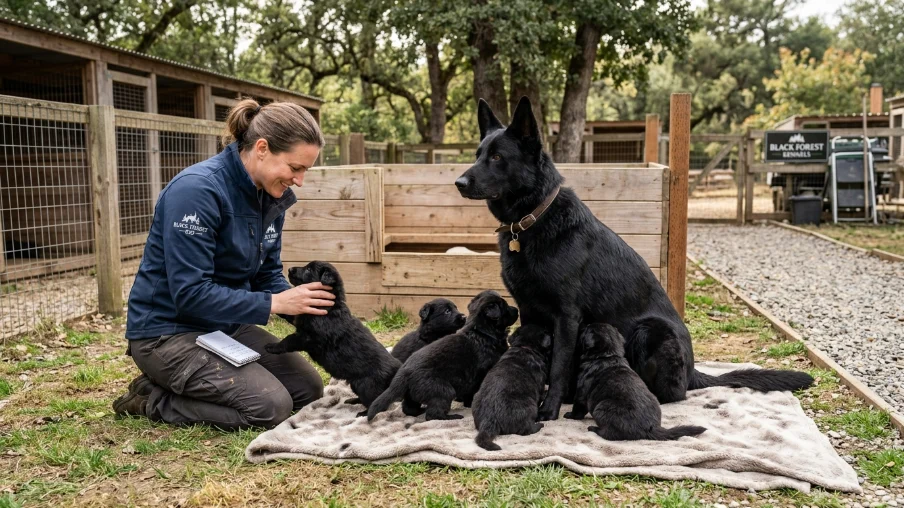
Black coat coloration results from recessive inheritance.
This means both parents must contribute the necessary genes for a puppy to display a solid black coat.
Common Myths
| Myth | Reality |
|---|---|
| Black dogs are larger | Not necessarily |
| Black dogs are smarter | No evidence supports this |
| Black dogs are healthier | Color alone does not affect health |
| Black dogs are more aggressive | Temperament depends on breeding and training |
Responsible breeders evaluate far more than color when selecting breeding stock.
Temperament and Personality
One reason German Shepherds remain so popular is their outstanding temperament when responsibly bred.
Black German Shepherd puppies are typically:
- Loyal
- Intelligent
- Confident
- Protective
- Trainable
- Family-oriented
They often form strong bonds with their owners and enjoy being involved in daily activities.
Proper socialization is essential.
Without early exposure to people, environments, sounds, and experiences, puppies may develop fear-based behaviors or excessive suspicion.
A stable German Shepherd should be confident rather than nervous and alert rather than reactive.
Intelligence and Trainability
German Shepherds consistently rank among the most intelligent dog breeds.
Black German Shepherd puppies usually learn quickly and enjoy structured training.
They excel in:
- Obedience
- Agility
- Tracking
- Protection sports
- Service work
- Search and rescue
Training should begin immediately after bringing a puppy home.
Short, positive sessions are generally more effective than long repetitive lessons.
Many behavioral issues arise not because the dog is stubborn, but because the dog lacks mental stimulation.
Raising a Black German Shepherd Puppy
The first year is critical.
First Week at Home
Focus on:
- Building trust
- Establishing routines
- Crate introduction
- House training
Socialization
Expose puppies safely to:
- Different people
- New environments
- Various surfaces
- Household noises
Puppy Biting
Most German Shepherd puppies go through a significant biting phase.
This is normal.
Consistent redirection and training are usually more effective than punishment.
Fear Periods
Many puppies experience temporary fear stages during development.
Owners should provide guidance and confidence rather than forcing interactions.
Exercise Requirements
Black German Shepherd puppies are energetic dogs.
However, excessive exercise during growth can stress developing joints.
Puppy Exercise Guidelines
- Short walks
- Play sessions
- Training games
- Controlled exploration
Adult Exercise Requirements
Most adults need:
- 60–120 minutes of activity daily
- Mental enrichment
- Structured training
Insufficient exercise often contributes to destructive behavior.
Health Problems and Genetic Risks
Black German Shepherds face the same health concerns as other German Shepherds.
Common Conditions
Hip Dysplasia
A developmental joint disorder affecting mobility.
Elbow Dysplasia
A common orthopedic condition.
Degenerative Myelopathy
A progressive neurological disease.
Bloat
A potentially life-threatening emergency affecting large breeds.
Allergies
Skin and environmental allergies are relatively common.
Recommended Health Testing
Responsible breeders commonly perform:
- Hip evaluations
- Elbow evaluations
- Genetic screening
- Cardiac screening
Health testing significantly improves breeding decisions.
Puppy Growth and Development Timeline
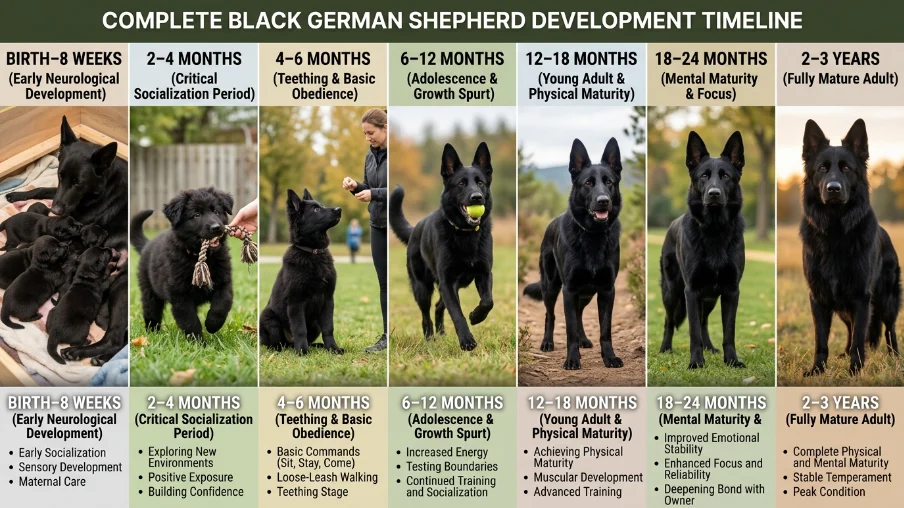
| Age | Development Stage |
|---|---|
| Birth–8 Weeks | Early social development |
| 2–4 Months | Critical socialization period |
| 4–6 Months | Teething and rapid learning |
| 6–12 Months | Adolescence |
| 12–18 Months | Continued physical growth |
| 18–24 Months | Mental maturity develops |
| 2–3 Years | Full adult temperament |
Typical Weight Progression
| Age | Weight Range |
|---|---|
| 8 Weeks | 10–20 lbs |
| 3 Months | 20–35 lbs |
| 6 Months | 40–60 lbs |
| 12 Months | 60–80 lbs |
Individual growth varies based on genetics and nutrition.
Feeding and Nutrition
Large-breed puppy nutrition is extremely important.
Goals should include:
- Steady growth
- Lean body condition
- Balanced nutrients
Avoid overfeeding.
Rapid growth can increase stress on developing joints.
Fresh water should always be available.
Grooming Guide
Black German Shepherd puppies require moderate grooming.
Brushing
- 2–3 times weekly
- More during seasonal shedding
Bathing
Only when necessary.
Overbathing can strip natural oils.
Nail Care
Trim regularly to prevent discomfort.
Ear Care
Inspect routinely for irritation or debris.
Step-by-Step Care Guide
Daily
- Exercise
- Training
- Social interaction
- Mental stimulation
Weekly
- Brushing
- Ear inspection
- Nail checks
Monthly
- Weight assessment
- Equipment inspection
- Preventive care review
Common Owner Mistakes
Choosing Color Over Quality
Many buyers become fixated on appearance.
Temperament and health should always come first.
Delaying Socialization
Missed socialization opportunities can create long-term issues.
Inadequate Exercise
German Shepherds need both physical and mental outlets.
Inconsistent Training
Dogs thrive when expectations remain clear.
Insights Most Articles Miss
Appearance alone tells you very little.
Many people assume the darkest, largest, or boldest puppy is automatically the best choice.
Experienced breeders focus on:
- Recovery from stress
- Environmental confidence
- Food drive
- Toy drive
- Nerve strength
- Structural soundness
These traits often predict future success far better than coat color.
Price Guide and Ownership Costs
Puppy Purchase Price
| Source | Typical Price |
|---|---|
| Pet Quality | $1,000–$2,000 |
| Show Line | $2,000–$4,000 |
| Working Line | $2,500–$5,000+ |
Ongoing Expenses
| Expense | Annual Estimate |
|---|---|
| Food | $600–$1,200 |
| Veterinary Care | $500–$2,000 |
| Training | $300–$2,500 |
| Supplies | $300–$800 |
The cheapest puppy often becomes the most expensive if health or behavioral issues develop later.
How to Find a Reputable Breeder
Look for breeders who:
- Perform health testing
- Prioritize temperament
- Provide documentation
- Socialize puppies
- Offer lifetime support
Avoid breeders whose primary marketing message focuses exclusively on rare colors.
Questions to Ask Before Buying
- Have the parents passed health testing?
- What temperament traits do they display?
- How are puppies socialized?
- Can I meet the mother?
- What genetic testing has been completed?
- What support is offered after purchase?
Buyer Warning Section
Red flags include:
- No health records
- Extremely low prices
- Poor living conditions
- Pressure to buy immediately
- Color-focused marketing
Responsible breeding is never based solely on appearance.
Lifestyle Compatibility
| Lifestyle Factor | Suitable? | Notes |
|---|---|---|
| Families | Yes | Excellent with training |
| Children | Yes | Supervision recommended |
| Apartments | Sometimes | Needs exercise |
| Active Owners | Excellent | Strong match |
| Working Homes | Excellent | Thrives with jobs |
| First-Time Owners | Sometimes | Requires commitment |
Black German Shepherd vs Black and Tan German Shepherd
| Trait | Black | Black and Tan |
|---|---|---|
| Color | Solid Black | Black and Tan |
| Popularity | Less Common | More Common |
| Temperament | Similar | Similar |
| Intelligence | Similar | Similar |
| Health Risks | Similar | Similar |
The primary difference is appearance rather than temperament or ability.
Preparation Checklist
Before bringing your puppy home:
- Purchase a crate
- Prepare food and water bowls
- Schedule a veterinary appointment
- Puppy-proof your home
- Create a socialization plan
- Research training methods
FAQs
Are Black German Shepherd puppies purebred?
Yes. Black coloration is a recognized color variation within the German Shepherd breed.
Are they rare?
They are less common than black-and-tan German Shepherds but not extremely rare.
Do they stay black?
Yes. Their coat remains black throughout life.
Are they more expensive?
Often yes, though breeder quality should matter more than color.
Are they good family dogs?
Well-bred and properly trained Black German Shepherds can be excellent family companions.
Are they aggressive?
No. Temperament depends on genetics, training, and socialization.
Do they shed heavily?
Yes. German Shepherds are moderate to heavy shedders.
How much exercise do they need?
Most adults require one to two hours of daily activity.
Conclusion
Black German Shepherd puppies combine the intelligence, loyalty, athleticism, and versatility that have made German Shepherds one of the world’s most respected working breeds. While their striking black coat attracts attention, experienced breeders understand that temperament, health testing, structure and trainability matter far more than color.
Choosing a responsibly bred puppy from health-tested parents gives owners the best chance of raising a confident, healthy, and capable companion for years to come.