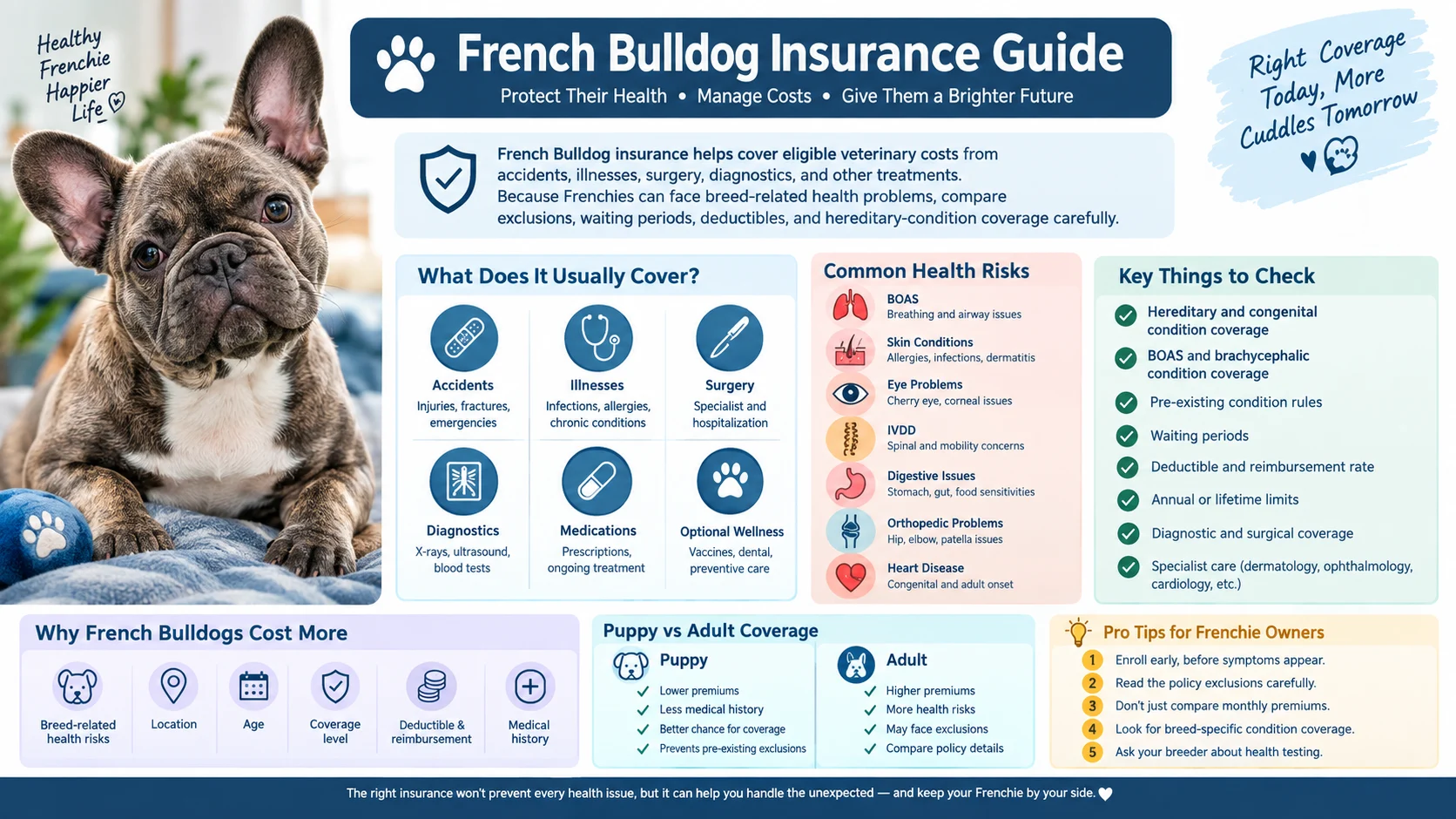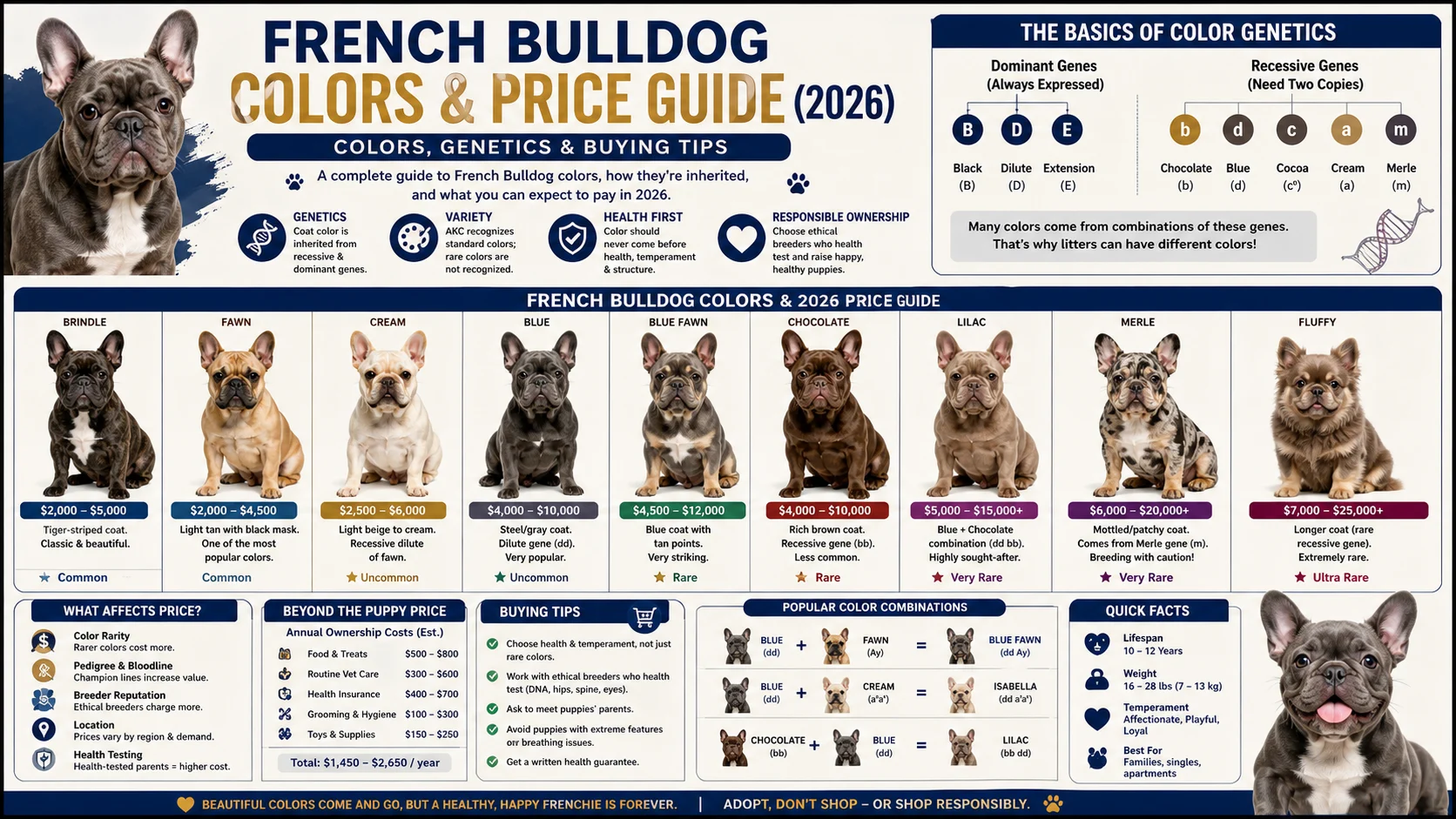
French Bulldog colors include brindle, fawn, cream, white, and pied patterns. Prices vary by breeder, pedigree, health testing, location, and color. Rare colors may cost more, but color alone does not indicate better health or quality. Responsible buyers should prioritize health, structure, temperament, and ethical breeding.
Quick Snapshot Table
| Category | Key Information |
|---|---|
| Breed | French Bulldog |
| Common Standard Colors | Brindle, fawn, white, combinations of these |
| Common Patterns | Brindle, pied, white markings, black mask |
| Coat | Short, smooth and brilliant |
| Rare Color Marketing | Often refers to non standard colors |
| Commonly Advertised Colors | Blue, lilac, chocolate, merle, black and tan |
| AKC Standard Status | Many advertised rare colors are disqualifying |
| Typical Puppy Price | Varies substantially by breeder, location and pedigree |
| Main Buyer Priority | Health, structure, temperament and responsible breeding |
| Biggest Pricing Mistake | Assuming rarer color means better quality |
Why French Bulldog Colors Matter More Than You Think
French Bulldogs come in a surprisingly wide range of colors and patterns, but not every color advertised online represents a color accepted by the breed standard.
The French Bull Dog Club of America lists brindle, fawn, white, brindle and white, and fawn and white among the recognized color combinations, while colors and patterns such as blue, liver, black and tan and merle are disqualifications under the U.S. breed standard.
That distinction matters when you are comparing French Bulldog prices.
A puppy marketed as “rare” or “exotic” may cost considerably more without being healthier, better bred or more valuable as a representative of the breed.
French Bulldog Colors Explained
Brindle French Bulldog
Brindle is one of the classic French Bulldog colors and consists of a fawn base with darker hairs forming stripes.
The pattern can range from relatively light striping to extremely dark brindling where only small amounts of the fawn background remain visible.
A correctly patterned brindle Frenchie can look almost black from a distance while still showing the required brindle character upon closer inspection.
Fawn French Bulldog
Fawn can range from:
- pale cream
- golden fawn
- warm tan
- reddish fawn
Some fawn French Bulldogs have a black mask, which is an accepted feature.
The shade can change significantly depending on lighting, age and individual pigmentation.
Cream French Bulldog
Cream is a very light coat variation and can appear almost white in photographs.
This is one reason online color identification can be misleading. Lighting, camera processing and coat condition can make cream, pale fawn and white dogs look remarkably similar.
White French Bulldog
White French Bulldogs can have predominantly white coats, but white does not automatically mean every marking pattern is identical.
The breed standard also recognizes specific combinations involving brindle or fawn markings.
Pied French Bulldog
Pied French Bulldogs have a predominantly white background with patches of color.
They may be:
- brindle pied
- fawn pied
Correct identification can be more complicated than simply calling a dog “white and brown.”
French Bulldog Color Chart
| Frenchie Color | Appearance | Standard Status |
|---|---|---|
| Brindle | Dark stripes over fawn | Accepted |
| Fawn | Light to reddish tan | Accepted |
| Cream | Very pale fawn/cream | Accepted |
| White | Predominantly white | Accepted |
| Brindle & White | Brindle patches on white | Accepted |
| Fawn & White | Fawn patches on white | Accepted |
| Blue | Diluted gray/blue pigmentation | Disqualifying under U.S. standard |
| Blue Fawn | Diluted fawn | Disqualifying under U.S. standard |
| Liver | Brown/chocolate pigmentation | Disqualifying |
| Black & Tan | Black body with tan points | Disqualifying |
| Merle | Irregular mottled patches | Disqualifying |
| Solid Black | Black without brindle trace | Disqualifying |
The French Bull Dog Club of America specifically identifies blue, blue fawn, liver, black and tan, black and white, white with black and merle among disqualifying colors or patterns.
Rare French Bulldog Colors
What Does “Rare Color” Actually Mean?
“Rare” is primarily a marketing term when used in French Bulldog advertisements.
A color can be genetically uncommon without being desirable under the breed standard.
This is particularly important with:
- blue
- lilac
- chocolate
- Isabella
- merle
- black and tan
The FBDCA specifically describes non standard “fad colors” as colors disqualified by the breed standard and warns buyers about inflated pricing associated with these dogs.
Why Rare Colors Cost More
Breeders may charge more because:
- fewer breeders produce them
- buyers perceive them as exclusive
- social media increases demand
- marketing emphasizes rarity
But a higher price does not establish better health or superior breeding quality.
French Bulldog Color Genetics
How Frenchie Color Is Produced
Coat color is controlled by multiple genetic loci rather than one simple “color gene.”
Relevant genetic systems include:
- E locus
- K locus
- A locus
- B locus
- D locus
- S locus
- M locus
- Cocoa locus
The AKC’s DNA testing information notes that French Bulldogs have a breed-specific cocoa locus and that the dilution locus is associated with lighter pigmentation such as blue and silver. It also emphasizes that coat color is genetically complex and cannot always be predicted from testing alone.
Why Genetics Matter to Buyers
A responsible breeder should be able to explain:
- parentage
- pedigree
- health testing
- relevant genetic testing
- expected coat colors
A breeder who talks endlessly about color but barely discusses health deserves additional scrutiny.
French Bulldog Price Guide 2026
French Bulldog puppy prices vary substantially according to:
- location
- pedigree
- breeder reputation
- health testing
- conformation
- age
- registration
- breeding rights
Because pricing changes significantly between countries and individual breeders, there is no single reliable “French Bulldog price.”
Typical Price Factors
| Factor | Effect on Price |
|---|---|
| Health Tested Parents | Often increases responsible breeding costs |
| Strong Pedigree | Can increase price |
| Show Potential | Often higher |
| Pet Quality | Usually lower than breeding/show prospects |
| Rare Color Marketing | Can dramatically increase advertised price |
| Breeder Reputation | Often increases price |
| Location | Major regional variation |
| Registration | May affect price |
| Health Guarantee | Can affect overall purchase cost |
The important distinction is this:
Price tells you what a breeder is charging. It does not tell you how healthy the puppy will be.
French Bulldog Color vs Price
Does Color Determine French Bulldog Price?
Color can influence asking price, but it should not be the primary measure of puppy quality.
A well bred brindle French Bulldog with appropriate health screening can be a far more responsible purchase than an expensive “rare color” puppy from a breeder who prioritizes appearance over health.
The FBDCA explicitly advises buyers to avoid breeders who produce and market disqualifying colors as rare or exotic.
Why Two French Bulldogs Can Have Very Different Prices
Consider two puppies:
| Puppy | Marketing | What Buyers Should Investigate |
|---|---|---|
| Standard Brindle | Classic color | Health testing, structure, pedigree |
| Blue “Rare” | Exotic color | Genetic background, health, breeder practices |
| Fawn Pied | Standard pattern | Health and conformation |
| Merle “Rare” | Highly marketed | Breed standard and health concerns |
The cheaper puppy is not automatically better.
The expensive puppy is not automatically better either.
The breeder’s program and the dog’s health should carry far more weight.
French Bulldog Health and Color
Why Color Should Never Come Before Health
French Bulldogs already require thoughtful breeding because of their brachycephalic structure and other breed-specific health considerations.
The French Bull Dog Club of America emphasizes health testing and responsible breeding as important parts of improving quality of life and longevity.
Important areas for buyers to investigate include:
- breathing function
- spine and orthopedic health
- eyes
- skin
- allergies
- reproductive health
- genetic testing
Color Related Health Questions
When a breeder is producing unusual colors, ask:
- Why was this color selected?
- What genetic tests were performed?
- Are both parents health tested?
- What health problems exist in the pedigree?
- Does the breeder prioritize breed standard structure?
- Can you see veterinary and health documentation?
These questions reveal much more than the puppy’s coat color.
French Bulldog Temperament Across Colors
Does Color Change Personality?
No reliable evidence supports the idea that a French Bulldog becomes more affectionate, intelligent or aggressive because it has a particular coat color.
Temperament is influenced by:
- genetics
- breeding selection
- early socialization
- environment
- individual personality
The official breed standard describes French Bulldogs as affectionate, adaptable, alert and playful with an even disposition.
A blue Frenchie is not automatically calmer.
A brindle Frenchie is not automatically more intelligent.
Color should not be used as a shortcut for predicting personality.
Puppy Development and Color Changes
Do French Bulldog Puppies Change Color?
Some can.
Puppies may appear:
- darker when young
- lighter after shedding puppy coat
- more strongly patterned as they mature
Brindle patterns can also become easier to identify as the coat develops.
When Is French Bulldog Color Most Obvious?
By the time a puppy is several months old, its basic color and pattern are usually much easier to evaluate.
However, photographs can still distort:
- cream vs fawn
- blue vs gray
- chocolate vs dark brown
- white vs very pale cream
Always evaluate the actual puppy in natural lighting when possible.
How to Choose a French Bulldog Breeder
What Responsible Breeders Prioritize
A responsible breeder should be able to discuss:
- health testing
- pedigree
- temperament
- structure
- puppy socialization
- veterinary care
- contracts
- lifetime support
The FBDCA recommends a written transaction contract and notes that responsible breeders should provide appropriate health and pedigree documentation.
What Should Make You Cautious
Be careful when a breeder’s website focuses heavily on:
- “ultra rare”
- “exclusive color”
- “designer Frenchie”
- “micro”
- “exotic”
- extreme pricing
while providing little information about health.
Buyer Warning: Don’t Pay for a Color Fantasy
The French Bulldog market has created powerful color marketing.
Words like:
- platinum
- lilac
- Isabella
- fluffy
- merle
- blue
- chocolate
can make an ordinary purchase decision feel like a luxury collectible purchase.
That is exactly when buyers should slow down.
The FBDCA states that it does not support breeding non standard colors and patterns including blue, lilac, Isabella, chocolate, merle and fluffy French Bulldogs.
The question should not be:
“Which color is rarest?”
It should be:
“Which puppy comes from the healthiest and most responsible breeding program?”
French Bulldog Colors Most Articles Get Wrong
Blue Is Not Simply “Gray”
Blue coloration is associated with pigment dilution and is commonly marketed as an exotic French Bulldog color.
Under the U.S. breed standard, however, blue is disqualifying.
Black Is Not Always a Disqualifying Frenchie
A dark brindle can look nearly black.
The distinction is whether there is evidence of brindling. The breed standard specifically states that solid black without a trace of brindle is disqualifying.
White and Pied Are Not Identical
A predominantly white French Bulldog with correctly recognized brindle or fawn patches falls into a different category from a dog with disqualifying black markings.
This is one reason experienced breeders and judges evaluate the actual pattern rather than relying on casual color labels.
French Bulldog Preparation Checklist
Before Contacting a Breeder
Check:
- breeder reputation
- health testing
- pedigree
- parent health history
- puppy veterinary records
- contract
- registration details
Before Paying a Deposit
Ask:
- What health tests have the parents completed?
- Can I see the documentation?
- What is the puppy’s exact registered color?
- What does the contract cover?
- What happens if the puppy develops a serious inherited condition?
- Can I meet the mother?
- How are puppies socialized?
Before Bringing the Puppy Home
Prepare:
- secure sleeping area
- food recommended by the breeder or veterinarian
- harness and lead
- temperature controlled environment
- veterinary appointment
- emergency veterinary contact
French Bulldogs should receive particular attention to temperature management because the breed can struggle in extreme heat and cold.
Frequently Asked Questions
What is the most common French Bulldog color?
Brindle is one of the most common and recognizable French Bulldog colors.
What colors are accepted in French Bulldogs?
Under the U.S. French Bulldog breed standard, accepted colors include brindle, fawn, white and combinations such as brindle and white or fawn and white.
What is the rarest French Bulldog color?
There is no single meaningful “rarest” color because many unusual colors are produced through specific genetic combinations and breeding practices. Some are also disqualified by the breed standard.
Are blue French Bulldogs purebred?
A dog can have French Bulldog ancestry and be genetically a French Bulldog while having a color that is disqualified under the breed standard. “Purebred” and “standard-accepted color” are not the same question.
Are rare French Bulldogs more expensive?
They can be advertised at much higher prices, but rarity alone does not establish health, quality or responsible breeding.
How much does a French Bulldog cost in 2026?
There is no universal 2026 price. Location, pedigree, health testing, breeder reputation, conformation and breeding rights can substantially change the asking price.
Is merle an accepted French Bulldog color?
Merle is disqualifying under the U.S. French Bulldog breed standard.
Is lilac an official French Bulldog color?
Lilac is not an accepted color under the FBDCA/AKC French Bulldog breed standard and is included among the non standard colors that the FBDCA does not support breeding for.
Which French Bulldog color is healthiest?
Color itself should not be treated as a reliable indicator of health. Breeding quality, health screening, structure and responsible selection matter far more.
Final Thoughts
French Bulldog colors are fascinating, but they can also create one of the biggest traps in the modern Frenchie market: confusing rarity with quality.
Brindle, fawn, white and correctly recognized combinations represent the traditional color spectrum described by the breed standard. Other colors may be heavily marketed as exotic or rare, but several are specifically disqualified under the U.S. standard.
For buyers, the smartest approach is simple: look past the color.
Prioritize health testing, breathing function, structure, temperament, pedigree and breeder ethics before paying a premium for a particular coat.
A beautiful French Bulldog is appealing.
A responsibly bred, healthy French Bulldog is what matters.