A Fluffy French Bulldog is a Frenchie with a genetically inherited long coat caused by recessive FGF5 variants. It is rare and visually distinctive, but the fluffy coat does not make the dog healthier or a separate breed.
Quick Snapshot
| Category | Details |
|---|---|
| Breed | French Bulldog |
| Common Names | Fluffy Frenchie, Long Haired French Bulldog |
| Coat Type | Long, soft, fluffy |
| Main Genetic Factor | FGF5 long hair variant |
| Inheritance | Recessive |
| Standard Frenchie Coat | Short and smooth |
| Fluffy Status | Non standard coat |
| Temperament | Affectionate, playful, alert |
| Exercise | Moderate |
| Grooming | Higher than standard Frenchie |
| Heat Tolerance | Poor |
| Typical Weight | Generally under 28 lb in AKC standard |
| Main Health Considerations | Airway, spine, joints, eyes, skin |
| Best For | Owners wanting a companion rather than an athletic dog |
What Is a Fluffy French Bulldog?
A Fluffy French Bulldog is a French Bulldog with a genetically inherited long coat instead of the breed’s standard short, smooth coat.
The fluffy appearance is associated with recessive variants in the FGF5 gene, which controls coat length in dogs. UC Davis Veterinary Genetics Laboratory specifically identifies the French Bulldog’s long hair phenotype with the L4 FGF5 variant.
The important distinction is that fluffy describes coat length, not a separate breed.
A Fluffy Frenchie can still have the familiar:
- compact body
- bat ears
- short muzzle
- broad chest
- muscular build
- playful French Bulldog personality
What changes most noticeably is the coat.
Fluffy vs Standard French Bulldog
| Feature | Standard Frenchie | Fluffy Frenchie |
|---|---|---|
| Coat | Short and smooth | Long and soft |
| FGF5 | Standard short coat genotype | Long hair variant |
| Face | French Bulldog type | French Bulldog type |
| Ears | Bat ears | Bat ears |
| Body | Compact | Compact |
| Temperament | French Bulldog temperament | Generally similar |
| Grooming | Relatively simple | More demanding |
| Show Coat | Standard | Disqualified from conformation |
| Rarity | Common | Uncommon |
The official French Bulldog standard calls for a short, smooth coat, and coats other than short and smooth are a disqualification in the AKC standard.
That does not mean a long haired dog cannot be a French Bulldog. It means the coat does not conform to the breed standard for conformation showing.
Why Are Fluffy French Bulldogs So Rare?
The answer is genetics.
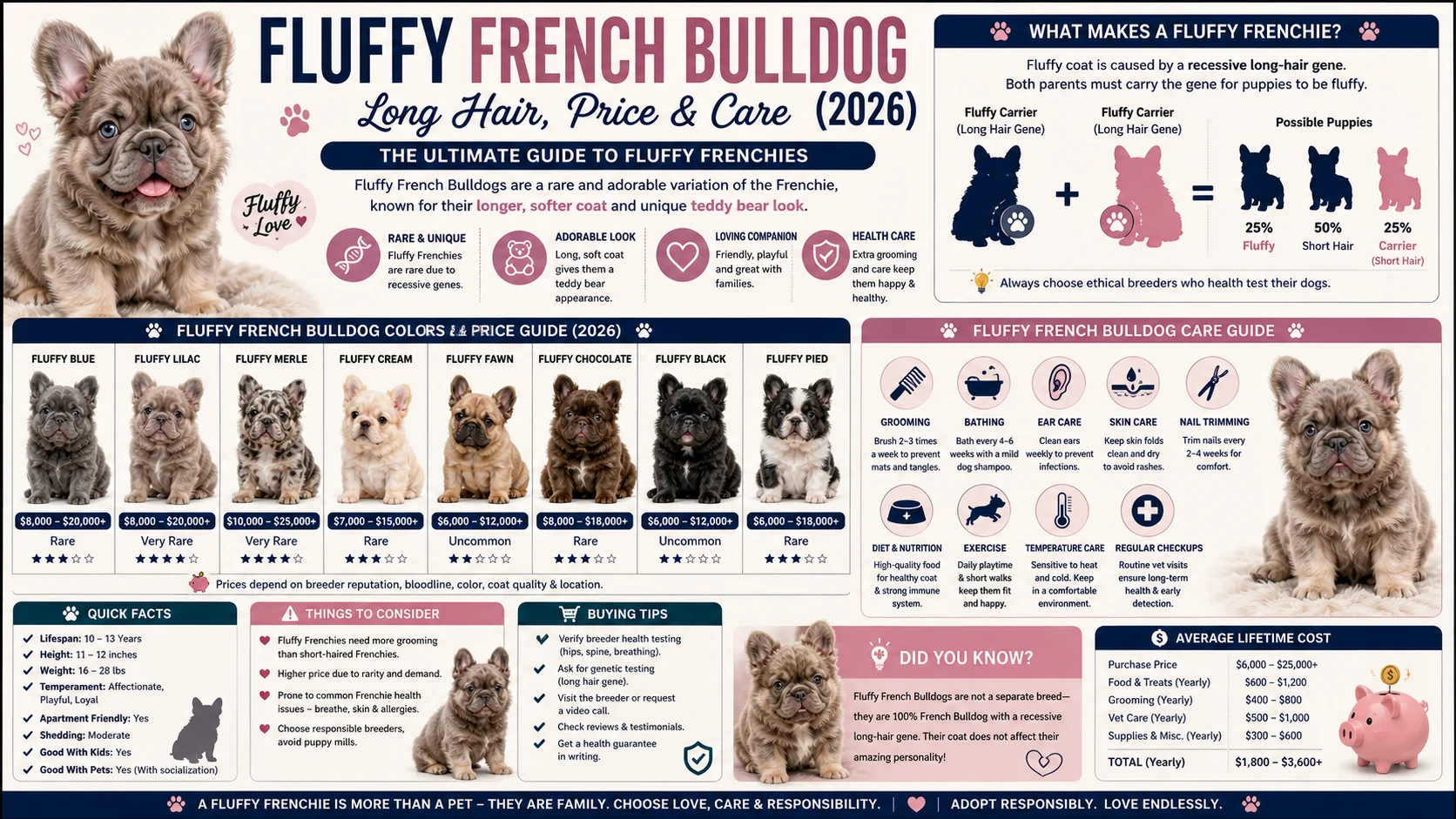
Long hair is generally recessive. A French Bulldog normally needs two copies of the relevant long hair variant to express the fluffy phenotype. UC Davis identifies several FGF5 variants across dogs and specifically notes the L4 variant in French Bulldogs.
How the Genetics Work
For simplicity, breeders often describe the long hair locus using:
L = short coat
l = long coat
A dog with:
| Genotype | Appearance |
|---|---|
| L/L | Short coated |
| L/l | Short coated carrier |
| l/l | Long haired or fluffy |
The terminology can vary between laboratories because different FGF5 variants exist, so buyers should look at the actual DNA report rather than relying only on labels such as “fluffy carrier.”
Can Two Short Haired Frenchies Produce a Fluffy Puppy?
Yes.
This is one of the most important facts for prospective breeders to understand.
Two visually normal short coated carriers can produce a long haired puppy because each parent can pass one recessive long hair allele.
That is why appearance alone cannot reliably tell you whether a French Bulldog carries the fluffy gene.
A DNA test is far more useful.
Fluffy French Bulldog Genetics
What the FGF5 Gene Does
FGF5 is involved in regulating hair growth.
Variants affecting this gene can change the length of the dog’s coat. The AKC explains that FGF5 is one of the major genes involved in canine coat length, while UC Davis identifies five known long hair variants and notes that the L4 variant occurs in French Bulldogs.
This is why the fluffy coat should not be confused with:
- a new breed
- a designer cross
- a special health condition
- a completely different French Bulldog type
It is primarily a coat-length trait.
Does Fluffy Mean Healthier?
No.
This is an important buyer distinction.
The long coat itself should not be treated as a health upgrade.
A Fluffy French Bulldog still has the underlying breed characteristics that require careful health consideration.
The French Bull Dog Club of America identifies breathing problems associated with brachycephalic structure, spinal conditions, allergies, and orthopedic problems among important French Bulldog health concerns.
So the real question is not:
“Is this puppy fluffy?”
It is:
“How healthy are the parents and how responsibly was this puppy bred?”
What Does a Fluffy French Bulldog Look Like?
The easiest way to recognize one is to look beyond the face.
The classic French Bulldog appearance remains, but the coat becomes noticeably longer and softer.
Common Coat Characteristics
You may see longer hair around:
- ears
- neck
- chest
- legs
- tail
- sides of the body
Some dogs have a moderately long coat, while others appear dramatically plush.
That variation is normal.
Puppy Coat vs Adult Coat
A young Fluffy French Bulldog may look only slightly different from a short coated puppy.
As the dog matures, the coat can become:
- fuller
- softer
- longer
- more feathered
This is one reason photographs alone are not always enough when evaluating a very young puppy.
Fluffy French Bulldog Colors
The fluffy gene is about coat length, not color.
That means a long haired French Bulldog can potentially occur with different color genetics.
You may see terms such as:
- fluffy cream
- fluffy fawn
- fluffy brindle
- fluffy pied
- fluffy blue
- fluffy chocolate
- fluffy lilac
But these terms describe combinations of different genetic traits.
Coat Length and Color Are Separate Traits
This matters because sellers sometimes bundle several “rare” traits together and create the impression that each trait represents a separate breed.
It does not.
A puppy’s:
- coat length
- base color
- dilution
- pattern
- markings
come from different genetic mechanisms.
The AKC’s French Bulldog DNA resources separately identify coat color loci and the L locus for long hair/fluffy.
Temperament and Personality
A Fluffy French Bulldog is still fundamentally a French Bulldog.
The longer coat does not automatically make the dog:
- calmer
- friendlier
- smarter
- more energetic
- more affectionate
Temperament is influenced by genetics, early development, socialization, training, and individual personality.
Typical French Bulldog Personality
Many Frenchies are:
- affectionate
- people oriented
- playful
- curious
- entertaining
- stubborn at times
- strongly attached to their owners
They often want to be involved in whatever their people are doing.
That can be charming.
It can also mean they do not particularly enjoy being ignored.
Are Fluffy French Bulldogs Good Family Dogs?
They can be excellent companion dogs for the right household.
They often fit well with:
- singles
- couples
- families
- apartment residents
- people who want a close companion
But their brachycephalic structure creates important lifestyle limitations.
The AKC notes that French Bulldogs have reduced heat and strenuous exercise tolerance compared with longer nosed breeds.
So they may be affectionate couch companions, but they are not built for long-distance running or intense outdoor exercise.
Exercise Requirements
A common mistake is assuming a French Bulldog needs very little activity.
The better description is moderate activity with careful intensity control.
Better Activities
Consider:
- short walks
- indoor play
- obedience games
- scent games
- puzzle toys
- controlled exploration
Avoid Excessive Heat
This is especially important.
French Bulldogs have short airways and can struggle to dissipate heat efficiently. The French Bull Dog Club of America specifically recommends keeping Frenchies cool and avoiding strenuous exercise in warm conditions.
The fluffy coat does not remove this limitation.
In fact, owners should be particularly attentive to overheating during warm weather.
Grooming a Fluffy French Bulldog
This is where the long coat makes a practical difference.
A standard French Bulldog has a short coat that generally requires relatively simple brushing.
A Fluffy Frenchie has more hair to maintain.
Weekly Grooming Routine
A practical routine includes:
- gentle brushing
- checking behind the ears
- checking skin folds
- inspecting paws
- nail trimming
- regular dental care
Why Ear and Fold Care Matters
Longer hair can make certain areas harder to inspect.
Owners should routinely check for:
- moisture
- irritation
- trapped debris
- redness
- odor
The goal is not excessive bathing.
It is consistent observation.
Puppy Development
Fluffy French Bulldog puppies generally follow the same broad developmental stages as other French Bulldogs.
The long coat does not automatically mean slower growth.
Puppy Development Timeline
| Age | Typical Development |
|---|---|
| 0–3 Weeks | Nursing, rapid early development |
| 3–5 Weeks | Walking, exploration begins |
| 5–8 Weeks | Social learning accelerates |
| 8–12 Weeks | New home and foundational training |
| 3–6 Months | Teething and rapid behavioral development |
| 6–12 Months | Adolescence and boundary testing |
| 1–2 Years | Adult personality becomes clearer |
What Owners Should Watch
During puppyhood, focus on:
- breathing quality
- healthy weight
- movement
- skin condition
- eye health
- social confidence
- tolerance for handling
Do not let the novelty of a fluffy coat distract you from ordinary puppy health checks.
Health Considerations
The long hair trait is not the main health concern.
The French Bulldog’s underlying structure deserves much more attention.
The French Bull Dog Club of America identifies several significant breed health concerns, including brachycephalic airway problems, vertebral abnormalities, disc disease, allergies, hip dysplasia, and patellar luxation.
Important Health Areas
| Health Area | Why It Matters |
|---|---|
| Airway | Short faced structure can impair breathing |
| Spine | Vertebral abnormalities and disc disease can occur |
| Hips | Hip evaluation is part of recommended screening |
| Patellas | Luxating patella evaluation is recommended |
| Eyes | Eye examinations are recommended |
| Heart | Cardiac evaluation is part of breed health screening |
| Skin | Wrinkles and allergies can require management |
Heat Tolerance Deserves Special Attention
A Frenchie that becomes extremely noisy, distressed, or overheated during mild activity should not simply be labeled “lazy.”
That can be a health warning.
The FBDCA recommends veterinary evaluation when breathing appears problematic and emphasizes the increased anesthesia risk associated with brachycephalic dogs.
Breeder Health Testing
This is one of the most important sections for anyone considering a Fluffy French Bulldog puppy.
The fluffy gene is interesting.
Health testing is more important.
The French Bull Dog Club of America lists hip, eye, patella, and cardiac evaluations within its CHIC health requirements, with additional recommended evaluations including respiratory function, elbows, juvenile hereditary cataracts, and other breed relevant testing.
Questions to Ask a Breeder
Ask:
- Have both parents been health tested?
- Can I see the actual results?
- What is the puppy’s FGF5 result?
- Are the parents carriers or affected for long hair?
- What respiratory health information is available?
- Have the parents had hip and patella evaluations?
- Has an ophthalmologist examined them?
- Can I see the pedigree?
- What health guarantees are provided?
- Can I meet the mother?
A breeder who talks for 30 minutes about coat color but avoids health testing is giving you useful information too.
Fluffy French Bulldog Price
Fluffy French Bulldogs often command higher asking prices because the trait is uncommon and demand is high.
However, there is an important distinction between rarity and quality.
A higher price does not automatically mean:
- better structure
- healthier parents
- better temperament
- ethical breeding
What Should Influence Puppy Value?
Look beyond the coat and consider:
- health testing
- pedigree
- breeder reputation
- veterinary care
- early socialization
- genetic testing
- structural quality
- respiratory health
- parental temperament
A fluffy coat should never be the main reason to pay a large premium.
AKC Registration and Show Status
This area causes considerable confusion.
The official AKC French Bulldog standard specifies a short, smooth coat and lists coats other than short and smooth as a disqualification in conformation.
So:
Fluffy does not mean “different breed.”
But:
Fluffy is not a standard show coat.
A breed standard describes the characteristics expected for conformation evaluation. AKC explains that a disqualification means a dog cannot compete in the conformation ring under that standard.
That distinction is important for buyers.
Fluffy French Bulldog vs Standard French Bulldog
| Factor | Fluffy Frenchie | Standard Frenchie |
|---|---|---|
| Breed | French Bulldog | French Bulldog |
| Coat | Long | Short |
| Coat Gene | Recessive long hair variant | Standard short coat |
| Grooming | Higher | Lower |
| Appearance | Plush | Sleek |
| Temperament | Generally Frenchie type | Frenchie type |
| Exercise | Moderate and controlled | Moderate and controlled |
| Heat Sensitivity | Still significant | Significant |
| Show Coat | Not standard | Standard |
| Health Priorities | Breed health concerns remain | Breed health concerns remain |
The biggest practical difference is the coat.
The biggest health considerations come from being a French Bulldog.
Common Mistakes Buyers Make
Mistake 1: Paying for Fluff Instead of Health
The coat is immediately visible.
Airway health is not.
That makes it easy for buyers to focus on the wrong thing.
Mistake 2: Assuming Rare Means Better
Rare is a description of frequency.
It is not a measurement of quality.
Mistake 3: Ignoring Respiratory Health
A cute puppy that struggles to breathe is not a healthy bargain.
Mistake 4: Buying Based on Social Media Photos
Photos can hide:
- poor structure
- breathing problems
- weak rear movement
- skin issues
- unhealthy body condition
Mistake 5: Confusing DNA Testing With Complete Health Testing
A genetic panel can answer specific genetic questions.
It cannot replace:
- physical examinations
- orthopedic evaluations
- cardiac checks
- eye examinations
- respiratory assessments
That distinction is especially important in French Bulldogs because several major health concerns are not simple single-gene disorders.
What Most Fluffy Frenchie Articles Miss
The Coat Is Not the Whole Story
The fluffy coat is what makes these dogs visually unusual.
But responsible ownership starts with the same question asked for every French Bulldog:
Can this dog breathe, move, eat, sleep, and live comfortably?
Long Hair Does Not Fix Breed Health Issues
Adding a long coat does not change the fundamental brachycephalic structure.
A fluffy Frenchie remains a short faced dog.
DNA Testing Can Tell You More Than Appearance
A short haired Frenchie can carry the long hair variant without showing it.
That means a breeder who claims:
“Neither parent is fluffy, so neither carries the gene.”
is not demonstrating sound genetic understanding.
Buyer Warning: Red Flags
Be especially careful when a breeder uses phrases such as:
- “ultra rare”
- “exclusive fluffy”
- “micro fluffy”
- “healthiest rare Frenchie”
- “guaranteed perfect airway”
- “rare coat means superior quality”
Marketing language is not health evidence.
A Better Breeder Conversation
A responsible breeder should be comfortable discussing:
- health testing
- pedigree
- genetic results
- respiratory health
- structure
- temperament
- puppy socialization
- veterinary records
The FBDCA emphasizes health registries and vertical pedigree information because records on parents and relatives can help breeders make more informed breeding decisions.
Preparation Checklist
Before bringing home a Fluffy French Bulldog, prepare:
Health
☐ Find a veterinarian experienced with brachycephalic dogs
☐ Ask for complete puppy veterinary records
☐ Review parental health testing
☐ Understand the puppy’s genetic results
Home
☐ Keep the environment temperature controlled
☐ Prepare a comfortable sleeping area
☐ Keep wrinkles and skin folds clean and dry
☐ Have appropriate grooming tools
Training
☐ Start gentle socialization
☐ Teach handling tolerance
☐ Begin basic obedience
☐ Avoid excessive heat and strenuous exercise
Is a Fluffy French Bulldog Right for You?
A Fluffy Frenchie may be a good match if you want:
- a close companion
- a playful house dog
- a visually unusual Frenchie
- a dog that enjoys human interaction
- a breed suited to moderate activity
It may not be the right choice if you want:
- a running partner
- a hiking dog for extreme heat
- a very low maintenance coat
- a dog with minimal potential health management
The coat should be one factor.
It should never be the only factor.
Frequently Asked Questions
What is a Fluffy French Bulldog?
A Fluffy French Bulldog is a French Bulldog with a genetically inherited long coat caused by recessive FGF5 variants associated with long hair.
Is a Fluffy French Bulldog a purebred?
A long coat does not by itself make a dog a mixed breed. A French Bulldog with the long hair trait can still have French Bulldog parentage and pedigree, although the coat is outside the AKC breed standard for conformation.
Why are Fluffy French Bulldogs so rare?
The long hair trait is recessive, so a puppy generally needs two copies of the relevant variant to express the long coat.
Can two short haired French Bulldogs produce a fluffy puppy?
Yes. If both parents carry a recessive long hair variant, they can produce a puppy that inherits two copies.
Is the Fluffy French Bulldog healthier than a normal Frenchie?
No. The fluffy coat should not be considered a health advantage. The dog still has the breed’s underlying health considerations, particularly concerning breathing, spine, joints, eyes, and skin.
Do Fluffy French Bulldogs shed?
Yes. Coat length does not mean zero shedding. Individual shedding levels vary, and the longer coat makes regular brushing more important.
Are Fluffy French Bulldogs difficult to groom?
They generally require more coat maintenance than the standard short coated French Bulldog, particularly around longer feathered areas.
Can Fluffy French Bulldogs be shown?
A long coat does not meet the AKC French Bulldog breed standard. The official standard specifies a short, smooth coat and lists other coat types as a disqualification in conformation.
Do Fluffy French Bulldogs overheat?
They can. Their long coat does not remove the heat and breathing limitations associated with the breed’s brachycephalic structure. French Bulldogs should be protected from excessive heat and strenuous exercise.
What should I test before buying a Fluffy French Bulldog?
Ask about FGF5 coat testing as well as breed relevant health evaluations. The FBDCA recommends hip, eye, patella, and cardiac evaluations and lists additional respiratory and genetic screening considerations.
Final Thoughts
The Fluffy French Bulldog is one of the most visually distinctive Frenchie variations because it combines the familiar compact French Bulldog appearance with a soft, longer coat.
But the smartest way to evaluate one is to look beyond the fluff.
Coat rarity is interesting. Health is important.
The best puppy is not necessarily the one with the longest coat, rarest color, or highest price. Look for responsible breeding, documented health testing, sound structure, stable temperament, and a breeder who is willing to discuss the dog’s health as openly as its appearance.
That is what turns a beautiful French Bulldog into a responsible long term companion.