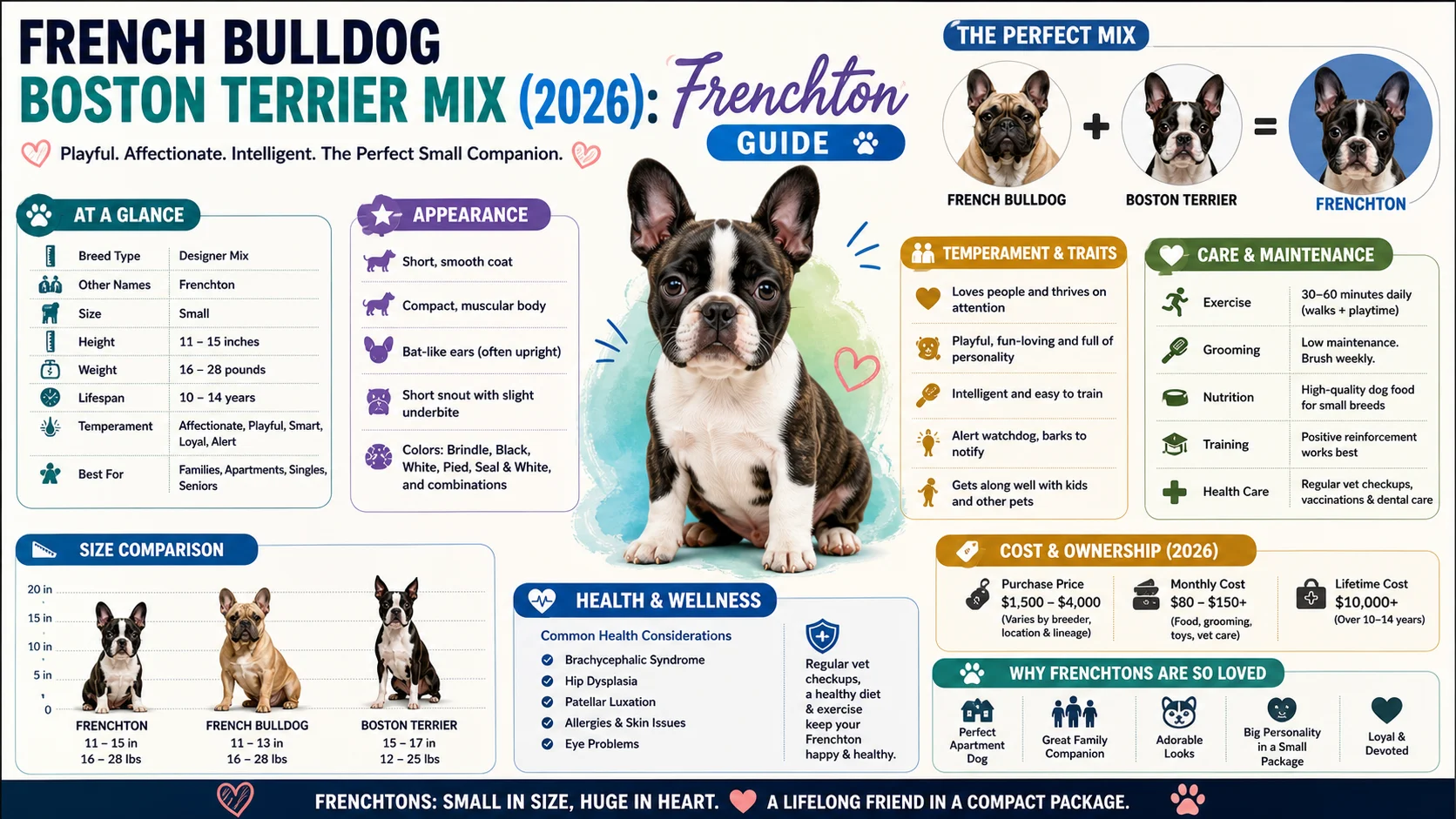
The French Bulldog Boston Terrier Mix, commonly called a Frenchton, is a small, affectionate companion dog known for its playful personality, compact build, and expressive face. Because both parent breeds are brachycephalic, breathing and heat tolerance are important health considerations.
Quick Snapshot
| Feature | Frenchton Details |
|---|---|
| Full Name | French Bulldog Boston Terrier Mix |
| Common Name | Frenchton |
| Other Names | Frenchbo, Boston Frenchie, Faux Frenchbo |
| Type | Mixed breed |
| Size | Small |
| Typical Height | About 11–15 inches |
| Typical Weight | About 15–25 pounds |
| Lifespan | Often estimated around 10–15 years |
| Coat | Short and smooth |
| Shedding | Low to moderate |
| Energy | Moderate |
| Temperament | Affectionate, playful, social |
| Trainability | Moderate to good |
| Apartment Living | Often suitable |
| Heat Tolerance | Poor to moderate |
| Main Health Concern | Brachycephalic breathing problems |
Because the Frenchton has no universal breed standard, adult size, appearance, and lifespan can vary considerably from one dog to another.
What Is a French Bulldog Boston Terrier Mix?
A French Bulldog Boston Terrier Mix is a cross between a French Bulldog and a Boston Terrier. The mix is commonly called a Frenchton, although names such as Frenchbo, Boston Frenchie, and Faux Frenchbo are also used.
It is a companion dog rather than a recognized separate breed with a universal kennel club standard. That means two Frenchton puppies from different breeders can look surprisingly different.
One puppy may inherit more of the French Bulldog’s stocky body and flatter face, while another may take after the Boston Terrier with a slightly longer muzzle and leggier frame.
That variation is important when buying a puppy.
You are not buying a predictable standardized breed. You are buying an individual cross whose traits can fall somewhere between two brachycephalic parent breeds.
Frenchton Appearance
What Does a Frenchton Look Like?
Most Frenchtons are small, muscular, compact dogs with a broad head and expressive eyes.
Common features include:
• Upright or semi-upright ears
• Short muzzle
• Broad chest
• Compact body
• Short smooth coat
• Short tail
• Large expressive eyes
• Strong facial wrinkles in some dogs
The Boston Terrier influence can sometimes produce a slightly longer muzzle and lighter athletic build.
The French Bulldog influence may produce:
• broader shoulders
• heavier bone
• shorter legs
• more pronounced facial folds
There is no guarantee which parent will dominate visually.
Frenchton Coat Colors
Possible colors include:
| Color or Pattern | Appearance |
|---|---|
| Brindle | Dark striped pattern |
| Black and White | Strong Boston Terrier influence |
| Fawn | Warm tan or cream body |
| Cream | Pale solid coat |
| Pied | White base with colored patches |
| Tuxedo | Dark body with white chest and markings |
Color should never be the primary reason to choose a puppy.
A healthy airway, sound movement, stable temperament, and responsible parent testing matter considerably more.
Frenchton Size and Weight
How Big Does a French Bulldog Boston Terrier Mix Get?
Most Frenchtons remain small dogs, commonly around 11–15 inches tall and 15–25 pounds, although individual dogs can fall outside those ranges.
| Growth Stage | Approximate Development |
|---|---|
| 8 Weeks | Small puppy with rapid growth ahead |
| 3 Months | Body and legs begin lengthening |
| 4–6 Months | Most noticeable puppy growth |
| 6–9 Months | Approaching adult height |
| 9–12 Months | Body begins filling out |
| 12–18 Months | Most reach mature proportions |
Because this is an unstandardized cross, weight alone should not be used to judge whether a puppy is developing correctly.
Body condition, muscle development, movement, appetite, and veterinary growth assessments provide a much better picture.
Frenchton Puppy Development
Birth to 8 Weeks
Frenchton puppies develop rapidly during their first two months.
Important milestones include:
• walking
• hearing and vision development
• social interaction with littermates
• beginning environmental exposure
• transitioning toward solid food
A responsible breeder should already be paying attention to breathing, movement, facial structure, and overall development.
8 to 12 Weeks
This is an important transition period.
Puppies begin:
• exploring independently
• learning household routines
• developing bite inhibition
• responding to basic cues
• building confidence
Gentle socialization is particularly important.
3 to 6 Months
This is where the puppy becomes noticeably more active.
You may see:
• increased playfulness
• chewing
• testing boundaries
• stronger attachment to owners
• rapid physical development
Training should remain positive and short.
Because Frenchtons can have breathing limitations, exercise should be adjusted to the individual puppy rather than pushed simply to “wear the dog out.”
6 to 12 Months
Adolescence begins.
Some Frenchtons become:
• stubborn
• energetic
• easily distracted
• more confident
• more independent
Consistent routines usually work better than harsh correction.
Temperament and Personality
Frenchtons are generally bred as companion dogs, and both parent breeds are strongly people-oriented.
A typical Frenchton may be:
• affectionate
• playful
• social
• entertaining
• attention-seeking
• moderately energetic
• occasionally stubborn
Sources describing the cross commonly emphasize its affectionate and outgoing personality, although individual temperament can vary.
The French Bulldog Influence
French Bulldogs often contribute:
• relaxed indoor behavior
• strong attachment
• playful stubbornness
• affection
• clownish behavior
The Boston Terrier Influence
Boston Terriers can contribute:
• alertness
• enthusiasm
• play drive
• responsiveness
• slightly more athletic movement
The result can be a dog that loves being involved in whatever the family is doing.
Is a Frenchton Good With Children?
Often, yes.
Their small size and affectionate personality can make them suitable family companions.
However, supervision remains important.
A Frenchton can become excitable during play, while young children may not understand when a small dog needs space.
Teach children to:
• avoid pulling ears or tails
• leave the dog alone while eating
• respect sleeping time
• avoid climbing on the dog
• interact calmly
Temperament is individual, so meeting the puppy and both parents is more informative than relying on breed labels alone.
Frenchton Training
Are Frenchtons Easy to Train?
Usually moderately easy, but they are not guaranteed to be obedient.
Both parent breeds are intelligent, but French Bulldogs can be stubborn and individual Frenchtons may inherit that independent streak.
Positive reinforcement is generally the most practical approach.
Focus on:
• name recognition
• recall
• loose-leash walking
• basic obedience
• calm greetings
• crate training
• handling tolerance
The Biggest Training Mistake
Do not confuse a small dog with a dog that needs little training.
A Frenchton that never learns boundaries can develop:
• excessive barking
• jumping
• leash pulling
• demanding behavior
• separation-related problems
Small size does not make poor behavior harmless.
Frenchton Exercise Needs
Frenchtons usually need moderate daily activity rather than intense athletic exercise.
Suitable activities include:
• short walks
• controlled play
• indoor games
• scent games
• basic obedience
• food puzzles
The major consideration is breathing.
Both parent breeds are brachycephalic, so a Frenchton may have difficulty cooling itself efficiently during exercise, particularly in hot or humid conditions.
Heat Safety
Avoid intense exercise during:
• hot afternoons
• humid weather
• poorly ventilated areas
Watch for:
• excessive panting
• slowing down
• noisy breathing
• weakness
• difficulty recovering after activity
A Frenchton should never be pushed through respiratory distress.
Frenchton Health and Genetics
Are Frenchtons Healthier Than French Bulldogs?
This is one of the biggest misconceptions surrounding the mix.
Crossing a French Bulldog with a Boston Terrier does not automatically produce a healthier dog.
Both parent breeds have brachycephalic anatomy, so a Frenchton can still inherit breathing problems.
The amount of muzzle length can vary, but appearance alone cannot guarantee healthy airway function.
Common Health Concerns
| Health Concern | Why It Matters |
|---|---|
| BOAS | Can restrict breathing and exercise tolerance |
| Heat intolerance | Short muzzles reduce cooling efficiency |
| Eye problems | Prominent eyes can be vulnerable to injury |
| Skin allergies | Both parent breeds can experience skin problems |
| Patellar luxation | Kneecap instability can affect movement |
| Spinal problems | Compact body structure can carry vertebral risks |
| Dental crowding | Short skulls can create oral problems |
Frenchtons may inherit health predispositions from either parent, making breeder selection particularly important.
Frenchton Breathing: The Issue Buyers Should Understand
A Frenchton can inherit brachycephalic airway obstruction from either side of the family.
Potential signs include:
• noisy breathing
• snoring
• exercise intolerance
• excessive panting
• difficulty exercising in heat
• prolonged recovery after activity
Occasional snoring is not automatically proof of disease, but persistent noisy breathing should not simply be dismissed as “normal for the breed.”
The healthier-looking puppy is not necessarily the healthier-breathing puppy.
Ask to see both parents moving and breathing normally after mild activity.
Frenchton Lifespan
Published estimates vary, with several sources placing Frenchton lifespan broadly around 10–15 years.
The variation exists because the Frenchton has no standardized population with a consistent breeding system.
Lifespan can be influenced by:
• genetics
• body condition
• airway health
• veterinary care
• diet
• heat exposure
• overall breeding quality
A healthy weight is especially important for a short-muzzled dog.
Extra body fat can make breathing and heat management more difficult.
Grooming and Shedding
Frenchtons usually have short, relatively easy-care coats.
Weekly Grooming
A basic routine can include:
• brushing once or twice weekly
• nail trimming
• ear checks
• dental care
• wrinkle cleaning when needed
They are not hypoallergenic.
Short hair also does not mean zero shedding.
Frenchton Diet and Weight Management
Nutrition should be based on:
• age
• body condition
• activity
• veterinary recommendations
Avoid allowing a Frenchton to become overweight.
This is particularly important because excess weight can place additional strain on:
• breathing
• joints
• heat regulation
• mobility
Instead of judging weight by the number on a scale alone, monitor body condition and discuss changes with your veterinarian.
Frenchton Puppy Buyer Guide
What Should You Ask a Breeder?
Ask:
- Can I meet both parents?
- How do the parents breathe after exercise?
- What health testing has been performed?
- Have the parents had airway or respiratory evaluations?
- Are there documented eye examinations?
- What health problems have occurred in previous litters?
- How are puppies socialized?
- What veterinary records come with the puppy?
The Most Important Visual Check
Watch the puppy breathe while it is:
• awake
• relaxed
• walking
• playing briefly
Do not select a puppy simply because it has the flattest face or most dramatic wrinkles.
In this mix, a more moderate facial structure can be a meaningful advantage, but veterinary assessment is still more reliable than appearance alone.
Frenchton Price
Frenchton puppy prices vary significantly according to location, breeder reputation, pedigree, health testing, demand, and puppy characteristics.
Some current sources report prices ranging from roughly $1,500 to $5,500, but there is no standardized market price.
A higher price does not automatically mean better breeding.
Look for:
• documented health testing
• transparent parent information
• veterinary records
• responsible socialization
• honest discussion of brachycephalic risks
Common Mistakes
Choosing the Flattest Face
A very short muzzle may look appealing but can be associated with greater respiratory challenges.
Assuming “Mixed Breed” Means Healthy
Crossbreeding does not automatically remove inherited health problems.
Exercising Too Hard
Frenchtons can be playful enough to keep going even when their breathing capacity is limited.
Ignoring Weight Gain
A few extra pounds matter on a small brachycephalic dog.
Buying From a Color First Breeder
Rare colors and unusual markings should never outweigh health and temperament.
Insights Most Articles Miss
A Slightly Longer Muzzle Is Not a Health Guarantee
A Frenchton may have a more pronounced muzzle than its French Bulldog parent, but that does not prove the airway is healthy.
Breathing function matters more than appearance.
Two Friendly Parents Do Not Guarantee Identical Puppies
Genetics can produce significant variation within the same litter.
One puppy may be:
• calmer
• more athletic
• more stubborn
• more social
• more brachycephalic
than its siblings.
Breeder Selection Is the Biggest Variable You Can Control
You cannot predict every genetic outcome.
You can, however, improve your odds by choosing breeders who prioritize:
• health
• stable temperament
• functional structure
• transparent records
Common Frenchton Mistakes at Home
Overheating
Never assume a Frenchton can handle summer exercise like a Boston Terrier with a longer muzzle.
Treating Snoring as Automatically Normal
Persistent or severe respiratory noise deserves veterinary attention.
Letting the Dog Become Sedentary
Heat limitations do not mean zero exercise.
Mental stimulation and controlled physical activity remain important.
Allowing Uncontrolled Jumping
Repeated jumping from furniture can be hard on a compact dog, particularly if orthopedic issues are present.
Lifestyle Compatibility
| Lifestyle | Compatibility |
|---|---|
| Apartment | Often excellent |
| Family home | Excellent |
| Active family | Good with heat management |
| Seniors | Often suitable |
| First-time owner | Potentially suitable |
| Hot climate | Requires significant caution |
| Long-distance runner | Poor match |
| Outdoor-only lifestyle | Poor match |
Frenchton Preparation Checklist
Before Bringing Home a Puppy
☐ Find a responsible breeder or reputable rescue
☐ Meet the puppy in person
☐ Observe breathing at rest and during gentle activity
☐ Meet both parents where possible
☐ Review veterinary records
☐ Ask about health screening
☐ Prepare a temperature-controlled sleeping area
☐ Choose appropriate puppy food
☐ Schedule a veterinary examination
☐ Plan positive-reinforcement training
Frequently Asked Questions
What is a French Bulldog Boston Terrier Mix called?
The most common name is Frenchton. Other names include Frenchbo, Boston Frenchie, and Faux Frenchbo.
How big does a Frenchton get?
Most are around 11–15 inches tall and 15–25 pounds, although the cross has no standardized size and individual dogs vary.
Is a Frenchton a good family dog?
Often yes. They tend to be affectionate, playful, and people-oriented, but young children should always be supervised around dogs.
Do Frenchtons have breathing problems?
They can. Both French Bulldogs and Boston Terriers are brachycephalic, so Frenchtons can inherit airway obstruction and heat intolerance.
Are Frenchtons healthier than French Bulldogs?
Not automatically. Some individuals may have a less extreme facial structure, but crossing two brachycephalic breeds does not eliminate inherited respiratory or other health risks.
Are Frenchtons easy to train?
Generally, they can learn quickly with positive reinforcement, but some inherit a stubborn streak. Consistency is more effective than harsh correction.
Do Frenchtons shed?
Yes. Their short coat is relatively easy to maintain, but they can still shed.
Can Frenchtons live in apartments?
Yes, many adapt well to apartment living because of their small size and moderate exercise needs. Heat management and daily mental stimulation remain important.
Conclusion
The French Bulldog Boston Terrier Mix is a small companion dog with a big personality. The Frenchton can combine the French Bulldog’s affectionate, comic nature with the Boston Terrier’s playful and alert temperament.
But there is one point prospective owners should remember above everything else: cute does not equal healthy.
Both parent breeds have brachycephalic characteristics, so responsible buyers should evaluate breathing, facial structure, movement, temperament, and health testing rather than relying on appearance or the promise that a mixed breed is automatically healthier.
For the right owner, a well-bred Frenchton can be an affectionate, entertaining, highly engaging household companion. The best puppy is not necessarily the smallest, flattest-faced, or most unusual-looking one. It is the puppy coming from breeding decisions that put function, health, and stable temperament ahead of fashion.