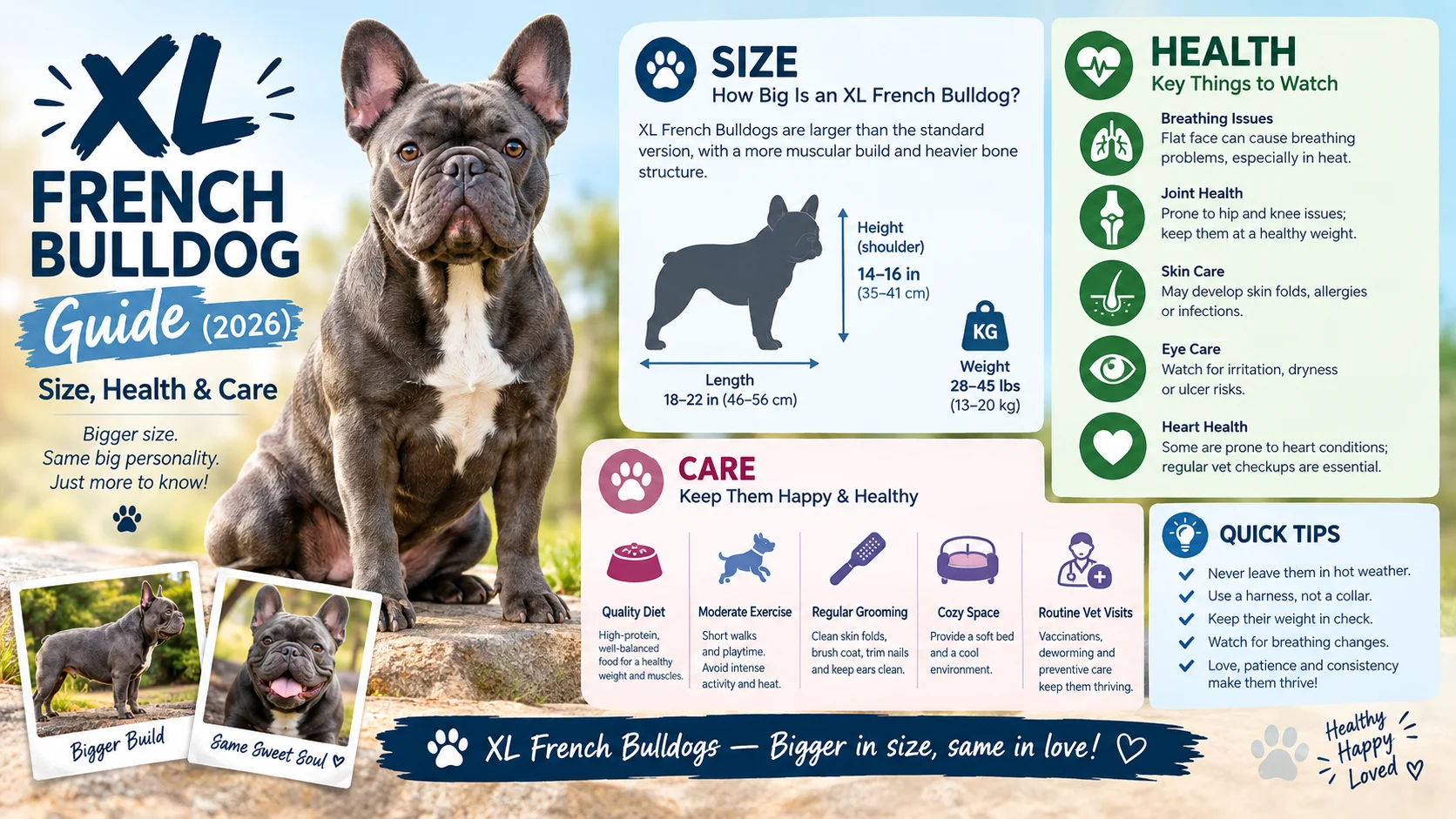
The XL French Bulldog is a larger-than-standard Frenchie, but “XL” is not an official breed size.
Its bigger frame can look impressive, yet breathing, structure, and healthy body condition matter more than size. Before buying, check the parents’ health testing and understand exactly what the breeder means by “XL.”
What Is an XL French Bulldog?
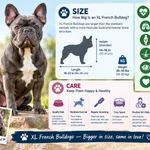
An XL French Bulldog is an informal term used for a Frenchie that is noticeably larger or heavier than the traditional breed type. It is not a separate breed or an official AKC size category.
The distinction matters because the official AKC French Bulldog standard describes a compact, muscular dog and sets a maximum weight of 28 pounds for the breed standard. A French Bulldog exceeding that weight falls outside the AKC conformation standard.
So when a breeder advertises an “XL French Bulldog,” “giant Frenchie,” or “big Frenchie,” the label alone does not tell you why the dog is larger.
The extra size could come from:
- natural variation within the breed
- a larger individual from a particular bloodline
- heavier bone and muscle
- excess body fat
- breeding outside traditional breed type
- crossbreeding or unclear pedigree
Experienced breeders therefore look beyond the word XL.
The real question is not simply, “How big will this Frenchie get?”
It is:
Why is this dog larger, and does that size come with sound structure and good health?
XL French Bulldog Size and Weight
There is no universally accepted official measurement for an “XL French Bulldog.”
That means two breeders can use the term while describing completely different dogs.
Traditional French Bulldog Size
The AKC standard specifies a maximum weight of 28 pounds and describes the breed as compact, muscular, and heavy boned.
| Category | Traditional French Bulldog | XL French Bulldog |
|---|---|---|
| Official AKC size class | Yes | No |
| AKC standard maximum weight | 28 lb | No official XL limit |
| Body type | Compact and muscular | Usually larger or heavier |
| Bone | Heavy for size | Often noticeably heavier |
| Height | No separate XL standard | Varies |
| Breed status | French Bulldog | Depends on pedigree |
| Main concern | Breed appropriate structure | Why the dog is oversized |
An XL Frenchie should therefore not be judged by weight alone.
A heavily muscled, structurally sound dog is very different from a dog carrying excessive body fat.
How Big Can an XL French Bulldog Get?
There is no reliable universal adult weight because “XL” is a marketing term rather than a standardized variety.
Some dogs described this way may be only moderately larger than typical Frenchies, while others may be substantially heavier.
That makes breeder claims such as “guaranteed 40 lb XL Frenchie” worth questioning.
Genetics, nutrition, sex, skeletal development, and pedigree all influence adult size.
Why Are Some French Bulldogs So Large?
Several factors can produce a larger than expected French Bulldog.
Bloodline Genetics
Some family lines naturally produce dogs with:
- heavier bone
- more muscle
- broader frames
- larger overall proportions
This does not automatically mean the dog is unhealthy.
The concern begins when exaggerated size is prioritized over functional structure.
Mixed or Unclear Genetics
Some dogs advertised as XL French Bulldogs may have ancestry from another breed.
That does not necessarily make them poor pets, but buyers should know exactly what they are purchasing.
A breeder should be able to explain:
- pedigree
- parentage
- registration
- health testing
- expected adult size
Nutrition and Body Condition
Not every large Frenchie is genetically XL.
Some are simply overweight.
This is especially important because excess weight places additional physical demands on a short faced breed.
A healthy dog should be evaluated by body condition and muscle coverage, not by a scale alone.
XL French Bulldog Appearance
A larger French Bulldog can still have the recognizable features people associate with the breed:
- broad head
- bat ears
- short muzzle
- compact body
- muscular shoulders
- short coat
- distinctive facial wrinkles
However, bigger does not automatically mean better.
The official breed standard emphasizes balance and proportion, not maximum possible size.
What Good Structure Looks Like
Look for:
- balanced proportions
- comfortable movement
- stable gait
- adequate breathing at rest
- strong but not exaggerated bone
- healthy body condition
- functional nostrils
- clear eyes
A Frenchie that looks impressive standing still but struggles to breathe or walk comfortably is not a successful breeding outcome.
Temperament of an XL French Bulldog
Size does not create a unique XL temperament.
A well bred French Bulldog is generally:
- affectionate
- playful
- people oriented
- adaptable
- alert
- sometimes stubborn
- often entertainingly expressive
The larger dog can still have the same companion oriented personality as a standard sized Frenchie.
Are XL French Bulldogs Aggressive?
Being larger does not inherently make a French Bulldog more aggressive.
Temperament is influenced by genetics, early development, socialization, environment, and training.
A responsible breeder should evaluate temperament rather than using size as a selling point.
Energy Level
French Bulldogs are generally companion dogs rather than endurance athletes.
An XL Frenchie may look capable of more physical work because of its larger frame, but owners should not assume that extra size means greater exercise tolerance.
The short muzzle remains an important consideration.
French Bulldogs are brachycephalic, meaning their shortened facial structure can make breathing less efficient than in longer nosed breeds. They can also be less tolerant of heat and strenuous exercise.
This is one of the biggest misconceptions surrounding large Frenchies:
A bigger Frenchie is not automatically a more athletic Frenchie.
Health Considerations for XL French Bulldogs
Health should be the most important section for anyone considering an XL Frenchie.
French Bulldogs already require careful attention to several structural and inherited health concerns. Making the dog larger does not remove those concerns.
Breathing and Brachycephaly
Short faced anatomy can affect airflow and exercise tolerance.
Watch for:
- noisy breathing
- excessive panting
- difficulty recovering after activity
- overheating
- exercise intolerance
- breathing distress
The severity varies between individual dogs, so buyers should evaluate the actual puppy and parents rather than relying on appearance.
Spine and Joint Concerns
French Bulldogs can also experience orthopedic and spinal problems.
The American Kennel Club’s French Bulldog health resources identify genetic risks including intervertebral disc disease risk associated with chondrodystrophy.
A larger, heavier body may make sound structure even more important.
Eye Problems
Prominent French Bulldog eyes can require particular attention.
Breed health information includes ophthalmic screening among recommended evaluations for breeding dogs.
Owners should watch for:
- redness
- squinting
- excessive tearing
- cloudiness
- rubbing at the face
Eye problems should be assessed promptly by a veterinarian.
Skin and Wrinkle Care
The characteristic facial folds require routine care.
Moisture and debris can accumulate in skin folds, particularly around the face.
Keep folds:
- clean
- dry
- regularly inspected
Other Genetic Health Concerns
French Bulldog genetic screening can include conditions such as:
- hereditary cataracts
- cystinuria type 3
- degenerative myelopathy
- hyperuricosuria
- intervertebral disc disease risk
- multifocal retinopathy
- progressive retinal disorders
The AKC specifically lists these among genetic variants identified for French Bulldogs.
This is why buying an “XL” puppy without seeing the parents’ health documentation is risky.
Puppy Development Timeline
An XL French Bulldog puppy should not be judged solely by how heavy it is at eight or ten weeks.
Puppies develop unevenly.
The better question is whether growth is proportionate and whether movement, breathing, appetite, and overall development appear healthy.
| Age | Typical Development | What Owners Should Watch |
|---|---|---|
| 0 to 4 weeks | Rapid early growth | Nursing, breathing, weight gain |
| 4 to 8 weeks | Coordination improves | Body proportions and movement |
| 2 to 3 months | Growth becomes obvious | Legs, chest, head and body balance |
| 3 to 6 months | Major skeletal and muscular development | Weight gain versus body condition |
| 6 to 9 months | Adolescent structure develops | Mobility, breathing and stamina |
| 9 to 12 months | Growth begins slowing | Healthy body condition |
| 12 to 18 months | Adult proportions become clearer | Final frame and muscle development |
The Most Important Puppy Growth Period
The first six months deserve particular attention.
This is when owners can easily confuse:
“big puppy”
with
“healthy puppy.”
They are not the same thing.
A puppy carrying too much weight can look impressive while placing unnecessary stress on developing joints.
How to Monitor an XL Frenchie Puppy
Track:
- body weight
- body condition
- appetite
- stool quality
- breathing
- activity tolerance
- gait
- growth pattern
Regular veterinary examinations are more useful than comparing your puppy’s weight with random internet charts.
XL French Bulldog Exercise Needs
Exercise should be moderate and carefully controlled.
French Bulldogs are not built for long distance running, particularly in hot or humid conditions.
Better Activities
Good options include:
- short walks
- indoor play
- scent games
- basic obedience
- food puzzles
- controlled play sessions
Exercise Mistakes to Avoid
Avoid:
- long runs
- intense outdoor exercise in heat
- forced exercise
- prolonged activity without breaks
- assuming a larger dog can tolerate more exertion
A Frenchie should finish activity comfortable rather than exhausted.
XL French Bulldog Care Guide
Feeding
The goal is controlled growth and healthy body condition.
Avoid intentionally overfeeding a puppy because you want a larger adult.
Puppy nutrition should be discussed with a veterinarian, particularly when growth appears unusually fast.
Grooming
The short coat is relatively easy to maintain.
A basic routine includes:
- weekly brushing
- wrinkle inspection
- ear checks
- nail trimming
- dental care
Dental Care
French Bulldogs can have significant dental crowding because of their head and jaw structure.
Regular veterinary dental assessment and home dental care are therefore valuable parts of long term ownership.
XL French Bulldog Breeder Evaluation
This is where buyers need to slow down.
A breeder advertising “XL,” “huge,” or “extra large” should not automatically impress you.
Experienced breeders focus on health first.
Ask for Parent Health Testing
The AKC lists recommended French Bulldog evaluations including:
- patella evaluation
- hip evaluation
- cardiac examination
- ophthalmologist evaluation
Ask the breeder for actual documentation rather than accepting statements such as:
“The parents are healthy.”
Questions to Ask the Breeder
Ask:
- How much do the parents weigh?
- Why are these puppies considered XL?
- Are they purebred?
- Can I see the pedigree?
- What health testing was performed?
- Have the parents had cardiac evaluations?
- Have their eyes been examined?
- Have their hips and patellas been evaluated?
- How do the parents breathe after exercise?
- Have previous puppies developed respiratory or spinal problems?
The breeder’s answers can tell you almost as much as the puppy itself.
XL French Bulldog Price
There is no official price category for XL French Bulldogs.
A higher price does not prove higher quality.
Some breeders charge premiums for:
- unusual size
- rare colors
- unusual markings
- pedigree
- breeding potential
But buyers should separate rarity marketing from genuine health value.
A more expensive puppy is not automatically healthier.
Common Mistakes Buyers Make
Choosing Size Over Structure
A massive Frenchie may attract attention, but structural balance matters more.
Assuming Bigger Means Healthier
This is one of the most dangerous assumptions.
Size does not automatically improve breathing, joints, spine, or heat tolerance.
Paying Extra for the Word “XL”
XL is not a standardized AKC designation.
Ask what the breeder actually means.
Ignoring the Parents
The parents often provide valuable information about:
- adult size
- breathing
- movement
- temperament
- skin
- eyes
- structure
Overfeeding the Puppy
Trying to make a puppy “extra large” can create an unhealthy body condition.
Insights Most Articles Miss
XL Does Not Mean Giant Breed
An XL French Bulldog is still fundamentally a small brachycephalic companion dog.
Calling a Frenchie “XL” should not make owners treat it like a larger athletic breed.
Weight Is Not the Same as Muscle
A muscular Frenchie and an overweight Frenchie can have very different health profiles.
Learn to evaluate body condition rather than chasing a number.
The Parents Matter More Than the Advertisement
A breeder’s website may show an impressive adult dog.
The more useful information is often hidden in the health records of the parents.
Breathing Should Be Evaluated Functionally
A Frenchie that looks attractive while standing still may still have serious exercise limitations.
Observe:
- resting breathing
- recovery after gentle activity
- heat response
- willingness to move
Appearance cannot replace functional evaluation.
Lifestyle Compatibility
| Lifestyle | XL French Bulldog Suitability |
|---|---|
| Apartment living | Often suitable |
| Family companion | Often suitable |
| Young children | Suitable with supervision |
| Hot climate | Requires extra caution |
| Long distance runner | Poor match |
| Hiking enthusiast | Limited |
| First time owner | Possible with preparation |
| Low activity household | Often suitable |
Hot Weather Warning
French Bulldogs require particular caution in hot conditions because their short faced anatomy can reduce heat tolerance.
An XL body does not eliminate this concern.
In hot climates, owners should prioritize:
- air conditioning
- cool indoor environments
- short outdoor sessions
- water access
- avoiding midday heat
Heat related breathing distress can become an emergency.
Preparation Checklist
Before bringing home an XL French Bulldog, confirm:
Health
- Parent health records reviewed
- Puppy examined by a veterinarian
- Breathing appears comfortable
- Eyes appear healthy
- Movement is normal
- Body condition is appropriate
Breeder
- Pedigree available
- Parent information available
- Health testing documented
- Clear explanation of XL terminology
- No pressure to buy immediately
Home
- Cool sleeping area
- Safe flooring
- Limited stairs
- Comfortable harness
- Appropriate food
- Wrinkle care supplies
- Veterinary plan
Frequently Asked Questions
Is an XL French Bulldog a real breed?
No. XL French Bulldog is an informal description rather than a separate recognized breed or official AKC size category.
How much does an XL French Bulldog weigh?
There is no standardized XL weight. The official AKC French Bulldog standard sets a maximum weight of 28 pounds, so dogs above that fall outside the AKC conformation standard.
Are XL French Bulldogs healthy?
They can be healthy individuals, but larger size does not guarantee better health. French Bulldog buyers should pay particular attention to breathing, spinal health, joints, eyes, heart, and body condition.
Are XL French Bulldogs purebred?
Some may be purebred French Bulldogs that are simply larger than the breed standard, while others advertised as XL may have different ancestry. Ask for pedigree and parentage documentation.
Do XL French Bulldogs have more health problems?
Not necessarily because they are “XL,” but health risks can become more concerning when excessive weight or poor structure is involved. The individual dog’s anatomy and health history matter more than the label.
Can XL French Bulldogs exercise more than normal Frenchies?
Not automatically. French Bulldogs remain brachycephalic, and their breathing and heat tolerance should determine exercise intensity rather than their body size.
What health tests should an XL French Bulldog breeder provide?
Useful evaluations include patella, hip, cardiac, and ophthalmologist examinations, along with relevant genetic testing. The AKC lists these health evaluations in its French Bulldog recommendations.
Final Thoughts
An XL French Bulldog can be an affectionate, entertaining, and devoted companion, but the word XL should never be the reason you buy one.
The better approach is to investigate why the dog is larger, whether the parents are health tested, how the puppy breathes and moves, and whether its structure remains functional.
Experienced French Bulldog breeders focus on the same fundamentals that responsible owners should look for:
health, breathing, structure, temperament, and longevity.
Size can be interesting.
It should never become more important than the dog underneath it.