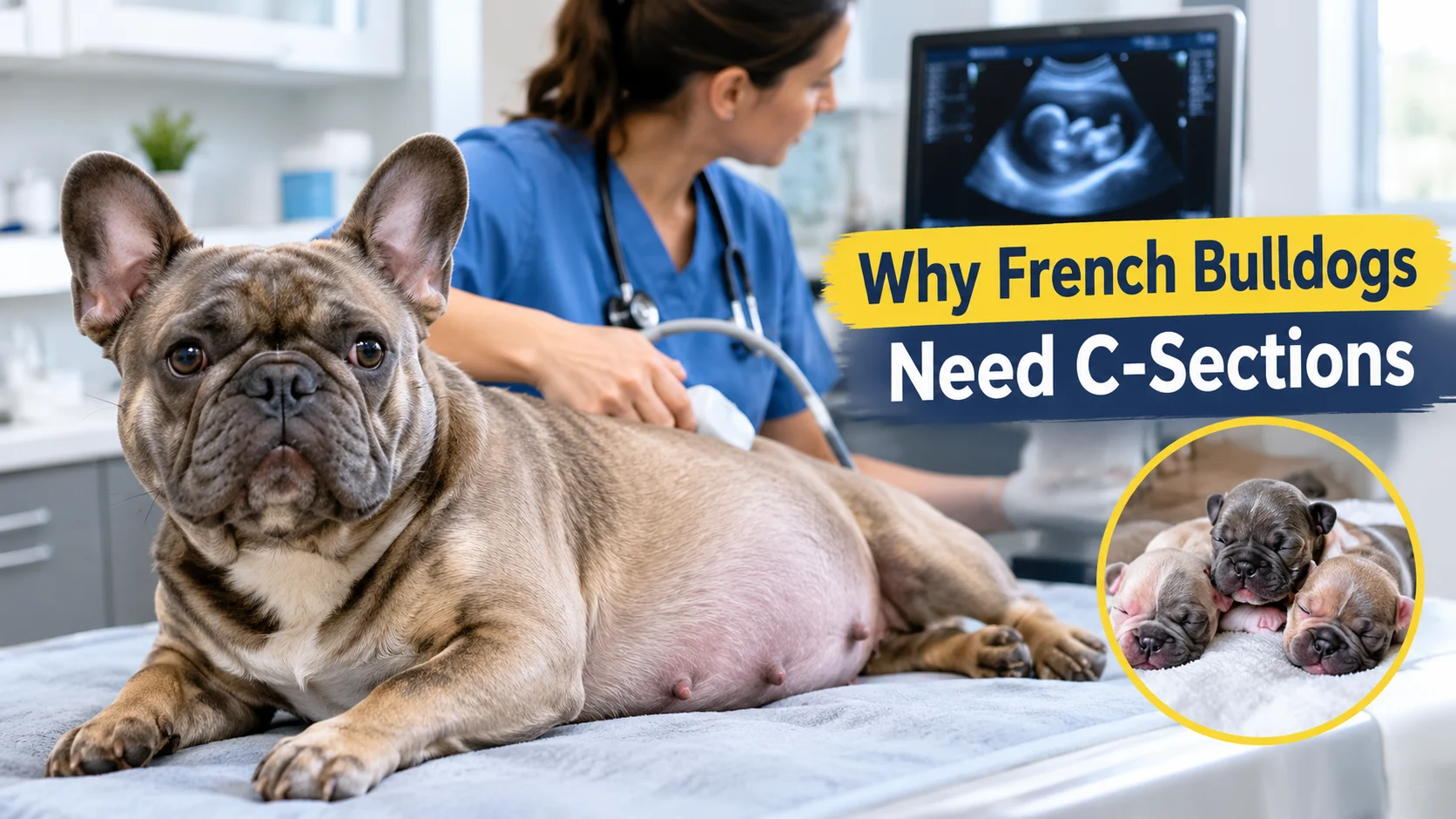
French Bulldogs often need C sections due to difficult births.
Quick Snapshot Table
| Factor | Why It Matters |
|---|---|
| Breed | French Bulldog |
| Main Birth Risk | Dystocia, or difficult labor |
| Head Size | Relatively large puppy heads |
| Pelvis | Relatively narrow maternal birth canal |
| Body Structure | Compact, muscular conformation |
| Puppy Size | Can contribute to difficult delivery |
| Natural Birth | Possible in some cases |
| C Section | Commonly recommended when risk is high |
| Main Concern | Safe delivery of mother and puppies |
| Planning | Veterinary assessment is essential |
Why French Bulldogs Need C Sections
French Bulldogs are one of the dog breeds in which difficult birth, known as dystocia, is a significant concern. Their compact body structure, relatively large puppy heads, and maternal pelvic anatomy can make natural delivery difficult or dangerous.
The important point is that French Bulldogs do not automatically require a C section in every pregnancy. The decision depends on the individual female, pregnancy, puppy size and position, previous reproductive history, and veterinary assessment.
For high risk pregnancies, a planned cesarean section can reduce the danger of prolonged or obstructed labor.
The Anatomy Behind Difficult Births
Large Puppy Heads
French Bulldog puppies have relatively broad heads compared with the mother’s pelvic dimensions.
This can create a problem called fetopelvic disproportion, where the puppy is too large to pass safely through the mother’s birth canal.
Narrow Maternal Pelvis
The female French Bulldog’s compact skeletal structure can contribute to a relatively restricted birth canal.
When a puppy’s head or shoulders cannot pass easily, labor may become prolonged or obstructed.
Compact Body Structure
The breed’s short muzzle, broad head, compact frame, and muscular build are part of the appearance people love.
Unfortunately, some of those same physical characteristics can make natural delivery more challenging.
Here is where many owners get it wrong: the problem is not simply that French Bulldogs are “small.” It is the relationship between the puppy’s size and shape and the mother’s pelvic anatomy.
What Is Dystocia?
Dystocia means difficult or abnormal labor.
In French Bulldogs, dystocia can occur when:
- a puppy is too large to pass
- a puppy is positioned incorrectly
- contractions are inadequate
- the mother becomes exhausted
- multiple puppies create complications
- the birth canal cannot accommodate the puppy
Dystocia is a veterinary emergency when labor becomes obstructed or the mother or puppies show signs of distress.
Why Puppy Size Matters
Fetopelvic Disproportion
One of the major concerns is a mismatch between puppy size and the mother’s pelvic canal.
A puppy does not need to be unusually large overall to create a problem. Head width, shoulder dimensions, position, and the mother’s anatomy all matter.
Litter Size Can Also Matter
A very small litter can sometimes present additional concerns because individual puppies may have more room and potentially become larger.
This is one reason responsible breeders do not rely on a single factor when predicting delivery difficulty.
Why a Planned C Section May Be Safer
A planned C section allows the veterinary team to prepare before a crisis develops.
Potential advantages include:
- controlled timing
- prepared surgical staff
- reduced risk of prolonged obstructed labor
- rapid access to neonatal support
- better planning for high risk pregnancies
The goal is not convenience.
The goal is to prevent a potentially dangerous emergency when the veterinarian has good reason to believe natural delivery carries substantial risk.
When Is a French Bulldog C Section Planned?
Prenatal Assessment
Veterinarians may evaluate:
- pregnancy progression
- fetal size
- number of puppies
- fetal position
- maternal health
- previous reproductive history
Ultrasound can help evaluate fetal viability, while radiographs later in pregnancy can help determine fetal number and provide useful information about fetal size and positioning.
Previous Difficult Births
A French Bulldog that has previously experienced serious dystocia may be considered higher risk during subsequent pregnancies.
Signs Labor May Be Becoming Dangerous
Owners should not attempt to manage suspected dystocia at home.
Potential warning signs include:
- prolonged active labor without a puppy
- strong contractions without successful delivery
- obvious exhaustion
- severe distress
- abnormal discharge
- a visible puppy that cannot be delivered
- signs of fetal distress
The exact situation matters, so an emergency veterinary evaluation is essential when labor is not progressing normally.
Can French Bulldogs Give Birth Naturally?
Yes, But Natural Birth Is Not Always Safe
Some French Bulldogs can deliver puppies naturally.
However, the breed has a substantially higher risk of dystocia than many other breeds, so pregnancy should be monitored carefully.
A responsible owner should never assume that because a previous French Bulldog delivered naturally, every future pregnancy will be equally safe.
Why “Let Nature Take Its Course” Can Be Dangerous
In a low risk pregnancy, natural labor may progress normally.
But once an obstruction occurs, waiting can put both the mother and puppies at risk.
The real issue is recognizing when normal labor has stopped being normal.
How Veterinarians Decide on a C Section
There is no single rule that applies to every French Bulldog pregnancy.
Veterinarians consider several factors together.
| Factor | Possible Concern |
|---|---|
| Puppy size | Difficult passage |
| Puppy position | Obstructed delivery |
| Maternal pelvis | Restricted birth canal |
| Fetal number | Changes pregnancy dynamics |
| Labor progression | Prolonged labor |
| Previous dystocia | Increased concern |
| Maternal condition | Reduced ability to deliver |
| Fetal condition | Possible emergency |
This individualized approach is much safer than choosing a delivery method based solely on breed reputation.
French Bulldog Pregnancy Timeline
| Stage | What Happens |
|---|---|
| Early Pregnancy | Pregnancy is confirmed and maternal health assessed |
| Middle Pregnancy | Fetal development is monitored |
| Late Pregnancy | Fetal number and size become increasingly relevant |
| Final Days | Veterinary delivery planning may occur |
| Delivery | Natural labor or planned C section depending on risk |
| After Birth | Mother and puppies require close monitoring |
What Happens During a C Section?
Before Surgery
The veterinary team typically:
- confirms the pregnancy status
- assesses the mother’s condition
- prepares anesthesia
- prepares neonatal equipment
- establishes a surgical plan
During Surgery
The veterinarian performs the cesarean section under anesthesia and removes the puppies through a surgical opening in the abdomen and uterus.
The veterinary team then focuses on:
- stabilizing the mother
- assessing each puppy
- helping newborn puppies breathe and maintain body temperature
After Surgery
The mother requires monitoring for:
- pain
- bleeding
- infection
- anesthesia recovery
- adequate nursing
Newborn puppies also need careful monitoring immediately after delivery.
French Bulldog C Section Recovery
Mother
Recovery typically requires:
- veterinary prescribed pain control
- incision monitoring
- restricted activity
- clean bedding
- careful feeding
- close observation
Owners should contact their veterinarian if they notice:
- worsening lethargy
- significant bleeding
- foul smelling discharge
- fever
- severe pain
- incision problems
- refusal to care for puppies
Puppies
Newborn French Bulldog puppies are vulnerable and need:
- warmth
- regular feeding
- weight monitoring
- breathing observation
The first days after birth require particularly close attention.
Breeding and Ethical Considerations
C Sections Should Not Be Treated as Routine Convenience
A C section is major abdominal surgery.
Responsible breeding means reducing avoidable risks before pregnancy occurs.
Ethical breeders should consider:
- maternal health
- genetic health
- structural soundness
- reproductive history
- temperament
- appropriate veterinary supervision
The Bigger Issue Is Breed Structure
The popularity of the French Bulldog has increased demand for exaggerated physical features.
Experienced breeders and veterinarians should prioritize healthy structure and functional anatomy rather than selecting solely for extreme appearance.
A dog should be able to breathe, move, exercise, reproduce safely when appropriate, and live comfortably.
Common Mistakes French Bulldog Owners Make
Waiting Too Long During Labor
One of the most dangerous mistakes is assuming prolonged labor will eventually resolve itself.
Breeding Without Veterinary Planning
French Bulldog pregnancy should not be approached casually.
Assuming Every Pregnancy Is the Same
Previous successful delivery does not guarantee future deliveries will be uncomplicated.
Choosing a Breeder Based Only on Appearance
A beautiful puppy is not evidence of responsible breeding.
Health records, parent health, reproductive history, and veterinary involvement matter much more.
Insights Most Articles Miss
A C Section Does Not Fix Poor Breeding
Surgery can manage delivery risk, but it does not eliminate the underlying structural or genetic concerns associated with breeding.
Emergency and Planned C Sections Are Different
A planned procedure allows preparation.
An emergency procedure may occur after labor has already become complicated.
That distinction matters because early planning can prevent some situations from becoming emergencies.
The Mother Matters as Much as the Puppies
Owners sometimes focus entirely on puppy survival.
But protecting the mother’s health is equally important.
A successful delivery means bringing healthy puppies into the world without unnecessarily compromising the female’s wellbeing.
Buyer and Breeder Warning
If you are considering purchasing a French Bulldog puppy, ask the breeder:
Health Questions
- Have the parents undergone appropriate health screening?
- What is the mother’s reproductive history?
- Has she experienced dystocia before?
- Have previous litters required C sections?
- Is a veterinarian involved in pregnancy and delivery planning?
Red Flags
Be cautious when a breeder:
- treats repeated C sections as irrelevant
- breeds females too frequently
- cannot explain previous delivery complications
- prioritizes extreme physical traits
- refuses to discuss health testing
Lifestyle and Ownership Considerations
A French Bulldog can be an affectionate companion, but prospective owners should understand that reproductive health can be more complicated than with many other breeds.
| Owner Situation | Consideration |
|---|---|
| Companion-only owner | Usually straightforward |
| First time Frenchie owner | Learn breed specific health risks |
| Prospective breeder | Veterinary planning is essential |
| Emergency preparedness | Very important during pregnancy |
| Responsible breeding program | Health and structure should come first |
French Bulldog C Section Preparation Checklist
Before Pregnancy
☐ Choose a responsible breeding program
☐ Evaluate the female’s health
☐ Review reproductive history
☐ Discuss pregnancy risks with a veterinarian
☐ Confirm appropriate genetic and health screening
During Pregnancy
☐ Schedule veterinary monitoring
☐ Track maternal condition
☐ Monitor fetal development
☐ Establish an emergency veterinary plan
☐ Discuss delivery options before labor begins
Around Delivery
☐ Have transportation ready
☐ Know the emergency clinic location
☐ Prepare a warm, clean recovery area
☐ Have neonatal supplies available
☐ Follow veterinary instructions closely
Frequently Asked Questions
Why do French Bulldogs need C sections?
French Bulldogs have a high risk of difficult birth because their compact anatomy can make it difficult for relatively broad headed puppies to pass through the mother’s birth canal.
Do all French Bulldogs need C sections?
No. Some French Bulldogs deliver naturally, but the breed has an elevated risk of dystocia. The delivery method should be determined by the individual pregnancy and veterinary assessment.
Is a C section safer for French Bulldogs?
For a pregnancy considered high risk, a planned C section may be safer than waiting for difficult labor to develop. The decision should be made with a veterinarian.
Can a French Bulldog give birth naturally?
Yes, some can. However, natural delivery carries a meaningful risk of dystocia in the breed and requires careful monitoring.
What is dystocia in French Bulldogs?
Dystocia is difficult or abnormal labor. It can occur when a puppy cannot pass through the birth canal or when labor fails to progress normally.
Can French Bulldogs have another litter after a C section?
Potentially, but this depends on the individual dog’s health, reproductive history, surgical recovery, and veterinary assessment. A previous C section should be considered when planning any future pregnancy.
Is breeding French Bulldogs risky?
Yes. Pregnancy and delivery require careful planning because the breed has an elevated risk of dystocia and may require veterinary intervention.
Conclusion
French Bulldogs can be wonderful companions, but reproduction is one area where their unique anatomy deserves serious attention. Their compact bodies and relatively broad headed puppies can make natural delivery difficult, which is why C sections are common in the breed.
The most responsible approach is not to assume that every French Bulldog requires surgery or that every dog can safely deliver naturally.
Instead, the priority should be health screening, veterinary monitoring, realistic breeding decisions, and early preparation for complications.
For breeders, the goal should always extend beyond producing desirable puppies. The health and welfare of the mother must remain central to every breeding decision.