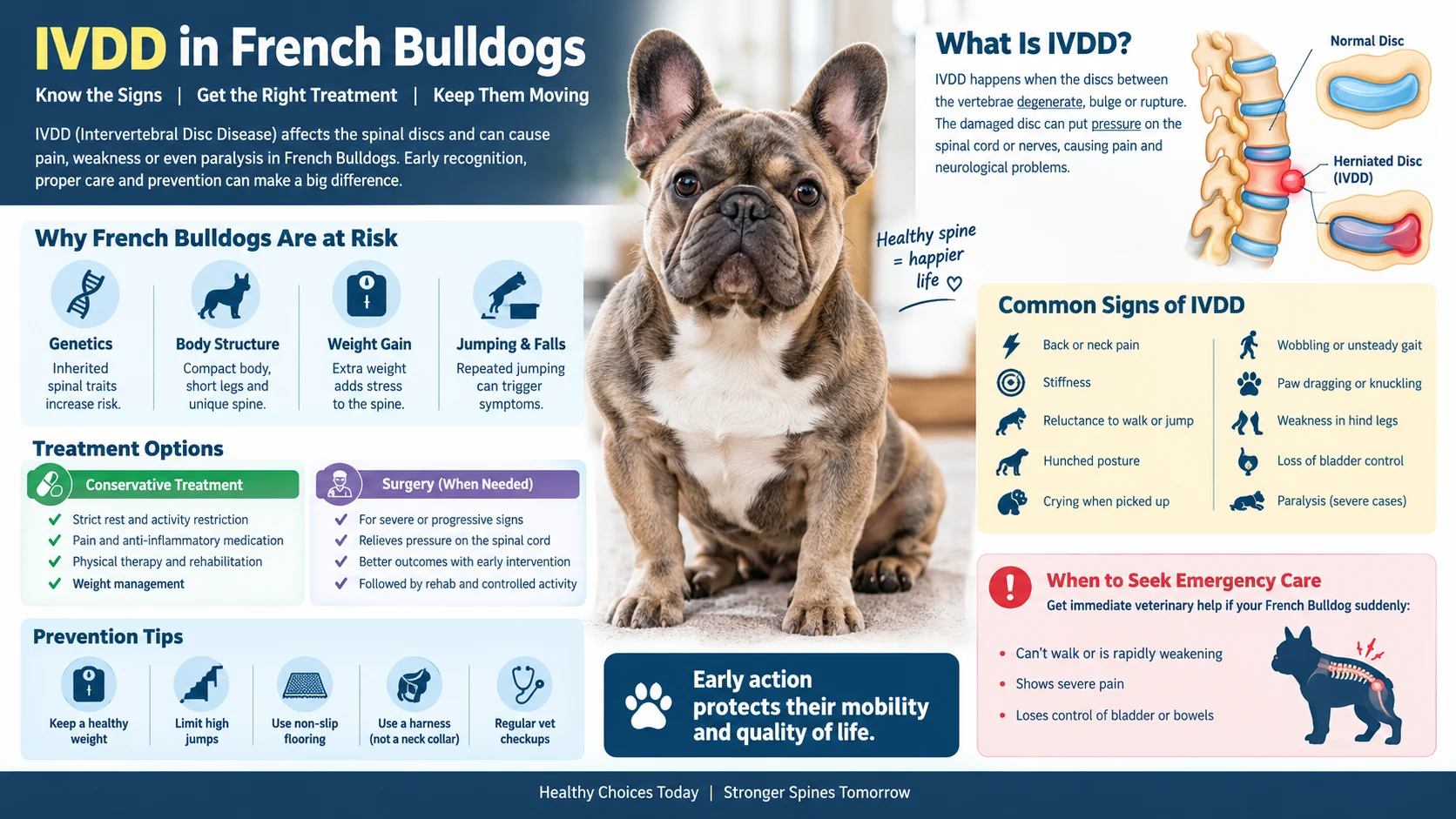
IVDD in French Bulldogs is a spinal condition that can cause back pain, weakness, difficulty walking, or sudden paralysis. Early veterinary treatment is essential to protect mobility and improve recovery chances.
Quick Snapshot
| Category | Key Information |
|---|---|
| Condition | Intervertebral Disc Disease |
| Common Abbreviation | IVDD |
| Affected Area | Spinal discs and spinal cord |
| French Bulldog Risk | Higher than many breeds |
| Main Signs | Back pain, stiffness, weakness, wobbling |
| Severe Signs | Paralysis or loss of bladder control |
| Diagnosis | Neurological exam and advanced imaging |
| Treatment | Rest, medication, rehabilitation, or surgery |
| Emergency Risk | High when weakness or paralysis appears suddenly |
| Recovery | Depends heavily on neurological severity |
| Prevention | Weight control, safe movement, veterinary monitoring |
French Bulldogs are among the breeds recognized as having increased susceptibility to intervertebral disc disease.
What Is IVDD in French Bulldogs?
Intervertebral disc disease, or IVDD, occurs when the cushioning discs between the vertebrae degenerate, bulge, or rupture. Displaced disc material can put pressure on the spinal cord or spinal nerves, causing pain, weakness, abnormal walking, and in severe cases paralysis.
The discs essentially work as shock absorbers between the bones of the spine.
When one degenerates, even an apparently minor movement can sometimes trigger a serious episode.
That is why an owner may see a French Bulldog playing normally in the morning and struggling to walk later the same day.
Why French Bulldogs Are at Risk
French Bulldogs have several breed characteristics that make spinal health particularly important.
Spinal abnormalities are recognized health concerns in the breed, and veterinary sources specifically list IVDD among French Bulldog health conditions.
Genetics and Spinal Structure
The important point is that IVDD is not simply caused by one bad jump.
Disc degeneration can develop over time, and an eventual rupture may occur after relatively minor activity. The movement may appear to cause the problem, but underlying disc degeneration can already be present.
Body Shape Matters
French Bulldogs have a compact, muscular body and relatively short limbs.
That does not mean every French Bulldog will develop IVDD.
It does mean owners should take spinal symptoms seriously instead of assuming a dog is merely tired, stubborn, or reluctant to move.
IVDD Symptoms in French Bulldogs
The symptoms depend on where the affected disc is located and how severely the spinal cord or nerves are compressed.
Early Warning Signs
Watch for:
- reluctance to walk
- unusual stiffness
- hunched posture
- back or neck pain
- reluctance to climb or jump
- crying when picked up
- reduced activity
- trembling
- difficulty getting comfortable
- changes in gait
A dog may initially show pain without obvious weakness.
That stage should not be ignored.
Neurological Symptoms
As spinal cord compression becomes more severe, a French Bulldog may develop:
- wobbling
- dragging a paw
- knuckling
- crossing the rear legs
- difficulty standing
- weakness in the hind legs
- inability to walk normally
Severe disc disease can progress to paralysis.
Emergency Warning Signs
Treat these as veterinary emergencies:
- sudden inability to walk
- rapidly worsening weakness
- complete paralysis
- severe uncontrolled pain
- inability to urinate normally
- major loss of coordination
Do not wait to see whether a paralyzed dog improves overnight.
Rapid neurological deterioration can require urgent referral for advanced imaging and surgical treatment.
What Does IVDD Look Like in a French Bulldog?
One reason IVDD can be missed is that early symptoms can look surprisingly ordinary.
A French Bulldog may simply:
stop jumping onto the sofa
or
refuse to climb stairs
or
become unusually quiet.
These small behavioral changes can be meaningful.
Common Physical Changes
| Sign | What Owners May Notice |
|---|---|
| Back pain | Tension, crying, reluctance to move |
| Stiffness | Short, careful steps |
| Weakness | Difficulty standing |
| Wobbling | Unsteady rear end |
| Paw dragging | Nails scraping the floor |
| Knuckling | Paw placed incorrectly |
| Paralysis | Unable to stand or walk |
The severity of clinical signs depends partly on how much and how quickly disc material compresses the spinal cord or nerve roots.
Causes and Risk Factors
Disc Degeneration
The underlying problem is often degeneration of the intervertebral disc.
As the disc deteriorates, it becomes more vulnerable to protrusion or rupture.
Jumping and Falls
Owners often blame a single jump from a sofa or bed.
Sometimes that event is the trigger.
But it may not be the underlying cause.
The disc may already have been degenerating before the jump occurred.
Excess Body Weight
Obesity can increase mechanical stress and is an important risk factor to manage in dogs susceptible to disc disease. Veterinary guidance emphasizes maintaining a healthy body weight.
For French Bulldogs, maintaining a lean body condition is especially sensible because the breed already has multiple structural and mobility considerations.
Diagnosing IVDD
Veterinary Neurological Examination
The veterinarian may assess:
- walking pattern
- reflexes
- paw placement
- spinal pain
- muscle tone
- neurological responses
This helps determine whether the problem appears orthopedic, neurological, or spinal.
X Rays
X-rays can help identify certain spinal abnormalities and rule out some other conditions.
However, ordinary X-rays do not provide the same view of the spinal cord and discs as advanced imaging.
MRI and Advanced Imaging
MRI is particularly valuable when veterinarians need to identify the affected disc and assess spinal cord compression.
CT or other advanced imaging may also be used depending on the case and the specialist’s assessment.
Treatment for IVDD in French Bulldogs
Treatment depends on the dog’s neurological condition.
There is no single treatment plan that fits every French Bulldog with IVDD.
Conservative Treatment
For dogs with appropriate mild or moderate signs, veterinarians may recommend:
- strict activity restriction
- prescribed pain medication
- anti inflammatory medication when appropriate
- muscle relaxants
- controlled rehabilitation
Rest is not the same as simply taking shorter walks.
During acute recovery, the dog may need strict confinement to prevent movements that could worsen the injury.
When Surgery May Be Needed
Surgery may be recommended when there is:
- severe neurological dysfunction
- progressive weakness
- paralysis
- severe or recurrent pain
- poor response to conservative treatment
The purpose is generally to relieve pressure on the spinal cord by removing problematic disc material.
IVDD Surgery and Recovery
What Happens During Surgery?
A veterinary specialist identifies the affected region and creates surgical access to the spine so compressed disc material can be removed.
The exact procedure depends on the location and nature of the disc problem.
Recovery After Surgery
Recovery can involve:
- strict confinement
- pain management
- bladder monitoring
- gradual activity increases
- physiotherapy
- neurological rechecks
Rehabilitation can play an important role in improving strength, mobility, and functional recovery.
How Long Does Recovery Take?
There is no universal recovery timeline.
A dog with pain but normal walking ability has a very different prognosis from a dog that arrives at the hospital paralyzed.
The severity and duration of neurological damage are major factors.
Puppy Development and IVDD Awareness
French Bulldog owners should begin thinking about spinal protection while their dog is still young.
Puppy Stage
Young French Bulldogs are naturally energetic and curious.
They may repeatedly:
- jump from furniture
- race across slippery floors
- launch themselves down stairs
- wrestle aggressively
- twist while playing
Not every energetic puppy will develop IVDD, but sensible owners can reduce unnecessary spinal stress.
Young Adult Stage
As the dog matures, maintaining a healthy weight becomes increasingly important.
A French Bulldog should not become overweight simply because its exercise capacity is limited.
Controlled activity is preferable to occasional bursts of intense movement.
Adult Stage
Owners should pay attention to subtle changes such as:
- avoiding stairs
- refusing the sofa
- slower walking
- unusual posture
- reluctance to play
A behavior change can sometimes be the first clue that a dog is experiencing pain.
Prevention and Everyday Care
There is no guaranteed way to prevent IVDD, particularly when genetic and structural susceptibility is involved.
However, sensible management can reduce avoidable stress and help protect mobility.
Keep Your French Bulldog Lean
Weight management should be a lifelong priority.
A lean dog places less unnecessary load on its musculoskeletal system.
Reduce High Risk Jumping
Consider limiting repeated jumping from:
- beds
- sofas
- high furniture
- car trunks
Use ramps or carefully controlled access where appropriate.
Improve Floor Traction
Slippery flooring can be difficult for compact, short legged dogs.
Use:
- rugs
- runners
- non slip mats
especially in areas where the dog regularly turns or accelerates.
Use a Harness
If your French Bulldog has cervical or spinal disease, your veterinarian may recommend a harness rather than attaching a leash to a neck collar.
Common Mistakes French Bulldog Owners Make
Mistake 1: Waiting for Paralysis
Pain and stiffness can appear before severe neurological dysfunction.
Waiting until the dog cannot walk is a dangerous approach.
Mistake 2: Assuming It Is a Muscle Strain
A painful back is not automatically a pulled muscle.
Spinal disease needs to be considered when neurological signs are present.
Mistake 3: Allowing Normal Activity During Recovery
A dog may appear better after medication while the underlying disc injury still needs time to heal.
Veterinary prescribed restriction should be followed even when the dog seems eager to play.
Mistake 4: Letting Weight Creep Up
A few extra pounds can make movement harder for a small, compact dog.
Mistake 5: Treating “Small” as “Fragile”
French Bulldogs still need appropriate exercise and muscle conditioning.
The goal is not to keep them inactive.
The goal is controlled, sensible movement.
Insights Most Articles Miss
IVDD Is Not Always Dramatic at First
A French Bulldog does not necessarily scream or collapse when disc disease begins.
Sometimes the first clue is simply that the dog behaves differently.
A Jump May Be the Trigger, Not the Cause
The underlying disc may already be degenerating before an apparently harmless jump results in clinical signs.
Pain and Neurological Damage Are Different
A dog can be extremely painful while still walking normally.
Another dog may have relatively little obvious pain but significant neurological weakness.
Both situations deserve veterinary assessment.
Recovery Is Not Just About Surgery
Surgery can relieve spinal cord compression when indicated, but recovery also depends on appropriate aftercare and rehabilitation.
Buyer Warning
If you are buying a French Bulldog puppy, spinal health should be part of your breeder evaluation.
Ask the Breeder About
- parental health history
- known spinal abnormalities
- veterinary records
- family history of neurological problems
- overall structural quality
- breeding decisions
What Should Concern You?
Be cautious when a breeder:
- dismisses spinal problems as normal
- cannot provide meaningful health information
- breeds primarily for extreme appearance
- avoids discussing inherited conditions
- makes unrealistic health guarantees
A responsible breeder should be willing to discuss health honestly rather than pretending the breed has no vulnerabilities.
Lifestyle Compatibility
| Lifestyle | IVDD Consideration |
|---|---|
| Apartment living | Can work well with controlled movement |
| Home with stairs | Extra management may be needed |
| Active family | Good with sensible exercise |
| Frequent sofa jumping | Needs modification |
| Overweight dog | Higher concern |
| High impact sports | Discuss with veterinarian |
| Senior French Bulldog | Increased mobility monitoring |
Preparation Checklist
For Everyday Prevention
Keep these habits in place:
☐ Maintain a healthy body condition
☐ Use secure, controlled exercise
☐ Reduce repeated high jumps
☐ Improve traction on slippery floors
☐ Monitor changes in walking
☐ Take unusual pain seriously
☐ Keep routine veterinary examinations
☐ Follow specialist instructions after an IVDD episode
For a Suspected IVDD Episode
If your French Bulldog suddenly develops pain or weakness:
- Stop strenuous activity.
- Keep the dog safely confined.
- Avoid unnecessary stairs and jumping.
- Do not give human pain medication.
- Contact a veterinarian promptly.
- Seek emergency care if weakness or paralysis develops.
Frequently Asked Questions
What is IVDD in French Bulldogs?
IVDD is a disease in which the discs between the spinal vertebrae degenerate, bulge, or rupture and potentially compress the spinal cord or nerves.
Are French Bulldogs prone to IVDD?
Yes. French Bulldogs are considered among the breeds with increased susceptibility to intervertebral disc disease.
What are the first signs of IVDD in a French Bulldog?
Early signs can include back or neck pain, stiffness, reluctance to move, unusual posture, reduced activity, or changes in walking.
Can IVDD cause paralysis?
Yes. Severe spinal cord compression can cause partial or complete paralysis.
Can a French Bulldog recover from IVDD?
Many dogs can improve, but recovery depends heavily on the severity of neurological damage, how quickly treatment begins, and the treatment approach.
Does every French Bulldog with IVDD need surgery?
No. Some dogs with appropriate mild or moderate signs may be managed conservatively, while severe or progressive neurological disease may require surgery.
Can IVDD be prevented in French Bulldogs?
It cannot be completely prevented, but maintaining a healthy weight, reducing unnecessary high impact activity, improving traction, and monitoring spinal symptoms are sensible protective measures.
Can IVDD come back after treatment?
Yes. Recurrence is possible, particularly in dogs with ongoing disc degeneration or multiple affected discs.
Conclusion
IVDD in French Bulldogs is more than a simple “back problem.” It can begin with subtle pain or stiffness and, in severe cases, progress rapidly to weakness or paralysis.
The most important lesson for owners is simple: do not ignore changes in movement.
A French Bulldog does not need to be completely paralyzed before spinal disease deserves urgent attention. Early veterinary assessment, weight management, sensible exercise, safe home design, and appropriate treatment can make a meaningful difference to comfort and mobility.
For breeders, the priority is equally clear: healthy structure and responsible breeding matter far more than extreme appearance.