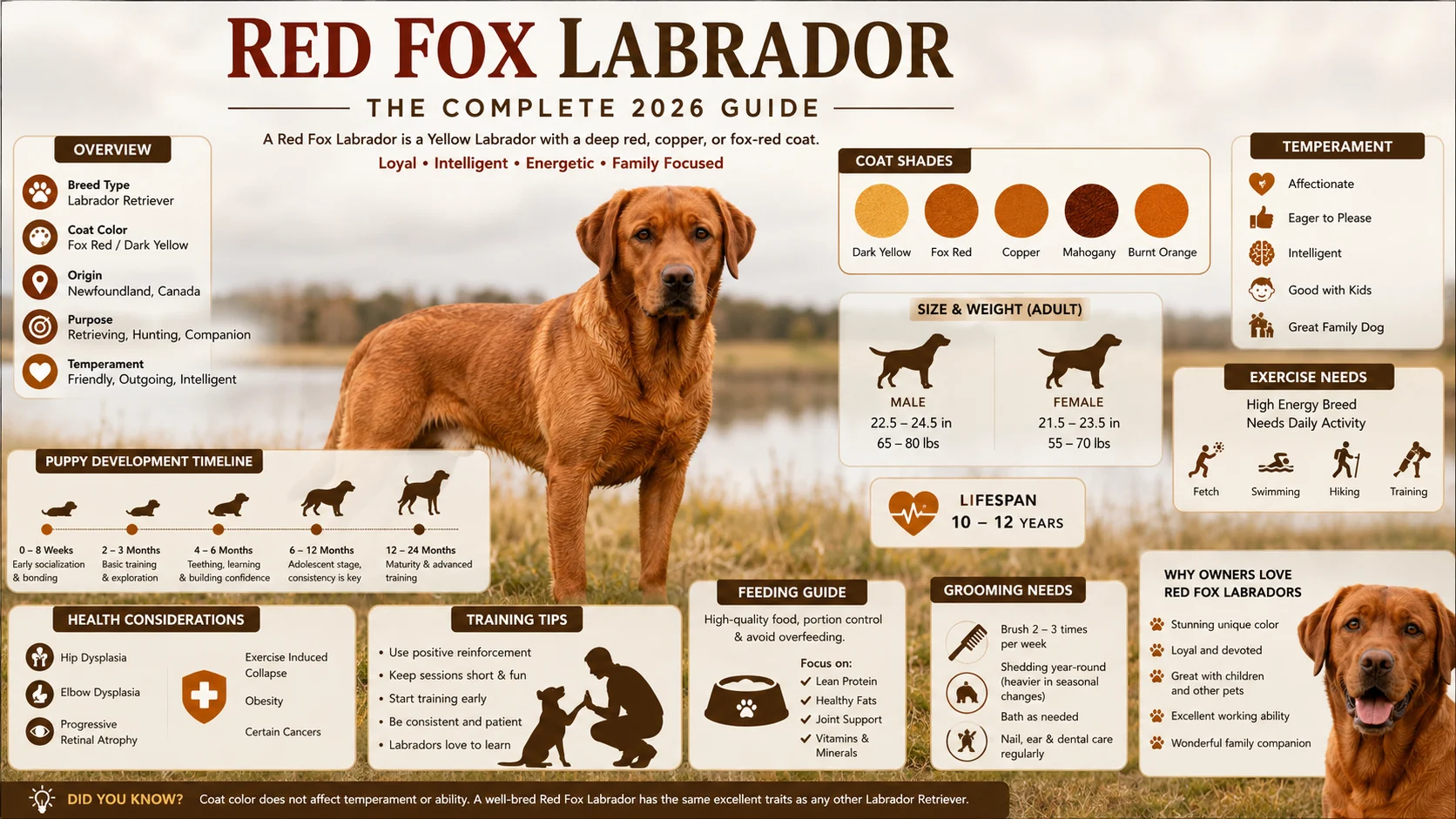
A Red Fox Labrador is a yellow Labrador Retriever with an unusually deep red or fox red coat, ranging from copper to dark mahogany shades.
Despite the striking color, it is not a separate breed; it remains a purebred Yellow Labrador when properly bred and registered.
Experienced breeders prioritize health, temperament, structure, and genetic testing over coat color because “fox red” describes appearance, not quality.
What Is a Red Fox Labrador?
A Red Fox Labrador is a Yellow Labrador Retriever with a much darker coat than the pale cream or traditional yellow shades most people associate with the breed.
The color can range from:
| Coat Shade | Appearance |
|---|---|
| Dark Yellow | Warm golden yellow |
| Fox Red | Deep reddish gold |
| Copper | Rich orange red |
| Mahogany | Very dark red brown |
| Burnt Orange | Strong reddish orange |
The important point is that Red Fox Labrador is a color description, not a separate Labrador breed.
A Red Fox Labrador can have the same breed characteristics as any other Labrador Retriever, including the familiar otter tail, dense double coat, friendly temperament, and strong retrieving instinct.
Is Fox Red an Official Labrador Color?
“Fox red” is commonly used by breeders and Labrador owners to describe very dark yellow Labradors.
Major kennel club standards generally classify these dogs under yellow, rather than recognizing “fox red” as a separate official color category.
That distinction matters when researching breeders.
A breeder advertising “rare red Labradors” is not necessarily offering a different type of Labrador. The puppy may simply have a darker expression of the yellow coat.
Why Are Red Fox Labradors So Dark?
The color comes from normal Labrador coat genetics rather than a separate “red Labrador gene.”
Labrador coat color is influenced by several genes that determine whether black, chocolate, or yellow pigment is expressed.
For yellow Labradors, the MC1R gene plays an important role in preventing dark eumelanin from being expressed in the coat. Other genetic factors influence how intensely the yellow pigmentation appears.
This is why two yellow Labrador puppies can have noticeably different shades.
Why Some Puppies Become Lighter
A fox red puppy may change visually as it grows.
Factors affecting the apparent shade include:
- puppy coat versus adult coat
- seasonal shedding
- sunlight exposure
- coat density
- genetics
- age
A puppy that looks extremely dark at eight weeks may not have exactly the same shade as an adult.
Does Fox Red Color Affect Temperament?
No.
Coat color does not automatically make a Labrador:
- more intelligent
- more aggressive
- calmer
- more energetic
- better at retrieving
Temperament comes primarily from genetics, early development, breeding selection, socialization, and environment.
Here is where many buyers get misled: a beautiful coat can make an average puppy look exceptional in photographs.
Experienced breeders evaluate the dog underneath the color.
Red Fox Labrador Appearance


A well bred Red Fox Labrador should still look unmistakably like a Labrador Retriever.
Typical characteristics include:
- broad head
- expressive eyes
- strong muzzle
- muscular body
- dense double coat
- thick otter tail
- powerful shoulders
- webbed feet
Fox Red Labrador Eyes and Nose
Yellow Labradors can have:
- brown eyes
- black pigmentation
- liver colored pigmentation in some genetic combinations
The exact appearance depends on the dog’s genetics and breeding line.
A responsible breeder should be able to explain why a puppy has its particular pigmentation rather than simply calling every dark yellow puppy “rare.”
Red Fox Labrador Size and Weight
Red Fox Labradors do not have a unique size standard because they are still Labrador Retrievers.
| Category | Typical Range |
|---|---|
| Male Height | About 22.5–24.5 inches |
| Female Height | About 21.5–23.5 inches |
| Male Weight | About 65–80 lbs |
| Female Weight | About 55–70 lbs |
| Lifespan | Commonly around 10–12 years |
Individual dogs can fall outside these ranges.
More importantly, weight should be evaluated alongside body condition rather than treated as a target number.
A Labrador that weighs 85 pounds is not automatically healthier than one that weighs 70 pounds.
Temperament and Personality
The typical Red Fox Labrador has the same basic temperament expected from a well bred Labrador Retriever.
They are often:
- affectionate
- outgoing
- intelligent
- food motivated
- playful
- people oriented
- eager to retrieve
However, Labrador temperament varies substantially between bloodlines.
Show Line vs Working Line
This is one of the most important distinctions for prospective owners.
| Trait | Show Or Bench Lines | Working Or Field Lines |
|---|---|---|
| Energy | Moderate to high | High to extremely high |
| Build | Heavier | Leaner and athletic |
| Drive | Moderate | Often very strong |
| Retrieving Instinct | Strong | Usually intense |
| Training Needs | Moderate | High |
| Off Switch | Often easier | May require more training |
A fox red coat does not tell you which type of Labrador you are buying.
The pedigree does.
Are Red Fox Labradors Good Family Dogs?
Usually, yes.
A properly bred and socialized Labrador can be an excellent family companion.
They often enjoy:
- children
- outdoor activities
- retrieving games
- swimming
- hiking
- training
- family interaction
But young Labradors can be exhausting.
A six month old Labrador with too much energy and too little structure can turn a peaceful home into a daily obstacle course.
The solution is not simply more exercise.
Mental stimulation, impulse control, appropriate rest, and consistent training are equally important.
Training a Red Fox Labrador
Labradors are generally highly trainable because they combine intelligence with a strong desire to work with people.
Their food motivation can be especially useful during training.
Best Training Methods
Use:
- positive reinforcement
- short training sessions
- food rewards
- retrieving games
- impulse control exercises
- gradual distractions
Teach foundational behaviors early:
- recall
- loose leash walking
- sit
- down
- stay
- leave it
- drop it
- place
The Problem With Over Exercising Puppies
Labrador puppies grow quickly, but their bones and joints are still developing.
Avoid turning a young puppy into a running partner.
Instead, emphasize:
- controlled walks
- free movement on appropriate surfaces
- play
- basic training
- sniffing
- age appropriate enrichment
Red Fox Labrador Puppy Development


A Red Fox Labrador puppy changes dramatically during its first two years.
| Age | Development |
|---|---|
| 0–8 Weeks | Rapid physical and social development |
| 8–12 Weeks | Important socialization period |
| 3–4 Months | Teething and confidence building |
| 5–6 Months | Increasing independence |
| 6–12 Months | Adolescent behavior begins |
| 12–18 Months | Strength and coordination improve |
| 18–24 Months | Adult behavior becomes more consistent |
8–12 Weeks
This is an important period for controlled socialization.
Expose puppies gradually to:
- household sounds
- different surfaces
- friendly people
- car travel
- grooming
- handling
- appropriate environments
Socialization should create confidence, not overwhelm.
3–6 Months
Expect:
- serious chewing
- teething
- increased curiosity
- bursts of energy
- testing boundaries
This is the time to establish household rules before adolescent behavior becomes stronger.
6–12 Months
Many owners are surprised by this stage.
The puppy may physically look mature while mentally behaving like a teenager.
You may see:
- selective listening
- increased excitement
- jumping
- leash pulling
- increased interest in other dogs
Consistency matters more than punishment.
Health and Genetic Considerations
A Red Fox Labrador is susceptible to the same major health concerns as other Labradors.
Important conditions include:
- hip dysplasia
- elbow dysplasia
- obesity
- progressive retinal atrophy
- exercise induced collapse
- hereditary eye disorders
- certain cancers
Health Testing Matters More Than Coat Color
A responsible breeder should be able to provide appropriate health screening for breeding dogs.
Depending on the breeding program, this may include:
- hip evaluation
- elbow evaluation
- ophthalmologist examination
- genetic testing
- pedigree health history
Organizations such as the Orthopedic Foundation for Animals can provide useful health certification information.
The real issue is simple: a dark coat does not compensate for poor hips or unstable temperament.
Red Fox Labrador Exercise Requirements

Adult Labradors generally need substantial daily activity.
Good outlets include:
- retrieving
- swimming
- hiking
- scent games
- obedience
- field training
- structured play
Mental Exercise Is Just as Important
A Labrador that receives only physical exercise may remain restless.
Try:
- puzzle feeders
- scent searches
- retrieve and wait games
- obedience chains
- controlled retrieving
- food finding exercises
A mentally satisfied Labrador is usually much easier to live with.
Feeding and Weight Management
Labradors are famous for loving food.
Unfortunately, this can become a health problem.
Obesity places additional stress on:
- hips
- elbows
- knees
- cardiovascular system
Practical Feeding Rules
Monitor:
- body condition
- growth rate
- treat calories
- meal portions
Do not judge a Labrador’s health by how “big” or muscular it looks.
A lean, athletic Labrador is generally preferable to an overweight one.
Grooming a Red Fox Labrador
The coat is relatively easy to maintain, but shedding is not.
Expect:
- regular shedding
- heavier seasonal shedding
- loose undercoat
- muddy paws
- wet dog odor after swimming
Simple Grooming Routine
| Task | Frequency |
|---|---|
| Brushing | 1–3 times weekly |
| Nail trimming | Every few weeks |
| Ear checks | Weekly |
| Bathing | As needed |
| Dental care | Regularly |
Avoid shaving a Labrador’s double coat.
Common Red Fox Labrador Misconceptions
“Red Fox Labs Are a Separate Breed”
False.
They are Yellow Labrador Retrievers with darker pigmentation.
“They Are Rarer, So They Are Better”
Not necessarily.
Rarity and quality are completely different things.
“Fox Red Labs Are More Aggressive”
There is no sound basis for assuming aggression from coat color.
“Red Labs Stay the Same Color Forever”
Not always.
The apparent shade can change with age, coat turnover, and lighting.
“A Red Fox Labrador Is Always a Field Lab”
False.
Coat color does not determine whether a dog comes from field or show lines.
What Most Red Fox Labrador Articles Miss
The Breeding Line Matters More Than the Red Coat
Two fox red Labradors can have dramatically different:
- energy levels
- body structure
- retrieving drive
- trainability
- temperament
Always investigate the parents.
Darker Does Not Mean Rarer in a Meaningful Genetic Sense
Marketing language often turns color variation into a selling point.
“Rare,” “exclusive,” and “premium red” are not substitutes for health testing.
Structure Should Be Evaluated While Moving
A good Labrador should not only look attractive while standing.
Watch the puppy:
- walk
- trot
- turn
- sit
- get up
- interact with people
Movement can reveal things a photograph cannot.
How to Choose a Red Fox Labrador Puppy


Choosing a puppy should involve considerably more than picking the darkest coat.
Ask the Breeder About
- parent health testing
- pedigree
- temperament
- puppy socialization
- vaccination records
- veterinary examinations
- genetic testing
- return policy
Observe the Parents
Look for adults that are:
- confident
- socially stable
- physically sound
- responsive to handlers
- comfortable in normal environments
A nervous or unstable parent deserves serious scrutiny.
Buyer Warning: Red Flags
Be particularly careful with breeders who advertise:
“Ultra rare red Labrador”
“Exclusive bloodline”
“Guaranteed perfect temperament”
“Micro red Labrador”
“English fox red miniature Lab”
These phrases can be marketing rather than meaningful breed information.
A Responsible Breeder Should Welcome Questions
You should not feel uncomfortable asking about:
- health certificates
- genetic tests
- parent temperament
- pedigree
- puppy socialization
If a breeder becomes defensive when you ask reasonable health questions, pay attention.
Lifestyle Compatibility
| Owner Lifestyle | Compatibility |
|---|---|
| Active family | Excellent |
| Outdoor enthusiast | Excellent |
| Hunter or retriever handler | Excellent |
| First time dog owner | Usually manageable |
| Sedentary household | Poor |
| Owner wanting a low shedding dog | Poor |
| Apartment with daily activity | Possible |
| Owner wanting a guard dog | Poor |
A Labrador generally wants to participate in your life.
If you want a dog that spends most of the day independently, this probably isn’t the ideal breed.
Red Fox Labrador Preparation Checklist
Before bringing home a puppy, prepare:
Home
- crate
- puppy safe area
- food and water bowls
- chew toys
- washable bedding
Training
- reward treats
- leash
- collar or harness
- identification
- basic training plan
Health
- veterinarian selected
- vaccination records
- deworming history
- microchip information
- health testing documentation
Lifestyle
- daily exercise schedule
- socialization plan
- grooming routine
- puppy supervision
Frequently Asked Questions
Is a Red Fox Labrador a purebred Labrador?
Yes. A Red Fox Labrador can be a purebred Labrador Retriever. “Fox red” describes a dark shade of yellow rather than a separate breed.
How much does a Red Fox Labrador cost?
Prices vary considerably by breeder, pedigree, location, health testing, and working or show lineage. A higher price does not automatically indicate a healthier puppy.
Are Red Fox Labradors rare?
They are less common than many lighter yellow Labradors, but “rare” is often exaggerated in advertising.
Are Red Fox Labradors good family dogs?
Yes, when properly bred, socialized, trained, and exercised. Their energetic nature can be challenging for families expecting a low-maintenance dog.
Do Red Fox Labradors shed?
Yes. They have a dense double coat and can shed heavily, particularly during seasonal coat changes.
Are Red Fox Labradors healthier than other Labs?
No. Coat color does not automatically provide better health. Health depends much more on genetics, breeding practices, nutrition, weight, and veterinary care.
Do Red Fox Labradors get darker with age?
Their apparent coat shade can change as the puppy coat is replaced and the adult coat develops. Some become lighter or simply look different depending on coat condition and lighting.
What is the difference between an English and American Red Fox Labrador?
“English” and “American” generally refer to different breeding styles or types rather than separate breeds. English type Labradors are often heavier and stockier, while American field bred Labradors tend to be leaner and more athletic. Either type can have a fox red coat.
Conclusion
The Red Fox Labrador is essentially a dark coated Yellow Labrador Retriever, but that simple description hides an important lesson for prospective owners.
The color is attractive. It is distinctive. And it photographs exceptionally well.
But it should never be the main reason you choose a puppy.
Look at the parents. Examine health testing. Ask about temperament. Study the pedigree. Watch how puppies interact with people and recover from unfamiliar situations.
A beautiful fox red coat is a bonus.
A healthy body, stable temperament, sound structure, and responsible breeding are what make a Labrador worth bringing home.