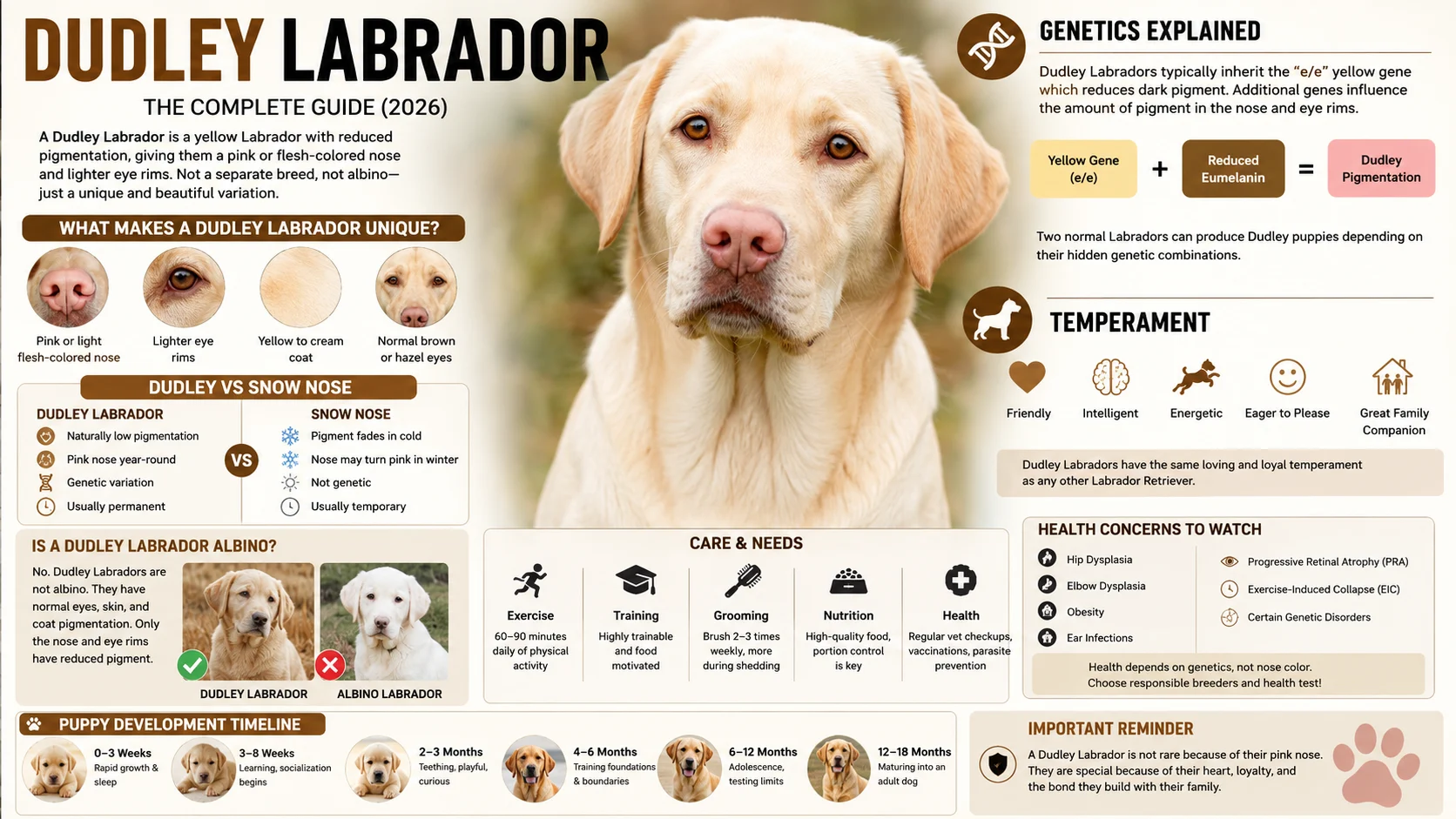
A Dudley Labrador is usually a yellow Labrador with unusually light or pinkish nose and eye-rim pigmentation caused by reduced eumelanin production.
The Dudley appearance does not automatically mean the dog is unhealthy, albino, or a mixed breed.
For buyers, the important questions are pigmentation genetics, overall health, temperament, and responsible breeding rather than nose color alone.
Quick Snapshot
| Feature | Dudley Labrador |
|---|---|
| Breed | Labrador Retriever |
| Common Color | Yellow |
| Defining Feature | Very light or pinkish nose pigmentation |
| Separate Breed? | No |
| Albino? | Usually no |
| Temperament | Friendly, intelligent, energetic |
| Trainability | Excellent |
| Exercise Needs | High |
| Shedding | Moderate to heavy |
| Grooming | Moderate |
| Typical Lifespan | About 10–12 years |
| Main Concern | Pigmentation, not necessarily overall health |
| Buyer Priority | Health and temperament over nose color |
What Is a Dudley Labrador?
A Dudley Labrador is generally a Labrador Retriever, most commonly a yellow Labrador, that has little or no dark pigmentation on the nose and surrounding areas.
Instead of the typical black or brown nose, the dog may have a:
- pink nose
- flesh-colored nose
- very pale brown nose
- lightly pigmented eye rims
The term “Dudley” describes pigmentation rather than a separate Labrador breed or variety.
This distinction matters because the internet sometimes treats Dudley Labradors as if they were a rare breed. They are not.
A Dudley Labrador is still a Labrador Retriever.
Why Is It Called a Dudley Labrador?
The word “Dudley” has historically been used in dog terminology to describe an animal with insufficient nose pigmentation.
In Labradors, the term became associated particularly with yellow dogs showing very pale pigmentation.
However, terminology can be used loosely by breeders and sellers. A pale nose does not automatically tell you exactly which genetic combination produced it.
That is why responsible evaluation should focus on the dog’s complete genetic and health background rather than a label.
What Does a Dudley Labrador Look Like?
The easiest way to recognize one is by looking at the nose and surrounding pigmentation.
A typical yellow Labrador generally has darker pigmentation, while a Dudley Labrador may have a much lighter nose.
Common Appearance
A Dudley Labrador may have:
- yellow, cream, or golden fur
- pale pink or flesh-colored nose
- lighter eye rims
- brown or hazel-looking eyes
- normal Labrador body proportions
- the same characteristic otter tail
- short, dense double coat
The rest of the dog can look completely typical for the breed.
Nose Color Can Change With Age
Pigmentation is not always identical throughout a Labrador’s life.
Some Labradors experience seasonal fading, particularly during colder months. This is sometimes called “snow nose.”
That is different from a dog that has consistently very little pigmentation from an early age.
This distinction is worth making before assuming every pale-nosed Labrador is a Dudley.
Dudley Labrador vs Snow Nose
| Feature | Dudley Labrador | Snow Nose |
|---|---|---|
| Pigmentation | Naturally very light | Temporarily fades |
| Appearance | May remain pale | Often darkens again |
| Cause | Genetic pigmentation variation | Seasonal pigment reduction |
| Usually a disease? | No | No |
| Permanent? | Often | Frequently temporary |
Here is where many articles get it wrong: a pinkish nose does not automatically mean the dog has a genetic disorder.
Is a Dudley Labrador an Albino Dog?
No, not usually.
A Dudley Labrador should not automatically be described as albino simply because its nose is pink.
Albinism involves a much broader absence or severe reduction of melanin throughout the body and can involve distinctive eye and skin characteristics.
A yellow Labrador with a pale nose can still have:
- normal vision
- normal eye pigmentation
- normal skin pigmentation
- normal coat color
- normal development
The lack of dark nose pigment alone is not enough to diagnose albinism.
Dudley Labrador Genetics Explained
Why Pigmentation Is Different
Labrador coat color is influenced by several genes, and pigmentation is more complicated than simply calling a dog “yellow.”
Yellow Labradors typically express the recessive e/e genotype at the MC1R locus, which prevents normal expression of dark eumelanin in the coat.
However, nose and skin pigmentation involve additional genetic factors.
This is why two yellow Labradors can have noticeably different nose pigmentation.
Does a Dudley Labrador Have a Special “Dudley Gene”?
There is not a simple single “Dudley gene” that can be used to explain every pale-nosed Labrador.
Pigmentation involves interactions between multiple genetic pathways.
Responsible breeders therefore avoid making exaggerated claims such as:
“Dudley Labradors have one rare gene that makes them healthier.”
There is no good reason to assume that.
Can Two Normal Labradors Produce a Dudley?
Depending on their pigmentation genetics, yes, unusual pigmentation can appear even when the parents do not have an obviously pale nose.
This is one reason pedigree information and genetic understanding are more useful than judging the parents by appearance alone.
Dudley Labrador Temperament
A Dudley Labrador does not have a special temperament because of its nose color.
The dog should still display the characteristic Labrador qualities that make the breed popular:
- friendliness
- intelligence
- enthusiasm
- food motivation
- retrieving instinct
- sociability
- willingness to work
Are Dudley Labradors Friendly?
Usually, yes.
A well-bred Labrador is generally known for being social and people-oriented.
However, temperament depends much more on:
- breeding
- early socialization
- training
- environment
- individual personality
The color of the nose does not determine whether a Labrador will be calm, confident, nervous, or highly energetic.
Intelligence and Trainability
Labradors are typically highly trainable dogs.
A Dudley Labrador can excel at:
- obedience
- retrieving
- scent work
- assistance work
- dock diving
- hunting
- therapy work
- family activities
Their biggest training advantage is often their willingness to interact with people.
Their biggest challenge is enthusiasm.
A young Labrador may understand what you want and still choose the food bowl, tennis ball, or interesting smell first.
Exercise Requirements
A Dudley Labrador should generally be exercised like any other healthy Labrador.
Daily Activity
Most adult Labradors benefit from:
- brisk walks
- retrieving games
- swimming
- training sessions
- scent games
- controlled off-leash exercise where appropriate
Young puppies require a more careful approach because their bones and joints are still developing.
Mental Exercise Matters
Physical exercise alone can create a very fit but still frustrated Labrador.
Add:
- food puzzles
- retrieving challenges
- scent searches
- obedience exercises
- controlled problem solving
A Labrador that receives both physical and mental stimulation is generally easier to live with.
Dudley Labrador Puppy Development
Dudley puppies generally follow the same developmental stages as other Labrador puppies.
The pigmentation difference does not mean the puppy develops into a different breed or fundamentally different type of dog.
Puppy Development Timeline
| Age | Development |
|---|---|
| Birth–2 Weeks | Rapid neurological and physical development |
| 3–4 Weeks | Walking and environmental awareness increase |
| 5–8 Weeks | Social learning and bite inhibition develop |
| 8–12 Weeks | Major socialization period |
| 3–4 Months | Coordination and confidence increase |
| 4–6 Months | Teething and increased independence |
| 6–12 Months | Adolescence begins |
| 12–18 Months | Physical and behavioral maturity develops |
| 18–24 Months | Adult temperament becomes more stable |
What Should You Watch For?
A healthy Labrador puppy should generally show:
- steady growth
- good appetite
- bright, responsive behavior
- clean eyes and ears
- healthy skin
- normal movement
- curiosity about its surroundings
Do not judge a puppy’s health simply by how pink its nose looks.
Dudley Labrador Health
The biggest misconception is that pale nose pigmentation automatically means poor health.
It does not.
A Dudley Labrador can be healthy and live a normal Labrador lifespan.
However, responsible owners should still consider the health conditions commonly associated with the Labrador breed.
Common Labrador Health Concerns
| Condition | Why It Matters |
|---|---|
| Hip dysplasia | Can cause pain and mobility problems |
| Elbow dysplasia | May affect movement and athletic ability |
| Obesity | Extremely common if food intake is poorly managed |
| Progressive retinal atrophy | Can affect vision |
| Exercise-induced collapse | Important consideration in breeding lines |
| Ear problems | Floppy ears can retain moisture |
| Certain inherited disorders | Genetic screening can reduce breeding risk |
The key point is simple:
Do not confuse pigmentation with health quality.
A beautifully pigmented Labrador from poorly screened parents can have far greater health risks than a pale-nosed Labrador from carefully tested lines.
Should Dudley Labradors Be Health Tested?
Absolutely.
If you are purchasing a puppy, ask the breeder about appropriate health screening for the parents.
Depending on the breeding program, this can include:
- hip evaluation
- elbow evaluation
- ophthalmologist examination
- DNA testing for relevant inherited diseases
- pedigree review
- temperament evaluation
Experienced breeders focus on the complete dog.
Not just the nose.
Can Dudley Labradors Have Sensitive Skin?
A pale nose contains less protective pigment, which can make the area more vulnerable to sunlight.
This does not mean every Dudley Labrador will develop skin problems.
Still, owners should pay attention to:
- prolonged intense sun exposure
- unusual redness
- crusting
- sores
- persistent irritation
If the nose changes suddenly or develops lesions, veterinary evaluation is appropriate.
Grooming a Dudley Labrador
The grooming routine is essentially the same as for other Labradors.
Weekly Grooming
Use regular brushing to remove:
- loose undercoat
- dead hairs
- dirt
- debris
During Seasonal Shedding
Expect significantly more loose hair.
A Labrador’s short coat can be deceptive. Short fur does not mean low shedding.
You may find hair:
- on furniture
- inside cars
- on clothing
- around food bowls
- throughout carpets
That is normal Labrador ownership.
Feeding and Weight Management
Labradors have an important relationship with food.
Many are exceptionally food motivated.
That sounds convenient during training, but it creates a major obesity risk.
Healthy Feeding Principles
Measure meals rather than free feeding.
Adjust portions according to:
- age
- body condition
- activity
- reproductive status
- veterinary guidance
Treats should also count toward daily calories.
A lean Labrador generally has a much better chance of maintaining healthy joints than an overweight one.
Common Mistakes Dudley Labrador Owners Make
Mistake 1: Paying More Because the Nose Is Pink
Some sellers market Dudley Labradors as extremely rare luxury dogs.
Be careful.
A unique appearance does not automatically justify an inflated price.
Mistake 2: Assuming Dudley Means Albino
It usually does not.
Pale pigmentation and albinism are not interchangeable terms.
Mistake 3: Ignoring Health Testing
The puppy’s nose may be the first thing you notice.
It should not be the first thing you evaluate.
Mistake 4: Underestimating Labrador Energy
A Dudley Labrador is still a Labrador.
Expect enthusiasm, retrieving behavior, chewing during puppyhood, and plenty of shedding.
Mistake 5: Overfeeding
This is one of the biggest practical problems in Labrador ownership.
Those pleading eyes are remarkably effective.
Do not let them determine the feeding schedule.
What Experienced Breeders Look For
Experienced breeders focus on characteristics that buyers cannot judge from a photograph.
Structure
Look at:
- balanced proportions
- sound movement
- strong topline
- appropriate bone
- healthy feet
Temperament
Look for:
- confidence
- curiosity
- recovery after mild stress
- human engagement
- appropriate sociability
Health History
Ask about:
- parental health clearances
- genetic testing
- previous litters
- longevity in the bloodline
Breeding Ethics
A breeder should be comfortable discussing why particular dogs were paired.
If the entire sales pitch revolves around:
“Look at this rare pink nose.”
that is a warning sign.
Buyer Warning: Is a Dudley Labrador Worth More?
Not necessarily.
A pale nose can make a Labrador visually unusual, but rarity should never replace quality.
Before paying a premium, ask:
| Question | Why It Matters |
|---|---|
| Are the parents health tested? | Reduces inherited disease risk |
| What is the puppy’s pedigree? | Helps evaluate breeding quality |
| How were puppies socialized? | Influences adult behavior |
| Are contracts provided? | Shows breeder responsibility |
| Can you meet the mother? | Gives useful temperament information |
| Is the breeder transparent? | Builds trust |
| Why are they charging more? | Helps identify appearance-based marketing |
The real value of a Labrador is its health, temperament, structure, and suitability for your household.
Dudley Labrador vs Standard Yellow Labrador
| Feature | Dudley Labrador | Standard Yellow Labrador |
|---|---|---|
| Breed | Labrador Retriever | Labrador Retriever |
| Coat | Yellow | Yellow |
| Nose | Very pale or pinkish | Usually darker |
| Temperament | Generally the same | Generally the same |
| Intelligence | Generally the same | Generally the same |
| Exercise Needs | Similar | Similar |
| Shedding | Similar | Similar |
| Grooming | Similar | Similar |
| Health | Depends on individual genetics | Depends on individual genetics |
The difference is primarily pigmentation, not personality.
Lifestyle Compatibility
| Lifestyle | Suitability |
|---|---|
| Active family | Excellent |
| Hiking household | Excellent |
| Retriever enthusiast | Excellent |
| First-time owner | Often suitable with preparation |
| Sedentary household | Poor |
| Apartment living | Possible with substantial exercise |
| Outdoor working lifestyle | Excellent |
A Dudley Labrador can fit into many households, provided the owner understands what a Labrador actually needs.
Preparation Checklist
Before Bringing Home a Dudley Labrador
- Research the Labrador breed beyond appearance
- Verify parental health testing
- Ask about genetic screening
- Meet the mother when possible
- Evaluate puppy temperament
- Prepare a safe sleeping area
- Purchase appropriate food
- Arrange veterinary care
- Prepare chew toys
- Plan puppy socialization
- Establish a training routine
- Prepare for shedding
Insights Most Articles Miss
Nose Color Is Not a Temperament Test
A pink nose cannot tell you whether a Labrador will be calm, energetic, confident, or difficult.
Temperament comes from genetics, development, and environment.
“Rare” Does Not Mean “Better”
This is especially important in online puppy sales.
Unusual appearance is easy to advertise.
Good genetics are much harder to demonstrate.
The Labrador’s Food Drive Matters More Than Its Nose
This sounds humorous, but it is a genuine ownership issue.
Weight control can have a major effect on a Labrador’s long-term mobility and quality of life.
Puppy Socialization Still Matters
A Dudley Labrador is not exempt from normal puppy development.
Early experiences with:
- people
- household sounds
- surfaces
- handling
- car travel
- appropriate dogs
can help produce a confident adult.
Frequently Asked Questions
What is a Dudley Labrador?
A Dudley Labrador is generally a yellow Labrador with unusually light or pinkish pigmentation on the nose and sometimes around the eyes.
Is a Dudley Labrador rare?
They are less commonly seen than normally pigmented Labradors, but they should not automatically be treated as an extremely rare or premium variety.
Is a Dudley Labrador albino?
Usually no. A pale nose alone does not indicate albinism.
Are Dudley Labradors healthy?
They can be perfectly healthy. Their nose pigmentation alone does not determine overall health. Responsible breeding and standard Labrador health screening remain much more important.
Do Dudley Labradors have a different temperament?
No specific temperament should be expected because of Dudley pigmentation. They generally have the same behavioral potential as other Labradors.
Can Dudley Labradors be registered?
Registration rules and breed-standard treatment can vary between kennel clubs and organizations. Buyers should check the rules of the registry relevant to their location.
Can a Dudley Labrador have a pink nose all year?
Yes. Some dogs naturally maintain very light pigmentation, while seasonal fading in other Labradors may become darker again.
Do Dudley Labradors need special care?
Usually, their general care is the same as other Labradors. Owners should pay attention to sun exposure if the nose has very little pigment and should follow normal Labrador health, exercise, nutrition, and grooming practices.
Should I buy a Dudley Labrador puppy?
You can, provided you evaluate the puppy like any other Labrador. Prioritize health testing, temperament, structure, socialization, and breeder ethics rather than paying extra simply for unusual pigmentation.
Conclusion
The Dudley Labrador is best understood as a pigmentation variation rather than a separate type of Labrador. The pale or pinkish nose can certainly make these dogs distinctive, but it does not automatically make them healthier, rarer, smarter, or more valuable.
For anyone considering a Dudley Labrador in 2026, the smartest approach is straightforward:
Look past the nose.
Evaluate the breeder, parents, health clearances, temperament, structure, puppy development, and living requirements.
A well-bred Dudley Labrador can be an affectionate, intelligent, energetic companion. But the quality of the dog should always be measured by the whole animal, not by one unusual feature.