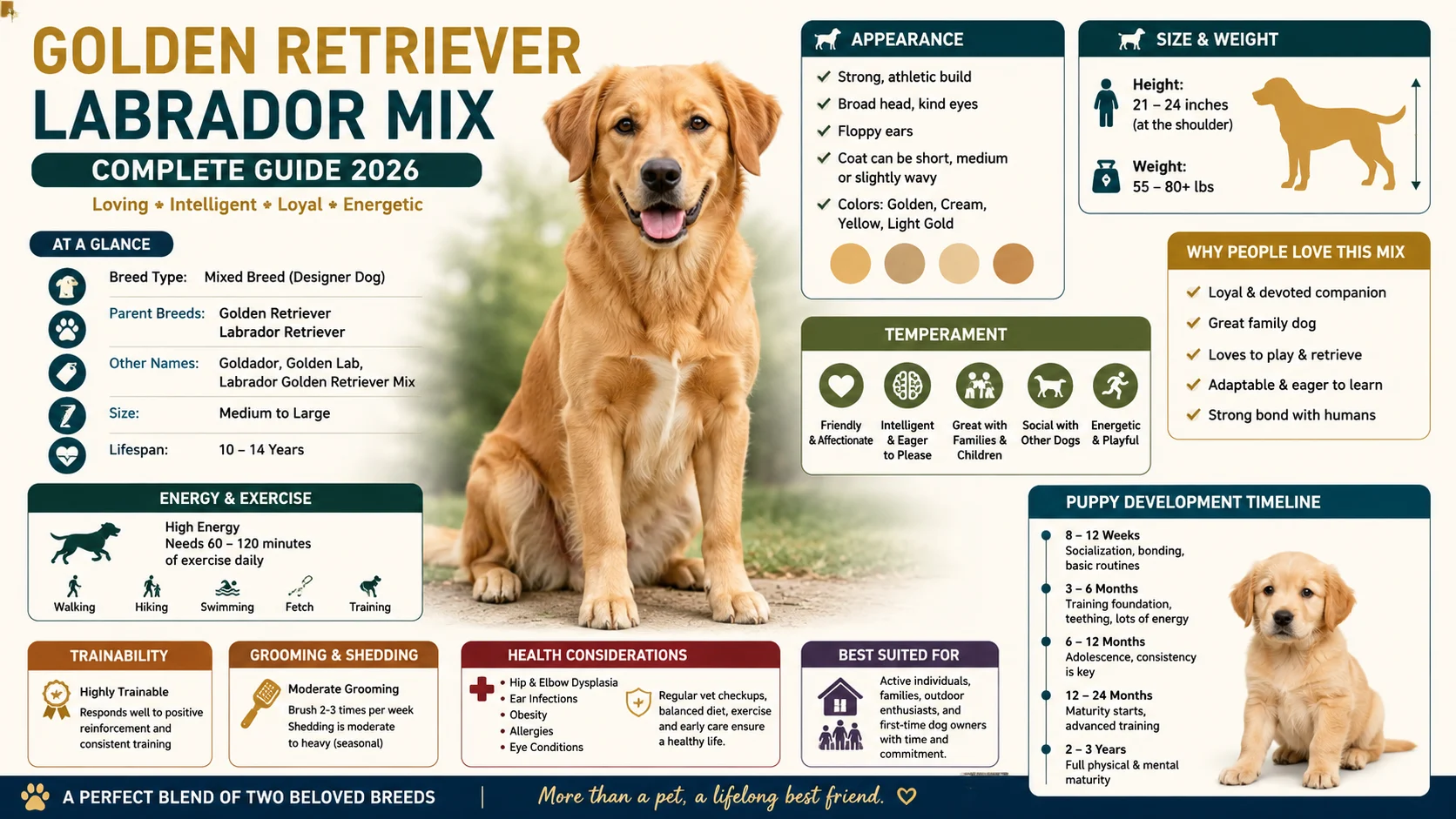
Golden Retriever + Labrador = loyal, energetic family dog.
Quick Snapshot Table
| Feature | Golden Retriever Labrador Mix |
|---|---|
| Common Names | Golden Lab, Goldador, Golden Retriever Lab Mix |
| Breed Type | Mixed breed |
| Parent Breeds | Golden Retriever × Labrador Retriever |
| Size | Medium to large |
| Height | Around 21–24 inches |
| Weight | Approximately 55–80+ lbs |
| Lifespan | Around 10–14 years |
| Temperament | Friendly, loyal, social, intelligent |
| Energy Level | High |
| Trainability | Excellent |
| Exercise Needs | High |
| Grooming | Moderate |
| Shedding | Moderate to heavy |
| Good With Children | Usually yes |
| Good With Other Dogs | Usually yes with proper socialization |
| Best For | Active families and involved owners |
What Is a Golden Retriever Labrador Mix?
The Golden Retriever Labrador Mix is a cross between a Golden Retriever and a Labrador Retriever.
You may also see this dog called a Goldador, Golden Lab, Golden Retriever Lab Mix, or Labrador Golden Retriever Mix.
Despite the different names, they generally refer to the same cross.
This mix is popular for an understandable reason: both parent breeds are intelligent, people-oriented, athletic dogs with strong histories as retrieving and working companions.
But there is an important catch.
A Golden Retriever Labrador Mix is not a predictable 50/50 package. Puppies can inherit different combinations of physical traits, energy levels, coat types, and personalities from each parent.
That variation is part of owning a mixed breed.
Why This Mix Is So Popular
Put a friendly Golden Retriever together with an outgoing Labrador Retriever and you often get a dog that is:
- affectionate
- highly trainable
- playful
- people-oriented
- eager to participate
- physically active
That combination works beautifully for many families.
It can also become a problem for owners who underestimate the exercise and training requirements.
The real issue is not whether this mix is “good.” It is whether your lifestyle matches the dog you are bringing home.
Golden Retriever vs Labrador Retriever vs Mix
| Trait | Golden Retriever | Labrador Retriever | Golden Lab Mix |
|---|---|---|---|
| Energy | High | High | High |
| Trainability | Excellent | Excellent | Usually excellent |
| Sociability | Very high | Very high | Usually very high |
| Retrieving Drive | High | Very high | Often high |
| Shedding | High | Moderate to high | Moderate to high |
| Coat | Longer | Short, dense | Variable |
| Water Interest | High | Very high | Often high |
| Size | Medium large | Medium large | Medium large |
| Family Suitability | Excellent | Excellent | Usually excellent |
Appearance and Physical Characteristics
There is no single appearance standard for a Golden Retriever Labrador Mix.
One puppy may look strongly like a Labrador, while another may have a more Golden Retriever influenced face and coat.
Common Physical Traits
You may see:
- broad heads
- floppy ears
- athletic bodies
- muscular shoulders
- long tails
- expressive eyes
- sturdy legs
- medium to large frames
Coat Colors
Common colors include:
- golden
- cream
- yellow
- light gold
- dark gold
- reddish gold
- pale cream
Some dogs look almost completely Labrador-like in color, while others have unmistakable Golden Retriever characteristics.
Coat Type
This is one of the biggest variables.
A Golden Retriever Labrador Mix may have:
- short dense fur
- medium length fur
- feathering around the tail
- feathering behind the legs
- a thicker Golden-style coat
You should never choose a puppy expecting an exact adult coat based only on its appearance at eight weeks.
Size and Weight
Most adult Golden Retriever Labrador Mixes fall somewhere around the size of their parent breeds.
| Measurement | Typical Range |
|---|---|
| Height | 21–24 inches |
| Weight | 55–80+ lbs |
| Build | Athletic and sturdy |
| Growth Completion | Usually around 18–24 months |
Males can be larger and heavier, although individual genetics matter more than sex alone.
When Does a Golden Retriever Lab Mix Stop Growing?
Most reach much of their adult height during the first year.
However, body mass and muscular development can continue well beyond that.
Large-breed development should therefore be managed carefully during puppyhood.
Rapid weight gain is not the goal.
Healthy, steady development is.
Temperament and Personality
This is where the Golden Retriever Labrador Mix often shines.
Both parent breeds are known for their strong relationships with people, and that tendency commonly carries into the mix.
Typical Personality
A well-socialized Goldador is often:
- affectionate
- playful
- confident
- curious
- friendly
- responsive
- eager to learn
They generally prefer being involved with their family rather than spending long periods isolated.
Are Golden Retriever Lab Mixes Aggressive?
Usually, no.
Neither Golden Retrievers nor Labrador Retrievers are typically selected for serious protective aggression, and the mix is generally known for a social temperament.
However, no breed or crossbreed is automatically guaranteed to be friendly.
Genetics, early socialization, environment, training, and individual temperament all matter.
A dog that is fearful, poorly bred, chronically stressed, or inadequately socialized can develop behavioral problems regardless of its breed mix.
Do They Make Good Family Dogs?
For many households, yes.
Their combination of sociability and trainability can make them excellent family companions.
However, young Goldadors can be extremely enthusiastic.
A 70-pound adolescent dog that jumps on guests because nobody taught impulse control is not particularly convenient.
Training needs to begin before the dog becomes physically powerful.
Intelligence and Trainability
The Golden Retriever Labrador Mix usually has excellent learning potential.
Both parent breeds were developed to work closely with humans, particularly in retrieving tasks.
That history often produces a dog that enjoys:
- learning commands
- retrieving objects
- food-based training
- interactive games
- obedience exercises
The Training Advantage
These dogs frequently respond well to:
- positive reinforcement
- reward-based training
- short sessions
- repetition
- consistency
The Training Challenge
Their intelligence can work against inexperienced owners.
A bored Goldador may create its own entertainment.
That can mean:
- chewing
- stealing household objects
- digging
- jumping
- excessive barking
- attention-seeking
The answer is not simply “more exercise.”
The dog needs both physical activity and mental work.
Exercise Requirements
This is an active mix.
Most adult Golden Retriever Labrador Mixes need substantial daily activity to remain physically and mentally balanced.
Good Exercise Options
Consider:
- brisk walking
- hiking
- swimming
- retrieving games
- obedience training
- scent games
- controlled running
- canine sports
How Much Exercise Do They Need?
A healthy adult may need roughly 60–120 minutes of combined daily activity, depending on age, health, temperament, and individual energy level.
Puppies require a different approach.
Long forced runs are inappropriate for young growing dogs because their joints and growth plates are still developing.
Mental Stimulation Matters
A tired dog is not necessarily a fulfilled dog.
Five minutes of thoughtful training can sometimes accomplish more behaviorally than another repetitive game of fetch.
This is especially true for highly food-motivated retriever mixes.
Puppy Development Timeline
Golden Retriever Labrador Mix puppies develop quickly, but their emotional maturity takes much longer than their physical growth suggests.
| Age | Typical Development |
|---|---|
| 8–12 Weeks | Socialization, bonding, basic routines |
| 3–4 Months | Curiosity and confidence increase |
| 4–6 Months | Teething, chewing, impulse-control challenges |
| 6–12 Months | Adolescence begins |
| 12–18 Months | Strength and independence increase |
| 18–24 Months | Adult body and behavior continue developing |
| 2–3 Years | Greater emotional maturity |
8–12 Weeks
This is an important socialization period.
Focus on:
- safe household experiences
- gentle handling
- different surfaces
- controlled sounds
- calm visitors
- basic name recognition
Do not try to expose a puppy to everything at once.
Quality matters more than quantity.
3–6 Months
This is often when the cute puppy starts becoming a genuine handful.
Expect:
- chewing
- jumping
- selective listening
- increased energy
- teething
Consistency becomes extremely important.
6–12 Months
Adolescence can test even experienced owners.
Your puppy may suddenly appear to “forget” commands it previously knew.
That does not necessarily mean training failed.
The dog’s brain and emotional control are still developing.
12–24 Months
Physical strength increases dramatically.
This is when polite leash behavior becomes particularly important.
A large adolescent Goldador that pulls continuously can become difficult to control.
Grooming and Shedding
Grooming requirements depend heavily on which parent contributes more coat characteristics.
A short-coated dog may be relatively easy to maintain.
A Goldador with Golden Retriever feathering can require considerably more brushing.
Brushing
Aim for:
- several brushing sessions per week
- more frequent brushing during heavy shedding
- regular inspection behind ears and legs
Shedding
Do not expect a low-shedding dog.
Both parent breeds shed, although their coat types differ.
A Goldador may leave significant amounts of hair on:
- furniture
- carpets
- clothing
- car seats
If you want a dog that barely sheds, this is probably not the right mix.
Feeding and Nutrition
Golden Retriever Labrador Mixes can be highly food motivated.
That is excellent for training.
It can also create a weight problem.
Portion Control Matters
Avoid free-feeding unless specifically recommended by your veterinarian.
Use:
- measured meals
- appropriate puppy food during growth
- healthy training treats
- regular weight monitoring
Watch Body Condition
Do not judge a puppy’s health purely by the number on the scale.
Body condition, muscle development, growth pattern, and veterinary assessment are more useful than chasing a specific weight.
Health and Genetic Considerations
Mixed breeding does not automatically eliminate inherited health problems.
Both Golden Retrievers and Labrador Retrievers can be affected by various inherited and acquired conditions.
Potential concerns include:
- hip dysplasia
- elbow dysplasia
- obesity
- ear problems
- allergies
- certain eye disorders
- some inherited cancers
The risk depends heavily on the health and genetics of both parents.
Why Parent Health Testing Matters
This is one of the most important points prospective owners should understand.
A breeder should be willing to discuss health screening performed on both parent dogs.
Ask about:
- hips
- elbows
- eyes
- relevant breed-specific genetic testing
- family health history
Experienced breeders focus on the parents’ health records, not simply how cute the puppies are.
Golden Retriever Labrador Mix Lifespan
A reasonable general expectation is around 10–14 years, although individual lifespan can vary considerably.
Health, genetics, body condition, nutrition, exercise, preventive veterinary care, and chance all influence longevity.
Keeping a retriever mix lean is particularly important because both parent breeds can be prone to weight gain.
Socialization and Social Behavior
This mix generally enjoys human interaction.
However, socialization should teach more than friendliness.
A well-socialized Goldador should learn how to:
- remain calm around strangers
- ignore distractions
- greet politely
- walk past other dogs
- settle indoors
- handle grooming
- tolerate veterinary handling
Dog Park Warning
Dog parks are not mandatory for socialization.
For some puppies, chaotic off-leash environments create more problems than they solve.
Controlled interactions with stable dogs are often more valuable.
Golden Retriever Labrador Mix With Children
They can be excellent family dogs, but supervision remains essential.
Their enthusiasm can become a problem around:
- toddlers
- elderly family members
- small children
A young Goldador may accidentally knock over a child simply because it is excited.
Teach:
- four paws on the floor
- calm greetings
- leave-it
- drop-it
- place or settle
Never rely on breed reputation as a substitute for supervision.
Common Mistakes Owners Make
Treating Exercise as the Only Solution
More running does not automatically fix behavioral problems.
Training and relaxation are equally important.
Overfeeding
Retriever breeds can be exceptionally persuasive around food.
Those pleading eyes are not nutritional science.
Ignoring Leash Training
A puppy pulling at 15 pounds is manageable.
A mature dog pulling at 70 pounds is a different situation.
Waiting Too Long to Train
Basic manners should begin immediately after bringing the puppy home.
Expecting a Predictable Coat
Genetics can produce significant variation between littermates.
Insights Most Articles Miss
The Mix Can Be More Energetic Than Expected
People sometimes assume combining two friendly family breeds automatically produces a calm family dog.
It can produce the opposite.
Both parent breeds were developed for active work.
Retrieving Drive Can Be Extremely Strong
Some Goldadors are obsessed with:
- tennis balls
- bumpers
- sticks
- swimming
- carrying objects
Channel that instinct into structured games rather than constantly trying to eliminate it.
Food Motivation Is a Major Training Advantage
Many individuals are highly responsive to food rewards.
Use that motivation intelligently.
Small treats can reinforce:
- recall
- leash manners
- calm behavior
- impulse control
Emotional Maturity Takes Time
A physically large one-year-old dog may still behave like an adolescent.
Owners often expect maturity too early.
Patience and consistency during the second year can make a significant difference.
Buyer Warning: Choosing a Golden Retriever Lab Mix Puppy
Questions to Ask the Breeder
Ask:
- Have both parents undergone appropriate health screening?
- Can I see the parents’ health documentation?
- What are the parents like temperamentally?
- How are the puppies being socialized?
- What veterinary care have the puppies received?
- What happens if a genetic or serious health issue appears later?
- Can I meet the mother?
Red Flags
Be cautious when a seller:
- refuses health documentation
- focuses entirely on color
- promises a guaranteed temperament
- cannot explain the parents’ history
- has multiple litters constantly available
- pressures you to pay immediately
- describes the mix as completely “hypoallergenic”
There is no such thing as a guaranteed perfect Goldador.
Is a Golden Retriever Labrador Mix Right for You?
| Your Lifestyle | Compatibility |
|---|---|
| Active family | Excellent |
| Hiker or outdoor enthusiast | Excellent |
| First-time owner willing to train | Good |
| Apartment with strong exercise routine | Possible |
| Sedentary household | Poor |
| Owner wanting a low-shedding dog | Poor |
| Owner wanting a guard dog | Poor |
| Family wanting an interactive companion | Excellent |
Preparation Checklist
Before bringing your puppy home, prepare:
Home
☐ Secure puppy area
☐ Comfortable crate or sleeping space
☐ Food and water bowls
☐ Puppy-safe toys
☐ Chew toys
☐ Enzyme cleaner
☐ Grooming brush
Training
☐ Puppy training plan
☐ Name and recall training
☐ Potty routine
☐ Leash introduction
☐ Bite inhibition work
☐ Calm greeting training
Health
☐ Veterinary appointment
☐ Vaccination records
☐ Parasite prevention plan
☐ Appropriate puppy nutrition
☐ Identification and microchip planning
Frequently Asked Questions
What is a Golden Retriever Labrador Mix called?
The mix is commonly called a Goldador, Golden Lab, Golden Retriever Lab Mix, or Labrador Golden Retriever Mix.
Is a Golden Retriever Lab Mix a good family dog?
Yes, usually. Their friendly and trainable nature makes them well suited to active families, provided they receive proper training, exercise, and supervision.
How big does a Golden Retriever Labrador Mix get?
Many adults reach approximately 21–24 inches at the shoulder and weigh around 55–80 or more pounds, depending on genetics and sex.
Does a Golden Retriever Lab Mix shed?
Yes. Expect moderate to heavy shedding, particularly if the dog inherits a dense or feathered Golden Retriever type coat.
Is a Goldador easy to train?
Generally, yes. Both parent breeds are highly trainable, and many Goldadors are strongly motivated by food, play, and interaction.
Are Golden Retriever Labrador Mixes aggressive?
Aggression is not considered a defining characteristic of this mix. However, individual temperament depends on genetics, socialization, training, and environment.
How long does a Golden Retriever Lab Mix live?
A general expectation is around 10–14 years, although individual dogs can live shorter or longer lives.
Is a Golden Retriever Lab Mix hypoallergenic?
No. This mix should not be considered hypoallergenic. Both parent breeds shed and produce allergens.
Is a Golden Retriever Labrador Mix good for apartment living?
It can be possible with a committed owner who provides adequate exercise, training, enrichment, and mental stimulation. A small home does not replace the dog’s need for activity.
Final Verdict
The Golden Retriever Labrador Mix brings together two of the most recognizable retrieving breeds in the world, creating a companion that is usually affectionate, intelligent, athletic, and eager to participate in family life.
But don’t buy this mix simply because it looks friendly.
Choose it because you genuinely want an active dog that needs daily interaction, training, exercise, and companionship.
The best Goldadors are not simply tired dogs. They are well trained, mentally fulfilled, socially stable dogs with healthy body condition.
And when evaluating a puppy, remember the most important rule:
Do not choose the cutest puppy. Choose the healthiest, most stable puppy from the most responsible breeding environment you can find.