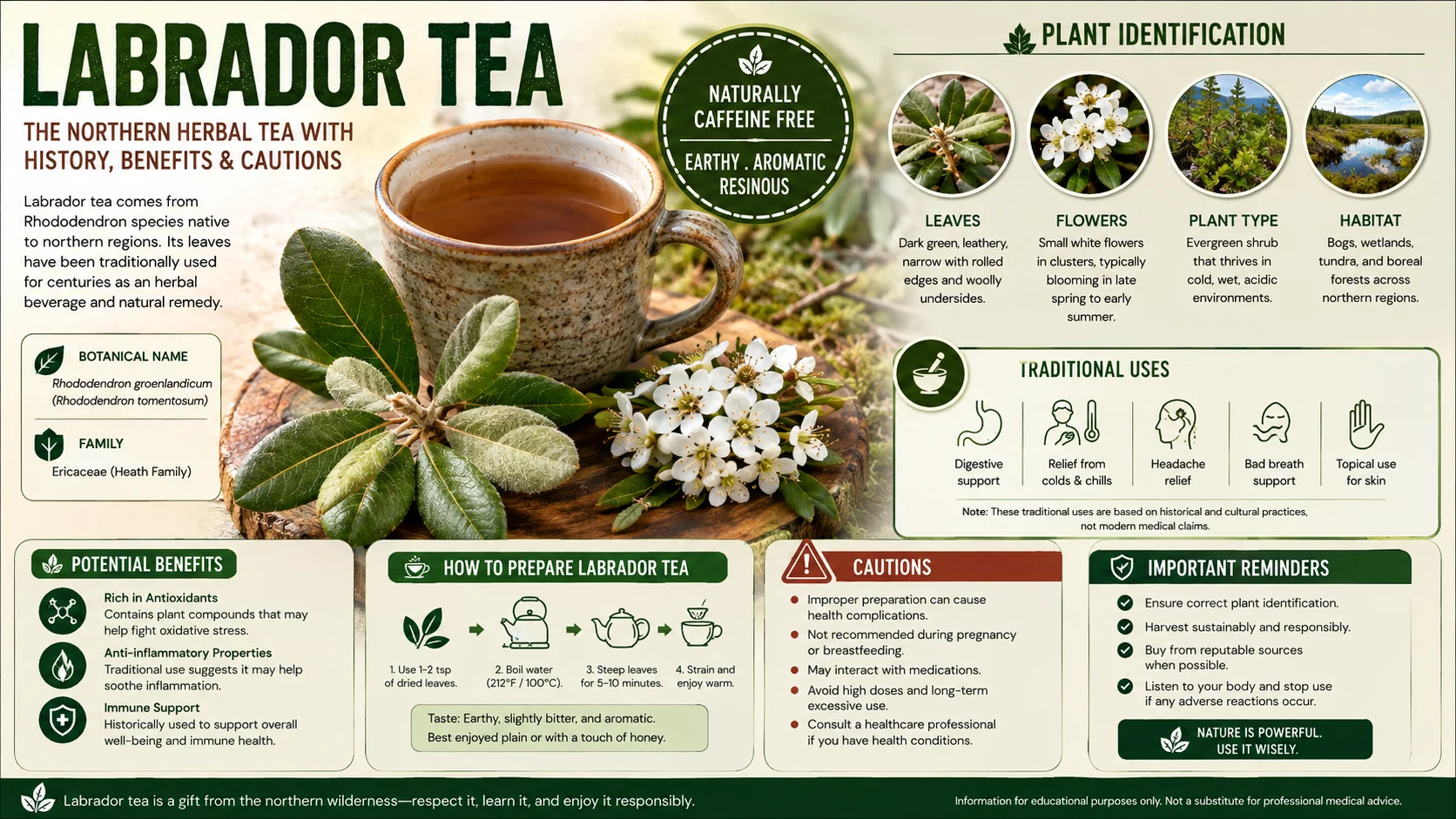
Labrador tea is a fragrant wild herbal tea made from leaves of northern Rhododendron species, especially Rhododendron groenlandicum and Rhododendron tomentosum. It has a long history of traditional use in northern regions.
Its earthy, resinous aroma makes it distinctive, but “natural” does not automatically mean harmless. Improper preparation or excessive use can cause health problems, so identification and cautious use matter.
Quick Snapshot Table
| Category | Labrador Tea |
|---|---|
| Common Name | Labrador tea |
| Botanical Group | Rhododendron |
| Common Species | Rhododendron groenlandicum, Rhododendron tomentosum |
| Former Botanical Name | Ledum groenlandicum / Ledum palustre |
| Plant Type | Evergreen aromatic shrub |
| Native Range | Northern North America and subarctic regions |
| Leaves | Dark green, leathery, woolly underneath |
| Flowers | Small white flower clusters |
| Flavor | Herbal, resinous, aromatic |
| Traditional Use | Herbal beverage and traditional medicine |
| Main Caution | Improper preparation can cause health complications |
| Best Approach | Correct identification and cautious use |
What Is Labrador Tea?
Labrador tea is a strongly aromatic evergreen shrub found across northern and subarctic environments. The name refers primarily to plants now classified within the genus Rhododendron, particularly Rhododendron groenlandicum and Rhododendron tomentosum.
The plant is easy to recognize once you know what to look for.
Its leaves are typically:
- dark green
- leathery
- narrow to oval depending on species
- slightly rolled around the edges
- covered with woolly hairs underneath
The plant produces clusters of small white flowers.
Canada’s Wapusk National Park describes two Labrador tea species in the Churchill region, with R. groenlandicum being the larger shrub and R. tomentosum occurring as a lower, smaller-leaved plant in tundra environments.
Why Is It Called Labrador Tea?
The name comes from its long history as a beverage in northern regions.
Indigenous peoples and early European settlers used Labrador tea leaves to prepare a hot drink. Traditional uses varied considerably between communities and regions.
The name can therefore be misleading if someone assumes Labrador tea comes from the Labrador Retriever or is associated with the Canadian province alone.
It is a plant name with a much broader northern history.
What Does Labrador Tea Taste Like?
Labrador tea does not taste exactly like conventional black or green tea.
Its flavor is generally described as:
- earthy
- aromatic
- resinous
- slightly bitter
- herbal
The aroma can be surprisingly strong, particularly when the leaves are crushed or heated.
That distinctive smell is one of the easiest characteristics to notice when identifying the plant.
Labrador Tea Plant Identification
Leaf Characteristics
The leaves are among the most useful identification features.
Look for:
- leathery texture
- dark green upper surface
- pale or woolly underside
- slightly rolled leaf margins
- strong aromatic scent
The exact leaf shape varies between species.
Flowers
Labrador tea produces rounded clusters of small white flowers.
The flowers are generally much less visually dramatic than the foliage, but they can make identification easier during the blooming season.
Habitat
Labrador tea is associated with northern environments and can grow in:
- bogs
- wetlands
- tundra
- boreal forests
- acidic soils
Its ability to survive harsh northern conditions is part of what makes the plant so interesting botanically.
Traditional Uses of Labrador Tea
Labrador tea has an extensive history of traditional use.
Historical and Indigenous uses reported by Parks Canada include preparations associated with:
- diarrhea
- stomach discomfort
- chills
- headache
- bad breath
- teething discomfort
Topical preparations have also traditionally been used for various skin complaints and other purposes.
However, traditional use should not automatically be interpreted as proof that Labrador tea treats a particular disease.
That distinction is important.
A plant can have a long cultural history while still requiring careful scientific evaluation for modern medical claims.
Potential Benefits of Labrador Tea
Antioxidant Interest
Labrador tea has attracted scientific and commercial interest because its plant compounds may have antioxidant properties.
Canadian agricultural research has investigated controlled extraction of medicinal ingredients from Labrador tea species.
However, laboratory findings should not be confused with proven clinical benefits in humans.
Traditional Digestive Uses
Traditional preparations have been associated with digestive complaints, including diarrhea and stomach flu.
There is not enough evidence to present Labrador tea as a proven treatment for gastrointestinal disease.
Traditional Respiratory and Cold Related Uses
Historically, Labrador tea has also been used in northern traditional medicine for various symptoms associated with illness.
Again, traditional use is evidence of cultural practice, not necessarily evidence of clinical effectiveness.
Is Labrador Tea Safe?
This is the section many articles get wrong.
Labrador tea should not be treated like an ordinary caffeine free tea simply because it is a plant.
Parks Canada specifically warns that improper preparation can cause health complications.
The safest approach is to distinguish between:
- traditionally prepared beverages
- concentrated herbal extracts
- essential oils
- large or repeated doses
These are not interchangeable.
Why Preparation Matters
The concentration of plant compounds can change considerably depending on:
- amount of plant material
- preparation method
- extraction time
- species
- plant part used
That means copying a random online recipe is not necessarily a safe approach.
Do Not Assume More Is Better
With medicinal plants, increasing the amount does not automatically increase the benefit.
It can increase exposure to compounds that may cause adverse effects.
This is particularly important with strongly aromatic plants.
Labrador Tea and Pregnancy
People who are pregnant or breastfeeding should be particularly cautious with herbal preparations.
There is not enough reliable evidence to assume that Labrador tea is automatically safe during pregnancy or breastfeeding.
For medicinal herbal products, discussing use with a qualified healthcare professional is the safer approach.
Labrador Tea and Children
Children should not be given concentrated herbal preparations casually.
Poison Control notes that botanical preparations can cause problems in children and may also interact with medicines.
This is especially important when a plant has strong pharmacological compounds or uncertain dosing.
Labrador Tea and Medication Interactions
Herbal products can interact with prescription and nonprescription medications.
Poison Control notes that documented interactions exist between numerous medicines and herbal or dietary products.
If you take prescription medication regularly, it is sensible to discuss Labrador tea with your doctor or pharmacist before using it medicinally.
How Labrador Tea Is Traditionally Prepared
Traditional preparation varies between communities and regions.
Some northern traditions involve using the leaves to make a hot beverage, but the exact preparation method should not be generalized as a universal medical recipe. Parks Canada specifically cautions that improper preparation can cause health complications.
A Better Modern Approach
If you want to try Labrador tea as a beverage:
- Make sure the plant has been correctly identified.
- Use a reputable source rather than an unknown wild plant.
- Follow the product’s preparation instructions.
- Avoid concentrated homemade extracts.
- Do not assume stronger tea provides greater health benefits.
- Stop using it if you experience concerning symptoms.
Wild Harvesting Labrador Tea
Wild harvesting can be appealing, especially in northern regions where the plant grows naturally.
But plant identification matters.
Poison Control advises against preparing food or tea from wild plants unless you are certain of the plant’s identity and know how to prepare it safely.
Harvesting Mistakes to Avoid
Do not rely only on:
- leaf shape
- smell
- an online photograph
- a social media identification
- a common name
Botanical identification should consider the entire plant and its habitat.
Labrador Tea vs Green Tea
| Feature | Labrador Tea | Green Tea |
|---|---|---|
| Plant Group | Rhododendron | Camellia |
| Caffeine | Naturally caffeine free | Contains caffeine |
| Origin | Northern/subarctic regions | East and South Asia |
| Flavor | Resinous and herbal | Vegetal and grassy |
| Traditional Role | Northern herbal beverage | Traditional tea beverage |
| Safety Considerations | Requires caution | Generally well established as a beverage |
The biggest misconception is assuming that every plant-based “tea” has the same safety profile as conventional tea.
It does not.
Labrador Tea vs Labrador Retriever
The names sound related, but they are completely different.
| Labrador TeaLabrador Retriever | |
|---|---|
| Plant | Dog breed |
| Genus | Rhododendron |
| Produces leaves and flowers | Produces puppies |
| Used historically as herbal beverage | Companion and working dog |
| Botanical subject | Animal subject |
This distinction is especially useful when searching online because “Labrador” strongly associates with the dog breed.
Common Mistakes People Make
Mistake 1: Treating It Like Ordinary Tea
Labrador tea has a different botanical and safety profile from conventional tea plants.
Mistake 2: Assuming Natural Means Safe
Natural substances can still cause toxicity or interact with medication.
Mistake 3: Using Too Much
Concentrated preparations may expose the body to much higher levels of plant compounds than a traditional beverage.
Mistake 4: Confusing Traditional Use With Medical Proof
A traditional remedy can be culturally important without having strong clinical evidence for every claimed benefit.
Mistake 5: Picking an Unknown Plant
Wild plant identification errors can have serious consequences.
Insights Most Articles Miss
The Botanical Name Has Changed
Older sources may refer to Labrador tea under the genus Ledum, while modern classifications place commonly recognized Labrador tea species in Rhododendron. Parks Canada currently identifies Rhododendron groenlandicum and Rhododendron tomentosum as Labrador tea species in the Churchill region.
This explains why searching older herbal books can produce apparently different plant names.
There Is More Than One Labrador Tea
“Labrador tea” is not always referring to one identical plant everywhere.
Species and regional naming can vary, which is another reason botanical identification matters.
Traditional Knowledge Deserves Context
The traditional use of Labrador tea is an important part of northern Indigenous and cultural history.
It should be discussed respectfully without turning traditional knowledge into exaggerated modern health claims.
Who Should Be Especially Careful?
Extra caution is appropriate for:
- pregnant people
- breastfeeding people
- children
- older adults taking multiple medications
- people with chronic medical conditions
- anyone using prescription medicines
A healthcare professional can help determine whether a particular herbal preparation is appropriate.
Labrador Tea Preparation Checklist
Before drinking Labrador tea, consider:
Identification
Correct botanical identification confirmed.
Source
Plant or tea obtained from a trustworthy source.
Preparation
Instructions followed rather than improvising a concentrated preparation.
Medication
Potential interactions considered.
Personal Health
Pregnancy, breastfeeding, age, and medical conditions taken into account.
Symptoms
Stop use and seek appropriate medical advice if unusual symptoms develop.
Frequently Asked Questions
What is Labrador tea?
Labrador tea is a fragrant northern shrub in the Rhododendron genus whose leaves have traditionally been used to prepare an herbal beverage.
What does Labrador tea taste like?
It has a strong herbal, earthy, resinous flavor and a distinctive aromatic smell.
Is Labrador tea caffeine free?
Yes. Labrador tea is naturally different from true tea made from Camellia sinensis and is generally considered a caffeine free herbal infusion.
What are the traditional benefits of Labrador tea?
Traditional uses have included digestive complaints, chills, headache, bad breath, and several topical applications. These traditional uses should not be treated as proof of modern medical effectiveness.
Is Labrador tea safe to drink?
It can be used traditionally as a beverage, but safety depends on correct identification and preparation. Parks Canada warns that improper preparation can cause health complications.
Can you drink Labrador tea every day?
There is not enough evidence to recommend a universal daily amount for everyone. Regular medicinal use should be discussed with a healthcare professional, especially if you take medication.
Is Labrador tea the same as green tea?
No. Labrador tea comes from Rhododendron species, while green tea comes from Camellia sinensis.
Is Labrador tea related to Labrador dogs?
No. The plant and Labrador Retriever are completely unrelated.
Conclusion
Labrador tea is one of the more interesting northern herbal plants because its story combines botany, traditional knowledge, wilderness ecology, and modern interest in plant compounds.
Its distinctive leaves and powerful aroma make it easy to remember, while its long history of traditional use explains why it continues to attract attention.
But the most important takeaway is simple: Labrador tea is a medicinally interesting plant, not an automatically harmless herbal drink.
Correct identification, sensible preparation, and respect for potential safety concerns matter more than chasing exaggerated health claims.
For anyone interested in Labrador tea in 2026, the best approach is to appreciate both sides of the plant: its rich traditional history and the need for modern evidence based caution.